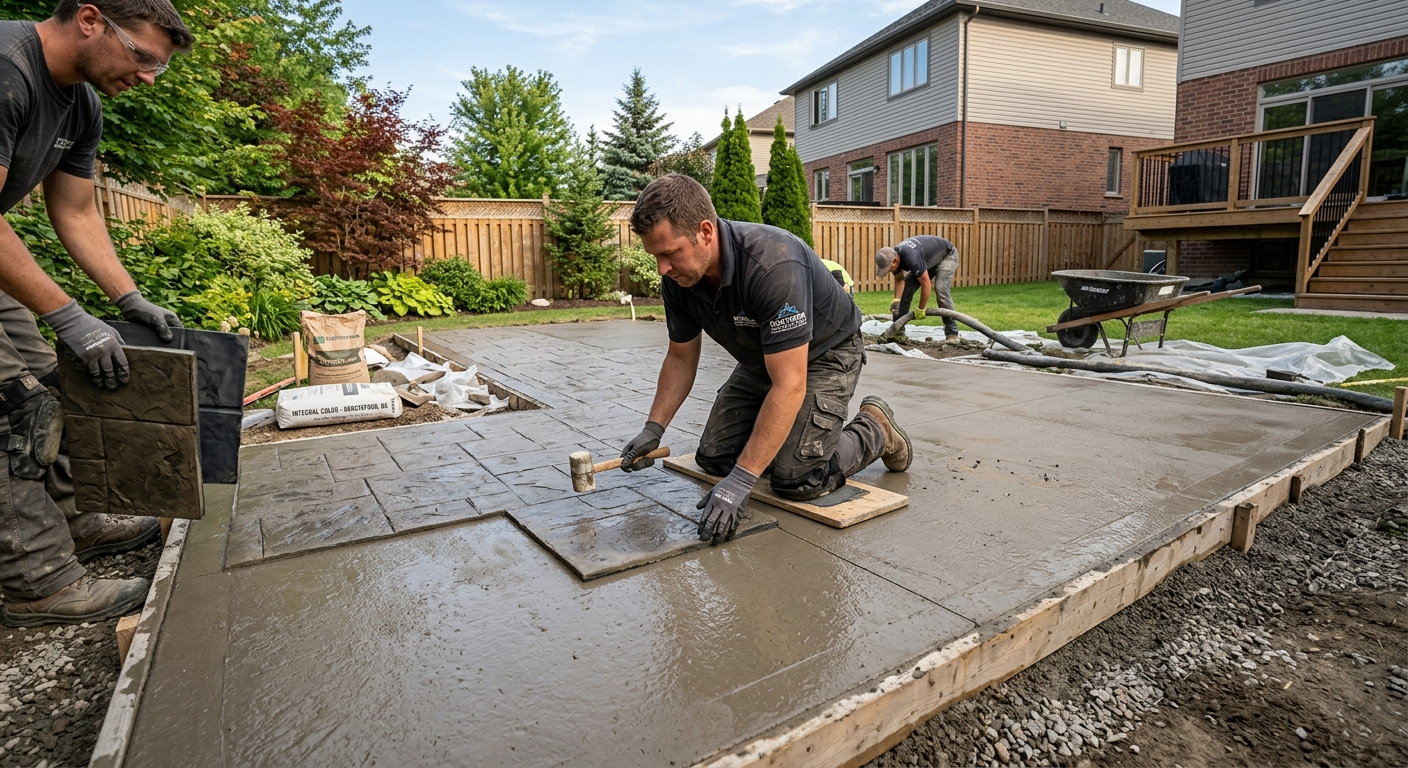
Concrete work options and costs in Harrison Hot Springs
Harrison Hot Springs offers a steady market for concrete work, especially because most residents are homeowners—about 81.4% of households own their homes (Statistics Canada, 2021 Census). With roughly 65.0% of dwellings being single-detached houses, a lot of projects start with driveway and backyard upgrades: new flatwork, patio expansions, garage slabs, and foundation repairs. You also see many older homes in the area; about 18.1% of homes were built before 1981 (Statistics Canada, 2021 Census), which often means retrofits to address settling, drainage, and aging concrete around entrances.
In the Lower Mainland–Southwest, concrete pricing is shaped by our shallow frost depth (commonly designed around ~450 mm / 18") and by frequent coastal-wet freeze–thaw cycles. Even though the frost line is generally less deep than interior or northern BC, exterior slabs still need proper base preparation, drainage, and air-entrained concrete to reduce scaling and spalling. Scheduling matters too: rain, cool nights, and high humidity can extend cure and require curing blankets or sealers to protect surfaces.
Contractors also stay busy where accessibility is easiest and lots are most active. In Harrison Hot Springs, demand is especially strong around the town’s core and near the waterfront-adjacent neighbourhoods, where property upgrades are common and driveways/patios get replaced as homeowners modernize landscaping and walkways.
Below is a practical comparison of common concrete options for this city, using local price bands for Harrison Hot Springs and the Lower Mainland–Southwest.
| Application |
Typical Size |
Key Spec |
Finish Option |
Price Range |
| Concrete driveway (standard broom finish) |
350–500 sq. ft. |
Reinforced with wire mesh or rebar; compacted granular base; air-entrained mix |
Broom finish + control joints |
$7,000 – $12,500 |
| Exposed aggregate driveway |
350–500 sq. ft. |
Proper grading and curing; air-entrained exterior mix |
Exposed aggregate topping |
$9,000 – $15,000 |
| Stamped concrete driveway or patio |
250–450 sq. ft. |
Air-entrained exterior mix; release agent; control joints |
Stamp pattern + colour hardener (optional) |
$6,000 – $14,500 |
| Plain concrete patio or walkway |
150–300 sq. ft. |
Compacted base; fibre or mesh as required; drainage attention |
Float/smooth or broom edge |
$2,400 – $7,800 |
| Garage floor (interior slab) |
400–600 sq. ft. |
Vapour barrier (as applicable); reinforcement; proper thickness for vehicle loads |
Plain trowel finish (no stamp) |
$7,500 – $14,500 |
| Foundation footings (structural, below frost) |
Varies by home size |
Excavate below design frost; engineered rebar and concrete thickness |
Structural concrete + forms |
$10,000 – $22,000 |
Prices are estimates only and vary by project scope, site access and material selection.
What affects the price of concrete work in Harrison Hot Springs
In Harrison Hot Springs and across the Lower Mainland–Southwest, it’s common to see quotes for the “same” concrete job swing by 30–50% depending on how the contractor handles specs and risk. The reason isn’t just concrete itself—it’s the full system: excavation, drainage, base thickness, mix design (especially air-entrainment), reinforcement, forming complexity, curing, and how weather impacts your pour calendar.
Frost line depth and freeze–thaw cycles dictate much of the specification in this region. Even with a shallow design frost depth (around 450 mm / 18"), exterior footings, piers, and thickened edges must be placed below the design frost level to prevent frost heave. At the slab level, exterior mixes need air-entrainment to survive repeated wetting, cooling, and thawing. In colder or more inland BC areas, a shorter pour season and the need for cold-weather curing can increase heating/blanket costs—while here we’re typically managing rain, cool nights, and humidity, the weather risk still affects labour productivity and cure timelines.
Two or three local examples that change price quickly: (1) if your driveway sits on saturated soil, extra granular base and improved drainage can raise costs (often shifting you toward the higher end of the $18–$28 per sq. ft. driveway band); (2) limited truck access near the waterfront and tighter municipal sidewalks can increase labour and equipment time; and (3) if your patio is in a high-salt splash zone, sealing requirements and longer curing protection can add cost but reduce surface scaling.
Housing age also matters. With an older housing mix (about 18.1% pre-1981), you’ll sometimes pay more for demolition and foundation-area preparation than brand-new builds—yet when the spec is done right, it protects the investment and avoids repeat repairs that cost far more over time. For homeowners comparing options, stamped concrete often falls into the $22–$36 per sq. ft. band, and exposed aggregate typically carries an additional finishing step; sometimes the look is worth the premium, but sometimes broom finish plus good sealing gives better value.
| Price Factor |
Why It Matters |
Cost Impact |
| Frost line depth |
Determines footing depth and form height |
More excavation and rebar coverage pushes structural costs toward the upper end of foundation pricing |
| Site preparation |
Excavation, grading, compacted granular base |
Unsuitable native soil or poor drainage increases granular volume and labour; can move driveway pricing upward |
| Reinforcement |
Rebar or wire mesh requirement |
Mesh/rebar added labour and steel cost; under-reinforcement risks early cracking and rework |
| Mix design |
Air-entrainment and compressive strength spec |
Air-entrained exterior mix and stricter strength requirements add cost, but reduce scaling/spalling failures |
| Finish type |
Broom vs. stamped vs. exposed aggregate |
Stamped and exposed finishing increases material steps and skilled labour time |
| Pour size and concrete truck access to site |
Queue time and placement efficiency |
Long carry distances or tight access can add labour hours and may require extra handling |
| Cold-weather curing precautions |
Heating and blankets |
When nights are too cool or rain is persistent, added curing protection and longer timelines increase costs |
| Control joint pattern and sealing cost |
Limits random cracking; protects surface |
Proper joint layout and sealing add line-item cost but help avoid premature surface deterioration |
Permits & regulations in British Columbia
In British Columbia, the rule of thumb is: if the concrete is part of a structure, assume you’ll need a building permit and likely engineered drawings. That means structural concrete work such as footings, foundation walls, grade beams, and foundation repairs tied into the building’s load path typically require a permit. Municipalities commonly review engineered details, rebar placement, and inspection points because these items affect safety and load capacity.
Concrete flatwork—driveways, patios, sidewalks, and walkways—often does not require a permit on its own, especially when it stays within the property and doesn’t meaningfully change lot grading or drainage. However, permits may come into play if the work affects lot grading, triggers impervious surface coverage considerations, changes drainage patterns that impact neighbours, or involves any work near municipal right-of-way or water management requirements. Always confirm with the local authority before breaking ground.
For contractor verification in Harrison Hot Springs (and throughout BC), don’t rely on claims—verify. Step-by-step: (1) check the contractor’s credential/licensing status via BC’s online registry or the applicable business listing; (2) request a certificate of liability insurance showing current coverage amounts and project location; (3) ask for confirmation of WCB coverage (workplace insurance) so you’re not left with liability if a worker is injured; and (4) request references from similar-size projects, ideally in the Lower Mainland–Southwest where wet/freeze–thaw exposure is comparable. If the contractor won’t provide paperwork promptly, that’s a major red flag.
Getting concrete right in Harrison Hot Springs's freeze-thaw climate
The biggest causes of concrete failure in Harrison Hot Springs are usually not “bad concrete,” but incomplete execution under our coastal-wet freeze–thaw conditions. Water gets under or through the slab edges, the base isn’t properly compacted, and the concrete doesn’t have enough air entrainment or the curing was rushed—then scaling, spalling, and random cracking show up sooner than expected. To spec the job correctly, focus on five areas.
(1) Base preparation: we place compacted granular sub-base to the right depth for the soil and local frost considerations, then verify drainage so the slab stays dry enough to resist freeze–thaw stress. (2) Mix design: for exterior flatwork, require an air-entrained mix with typical target air of 5–7% and a minimum 32 MPa compressive strength (as specified for the exposure and use). (3) Control joints: joints must be planned to limit random cracking and to ensure cracks occur where you can manage them. (4) Curing: plan for at least a 7-day curing period under proper conditions; in cool, humid weather, curing blankets and protection from rain can be critical. (5) Sealing: apply a penetrating sealer after the slab reaches cure (commonly after 28 days) to help repel de-icing salts and reduce surface breakdown.
Use these questions to avoid the classic failure: spalling from inadequate air-entrainment. For example, if one quote is cheaper by only a few dollars per sq. ft. but doesn’t clearly state the air content and joint plan, that “savings” often disappears when surface scaling starts—especially on driveways where vehicles track salt and moisture.
| Spec |
Why It Matters in Harrison Hot Springs |
What to Ask For |
Impact if Skipped |
| Compacted granular base (depth?) |
Reduces settlement and limits moisture movement under the slab |
Granular type and compacted thickness; describe drainage plan for saturated soils |
Early cracking, uneven surface, and higher freeze–thaw stress |
| Air-entrained concrete mix (target air %?) |
Protects against scaling and spalling during repeated wet/cold cycles |
Target air content of 5–7% for exterior flatwork; confirm exposure spec |
Surface scaling/spalling, especially near edges and splash zones |
| Compressive strength (MPa rating) |
Ensures durability and adequate load performance for the intended use |
Minimum 32 MPa compressive strength; specify in writing |
Wear, scaling, and reduced long-term durability |
| Control joints (spacing per ACI guidelines) |
Controls where cracks happen and helps manage shrinkage |
Joint spacing and depth; indicate saw-cut timeline |
Random cracking and wider joint-related deterioration |
| Minimum 7-day curing period |
Builds early strength before traffic, rain exposure, and seasonal temperature swings |
Temperature/protection plan; curing blankets if nights are cool |
Reduced surface strength and increased scaling risk |
| Penetrating sealer (when applied after cure) |
Repels moisture and helps defend against de-icing salt impacts |
Confirm sealer type and timing after cure (commonly after 28 days) |
Faster surface breakdown and staining in high-salt areas |
How to choose a concrete work contractor in Harrison Hot Springs
Choosing the right contractor in Harrison Hot Springs is about verifying three things: credentials, proof of coverage, and a scope that matches the freeze–thaw reality we live with in British Columbia. First, verify licensing/registration appropriate for the work. Second, ask for a certificate of liability insurance and confirm the policy is current and covers the work location. Third, confirm WCB/workplace coverage for workers so you’re not exposed if a worker is injured on your property. If the contractor can’t provide documents right away, move on—reliable concrete crews keep this information easy to share.
Next, get 2–3 itemised written quotes, not just a lump sum. You want separate lines for excavation, formwork, granular base, reinforcement, concrete supply/mix, finishing, joints, sealing, and disposal. Scope clarity is where quality is won or lost: confirm what’s excluded (old concrete removal, hauling, curb cuts, tie-ins to existing slabs), and whether permits or municipal coordination are included when required. Ask about the timeline too—start date, rain-day plan, and completion estimate—because concrete performance depends heavily on weather and cure management.
For payment, a safe approach is to never pay more than 10–15% upfront. Hold back a portion until the work is complete, edges are finished, joints are cut as planned, and the final clean-up is done. Also check warranty terms: workmanship warranty length, whether it covers settlement/cracking under normal conditions, product/manufacturer warranty for sealers/finishes, and whether any warranty is transferable to you if applicable.
- Ask for air-entrainment confirmation (target air content) in writing for exterior work.
- Confirm design frost considerations for footings and thickened edges below frost.
- Require the base prep depth and granular compaction method, not “standard base.”
- Get joint spacing details and whether joints are saw-cut on schedule.
- Verify reinforcement type and location (mesh vs rebar; overlap and support spacing).
- Ask who protects and cures the concrete during rain/cool nights.
- Confirm sealing type and timing (commonly after cure, not immediately).
- Confirm equipment access plan (concrete truck washout, pump use, mats if needed).
- Demand line-item disposal/haul-away pricing if demolition is part of the scope.
- Check if permits are included where structural concrete requires them.
- Request proof of liability insurance and workplace coverage before work starts.
- Use your contract to define tolerances and what “substantial completion” means.
Concrete contractor red flags in Harrison Hot Springs: vague scopes (“standard broom finish” with no mix/joint/base specs), refusal to put air-entrainment or curing steps in the quote, missing or out-of-date insurance/WCB documents, no clear payment schedule tied to milestones, and promises of “guaranteed no cracks” without discussing control joints and drainage.
Frequently asked questions — concrete work in Harrison Hot Springs
How much does concrete work cost in Harrison Hot Springs?
In Harrison Hot Springs, homeowners commonly see driveway and flatwork pricing that follows the Lower Mainland–Southwest bands. For example, a concrete driveway is typically in the $18–$28 per sq. ft. range (depending on base prep, reinforcement, drainage, and finishing). A stamped driveway or patio generally lands in the $22–$36 per sq. ft. range because the process takes extra labour, finishing materials, and skilled stamping steps. Plain patios and walkways are often closer to the $16–$26 per sq. ft. band. Foundation footings are quoted as a structural line item and are usually estimated in the $200–$350 range per unit of footing scope depending on depth and steel requirements.
How deep must footings be for Harrison Hot Springs's frost line?
In coastal BC like Harrison Hot Springs, the design frost depth used in local practice is commonly around 450 mm / 18", but footings still must extend below the design frost level to prevent frost heave. Practically, that means your engineered foundation design (and excavation depth) governs final footing depth—especially for structural items like footings, foundation walls, and grade beams. Also remember that drainage and water control matter: even if frost depth is “right,” saturated soils and poor edge drainage increase freeze–thaw stress around foundations. If you’re replacing or modifying foundation elements, confirm depths via engineering drawings and the permit process before excavating.
Why does concrete crack in Harrison Hot Springs and how is it prevented?
Concrete can crack anywhere, but in Harrison Hot Springs the most common triggers are shrinkage, temperature swings, and moisture movement during wet seasons. Freeze–thaw cycling can worsen surface and edge stress if the base isn’t well-prepared or if drainage is weak. The prevention strategy is a proper “whole system”: compacted granular base, air-entrained exterior mix, correctly planned control joints, and curing that gives concrete time to gain strength. Control joints must be spaced to encourage cracking at predictable locations rather than letting random cracks form. Sealing later (often after about 28 days) helps the surface resist de-icing salt and water-driven breakdown.
Stamped vs broom-finish concrete — cost difference?
Stamped concrete costs more because it adds several skilled steps: release agent, stamping mats, colour hardener or colouring (if selected), and more detailed curing/protection. In Harrison Hot Springs, broom-finished driveways often follow the $18–$28 per sq. ft. band, while stamped & decorative concrete typically sits in the $22–$36 per sq. ft. band. The best way to decide is to compare the total project value: if stamped is paired with the same proper base prep, air-entrained mix, reinforcement and joints, you’re paying for the finish and labour—not for cutting corners. If a quote for stamped concrete avoids those specs, that’s where you can lose durability.
When is the best time to pour concrete in Harrison Hot Springs?
The best time is when you can achieve controlled curing conditions—meaning minimal persistent rain, workable temperatures, and enough time for finishing and protection. In Harrison Hot Springs and across British Columbia, cool nights and high humidity can slow set and increase the need for curing blankets or other protection, so crews often plan for periods with better weather windows. That doesn’t mean you can’t pour in shoulder seasons, but your contractor should spell out the curing plan and protection steps in the written scope. If the job includes exterior flatwork where drainage and sealing timing matter, scheduling a proper cure is often more important than picking the earliest “dry day.”
How long does concrete take to cure?
Concrete curing has two parts: early strength and full durability. For many residential exterior slabs and patios in Harrison Hot Springs, crews plan for a minimum 7-day curing period before expecting normal conditions and traffic patterns—though “best performance” depends on weather and protection during the first days. For sealing, many contractors wait until the slab has fully cured—commonly about 28 days—so the sealer can bond properly and the surface is less likely to trap moisture. If cold, wet conditions slow strength gain, your contractor should protect the slab (curing blankets and rain control) and adjust the schedule rather than rushing. Always ask what curing/protection steps are included in your quote.