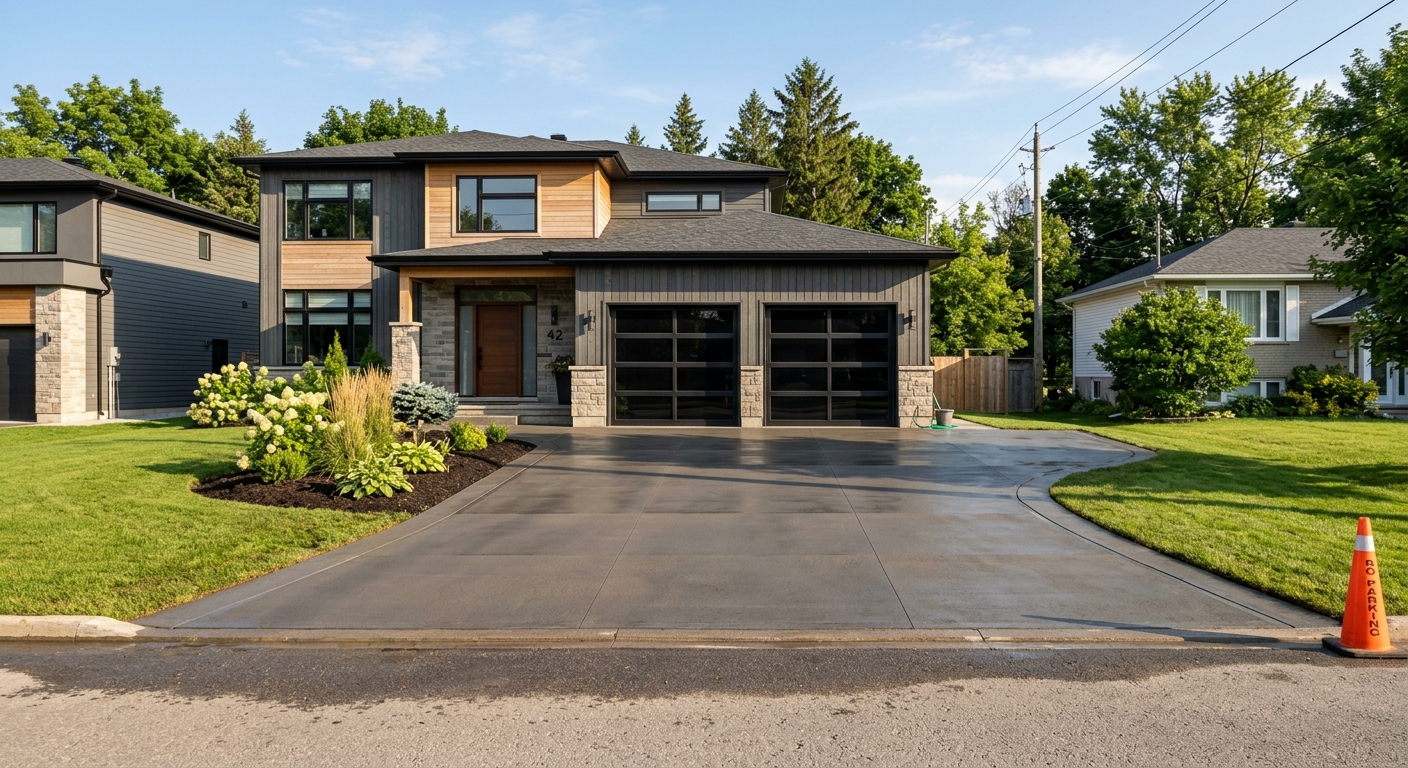
Concrete work options and costs in Lions Gate
Lions Gate, British Columbia is a small community within the Lower Mainland–Southwest, and that matters for concrete pricing because there are fewer crews who specialize in tight-access flatwork and the scheduling window can swing quickly with coastal rain. With a population of 2,660 (Statistics Canada, 2021 Census), the local market is niche—so good workmanship can book up faster during dry spells. Most homeowners are working in a neighbourhood context where detached housing forms a big share of demand, which typically translates into driveways, patios, and front steps that take the brunt of freeze–thaw cycles and winter wetting.
In this region, mild winters and a shallow frost line still drive the design: local practice often assumes a frost depth around 450 mm / 18", and exterior footings and thickened edges are placed below that to manage frost heave. We also plan for frequent freeze–thaw cycles, saturated soils, and heavy coastal rainfall—so base prep, drainage, and air-entrained mixes with proper control joints are non-negotiable. That’s why two “same-sized” slabs can come back 30–50% apart across the Lower Mainland–Southwest: one contractor designs for durability; another tries to hit a low unit price and then pays for it later in cracking or surface scaling.
In Lions Gate, the trade is especially active around the waterfront and hillside streets where access is tight and soils can be variable—these conditions commonly affect excavation, staging, and reinforcement decisions. Below is a practical comparison of common options so you can anchor your expectations before you request quotes.
| Application |
Typical Size |
Key Spec |
Finish Option |
Price Range |
| Concrete driveway (standard broom finish) |
400 sq. ft. |
Air-entrained exterior slab + control joints |
Broom finish, trowel-smooth edges |
$7,200–$11,200 |
| Exposed aggregate driveway |
400 sq. ft. |
Air-entrained exterior mix + proper curing |
Exposed finish with standard sealer |
$9,200–$14,000 |
| Stamped concrete driveway or patio |
300 sq. ft. |
Air-entrained mix + integral colour (where selected) |
Stamp pattern + release + sealer |
$8,000–$12,000 |
| Plain concrete patio or walkway |
250 sq. ft. |
Air-entrained mix + control joints |
Straightedge finish with broom edge |
$4,500–$7,000 |
| Garage floor (interior slab) |
480 sq. ft. |
Slab design for domestic loads + vapour control (as needed) |
Steel trowel finish (light broom at edges) |
$8,500–$14,000 |
| Foundation footings (structural, below frost) |
Typical footing per linear foot |
Excavation + formwork + rebar per engineer |
Reinforced concrete with proper placement |
$200–$350 |
Prices are estimates only and vary by project scope, site access and material selection.
What affects the price of concrete work in Lions Gate
In the Lower Mainland–Southwest, it’s common to see the “same” concrete scope return wildly different quotes—often by 30–50%—because the real cost drivers aren’t just the cubic yards. They’re the engineering intent (below-frost placement), the weather-ready mix (air-entrainment and curing plan), and the build quality (base, drainage, reinforcement, and jointing). When a contractor prices low by reducing base thickness, skipping proper drainage, or using the wrong mix, you may not notice until winter—after multiple freeze–thaw cycles and salty de-icing wetting in driveways and walkways.
Frost line depth and freeze–thaw cycles dictate every exterior spec here. Even with a shallow frost design (often around 450 mm / 18"), footings and thickened edges must extend below the design frost depth to prevent frost heave. Exterior slabs also require air-entrained concrete so the freeze–thaw cycle doesn’t drive scaling and spalling. Colder regions usually see even higher costs due to deeper excavations and a shorter pour season, but in coastal BC we still pay more when jobs must be scheduled around prolonged rain, cool nights, and high humidity. That can mean curing blankets, sealers, longer cure time before finishing, and additional supervision—especially for driveways that need durability.
Two examples from Lions Gate: (1) a narrow waterfront driveway often costs more because excavation and forming take longer—so the price climbs even if the square footage is modest; (2) a stamped or exposed aggregate option can cost more than a plain broom-finish slab, but the added labour (forms, texture, and finishing workflow) is what justifies the jump—often aligning with the $22–$36 per sq. ft. stamped & decorative band versus simpler driveway work. Meanwhile, older lots with variable fill can increase base prep and reinforcement, which typically nudges the job closer to the upper end of the $18–$28 driveway band.
| Price Factor |
Why It Matters |
Cost Impact |
| Frost line depth — determines footing depth and form height |
Helps prevent frost heave and uneven settlement |
More excavation and taller forms can add material and labour |
| Site preparation — excavation, grading, compacted granular base |
Stable support reduces cracking and allows correct slope/drainage |
Extra haul-off or granular supply pushes the quote upward |
| Reinforcement — rebar or wire mesh requirement |
Controls cracking and supports structural demands |
Rebar quantity, tying time, and chair supports increase labour |
| Mix design — air-entrainment and compressive strength spec |
Protects against freeze–thaw scaling/spalling |
Air-entrained requirements and testing add cost vs generic mixes |
| Finish type — broom vs. stamped vs. exposed aggregate |
Finishing workflow affects durability and appearance |
Stamping/aggregate adds labour steps and curing/sealer timing |
| Pour size and concrete truck access to site |
Access affects staging time and pour efficiency |
More trips, pump considerations, or manual conveyance add cost |
| Cold-weather curing precautions — heating and blankets |
Ensures concrete reaches design strength before finalizing |
Insulation blankets/heaters increase line items and supervision |
| Control joint pattern and sealing cost |
Directs cracking and extends surface durability |
Joint layout time + sealer product can move the total up |
Permits & regulations in British Columbia
In British Columbia, structural concrete work—like footings, foundation walls, and grade beams—typically requires a building permit and often involves engineered drawings that the municipality reviews. Concrete flatwork such as patios, walkways, and driveways usually does not require a permit unless it affects lot grading, changes how stormwater is managed, or conflicts with impervious surface/lot coverage expectations, or impacts the municipal right-of-way. Because requirements can vary based on how the work ties into drainage and adjacent structures, always confirm with the local authority before breaking ground.
From a homeowner’s perspective in Lions Gate, a good contractor will also be properly insured. Start by asking for: (1) proof of liability insurance, (2) proof of WCB coverage (coverage may be provided via WCB registration or acceptable documentation), and (3) references on similar-scale work in the Lower Mainland–Southwest.
Step-by-step to verify before you sign:
- Confirm licensing/registration: Check the provincial contractor registry relevant to your contractor’s trade activity (your contractor should provide a registration number).
- Ask for an insurance certificate: Get a current Certificate of Insurance naming you (or your property) as required by the contract, and confirm coverage limits.
- Verify WCB/WCB-equivalent coverage: Request confirmation documentation showing coverage is active.
- Read the scope: Ensure the permit responsibility is clear—structural work should be handled with the proper approvals.
- Request references: Ask for recent photos of exterior freeze–thaw-ready work (driveways and walkways) around Vancouver–Surrey–Abbotsford.
Getting concrete right in Lions Gate's freeze-thaw climate
Concrete fails in Lions Gate most often because water finds a weak spot and then freezes. That can expand within pores or along weak paste, leading to surface scaling and spalling—especially on exterior slabs where de-icing salts and coastal rain combine to keep surfaces wet. Specing the job correctly is about stacking the right defences: base preparation, mix design, joints, curing, and sealing.
(1) Base preparation: build a properly compacted granular sub-base to the correct depth for local soil and frost requirements. If you under-excavate or skip drainage, you’ll pay for it later with settlement cracks or damp, freeze-driven scaling. (2) Mix design: use an air-entrained exterior concrete mix, typically targeting about 5%–7% air content for durable freeze–thaw performance, plus minimum 32 MPa compressive strength. (3) Control joints: plan joint spacing to limit random cracking and to keep cracks where they’re easier to seal. (4) Curing: you need a minimum 7-day curing period under suitable conditions; in cool, damp coastal stretches, crews often extend cure time and use curing blankets to maintain temperature and moisture. (5) Sealing: apply a penetrating sealer after the cure—often around 28 days post-pour—so moisture and de-icing salts don’t keep pumping into the surface.
Here’s where price differences are (and aren’t) justified: moving from a plain broom-finish driveway to stamped decorative concrete often costs more—commonly aligning with the $22–$36 per sq. ft. decorative band. The extra cost is justified when the contractor keeps the same durable base and air-entrained mix, not when it’s treated as “just surface cosmetics.” Ask how they’ll prevent spalling through air-entrainment and curing; that’s the real quality in Lions Gate’s winter wet weather.
| Spec |
Why It Matters in Lions Gate |
What to Ask For |
Impact if Skipped |
| Compacted granular base (depth?) |
Stable support prevents settlement and keeps water from sitting under slab edges |
“What granular depth and compaction method will you use for my site soil and frost design?” |
Cracking, edge failure, and premature deterioration |
| Air-entrained concrete mix (target air %?) |
Air voids relieve freeze–thaw pressure and reduce scaling/spalling |
“Will the mix be air-entrained and what air content target do you place for exterior work?” |
Surface spalling and flaking in winter cycles |
| Compressive strength (MPa rating) |
Ensures the slab reaches design strength for durability and abrasion resistance |
“What minimum compressive strength (MPa) is specified and how is it tested?” |
Reduced surface strength and increased risk of damage |
| Control joints (spacing per ACI guidelines) |
Limits random cracking from shrinkage and temperature swings |
“What joint spacing are you proposing and how will joints line up with slab dimensions?” |
Chaotic cracking that’s harder to seal and repair |
| Minimum 7-day curing period |
Cold nights and coastal humidity make curing quality critical for strength gain |
“How long will you cure before traffic and before final finish/sealer timing?” |
Under-strength concrete and poor long-term performance |
| Penetrating sealer (when applied after cure) |
Repels moisture and reduces de-icing salt penetration |
“What sealer product will you use and when will it be applied post-pour (often ~28 days)?” |
Higher moisture uptake, faster scaling, and surface staining |
How to choose a concrete work contractor in Lions Gate
Choosing the right concrete contractor in Lions Gate starts with verification. In British Columbia, confirm your contractor has the appropriate registration for the type of work they’re doing, then ask for proof of liability insurance and active WCB coverage. To check insurance, request a current Certificate of Insurance (COI) showing effective dates and coverage limits; don’t rely on a screenshot or an expired COI. For WCB, ask for the coverage confirmation they use in the province. If they hesitate or can’t provide documentation quickly, that’s a warning sign.
Next, get 2–3 itemised written quotes, not just a lump sum. You want the labour and materials breakdown so you can see whether the difference is excavation/haul-off, reinforcement, mix design, finishing labour, pump access, or curing/sealing. Ask what’s included and what’s excluded: disposal, saw-cutting, sealing, perimeter forms, permitting support, and cleanup. For warranties, request both workmanship and product/manufacturer coverage details—how long, what it covers, and whether it transfers if you sell the property.
Payment scheduling matters. In good practice, never pay more than about 10–15% upfront; hold back a meaningful portion until forms are removed, finishes are acceptable, and curing/sealer steps are completed. Finally, demand a timeline in writing: start date, concrete delivery day, and estimated completion, with rain/cool-weather contingencies.
- Bring your own dimensions and photos; ask them to confirm takeoffs in writing.
- Request the exterior mix design details: air-entrainment and minimum strength.
- Ask for joint layout and sealing plan (when sealer is applied after cure).
- Confirm reinforcement type and placement (rebar/wire mesh and cover depth).
- Clarify excavation and granular base depth—especially for uneven or saturated soils.
- Check whether pump access or manual conveying is included if truck access is limited.
- Ask who handles disposal and how debris is hauled away.
- Verify scheduling around rain: curing blankets/curing plan must be described.
- Look for a detailed scope: thickness, finish, slopes, and edge details.
- Confirm lead time for materials and whether they reserve delivery slots in advance.
- Get a written warranty on workmanship and a separate product warranty (if applicable).
- Use a payment schedule tied to milestones; keep holdback until final cure/sealer steps.
Concrete red flags in Lions Gate: vague “we’ll do it properly” claims without mix/joint/curing specifics; quotes that omit air-entrainment for exterior slabs; no mention of drainage or base compaction; refusal to provide a current COI and WCB/WCB coverage proof; and payment terms asking for large upfront deposits without a signed milestone schedule.
Frequently asked questions — concrete work in Lions Gate
What is air-entrained concrete and why does it matter here?
Air-entrained concrete is mixed with tiny, evenly distributed air bubbles that give freezing water a place to expand. In Lions Gate and the Lower Mainland–Southwest, exterior slabs and walkways get hit with coastal rain, wet surfaces, and repeated freeze–thaw cycles, which is a recipe for scaling and spalling if the mix isn’t designed for it. That’s why you should expect air-entrainment for driveways and patios, not just “regular” concrete. A properly designed exterior mix also pairs air-entrainment with control joints and good curing, which helps manage cracking and surface deterioration over time. If a quote for a driveway is unusually low within the $18–$28 per sq. ft. driveway band, ask directly whether the mix is air-entrained and what target air content they’re placing for exterior exposure.
How do I prepare the base for a concrete slab?
Base prep is where most durability is won or lost. For Lions Gate, the goal is a stable, well-compacted granular sub-base at the right depth for local soil and frost design, with drainage so water doesn’t sit under slab edges. A typical process includes layout, excavation to the specified depth, proofing the subgrade, installing granular base, compacting in lifts, and checking slopes so runoff drains away from the slab. If you have variable fill or saturated soils, base preparation typically takes more time and granular supply, which is one reason quotes can differ within the same driveway size. A good contractor will also discuss reinforcement placement and joint layout before any pour. When you compare quotes, insist that the base scope and compaction approach are written into the proposal, not left as “standard prep.”
How do I compare concrete quotes?
To compare quotes fairly in British Columbia, don’t judge by total price alone. Ask for an itemised breakdown that separates excavation/haul-off, granular base, reinforcement, concrete mix design (especially air-entrainment for exterior), finishing labour, and curing/sealing. You also want clarity on exclusions like disposal, site cleanup, and whether control joints and saw-cutting are included. Check whether the quote addresses freeze–thaw durability: exterior slabs should be air-entrained and properly cured, and decks/driveways should include jointing and a sealing plan. In Lions Gate, decorative work (like stamped concrete) can land in the $22–$36 decorative band, but only makes sense if the contractor maintains the same durable base and mix spec. If one quote for a stamped driveway is far below the rest, it’s worth verifying what finish steps and air-entrainment requirements are actually included.
Can concrete be poured in cold weather in Lions Gate?
Yes, concrete can be poured in cold weather in Lions Gate, but it must be done correctly. Concrete needs to stay warm enough to reach the required strength gain without freezing early, especially in cool, damp conditions common to the coast. Contractors typically adjust with cold-weather procedures such as curing blankets, insulating measures, and sometimes additional heating at the site. The key is planning: delivery scheduling, protecting the slab from early temperature drops, and extending cure time as needed. A reputable contractor will describe their cold-weather curing precautions in the scope and connect it to the target 7-day curing period (and longer if conditions require). If a quote doesn’t mention curing blankets/heating or how they’ll protect the pour overnight, ask about temperature control and curing duration before you approve the schedule.
How do I maintain concrete in Lions Gate's freeze-thaw climate?
Maintenance in Lions Gate is mostly about keeping water and de-icing chemicals from saturating the surface. Start with a quality penetrating sealer applied after the slab fully cures—often around 28 days post-pour—because it helps repel moisture and slows down salt penetration. Use non-corrosive cleaning when possible and avoid aggressive sandblasting that damages the surface paste. For driveway and walkway cracks, don’t ignore small issues: sealed, properly managed joints prevent water from getting under the slab. Also, keep drainage paths clear so runoff doesn’t pool near edges. If your slab is still scaling after multiple winters, it can indicate the mix/curing wasn’t right (air-entrainment is the big one). In that case, maintenance alone won’t fix the root problem, and you should get the contractor to review the original spec.
What causes concrete to spall in Lions Gate winters?
Concrete spalling in Lions Gate winters is commonly caused by freeze–thaw damage amplified by moisture movement. When exterior concrete isn’t air-entrained correctly, water that enters pores or along weak paste can freeze and expand, popping off the surface (scaling and spalling). Poor curing—especially in cool, rainy stretches—can also reduce strength and increase permeability, letting water get in faster. Another contributor is inadequate base/drainage, which keeps slab edges wet and encourages freeze action at the perimeter. De-icing salt can accelerate surface deterioration if the slab isn’t sealed and if water isn’t managed. If you’re choosing between options within the $18–$28 driveway band or moving into the decorative $22–$36 band, don’t treat finish as the main durability factor—ask for the mix design (air-entrainment), jointing, curing plan, and sealing timing. Those are the spec items that determine whether spalling shows up after the first winter or after several seasons.