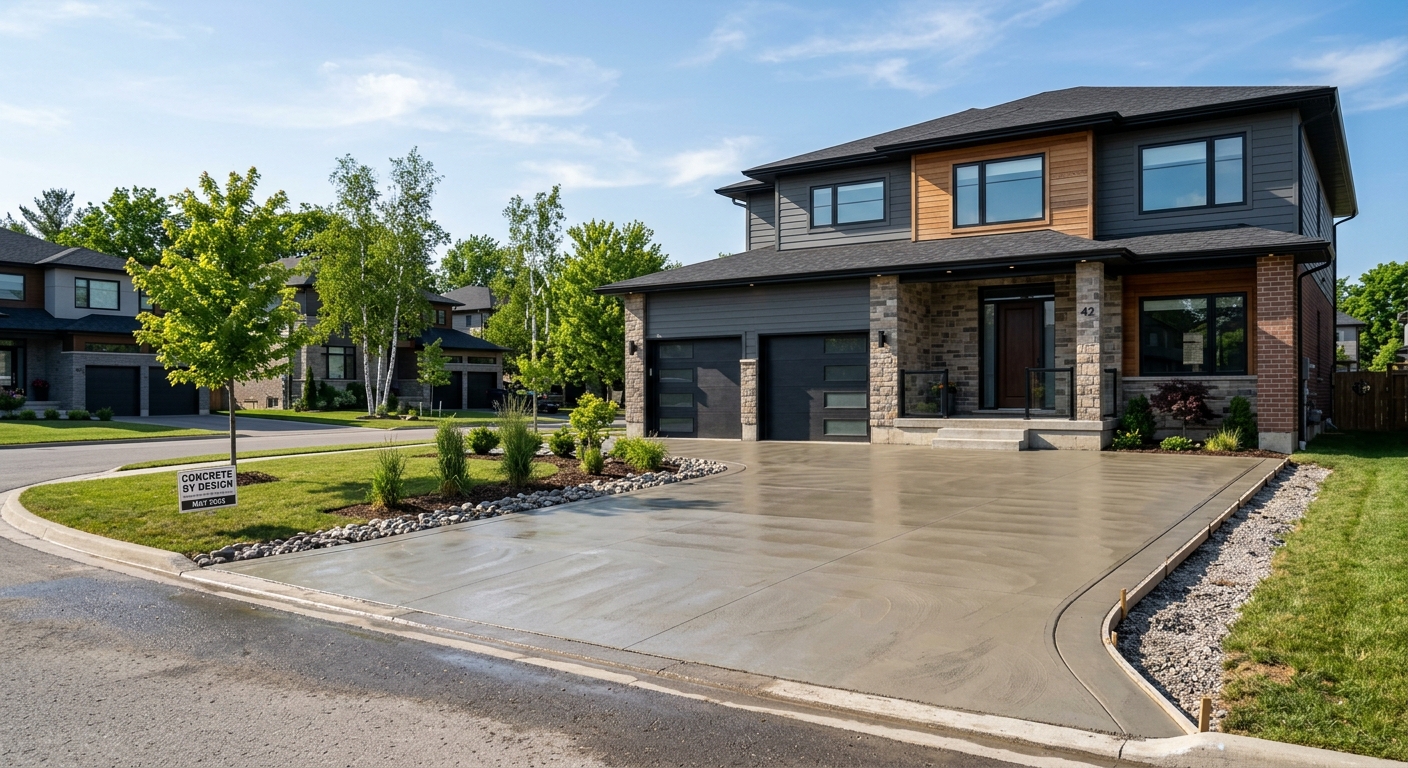
Concrete work options and costs in Bradner
Concrete contractors in Bradner, British Columbia, typically see the biggest demand for exterior flatwork—especially driveways, patios, and walkway repairs—because this is a suburban, homeowner-heavy market. With Bradner’s population at 3,213 (Statistics Canada, 2021 Census), most concrete projects start with a single household scope rather than large commercial sites, which can affect scheduling and minimum truck-load requirements. In the wider Lower Mainland–Southwest context, many homes are single-detached and the durable concrete look matters for curb appeal on rain-exposed lots; that’s why we’re often requested for replacements and expansions in the Abbotsford–Bradner corridor.
Lower Mainland–Southwest pricing is shaped by our mild winters paired with a shallow frost depth—commonly planned around about 450 mm / 18". Even though frost is less severe than interior or northern BC, freeze–thaw cycles and saturated soils still demand proper drainage, compacted granular base prep, and air-entrained mixes for any exterior slab. In practice, footings and thickened edges still must sit below the design frost line to avoid frost heave and service-life issues. Rainy stretches can also slow production because curing conditions matter; contractors often plan around cool nights and prolonged drizzle and may add curing blankets and sealer.
In Bradner, trade demand is especially strong around busy residential pockets along the rural routes where access is tight and crews need reliable truck access—so driveway and patio pours are commonly scheduled in peak windows. Use the table below to compare typical options and budget ranges before you request an itemised quote.
| Application |
Typical Size |
Key Spec |
Finish Option |
Price Range |
| Concrete driveway (standard broom finish) |
400 sq. ft. (approx. 20’ x 20’) |
Air-entrained slab, control joints, compacted granular base |
Broom-finished |
$7,200–$11,200 |
| Exposed aggregate driveway |
400 sq. ft. (approx. 20’ x 20’) |
Wash/expose process, air-entrained concrete, proper cure |
Exposed aggregate |
$9,200–$14,000 |
| Stamped concrete driveway or patio |
300 sq. ft. (approx. 15’ x 20’) |
Air-entrained mix, coloured densifier or integral colour |
Stamped pattern + sealer |
$8,700–$13,600 |
| Plain concrete patio or walkway |
240 sq. ft. (approx. 12’ x 20’) |
Air-entrained slab, control joints, slope to drain |
Float/trowel + light broom (as specified) |
$3,800–$6,200 |
| Garage floor (interior slab) |
480 sq. ft. (approx. 20’ x 24’) |
Vapour barrier (if required), fibre or mesh, joints as needed |
Standard smooth finish |
$7,700–$12,000 |
| Foundation footings (structural, below frost) |
Allowance varies by foundation plan |
Engineered sizing, rebar, excavation below frost depth |
Structural concrete only |
$4,000–$7,500 |
Prices are estimates only and vary by project scope, site access and material selection.
What affects the price of concrete work in Bradner
In the Lower Mainland–Southwest region around Bradner, it’s common to see quotes for the “same” concrete job come in 30–50% apart. The difference usually isn’t the concrete itself—it’s the unseen parts of the spec: excavation depth to suit our frost planning, base preparation, drainage, reinforcement, and the curing approach needed when cool nights and frequent rain extend the time concrete needs to safely reach design strength. Contractor availability also shifts seasonally; while winter is milder than interior BC, schedules still get tight when crews are booked for multiple residential pours that can’t start until weather and curing conditions cooperate.
Two major drivers are frost line depth and freeze–thaw cycles. Even though coastal BC plans for a shallower frost depth (often around 0.5–1.2 m in coastal BC practice), exterior footings and thickened edges must still extend below that design depth to prevent frost heave. For every exterior slab—driveways, patios, walkways—air-entrained concrete is a must for durability against scaling and surface deterioration from repeated wetting and thawing. Colder regions typically shorten the pour season and require heating/insulation blankets; in Bradner we may not always heat, but we still plan for cool-weather precautions and longer cure windows when rain lingers, which can add labour and materials time. De-icing salt can accelerate surface spalling on improperly made concrete, so sealing is a practical durability add-on.
In Bradner, a driveway may cost closer to $18–$28 per sq. ft. when you need more base thickness and good subgrade drainage, but can come down if the existing grade is stable and access is straightforward. Stamped work—often in the $22–$36 per sq. ft. band—costs more because of colouring, stamping labour, and careful curing/sealer timing. If your home is older and the soil has been disturbed by previous repairs, expect additional excavation and compaction; that can move a patio from the low end of the range to the mid/high end quickly.
| Price Factor |
Why It Matters |
Cost Impact |
| Frost line depth — determines footing depth and form height |
Footings/thickened edges must be below the design frost depth to resist heave. |
Higher excavation and formwork when depth and soils require it. |
| Site preparation — excavation, grading, compacted granular base |
Compacted base and correct grade control water and reduce settlement/cracking. |
More labour and granular import if the subgrade is soft or undermined. |
| Reinforcement — rebar or wire mesh requirement |
Limits cracking and controls slab movement where design calls for it. |
Added material + tying/install time, especially on thicker slabs. |
| Mix design — air-entrainment and compressive strength spec |
Exterior freeze–thaw durability depends on correct air content and strength. |
Potentially higher per-cubic-yard concrete cost and stricter batching. |
| Finish type — broom vs. stamped vs. exposed aggregate |
Finish drives extra steps (colouring, texture application, wash/expose work). |
Labour-intensive finishes typically add $/sq. ft. |
| Pour size and concrete truck access to site |
Truck placement affects how much labour is needed to move/finish concrete. |
Shorter access can increase costs due to hand-movement and scheduling. |
| Cold-weather curing precautions — heating and blankets |
Concrete needs time and temperature stability to reach strength safely. |
Added blanket/heating rental and monitoring in cooler periods. |
| Control joint pattern and sealing cost |
Joints manage cracking location; sealing helps repel moisture and salts. |
Additional sawing labour and sealer material/time at 28 days. |
Permits & regulations in British Columbia
In British Columbia, the permit situation for concrete comes down to whether the work is structural and whether it changes site drainage or lot grading. Structural concrete work—such as foundation footings, foundation walls, grade beams, and other load-bearing elements—typically requires a building permit, and engineered drawings may need municipal review. Concrete flatwork (like most patios, walkways, and driveways) often does not require a permit, unless it affects lot grading, impervious surface coverage limits, or the municipal right-of-way. Because Bradner projects can still tie into drainage and surface water management, confirm expectations before you break ground.
For a homeowner in Bradner, a practical contractor-check sequence is:
- Building permit + engineering: ask whether your scope includes any structural elements and whether permits are handled or required.
- Licence/registration (where applicable): check the contractor’s credentials using provincial resources and ensure the company is in good standing.
- Liability insurance: request a Certificate of Insurance naming you as certificate holder (or otherwise showing coverage limits for property and worksite risk).
- WCB/WSIB coverage: in BC, confirm the contractor has active WCB coverage for their workers; ask for documentation.
- References: request photos and references for similar-size jobs in the Lower Mainland–Southwest area so you can verify finishing and curing practices.
Getting concrete right in Bradner's freeze-thaw climate
Concrete can fail in Bradner’s climate mainly through cracking, scaling, and spalling—usually driven by water movement, inadequate base support, and the wrong mix for freeze–thaw exposure. The cure isn’t just “using concrete”; it’s specifying the full system: base, drainage, mix, finishing timing, joints, and curing. Start with (1) base preparation: compacted granular sub-base to the right depth for the local soil and frost planning (with exterior work designed for a shallow-but-real frost depth around 450 mm / 18"). That depth and compaction level are what keep your slab supported when the ground cycles between wetting and freezing.
Next, (2) mix design: for exterior flatwork, specify air-entrainment—commonly in the 5–7% air range for durable freeze–thaw performance—and a minimum 32 MPa compressive strength target (or higher if engineered). Without air-entrainment, freeze–thaw pressure breaks down the near-surface paste, and you can see early scaling and spalling even when the slab looks “fine” for the first season. (3) Control joints matter too: place joints to limit random cracking and manage shrinkage—then finish the joints so they’re sealed/managed appropriately if your spec calls for it.
For (4) curing, plan a minimum 7-day curing period under appropriate conditions; when pour days are cool or damp, contractors should extend curing attention with protective blankets as needed. Finally, (5) sealing: apply a penetrating sealer after cure (commonly at 28 days) to help repel de-icing salts and reduce moisture ingress.
When the spec is done right, the cost is easier to justify. For example, upgrading from a plain broom-finished driveway to a stamped concrete driveway can move you into the $22–$36 per sq. ft. band, but that’s often because of additional labour and colour/sealer steps—not because you’re “buying looks at the expense of durability.” Durability comes from air-entrained concrete, jointing, and curing; colour and texture come after those fundamentals.
| Spec |
Why It Matters in Bradner |
What to Ask For |
Impact if Skipped |
| Compacted granular base (depth?) |
Reduces settlement and limits water retention that fuels freeze–thaw damage. |
Base thickness and compaction method to suit local soil and slab thickness. |
Cracking, pumping, edge failures, and faster surface deterioration. |
| Air-entrained concrete mix (target air %?) |
Protects the paste against freeze–thaw scaling and spalling in wet coastal conditions. |
Air content target (typically 5–7% for exterior flatwork) and approved mix design. |
Early scaling/spalling, rough surface, reduced service life. |
| Compressive strength (MPa rating) |
Ensures the slab reaches durable strength despite cool nights and variable curing. |
Minimum 32 MPa (or project/engineer-specified strength) and documentation if requested. |
Soft surface, increased abrasion damage, and longer-term cracking risk. |
| Control joints (spacing per ACI guidelines) |
Directs cracking to predictable locations under shrinkage and movement. |
Joint spacing and timing (sawcut windows) to match your slab size and thickness. |
Random cracks that can allow water ingress and freeze–thaw acceleration. |
| Minimum 7-day curing period |
Gives the concrete time to gain strength while managing rain/cool temperatures. |
How curing is protected during your specific forecast conditions. |
Reduced strength gain, increased scaling, and surface weakness. |
| Penetrating sealer (when applied after cure) |
Repels moisture and helps protect against de-icing salt impacts. |
Sealer type and application schedule (commonly after 28 days). |
Higher water and salt uptake, more surface degradation over time. |
How to choose a concrete work contractor in Bradner
Choosing the right concrete contractor in Bradner starts with verification and clarity. In British Columbia, you should confirm the contractor is properly registered/licensed for their work category (where applicable), carries current liability insurance and has active workers’ coverage (WCB) for their crew. Ask for documentation before any work begins. If a contractor hesitates or can’t provide a Certificate of Insurance, that’s a red flag. For WCB, request proof of account status or coverage confirmation.
Next, get 2–3 itemised written quotes. Not just a lump sum—ask for line items for excavation, base/granular supply, formwork, reinforcement, concrete supply, finishing, joints, and cleanup/disposal. Confirm whether a permit is required for any structural parts and whether permit handling is included (or excluded). In Bradner’s wet conditions, ask what’s included for weather protection (curing blankets, tarping) and how long they plan to protect fresh concrete.
Warranty matters: ask for the workmanship warranty length, what it covers (cracks? spalling? surface scaling?) and whether it’s transferable to future owners. Then look at the payment schedule—never pay more than about 10–15% upfront. Hold back additional funds until the slab is complete, joints are cut/finished, and the site is cleaned to a safe standard. Finally, insist on a start date and completion estimate in writing, because scheduling is tightly linked to rain and curing windows.
- Ask who supplies the concrete and whether mix specs include air-entrainment for exterior work.
- Confirm foundation footings/frost depth planning is built into the quote if structural work is included.
- Request an itemised breakdown (labour + materials) instead of a single number.
- Check whether disposal and hauling are included in the scope.
- Verify reinforcement type (mesh vs. rebar) and where it’s placed (chairs/ties, not sitting on dirt).
- Ask about joint timing (sawcut window) and joint pattern for your slab size.
- Confirm curing approach and minimum protection period (especially in cool or rainy forecasts).
- Ask if sealing is offered and when (often 28 days post-pour for penetrating sealer).
- Get the truck access plan and how they’ll handle placement where access is limited.
- Review finish details: broom finish texture, exposed aggregate exposure depth, stamped pattern design/sealer.
- Confirm cleanup includes removal of waste and regrading around edges where needed.
- Ask for proof of insurance and WCB coverage before signing.
Concrete red flags in Bradner include: vague quotes that don’t specify air-entrainment, no discussion of frost depth or drainage for exterior work, contractors who want large deposits up front, refusing to provide insurance/WCB documentation, and promises to “pour through the rain” without a defined curing/protection plan.
Frequently asked questions — concrete work in Bradner
When is the best time to pour concrete in Bradner?
In Bradner and the wider Lower Mainland–Southwest region, the “best” time is when daytime temperatures are workable and you don’t have a multi-day stretch of heavy rain that could disrupt finishing and curing. Even with mild winters, cool nights and high humidity slow strength gain, so crews plan around weather forecasts and reserve protection measures (tarps or curing blankets) for any cold snaps. If you’re scheduling a driveway or patio, many homeowners aim for late spring through early fall because it improves curing reliability and reduces delays. Cost can be steadier in shoulder seasons, but availability can tighten near peak summer. For a typical exterior driveway that budgets around $18–$28 per sq. ft. in this market tier, timing can affect whether sealing and curing precautions are included as part of the plan.
How long does concrete take to cure?
Concrete curing is a staged process. For practical scheduling, many contractors treat the slab as “walkable” after a short period, but the strength development that matters for durability continues well beyond that. In Bradner’s climate, we typically plan for at least 7 days of curing attention under appropriate conditions before expecting full normal use, because cool nights and damp weather can extend the time needed to reach safe strength levels. If your project includes sealing, penetrating sealers are generally applied after the concrete has fully cured—commonly around 28 days—so the sealer can bond effectively and repel moisture and de-icing salts. If rain occurs soon after a pour, a good contractor will protect the surface and manage curing so you don’t compromise the final finish.
Do I need a permit for concrete work in British Columbia?
In British Columbia, the permit requirement depends on what concrete work you’re doing. Structural items such as foundation footings, foundation walls, and grade beams typically require a building permit and often engineered drawings reviewed by the municipality. For concrete flatwork like patios, walkways, and most driveways, permits often aren’t required unless the work impacts lot grading, impervious surface coverage limits, or the municipal right-of-way. Because drainage rules and lot grading can matter in Bradner, the safest approach is to ask your contractor to confirm whether your specific scope triggers a permit. Before ground is broken, also confirm the contractor is insured and has active WCB coverage—this is separate from the permit question, but it’s essential for a safe, accountable job.
Concrete vs pavers for a patio in Bradner?
Concrete and pavers can both work well in Bradner, but the choice often comes down to moisture performance, maintenance, and budget predictability. A plain concrete patio is typically a simpler build with fewer joints that can shift; with proper base prep and control joints, it can handle the freeze–thaw cycles that come with wet winters and spring thaws. Pavers can look more flexible and are sometimes easier to repair locally, but weeds and minor shifting can occur over time if base drainage isn’t built correctly. In this market tier, plain concrete patios commonly fall around the $16–$26 per sq. ft. band, while stamped decorative options run higher. If you want durability with minimal maintenance, concrete is often the straightforward option—especially when you also plan for proper slope away from the house and quality sealing if you’re using de-icing salts.
How long does a concrete driveway last?
A well-built concrete driveway in Bradner can last decades, but lifespan depends heavily on the “system,” not just the pour. Exterior freeze–thaw durability relies on air-entrained concrete, correctly compacted granular base, proper drainage, and correctly spaced control joints. Sealing helps repel moisture and can reduce early surface deterioration, especially if de-icing salts are used. In wet coastal climates, surface scaling risk increases when the mix isn’t right or curing was rushed. If your contractor specifies air-entrainment and follows a curing plan, you’re building the same durability foundation that keeps driveways looking acceptable through repeated wet and thaw seasons. Budgeting is also part of the expectation: standard broom-finished driveway work often sits in the $18–$28 per sq. ft. range here, and decorative upgrades can increase labour and material time.
What is air-entrained concrete and why does it matter here?
Air-entrained concrete is mixed with microscopic air bubbles designed to give freeze–thaw expansion somewhere safe to go. In British Columbia’s Lower Mainland–Southwest climate, exterior slabs still experience freeze–thaw cycles—even if winters are milder than inland regions—and the combination of rain, saturated soils, and temperature swings can damage concrete that lacks adequate air. The result of skipping air-entrainment is often visible early as surface scaling or spalling, especially near edges, joints, and areas that collect water. For exterior flatwork in Bradner, contractors commonly target an air content around 5–7% and specify suitable compressive strength. When you get quotes, ask directly: “Is the mix air-entrained for exterior exposure, and what target air percentage is being used?”