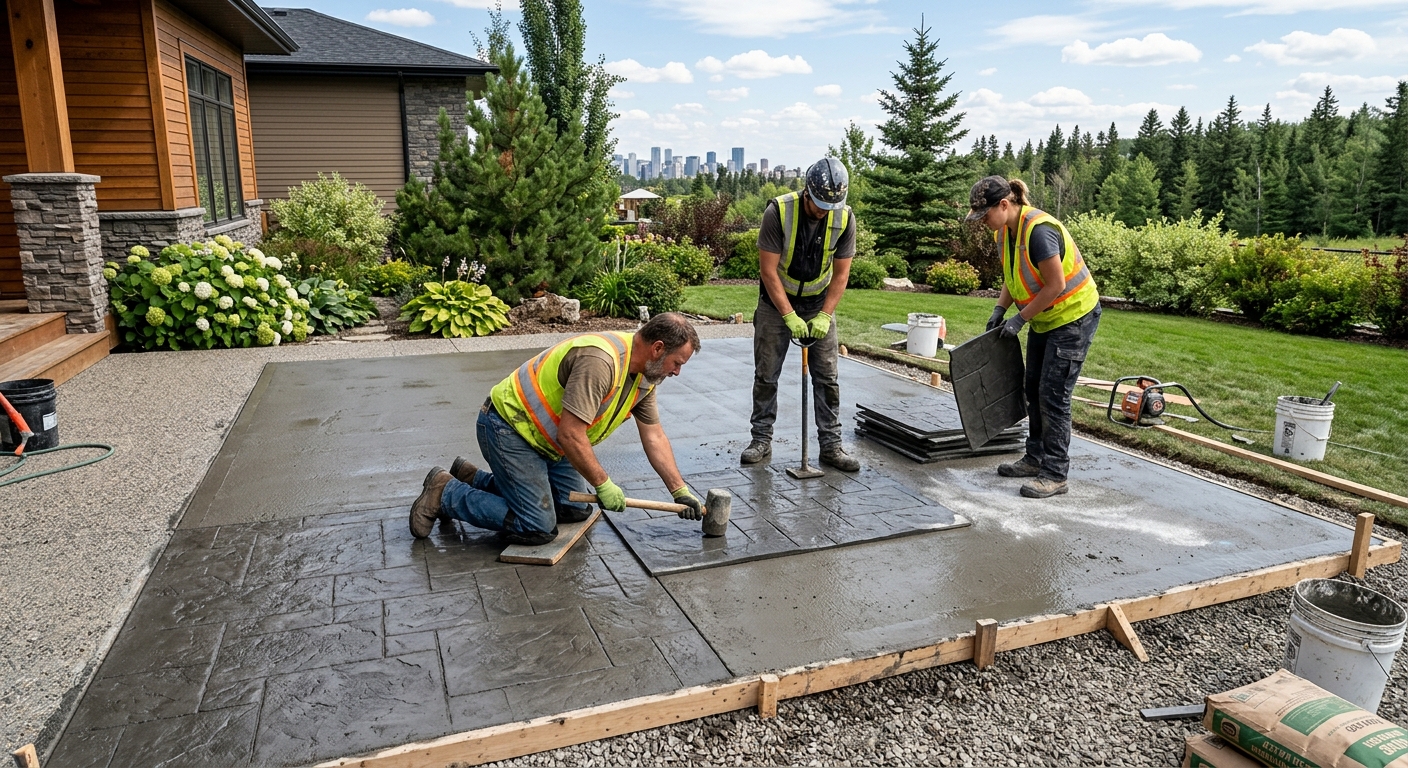
Concrete work options and costs in Gonzales
In Gonzales, concrete flatwork is a big part of how homeowners protect driveways, patios, and entry areas from the Lower Mainland–Southwest’s coastal-wet weather. Gonzales has a stable housing base—about 31.9% of the local dwelling stock is single-detached homes (Statistics Canada, 2021 Census)—and that type of property is typically where we see the most repeat demand for new driveways, backyard patios, and small walkways.
Even with mild winters, the frost line is still a real design driver. Local practice in the Lower Mainland–Southwest assumes frost depth around 450 mm / 18", so we place footings and thickened edges below that level to reduce freeze–thaw heave risk. You’ll also notice concrete scheduling changes more than you might expect: cool nights, prolonged rain, and high humidity can slow curing, so contractors plan pour dates and curing methods carefully (curing blankets, sealers, and longer cure time) to get to the intended durability.
In Gonzales, this trade is especially active around residential pockets like the Island View–Tillicum area, where properties commonly need driveway replacements, patio upgrades, and drainage improvements tied to foundation and slab performance. If you’re comparing options, it helps to look at finishes and thickness assumptions side-by-side—because the same slab can end up costing meaningfully more when base preparation, mix design (including air-entrainment), and finishing time are adjusted for freeze–thaw exposure. Below is a practical comparison table to help you align expectations before you request itemised quotes.
| Application |
Typical Size |
Key Spec |
Finish Option |
Price Range |
| Concrete driveway (standard broom finish) |
400–600 sq. ft. |
Air-entrained exterior mix; compacted granular base; control joints |
Broom finish, edges formed |
$18,000–$28,000 |
| Exposed aggregate driveway |
400–600 sq. ft. |
Air-entrained exterior mix; exposure process; extra curing attention |
Exposed aggregate finish |
$22,000–$33,000 |
| Stamped concrete driveway or patio |
300–600 sq. ft. |
Air-entrained mix; proper jointing; weather-appropriate curing |
Stamps + release + colour (integral and/or densifier) |
$24,000–$42,000 |
| Plain concrete patio or walkway |
200–450 sq. ft. |
Air-entrained mix; compacted base; expansion/control detailing |
Broom or smooth-trowel (light float) |
$16,000–$26,000 |
| Garage floor (interior slab) |
300–500 sq. ft. |
Vapour control (if required); reinforcement as specified; slab prep |
Standard smooth or broom finish |
$18,000–$30,000 |
| Foundation footings (structural, below frost) |
Typical home segmenting by design |
Excavate below ~450 mm / 18" frost line; reinforced concrete per engineer |
Structural concrete finish (not decorative) |
$200,000–$350,000 |
Prices are estimates only and vary by project scope, site access and material selection.
What affects the price of concrete work in Gonzales
In the Lower Mainland–Southwest, it’s common to see quotes for the “same” concrete job swing by 30–50% across British Columbia. The difference usually isn’t just the concrete itself—it’s the full scope: excavation depth, granular base thickness and compaction, reinforcement detailing, mix design requirements for freeze–thaw durability, and how crews manage cool, rainy curing windows to reach design strength.
Frost depth and freeze–thaw cycles dictate every exterior spec in this region. Footings and thickened slab edges must extend below the design frost depth (about 0.5–1.2 m in coastal BC design ranges), and exterior slabs typically require air-entrained concrete with proper control joints to manage cracking and surface scaling. Cold weather curing precautions can also add cost: if you’re pouring late season or during a rainy stretch with cold nights, teams may need insulating blankets and controlled curing to avoid strength loss. On top of that, de-icing salt is a spalling trigger—so sealing (applied after cure) and good surface finish matter more here than in drier climates.
In Gonzales specifically, two common pricing drivers are (1) saturated or poorly draining sites that require extra subgrade drainage and (2) challenging access for concrete trucks and pumps near driveways. If your driveway replacement includes regrading and improving drainage, you might spend toward the higher end of the driveway range (for example, closer to the mid-to-high teens on a broom finish, or higher when you add decorative finishes). Conversely, a straightforward backyard patio with stable soil and good access might land closer to the standard patio band (about $16–$26 per square foot project expectations depend on thickness and base, but finish upgrades will push it toward stamped pricing). Local housing stock also plays a role: older lots often have legacy drainage patterns and settled edges that require more demo and base rebuild, which is where costs climb by hundreds to thousands of dollars.
| Price Factor |
Why It Matters |
Cost Impact |
| Frost line depth — determines footing depth and form height |
Shallow designs can fail under freeze–thaw; deeper excavation increases labour and disposal |
Higher if excavation is deeper or shoring is needed |
| Site preparation — excavation, grading, compacted granular base |
Concrete lasts only as long as the base; saturated soils need extra drainage detailing |
Can add significant cost when existing base is poor |
| Reinforcement — rebar or wire mesh requirement |
Controls cracking and improves slab load capacity and durability |
Moderate to major depending on thickness and engineering |
| Mix design — air-entrainment and compressive strength spec |
Air entrainment reduces freeze–thaw scaling and spalling risk |
Small material premium but worthwhile long-term |
| Finish type — broom vs. stamped vs. exposed aggregate |
Decorative finishes require more time, tools and labour |
Stamped/exposed typically cost more than standard broom |
| Pour size and concrete truck access to site |
Large or hard-to-access pours may require smaller loads, pump costs, or extra staging |
Access issues can push labour and equipment up |
| Cold-weather curing precautions — heating and blankets |
Cool nights slow strength gain; curing protection helps reach design strength |
Adds labour materials when pouring near shoulder seasons |
| Control joint pattern and sealing cost |
Proper jointing manages cracking; sealing helps repel de-icing salts |
Usually moderate, but skipping it increases maintenance risk |
Permits & regulations in British Columbia
In British Columbia, most structural concrete work needs municipal approval—especially if it’s part of a foundation system. In practice, that means footing and foundation components such as concrete footings, foundation walls, and grade beams generally require a building permit and are often tied to engineered drawings reviewed through the permit process. For concrete flatwork like driveways, patios, and walkways, permits are commonly not required unless the work impacts lot grading, drainage, or the applicable impervious surface coverage/right-of-way conditions. Even when a permit isn’t required, it’s still important to confirm with the local authority before breaking ground, because small grading changes can affect runoff and neighbouring drainage.
For your protection in Gonzales, verify the contractor carries liability insurance and the proper workers’ compensation coverage (WSIB/WCB depending on the trade and coverage structure). Then ask for references on similar-scale concrete projects—ideally ones that match your exposure level (exterior driveway or salt/de-icing areas).
Step-by-step verification you can do before hiring: (1) request the contractor’s licence information and check it via the appropriate online registry; (2) ask for a current certificate of insurance naming you as an additional insured if applicable; (3) request proof of workers’ compensation clearance/coverage; (4) review the COI effective dates—an expired certificate is a red flag; and (5) confirm the permit responsibility in writing if the job is structural. If you’re replacing a driveway that ties into existing drainage or a foundation edge, ask whether a permit is triggered by grading or drainage changes.
Getting concrete right in Gonzales's freeze-thaw climate
Concrete problems in Gonzales usually come down to two things: water and temperature. Even in the Lower Mainland–Southwest’s milder winters, freeze–thaw cycles plus saturated soils can drive scaling, spalling, and cracking if the base, mix, joints, and curing aren’t specified correctly. The right approach is to “engineer the slab” for durability from day one—starting with base prep, then the concrete mix, then jointing and curing, and finishing with sealing where de-icing salts may be used.
(1) Base preparation: we excavate and place compacted granular sub-base to the right depth and density for local soil and frost protection needs. (2) Mix design: for exterior flatwork, insist on air-entrained concrete with target air content typically in the 5–7% range for freeze–thaw exposure, and minimum compressive strength around 32 MPa unless your engineer specifies otherwise. (3) Control joints: spacing and saw-cut timing are planned to limit random cracking—especially where driveways meet garage slabs, walkways, or steps. (4) Curing: in Gonzales’s coastal humidity and cool nights, plan a minimum 7-day curing period under proper conditions; when temps dip, crews use curing blankets or other cold-weather precautions to avoid surface weakness. (5) Sealing: apply a penetrating sealer after cure (often around the 28-day mark) to repel moisture and reduce de-icing salt-driven surface damage.
If you’re deciding between options, it’s worth spending where it prevents failure. For example, adding proper air-entrainment and correct base rebuild may cost more upfront, but it’s often cheaper than redoing a driveway after the surface starts spalling. Decorative finishes can add cost—stamped concrete might run higher (commonly in the decorative driveway band of $22–$36), but you don’t want decorative work layered on top of an underbuilt base or an incorrect freeze–thaw mix.
| Spec |
Why It Matters in Gonzales |
What to Ask For |
Impact if Skipped |
| Compacted granular base (depth?) |
Prevents pumping and reduces frost-susceptible voids in wet coastal soil |
Base thickness and compaction method/density target; drainage plan if needed |
Settlement, cracking, and premature surface breakdown |
| Air-entrained concrete mix (target air %?) |
Improves freeze–thaw durability and reduces scaling/spalling risk |
Confirm target air content (commonly 5–7% for exterior flatwork) and mix design record |
Spalling and scaling, especially near edges and areas exposed to salts |
| Compressive strength (MPa rating) |
Ensures the slab reaches design strength under Gonzales curing conditions |
Minimum 32 MPa (or engineer-specified rating) and cure plan |
Surface wear, scaling, and reduced long-term durability |
| Control joints (spacing per ACI guidelines) |
Controls where cracks form as the slab moves and contracts |
Joint layout plan, saw-cut timing, and coordination with expansion points |
Random cracking that can widen and admit water |
| Minimum 7-day curing period |
Coastal humidity and cool nights can delay strength gain |
Minimum cure duration and cold-weather curing measures if temps drop |
Weaker early-age slab; increased likelihood of cracking and scaling |
| Penetrating sealer (when applied after cure) |
Helps repel moisture and de-icing salt effects in exterior use |
Type of penetrating sealer and timing (commonly after full cure, around 28 days) |
Faster deterioration and higher maintenance costs over time |
How to choose a concrete work contractor in Gonzales
Start with verification. In British Columbia, confirm the contractor’s licence status where applicable for the trade scope, then check liability insurance and workers’ compensation coverage (WSIB/WCB). How to check: (1) ask for certificate of insurance and verify policy number, effective dates, and coverage limits; (2) request workers’ compensation proof/clearance and ensure it’s current; (3) look for a contractor who can reference similar projects around the Lower Mainland–Southwest; and (4) confirm who is responsible for permits if structural work is involved.
Next, get 2–3 itemised written quotes. You want a breakdown that includes labour, concrete and mix type (including air-entrainment spec), rebar/wire mesh or reinforcement, excavation and disposal, granular base and compaction, forms, joints, and finishing/sealing. Avoid lump sums that don’t explain what’s included—especially disposal and drainage. Ask whether permit pulling is included (if needed), and whether any engineering/inspection fees are separate.
Warranty matters. A workmanship warranty should be in writing (length and what it covers). Also clarify whether manufacturer warranties on sealers or admixtures are assigned to you and whether they’re transferable. Finally, payment scheduling: don’t let yourself be pushed into paying more than about 10–15% upfront. Hold back funds until completion and demobilization items are done (cleanup, sealing readiness, and punch-list work).
Timeline should be clear. Ask for a start date and a completion estimate that accounts for Gonzales weather—rain and cool nights can extend curing periods. A contractor who won’t discuss curing and access planning is taking avoidable risk.
- Request insurance COI and verify dates before work starts.
- Confirm workers’ compensation coverage (WSIB/WCB) with current documentation.
- Ask if a building permit is required for your specific scope (structural vs flatwork).
- Get itemised quotes: excavation/disposal, base, reinforcement, mix design, finishing, sealing.
- Require the mix spec to confirm air-entrainment for exterior freeze–thaw exposure.
- Ask who supplies and places the granular base and what compaction method is used.
- Confirm reinforcement type (rebar vs mesh) and slab thickness assumptions.
- Ask about control joint layout and saw-cut timing plan.
- Confirm curing approach for cool nights (blankets/curing compound if used).
- Clarify sealing: product type and timing after cure for exterior areas.
- Agree on a payment schedule with a holdback until completion and punch-list sign-off.
- Get the start/completion dates and weather contingency wording in writing.
Concrete red flags in Gonzales include: skipping air-entrainment “because it’s mild here,” refusing to discuss joint spacing and curing time, quoting without clarifying base thickness or drainage corrections, starting pours during rainy cold windows without a curing plan, and offering decorative finishes (stamping/exposed) without addressing underlying settlement or poor subgrade.
Frequently asked questions — concrete work in Gonzales
What is rebar and when is it required in British Columbia?
Rebar (reinforcing steel) is embedded in concrete to help control cracking and increase load capacity, especially in structural elements. In British Columbia, whether rebar is required depends on the engineered design and the structural role of the slab or footing. For typical exterior flatwork like driveways and patios, some contractors use wire mesh or rebar depending on thickness, soil conditions, and expected loads (and your local spec). For foundation footings and other structural concrete like grade beams and foundation walls, rebar requirements are much more common and are driven by engineer drawings tied to permits. In Gonzales, frost protection and drainage are crucial, so reinforcement decisions should be made alongside slab thickness, base prep, and control joints—not as an afterthought. If someone offers a “standard mix and no reinforcement” approach on a driveway that will see vehicle traffic, ask what thickness and steel plan they’re using.
How long does a concrete project take in Gonzales?
Project duration in Gonzales depends mainly on scope, access, and curing conditions. For most exterior flatwork, the actual pour and finishing day is often quick, but the schedule is shaped by base prep, forms, and drainage/soil correction work beforehand. After the pour, curing time is the limiter: you can walk on most slabs sooner, but performance and finishing/sealing steps depend on reaching adequate strength. As a practical range, a patio might be a short multi-day sequence (demo/base/steel/placement plus cure time), while a driveway can take longer due to thickness considerations, joint layout, and sometimes drainage tie-ins. If weather is cool and damp, teams may need additional curing protection to achieve the intended 32 MPa target. Cost-wise, the timeline pressure can be part of the reason driveway bids vary—standard broom jobs might align closer to the $18–$28 band, while decorative work often takes extra labour time for stamping/colour and careful curing.
What is a concrete overlay and is it suited to Gonzales?
A concrete overlay is a new concrete layer placed over an existing slab to restore surface appearance and function without full removal. It can be suited in Gonzales when the original slab is structurally sound, not badly settled, and the existing surface is prepared correctly (scarifying and proper bonding). However, overlays are not a fix for deep structural issues like significant spalling, widespread deterioration, or major base failure. Because the Lower Mainland–Southwest experiences freeze–thaw cycles and frequent wetting, the underlying causes—drainage, voids, or inadequate base—can continue and eventually show up through the overlay as cracking or delamination. If de-icing salts are used, the surface needs the right mix and sealing plan to protect against scaling. In many cases, replacing a deteriorated driveway outright costs more upfront (often falling in the driveway bands such as $18–$28 for standard broom, and higher for decorative), but it can be the more durable option if the existing slab has movement or water intrusion.
How do I seal concrete to protect it in Gonzales?
Sealing helps protect concrete by repelling moisture and reducing the impact of de-icing salts, which can accelerate spalling in freeze–thaw exposure. In Gonzales, sealing is most effective when the slab has fully cured. A common approach is to apply a penetrating sealer after about 28 days, assuming weather conditions allow proper curing and surface preparation. Before sealing, you want the surface clean and dry, with any laitance removed if needed. Ask your contractor which sealer type they use (penetrating vs film-forming) and whether they’ll handle timing based on temperature and humidity—coastal dampness can affect drying and application success. Also confirm that the underlying work was built correctly: air-entrained mix, proper joints, and curing are the foundation. Sealer alone can’t compensate for missing air-entrainment or poor base drainage.
What is the difference between concrete and cement?
Cement is one ingredient used to make concrete. Concrete is the final composite: typically cement plus water, sand, gravel (or crushed stone), and often admixtures such as air-entrainment agents for exterior freeze–thaw durability. In British Columbia and across the Lower Mainland–Southwest, exterior concrete should generally include air-entrainment so it can better resist scaling and spalling during freeze–thaw cycles. When you hear people talk about concrete strength (like minimum 32 MPa), that refers to the cured concrete performance, not just cement type. Contractors may also specify admixtures for workability and curing performance during cool nights. For homeowners in Gonzales, the practical takeaway is that “cement brand” is less important than the mix design: the air content, compressive strength target, and curing/jointing plan. Those details are what ultimately make the difference between a standard broom driveway and a more durable, properly protected exterior slab.
How much does concrete work cost in Gonzales?
Concrete pricing in Gonzales usually depends on thickness, base prep, reinforcement, finishing type, and access, plus the weather-related curing plan needed for durability. For guidance, driveway and slab projects often fall within regional price bands like $18–$28 for concrete driveways (standard broom finish). Patios and walkways commonly land around $16–$26 depending on size and finish, while decorative work such as stamped concrete usually runs higher—often in the $22–$36 range for decorative driveway or patio pricing depending on scope. Foundation/footings pricing is highly design-dependent and is commonly quoted based on structural requirements; the per-home total can vary widely because excavation depth below frost and reinforcement are dictated by engineering. A small, well-accessed patio on stable soil with proper compaction will be less expensive than a driveway that needs drainage corrections and careful curing around cool, rainy conditions.