Concrete work options and costs in Government Road
Concrete work in Government Road, British Columbia is shaped by our Lower Mainland–Southwest climate: mild winters overall, but frequent rain and short cold snaps that still create freeze–thaw stress at the surface. The local market is small—Government Road has a population of 2,325 (Statistics Canada, 2021 Census)—and most driveways, patios, and walkways are built for homeowners in low-rise neighbourhoods and older housing pockets where retrofits are common. In this area, concrete flatwork demand is especially noticeable around residential lanes off major routes toward the Vancouver–Surrey–Abbotsford corridor, where access and drainage complexity can affect excavation and base prep.
Because the regional frost depth is commonly designed around roughly 450 mm / 18" in practice, footings and thickened edges for exterior structural work are placed below that frost zone to reduce frost heave. The tradeoff is cost: even if it feels “milder” than interior BC, base prep still needs compacted granular and drainage detailing for saturated soils, and exterior mixes typically need air-entrainment to handle freeze–thaw cycles. Scheduling also affects pricing—contractors often plan pours around prolonged rain, cool nights, and high humidity, using curing blankets and longer curing windows so the slab reaches design durability.
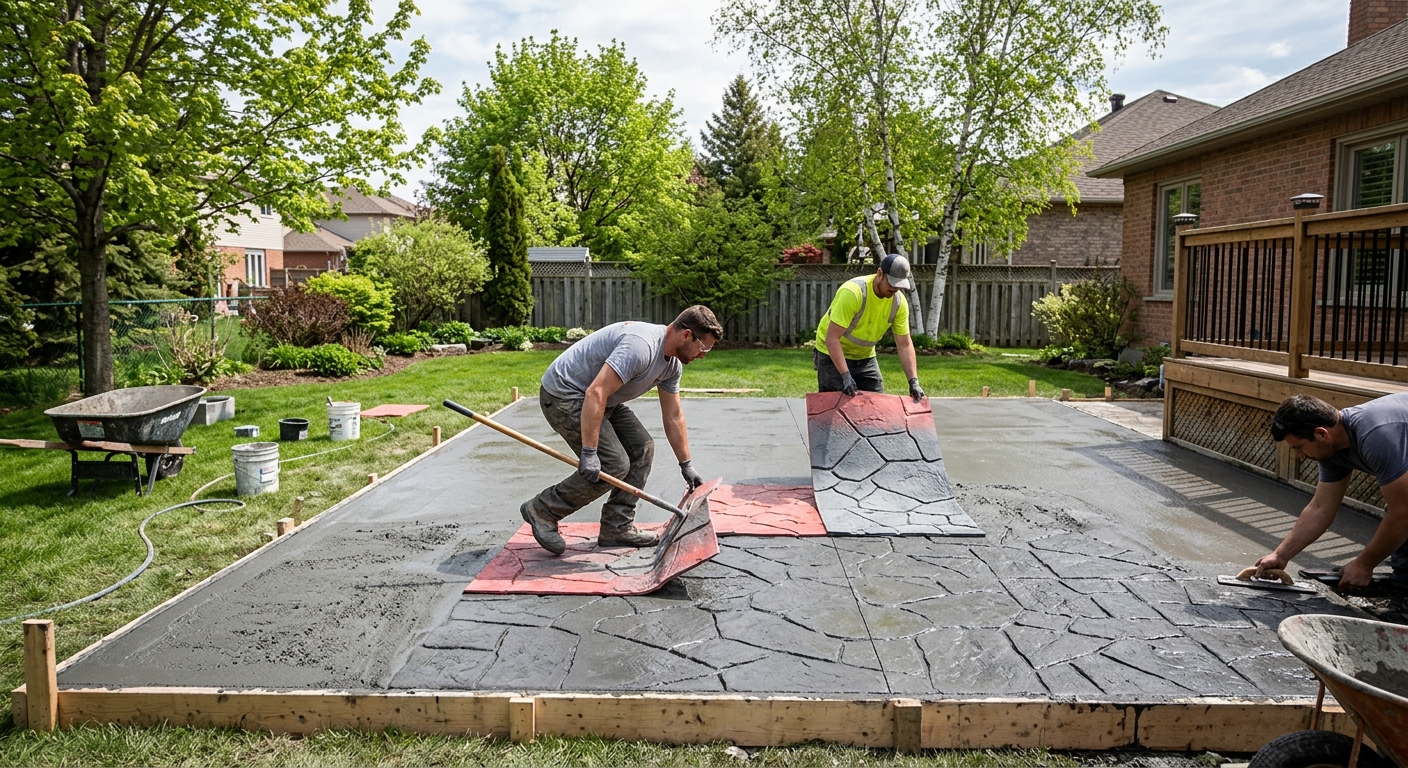
Most customers land somewhere between standard and premium finishes. For example, a plain patio or walkway can be cost-effective, while stamped or exposed aggregate adds labour and material for form liners, texture, and finishing. Below is a comparison table so you can benchmark your quote against typical Government Road project sizes and specs.
| Application |
Typical Size |
Key Spec |
Finish Option |
Price Range |
| Concrete driveway (standard broom finish) |
400–600 sq ft (approx. 30' x 14' to 20' x 30') |
Exterior slab, compacted granular base, air-entrained mix, joints as planned |
Broom finish + basic edging |
$18,000–$28,000 |
| Exposed aggregate driveway |
350–550 sq ft |
Exterior base prep + air-entrained concrete, controlled exposure |
Exposed aggregate (surface retarder + wash/expose) |
$22,000–$36,000 |
| Stamped concrete driveway or patio |
300–550 sq ft |
Exterior slab, proper curing plan for texture durability |
Stamped with release color + sealer |
$24,000–$42,000 |
| Plain concrete patio or walkway |
150–300 sq ft |
Compact and drain base, air-entrained for exterior exposure |
Broom or light trowel finish (non-slip) |
$16,000–$26,000 |
| Garage floor (interior slab) |
300–600 sq ft |
Vapour barrier (as required), reinforcement per design, interior mix |
Smooth trowel or light broom |
$18,000–$30,000 |
| Foundation footings (structural, below frost) |
Per linear foot equivalent (typical residential spreads) |
Engineered footing design, excavation to frost depth, rebar as specified |
Structural concrete; no decorative finish |
$200–$350 |
Prices are estimates only and vary by project scope, site access and material selection.
What affects the price of concrete work in Government Road
In the Lower Mainland–Southwest, the same basic concrete job can come in 30–50% apart across British Columbia because pricing isn’t only about “concrete dollars”—it’s about excavation, drainage, frost protection, reinforcement, finishing labour, and the contractor’s seasonal risk. A driveway that looks identical on paper can require different base depths, different mix air content, and different curing controls depending on soil moisture, slope, and how close the work is to coastal-wet ground conditions.
Frost line depth and freeze–thaw cycles dictate every exterior spec. In colder regions, footings and thickened edges must extend below the design frost depth to prevent frost heave; that drives excavation and forming height. In coastal BC, the frost depth is typically shallower (commonly around 0.5–1.2 m in coastal practice), but we still plan for freeze–thaw cycling at the slab edge and surface. That’s why exterior slabs require air-entrained concrete, controlled joints, and proper base preparation. Colder climates also shorten the pour season and require heated curing blankets, but even here, cool nights and rain can slow work and increase the time on site. De-icing salts common in residential use can accelerate surface spalling if the mix and curing aren’t done right—so sealing is often essential.
Two practical Government Road examples: (1) A driveway over soft, waterlogged subgrade may need extra granular and improved drainage, pushing costs toward the higher end of the $18–$28 driveway band; (2) Switching from broom finish to stamped concrete can be justified when you want premium texture and colour—stamped work frequently lands above the standard slab pricing, with typical quote ranges consistent with the regional $22–$36 stamped & decorative band.
| Price Factor |
Why It Matters |
Cost Impact |
| Frost line depth — determines footing depth and form height |
Footings and thickened edges must be placed below frost to reduce heave risk. |
Can add significant excavation and forming time, especially on uneven lots. |
| Site preparation — excavation, grading, compacted granular base |
Saturated soils and shallow drainage can ruin slabs without a engineered base. |
Usually one of the biggest cost drivers when access is tight or soils are poor. |
| Reinforcement — rebar or wire mesh requirement |
Rebar/wire is needed where design and loads require crack control. |
Adds material and labour; may increase costs for larger, thicker slabs. |
| Mix design — air-entrainment and compressive strength spec |
Exterior durability depends on air-entrained concrete for freeze–thaw resistance. |
Higher spec materials can add cost, but reduce long-term failure risk. |
| Finish type — broom vs. stamped vs. exposed aggregate |
Decorative work adds form liners/retarders, more finishing steps, and colour/texture control. |
Can shift your project toward the upper price bands. |
| Pour size and concrete truck access to site |
Long carries, wheelbarrows, or multiple loads increase labour and risk of cold joints. |
Bad access can add hours, extra personnel, and scheduling premiums. |
| Cold-weather curing precautions — heating and blankets |
Concrete must reach strength safely under cool, wet conditions. |
May add insulated blankets, heating, and longer protection time. |
| Control joint pattern and sealing cost |
Joints manage shrinkage; sealing helps protect against moisture and de-icing salt damage. |
Improper jointing can cause uncontrolled cracking; sealing is a relatively small add. |
Permits & regulations in British Columbia
In British Columbia, structural concrete work—such as footings, foundation walls, and grade beams—typically requires a building permit and often engineered drawings that a municipality reviews before construction. Concrete flatwork like patios, walkways, and most residential driveways usually does not require a permit on its own, unless it changes lot grading, affects stormwater/impervious surface limits, or impacts municipal right-of-way requirements. Even when a permit isn’t typical for flatwork, you still need to follow local requirements around drainage and site alterations, so confirm with the local authority before breaking ground.
To stay protected in Government Road, verify the contractor carries liability insurance and is properly covered through their work insurance arrangements (commonly WCB for eligible employers). Then ask for references on similar-scale residential projects where they dealt with wet subgrade, drainage adjustments, and exterior curing in coastal conditions.
Step-by-step homeowner checklist to verify contractor credentials in BC: (1) Ask the contractor for proof of liability insurance (certificate of insurance) naming you/your property as applicable; (2) Request their clearance/coverage letter and confirm it matches the contractor entity that will do the work; (3) Look up their licensing details through the appropriate provincial registry if applicable for their trade scope; (4) Confirm they’ll comply with permit/engineering requirements if the job includes structural elements (footings/foundations); (5) Keep the documents on file with your signed quote so you can match them to the work order and schedule.
Getting concrete right in Government Road's freeze-thaw climate
Concrete failures in Government Road are usually predictable: water gets in, freezes, expands, and the slab surface begins scaling or spalling. In Lower Mainland–Southwest conditions, that risk shows up even when winter temperatures aren’t extreme, because freeze–thaw cycles and persistent coastal rainfall can saturate edges and undermine the effectiveness of base drainage. To spec the job correctly, start with base prep: excavate to the correct depth for your compacted granular sub-base and ensure drainage routes water away from the slab perimeter. Next, require air-entrained concrete for exterior flatwork—typical target air content is about 5–7%—and use a minimum compressive strength spec (often 32 MPa for many residential exterior applications, depending on design and exposure class).
Third, control joints: spacing is the “planned cracking” approach, designed so shrinkage cracks don’t wander randomly. Fourth, curing: minimum 7-day curing is essential, and in cool or wet stretches, contractors may extend curing protection (blankets or seal timing) to achieve strength before the slab is exposed to freeze–thaw stress. Finally, sealing: apply a penetrating sealer after full cure (often around 28 days) to repel moisture and reduce de-icing salt effects.
Here’s where money is actually well-spent: if a quote for a standard broom-finished patio is near the lower end (around the $16–$26 band), but they offer a cheaper “no sealer/no air-entrainment” approach, that’s a false economy. Paying for proper air-entrainment and sealing is usually far less than repairing spalled edges later—especially on exterior work where the slab may need partial removal.
| Spec |
Why It Matters in Government Road |
What to Ask For |
Impact if Skipped |
| Compacted granular base (depth?) |
Controls settlement and provides drainage so water doesn’t freeze under edges. |
Ask for base depth based on excavation findings and soil conditions; confirm compacted lift thickness. |
Settlement cracks and edge spalling risk increases. |
| Air-entrained concrete mix (target air %?) |
Protects exterior concrete during freeze–thaw cycles common in Government Road winters. |
Request target air content of 5–7% for exterior flatwork and the mix ID/strength spec. |
Scaling and spalling become much more likely. |
| Compressive strength (MPa rating) |
Ensures durability and adequate resistance to surface deterioration in wet, cool conditions. |
Ask for minimum 32 MPa compressive strength (or the project’s design requirement). |
Surface wear accelerates and cracking risk rises. |
| Control joints (spacing per ACI guidelines) |
Limits random cracking from shrinkage and temperature changes. |
Ask for planned joint spacing and layout on your specific slab dimensions. |
Uncontrolled cracks and higher water infiltration at edges. |
| Minimum 7-day curing period |
Strength development needs time before exposure to coastal wetting and cold snaps. |
Ask how curing protection will be handled if nights are cool or rain is forecast. |
Weak surface layer; increased scaling/spalling risk. |
| Penetrating sealer (when applied after cure) |
Reduces moisture and salt penetration that contribute to surface damage. |
Request penetrating sealer application after full cure (commonly around 28 days). |
Faster degradation and more frequent maintenance. |
How to choose a concrete work contractor in Government Road
Start by verifying the contractor’s British Columbia compliance and coverage before you compare “price only.” Ask for a certificate of insurance (liability) and check that it covers the period of work and matches the legal name of the contractor who will be on site. Next, confirm their work coverage—typically WCB for eligible employers—by requesting the relevant clearance/coverage document and ensuring it applies to the people performing the work. If their scope includes structural work (footings/foundations/grade beams), they should clearly state how permits and any engineering requirements will be handled.
Then get 2–3 itemised written quotes, ideally broken out by excavation/grading, granular base, reinforcement, concrete supply, forming, finishing, curing protection, and sealing (if included). Avoid a “lump sum” quote that doesn’t list exclusions. Read the scope: is site cleanup included? Is disposal of excess material included? Will they repair disturbed landscaping? Is permit pull included where required? Also ask about warranty details: workmanship warranty length, whether it covers cracking/spalling related to execution, and whether any product/manufacturer warranty is transferable if you sell the home.
For payment, never hand over most of the money early. A common safe structure is small deposit for materials (often 10–15%), then staged payments tied to milestones, with a holdback until the job is fully complete and surfaces are cured/sealed as specified. Finally, insist on a written start date and completion estimate—Government Road pours can get delayed by rain and cool nights, so a realistic schedule matters.
- Ask for itemised labour and materials breakdown (not just total price).
- Confirm air-entrainment and minimum strength are stated in writing.
- Require details on base prep and how they handle wet subgrade.
- Check that reinforcement (rebar/wire) matches the project design.
- Verify control joint layout and who is responsible for saw-cut timing.
- Ask how they will protect curing in cool, humid weather.
- Confirm whether penetrating sealer is included and when it’s applied.
- Review what’s included for disposal, cleanup, and restoring landscaping.
- Ask about concrete truck access plan and lineal distance for pumping/placing.
- Get warranty terms in writing, including what defects are covered.
- Agree on a payment schedule with a holdback until completion.
- Ensure your quote lists exclusions, assumptions, and measurement method.
Concrete red flags I watch for in Government Road: (1) “Cheaper” exterior pours that don’t mention air-entrainment; (2) vague scope language like “standard base” without depth or drainage notes; (3) contractors who want large upfront payments; (4) no documented curing plan for cool nights/rain; and (5) quotes that omit sealing on exterior slabs that will face de-icing and wetting.
Frequently asked questions — concrete work in Government Road
How do I compare concrete quotes?
To compare concrete quotes in Government Road, don’t just line up the bottom-line numbers—line up the specs. Ask each contractor what base preparation depth and drainage steps are included (compact granular and how they handle saturated soil), whether the mix is air-entrained for exterior exposure, and what minimum strength they’re placing (often 32 MPa for typical residential applications). For pricing, benchmark finishes against local banding: for a driveway you’ll often see “standard broom” estimates in the $18–$28 range, while stamped & decorative commonly lands closer to the $22–$36 band depending on size and complexity. Also compare whether quotes include control joints, curing protection, and penetrating sealer timing—those details can swing cost and durability by more than finish type alone (Statistics Canada, 2021 Census).
Can concrete be poured in cold weather in Government Road?
Yes, concrete can be poured in Government Road in colder periods, but it depends on temperature, precipitation, and protection planning. The Lower Mainland–Southwest can have cool nights and rainy spells; that still matters for curing because concrete needs time and safe conditions to reach strength. A reputable crew will use insulated curing blankets and/or heating as needed, and they’ll protect the slab from wind chill and surface freezing. Make sure the quote explicitly addresses cold-weather curing precautions rather than assuming “summer conditions.” If the contractor can’t explain how they’ll protect curing for at least a minimum 7-day period, that’s a concern. If de-icing salts are used soon after, sealing schedule also becomes important for durability.
How do I maintain concrete in Government Road's freeze-thaw climate?
Maintenance in Government Road is mainly about keeping water out of the surface and protecting edges from freeze–thaw stress. Start with a penetrating sealer applied after the slab cures—commonly around 28 days post-pour—especially for driveways, patios, and walkways. During wet/cold seasons, avoid heavy salt or repeated application directly on fresh concrete surfaces; use sand for traction when possible. Keep an eye on joint lines: control joints are intended crack locations, but they must remain clean and not be packed with debris that traps moisture. If you spot early spalling or pop-outs at edges, address it promptly with the right patch system; waiting can allow water intrusion and expand damage around reinforcement. Seasonal cleaning (with proper detergents, not aggressive acid) helps protect the surface finish and sealer performance.
What causes concrete to spall in Government Road winters?
Spalling in Government Road usually comes down to a moisture + freeze–thaw combination, made worse by poor mix design or rushed curing. Exterior slabs must include air-entrainment (commonly 5–7% target air for exterior flatwork) so the concrete can tolerate freezing expansion at the micro-level. If a mix isn’t air-entrained, or if curing protection is inadequate during cool/wet nights, the surface layer can be weak and vulnerable to scaling and spalling. Saturated subgrade and lack of drainage also play a big role: if water gets trapped under slab edges, freeze–thaw pressure increases. De-icing salt accelerates damage, which is why sealing after cure is such a common recommendation for exterior work. If you’re comparing bids, ensure those elements are clearly included—cheap skips can cost far more later.
What is rebar and when is it required in British Columbia?
Rebar is reinforcing steel used to control cracking and add strength to concrete elements that experience tension or heavier structural loads. In British Columbia, rebar is required when the project design calls for it—most importantly for structural elements like footings, foundation walls, and grade beams, where engineering typically specifies reinforcement size, spacing, and cover. For exterior flatwork (like patios and many driveways), reinforcement may or may not be required depending on slab thickness, soil conditions, and expected loads; sometimes wire mesh or dowels are used, sometimes reinforcement is reduced or omitted if design criteria are met. The key is to match reinforcement to the engineering/design and the contractor should explain what they’re placing and where. For structural work, building permits and engineered drawings are commonly part of the process.
How long does a concrete project take in Government Road?
The timeline in Government Road depends on size, access, and weather-driven curing conditions. For a typical small patio or walkway, crews can often complete excavation, forms, finishing, and curing setup within a few days, but the slab still needs proper curing time. For larger driveways, expect longer on-site work because base preparation, drainage details, and joint layout take time, plus the finishing steps (especially for stamped or exposed aggregate). Even when the pour day is quick, you’re still working around curing—plan on at least a minimum 7-day curing period before subjecting the slab to full use. Cool nights and rain can add days because contractors protect the concrete to reach target strength. If your contractor quotes only “pour day length” and not curing/return-to-use timing, ask for the full schedule in writing.