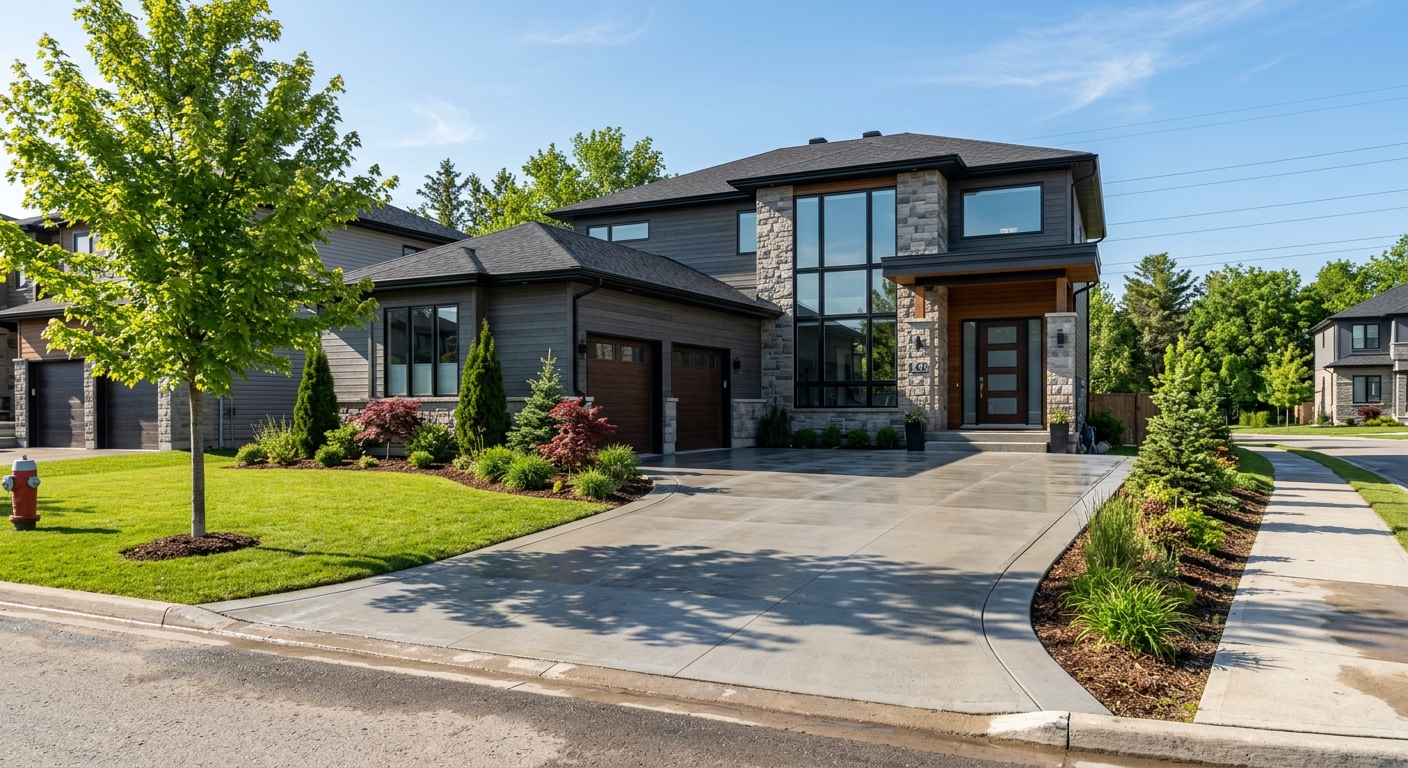
Concrete work options and costs in Salmo
In Salmo, concrete flatwork and structural concrete are mostly driven by the housing that’s already here—many properties are older, and the majority of homes are single-detached. In fact, 71.7% of households in Salmo are owner households, and 71.9% of dwellings are single-detached (Statistics Canada, 2021 Census). That matters because driveways, patios, garage floors, and basement work are the concrete projects most homeowners request year after year.
Pricing in the Kootenays isn’t “one-size-fits-all.” The cold continental winters and frequent freeze–thaw cycles mean contractors have to build in frost protection: footings generally need to be set below local frost depth, exterior slabs typically require air-entrained concrete, and control joints need tight spacing to limit random cracking. Add a shorter pour season and cold-weather curing requirements (blankets, insulation, sometimes temporary heat), and you’ll see why costs in Salmo can land toward the higher end of British Columbia’s price range.
We also see demand spike in established residential areas along Highway 3B, where homeowners often renovate driveways and add patios to improve accessibility and curb appeal. If you’re comparing quotes, the finish choice can be the most visible difference—standard broom finishes are typically the most economical, while exposed aggregate or stamped finishes include extra labour and finishing time. Use the ranges below as a starting point, then we’ll break down what moves the numbers up or down in section two.
| Application |
Typical Size |
Key Spec |
Finish Option |
Price Range |
| Concrete driveway (standard broom finish) |
24’ x 10’ (240 sq ft) |
Air-entrained exterior mix, compaction + base |
Broom finish + control joints |
$4,320 – $6,720 |
| Exposed aggregate driveway |
24’ x 10’ (240 sq ft) |
Air-entrained mix, washed/finished surface |
Exposed aggregate with edging |
$5,280 – $8,160 |
| Stamped concrete driveway or patio |
16’ x 12’ (192 sq ft) |
Air-entrained exterior mix, release agent |
Stamped pattern + sealer |
$4,800 – $7,680 |
| Plain concrete patio or walkway |
12’ x 10’ (120 sq ft) |
Air-entrained exterior mix, compacted base |
Float + broom or light texture |
$1,680 – $2,880 |
| Garage floor (interior slab) |
24’ x 22’ (528 sq ft) |
Interior mix, vapor control optional |
Light broom + curing compound |
$9,504 – $14,784 |
| Foundation footings (structural, below frost) |
Per linear foot equivalent (typ. 4’ wide) |
Excavation, formwork, rebar per engineer |
Structural concrete placement |
$70 – $120 |
Prices are estimates only and vary by project scope, site access and material selection.
What affects the price of concrete work in Salmo
It’s common to see quotes for the “same” concrete job vary by 30–50% across Kootenay communities and other parts of British Columbia. In practice, the difference is rarely just the concrete. It’s site conditions, how deep the frost-protected base needs to be, how much reinforcement is required, and how much time the contractor must spend on proper cold-weather curing and jointing. Even when a driveway is only 200–300 sq ft, the labour and prep can swing the total—especially on older lots where excavation, drainage fixes, or weak subgrade are discovered after forms come out.
In Salmo’s climate, freeze–thaw cycles dictate the specification: exterior slabs are typically air-entrained to survive repeated expansion and contraction. Footings must extend below design frost depth so the soil beneath them doesn’t heave and push the structure unevenly; if you’re using frost protection correctly, your footing depth and form height drive cost the fastest. Cold weather also means a shorter pour season and more protection requirements—blankets, insulation, and sometimes heating enclosures—so contractors plan work differently and price accordingly. De-icing salt accelerates surface scaling, so sealing becomes a “maintenance spec,” not a cosmetic add-on.
Local examples that move the price up or down: a driveway that needs deep over-excavation and granular replacement for a soft clay area can push you toward the higher end (for standard broom-finish concrete, think $18–$28 per sq ft band). A stamped patio with texture and additional finishing and sealing time often lands in the higher decorative range (commonly $25–$40 for stamped work). Finally, because many homes in Salmo are older—65.5% were built before 1981 (Statistics Canada, 2021 Census)—we frequently deal with tighter access, older drainage patterns, and surprises at subgrade, which is where budgets either get protected or get “unplanned.”
| Price Factor |
Why It Matters |
Cost Impact |
| Frost line depth |
Determines footing depth and form height |
Excavation + concrete volume increase significantly |
| Site preparation |
Excavation, grading, and compacted granular base |
More material handling if soil is unsuitable or wet |
| Reinforcement |
Rebar or wire mesh requirement for the slab/loading |
Additional labour + steel costs, especially in larger slabs |
| Mix design |
Air-entrainment and compressive strength spec |
Better durability, but higher-quality materials and placement control |
| Finish type |
Broom vs. stamped vs. exposed aggregate |
Stamped/exposed require extra steps, timing, and sealing |
| Pour size and concrete truck access to site |
Shorter distance helps; tight lots add labour |
Manual wheelbarrowing or multiple trips adds cost |
| Cold-weather curing precautions |
Heating and blankets to maintain proper cure |
Added equipment, energy costs, and scheduling constraints |
| Control joint pattern and sealing cost |
Joints manage shrinkage/movement; sealing protects from de-icing salt |
More saw-cut steps and material lead to a higher, but longer-lasting finish |
Permits & regulations in British Columbia
In British Columbia, structural concrete work—like footings, foundation walls, and grade beams—generally requires a building permit. In many cases, you’ll also need engineered drawings reviewed by the municipality (or the permitting authority involved in the plan review). For concrete flatwork (such as driveways, patios, and walkways), permits are often not required, unless the work affects things like lot grading, drainage, or impervious surface coverage limits, or it touches municipal right-of-way considerations. The safest approach is to confirm in advance with the local authority in Salmo before you pour.
For contractors, verify they carry liability insurance and that they have the required worker coverage under the province’s system (homeowners should see proof before work begins). Then ask for references on similar-scale projects—especially in the Kootenays where freeze–thaw durability matters.
Step-by-step for homeowners: (1) Ask the contractor for a copy of their certificate of liability insurance and review the expiry date; ensure you’re listed appropriately on the certificate if your lawyer/insurer requires it. (2) Confirm they have the current worker coverage clearance letter/status required in BC and that it matches the project location. (3) If the job involves structural components or engineering, confirm the contractor coordinates permit submissions and follows the approved drawings. (4) For workmanship verification, request photos or site visits from a recent driveway or foundation pour.
Getting concrete right in Salmo's freeze-thaw climate
Concrete failures in Salmo usually come down to three things: weak base prep, an incorrect mix for freeze–thaw exposure, and curing problems. With repeated freeze–thaw cycles, water expands in pores and along the interface between concrete and soil. If the concrete isn’t properly air-entrained, that expansion can lead to spalling—small surface breakouts that grow over time. Add de-icing salt and you’ll accelerate scaling, especially on driveways that see winter traffic.
To spec the job correctly, focus on: (1) base preparation—a compacted granular sub-base at the right depth for local soil and frost protection; don’t “save time” by under-excavating. (2) mix design—for exterior flatwork, target air content in the 5–7% range and specify minimum 32 MPa compressive strength (often adjusted based on engineering and exposure). (3) control joints—place them to control shrinkage cracking rather than letting it happen randomly. (4) curing—plan for at least 7 days of proper curing, using insulating blankets or heated enclosures when cold weather slows hydration. (5) sealing—use a penetrating sealer after cure (commonly at 28 days) to help repel de-icing salts.
When comparing options, the extra cost is justified when it buys durability. For example, if a standard broom-finish driveway is priced around the lower end of the local band, you might see a driveway option priced closer to the mid-range (roughly $18–$28 per sq ft). Switching to stamped may add labour and finishing time, but the price premium is only worth it if the contractor still delivers the same frost-safe base, correct air entrainment, and proper jointing. Ask how they’ll prevent spalling—not just how the surface will look.
| Spec |
Why It Matters in Salmo |
What to Ask For |
Impact if Skipped |
| Compacted granular base (depth?) |
Reduces settlement and protects against frost-related movement |
Specified excavation depth, granular replacement and compaction testing |
Uneven cracking, heaving, and premature driveway failure |
| Air-entrained concrete mix (target air %?) |
Durability through freeze–thaw cycles |
Target 5–7% air for exterior flatwork |
Spalling and scaling during winter freeze–thaw exposure |
| Compressive strength (MPa rating) |
Ensures concrete can resist traffic and weathering |
Minimum 32 MPa (confirm for your exposure class) |
Surface wear, cracking, and lower long-term performance |
| Control joints (spacing per ACI guidelines) |
Controls shrinkage cracks to predictable locations |
Joint layout plan and spacing per relevant ACI guidance |
Random cracking across visible areas |
| Minimum 7-day curing period |
Cold weather can slow hydration and weaken early strength |
At least 7 days, with blankets/heating if temps drop |
Low early strength, cracking, and scaling risk increases |
| Penetrating sealer (when applied after cure) |
Helps resist de-icing salt intrusion |
Apply after cure—commonly around 28 days |
More salt damage and faster surface deterioration |
How to choose a concrete work contractor in Salmo
Start by verifying BC coverage and responsibility. In British Columbia, you should be able to request and review (1) a certificate of liability insurance, (2) worker coverage status/clearance required for the province, and (3) any relevant business information such as proof they’re set up to contract for the work they’re proposing. Ask your contractor directly for documents before they schedule—don’t wait until the day of the pour. For the insurance certificate, look for the effective/expiry dates and confirm the project address is correctly identified where applicable. For worker coverage, request proof that’s current; if the contractor can’t produce it, that’s a major warning sign.
Next, get 2–3 itemised quotes—not just a lump sum. You want a breakdown that shows labour, concrete, base/grading, excavation, disposal, reinforcement, finishing, and sealing (if included). Confirm whether a permit is required for your scope (structural concrete usually is) and whether permit fees or engineering coordination are included or extra. Also ask about where curing blankets/heating are included for cold weather scheduling—this is where the Kootenay difference can affect total cost.
Warranty matters: ask for a workmanship warranty length, whether it covers cracking/spalling, and whether the product/manufacturer warranty is transferable if you sell the house. Finally, payment should be controlled. In my experience, never pay more than about 10–15% upfront; hold back until the work is complete and documented. Get a start date and completion estimate in writing, including weather-related contingencies.
- Provide proof of liability insurance before scheduling
- Provide current worker coverage proof/status required in BC
- Quote is itemised (base, disposal, steel, finishing, sealing)
- Clarify exclusions: removal of old concrete, drainage repairs, saw-cutting
- Confirm whether permits (if needed) are included
- Ask for reinforcement details (mesh vs rebar, slab thickness)
- Verify air-entrained mix and exterior spec targets
- Discuss cold-weather plan: blankets/heating if temps drop
- Require a control joint plan (spacing and pattern)
- Ask how they’ll protect fresh concrete from saturation in wet periods
- Get a written timeline and weather contingency plan
- Use a payment schedule with a holdback until final inspection
Concrete red flags in Salmo: contractors who won’t discuss air entrainment or joint layout, quotes that omit base preparation depth and compaction, crews that want full payment before finishing, “too-good-to-be-true” pricing on stamped work without extra finishing steps, and no clear plan for cold-weather curing when frost season approaches.
Frequently asked questions — concrete work in Salmo
How much does concrete work cost in Salmo?
In Salmo, most homeowners are shopping for driveway or patio flatwork, and pricing depends heavily on prep and the finish. For a standard concrete driveway with a broom finish, local project bands commonly land around $18 – $28 per sq ft (as a typical city-tier guideline), so a 240 sq ft driveway often comes out to roughly $4,320 – $6,720. A plain walkway or patio is often less—depending on size and base conditions—but stamped or exposed finishes add labour and finishing steps. Because Kootenay winters bring freeze–thaw cycles, proper air-entrainment and curing precautions can also move costs up or down compared with “low-bid” quotes. If your lot has soft soil or drainage issues, site preparation is usually where the biggest swing happens.
How deep must footings be for Salmo's frost line?
Footing depth is determined by design frost depth and engineering/municipal requirements, not guesswork. In British Columbia’s interior and Kootenays, frost protection is a serious spec because freeze–thaw can heave soil and crack foundations. Practically, contractors set footings below the design frost depth and build form height accordingly; if a contractor proposes shallow footings, that’s not a durability plan. For structural work (footings, foundation walls, grade beams), you’ll typically see drawings or permitting involvement that specify the required depth and reinforcement. The best homeowner approach in Salmo is to ensure the contractor follows approved engineering and can explain how their footing depth matches the frost design for the site conditions.
Why does concrete crack in Salmo and how is it prevented?
Concrete cracks for reasons that are predictable: shrinkage, thermal movement, and base movement. In Salmo, freeze–thaw and moisture are the triggers that turn small issues into visible damage. Random cracking often happens when control joints aren’t placed correctly or too late, and spalling can occur when air-entrainment isn’t right for exterior exposure. Prevention is spec-based: proper sub-base excavation and compaction, an exterior air-entrained mix (typically 5–7% air), and a control joint pattern designed to manage shrinkage. Cold-weather curing matters too—if hydration slows, early strength is weaker and cracking risk rises. Finally, sealing after cure helps reduce de-icing salt intrusion, which helps protect surfaces through winter.
Stamped vs broom-finish concrete — cost difference?
Stamped concrete costs more than broom finish mainly because it requires extra finishing steps: release agent, stamping timing, and often more detailed curing and sealing. In Salmo’s Kootenay climate, the underlying durability requirements are still the same—air-entrainment, correct base prep, proper jointing, and proper cure—so a “cheap stamp” quote can be misleading if it cuts corners on those basics. As a practical reference, standard driveway work often fits the local concrete flatwork band (commonly $18 – $28 per sq ft for driveway tier guidance), while stamped concrete is usually priced higher—often aligned with the decorative band around $25 – $40 for stamped & decorative work. The best value is when the contractor’s approach keeps the durability specs intact, not just the surface appearance.
When is the best time to pour concrete in Salmo?
The best time is when temperatures support strong early curing without excessive protection. In British Columbia’s interior and the Kootenays, winter weather can shorten the pour season and increase cost because contractors may need insulation blankets or heating enclosures to keep concrete curing properly. For homeowners in Salmo, late spring through early fall is generally easier for schedule reliability and curing control. That said, a capable contractor can pour in colder periods if they have a written cold-weather plan: heating where needed, insulating blankets to maintain curing temperatures, and protected curing time. The real test is how they plan for daily temperature swings and precipitation so the surface isn’t exposed to saturation or rapid freeze while still green.
How long does concrete take to cure?
Concrete “sets” quickly, but curing for strength and durability takes longer. For exterior flatwork in Salmo, contractors should plan for at least a 7-day curing period under proper conditions, and then allow additional time to reach full performance. If the job includes sealing, many contractors apply penetrating sealer after cure—commonly around 28 days—so the concrete has stabilized and can best resist de-icing salt intrusion. In cold weather, curing can slow significantly, which is why blankets or heating may be necessary. A good contractor will include curing protection in the scope and won’t push traffic or vehicle loads before the concrete has reached appropriate strength.