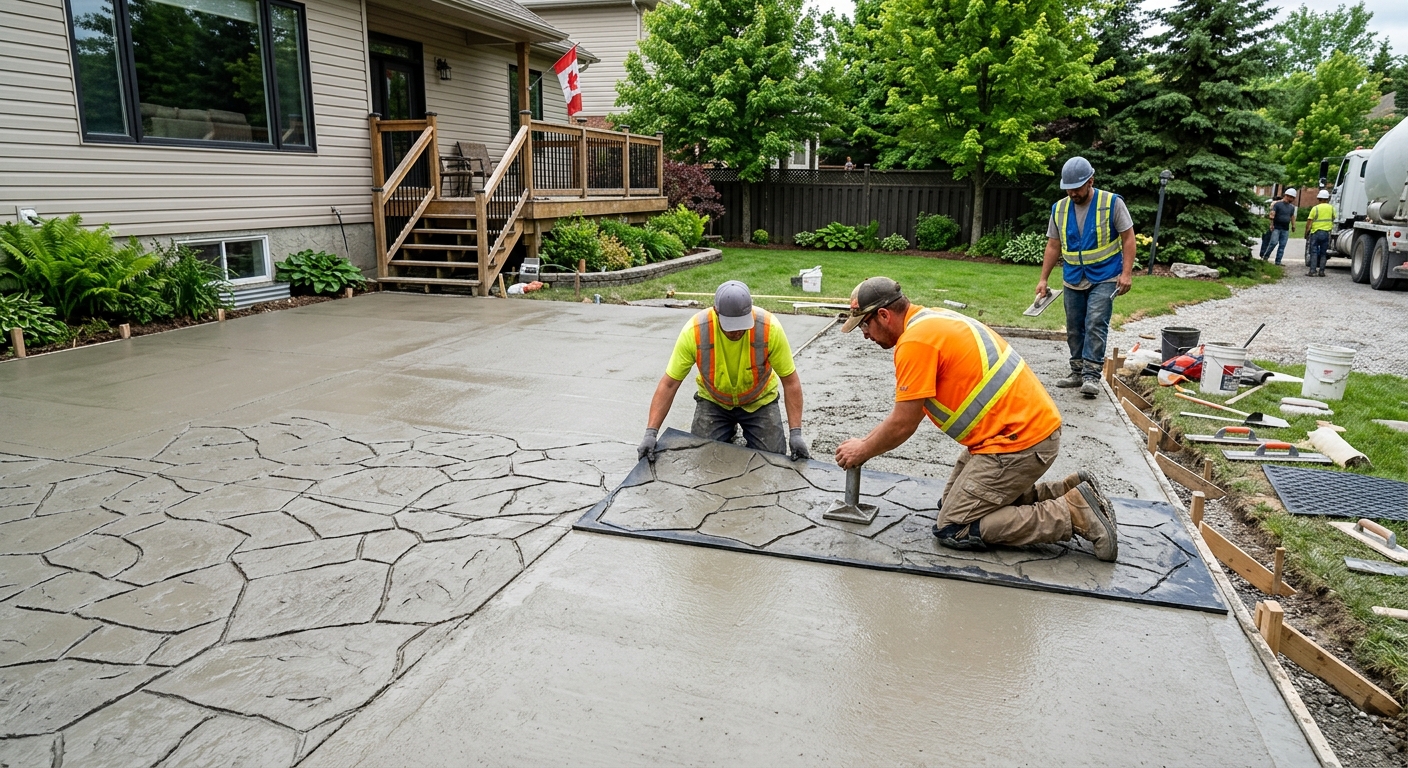
Concrete work options and costs in Saanich Core
Saanich Core, British Columbia is a very practical market for homeowners when it comes to concrete flatwork—close to the ocean, with relatively shallow frost and frequent wetting and cooling. With a population of 5,470 (Statistics Canada, 2021 Census), the area supports steady demand for driveways, patios and walkways from the many single-detached homes that dominate local streets and cul-de-sacs. The Vancouver Island and Coast climate band also means contractors stay busy in neighbourhood pockets like Tillicum and Gorge area where renovations, garage builds and landscaping updates commonly go hand-in-hand with new concrete.
Pricing here is shaped by freeze–thaw cycles more than harsh cold. Even when the air doesn’t get extremely low, repeated temperature swings plus damp soil can stress poorly prepared bases and mixes. That’s why exterior slabs need air-entrained concrete and why footings are designed to sit below the local design frost depth to reduce heave and random cracking. The other cost reality is logistics: rainy periods can slow excavation and curing, and saturated sites sometimes need granular base remediation before concrete gets placed. On top of that, decorative finishes (stamped and exposed aggregate) require more labour, tighter curing protection, and skilled finishing to achieve consistent texture.
Below are realistic budget ranges for common concrete projects in Saanich Core. Use them as a starting point before you compare itemized quotes table-by-table.
| Application |
Typical Size |
Key Spec |
Finish Option |
Price Range |
| Concrete driveway (standard broom finish) |
400–600 sq. ft. |
Air-entrained mix; compacted base; control joints |
Broom finish |
$6,400–$14,000 |
| Exposed aggregate driveway |
400–600 sq. ft. |
Air-entrained mix; washed finish; curing protection |
Exposed aggregate |
$10,000–$18,500 |
| Stamped concrete driveway or patio |
300–500 sq. ft. |
Air-entrained mix; colour hardeners; release agent |
Stamped pattern |
$7,000–$16,500 |
| Plain concrete patio or walkway |
200–400 sq. ft. |
Compacted base; proper slope/drainage; joints |
Plain trowel/broom |
$2,800–$8,800 |
| Garage floor (interior slab) |
400–600 sq. ft. |
Vapour barrier; reinforcement as required; saw-cut joints |
Float/smooth finish |
$7,200–$14,500 |
| Foundation footings (structural, below frost) |
Varies by home layout |
Excavation; forms; rebar; concrete below frost |
Structural concrete (not decorative) |
$8,000–$22,000 |
Prices are estimates only and vary by project scope, site access and material selection.
What affects the price of concrete work in Saanich Core
In Saanich Core and across the wider Vancouver Island and Coast region, it’s common to see the same “type” of job price move by 30–50% between quotes. The biggest driver isn’t just concrete—it’s everything around the concrete: how deep the base must be, how much excavation is required, whether reinforcement is needed, and what weather protections the contractor plans during curing. Labour availability also matters in peak seasons when crews are balancing driveways, patios and foundation crews across Victoria and the Saanich area.
Practically, frost line depth and freeze–thaw cycles dictate your entire spec. In coastal BC, local design commonly assumes frost depths in the ballpark of 0.5–1.2 m, and exterior slabs and footings must extend below the design frost depth to limit heave and cracking. For exterior flatwork, air-entrained concrete is non-negotiable to survive repeated wetting and freezing; this is part of why exterior costs sit in the typical bands of $16–$25 per sq. ft. for driveways and $14–$22 per sq. ft. for patios/walkways. If a contractor cuts corners on mix design, you may get short-term savings that show up later as scaling or spalling.
Cold-weather curing also adds real cost. While our winters are milder than interior BC, cool, damp conditions can slow strength gain, so crews may need insulating blankets, curing compounds, and scheduled protection—especially for larger slabs. De-icing salts accelerate surface damage, so sealing is often recommended once the concrete is fully cured (typically 28 days after pour).
Two common examples in Saanich Core: if your subgrade is soft and requires thicker granular base, prices rise quickly; if your site access allows a short chute and easy truck parking, labour and pump/placement costs stay lower. If you’re comparing a plain walkway at roughly $14–$22 per sq. ft. versus a stamped finish that can land in the $22–$35 per sq. ft. range, the difference is usually justified by labour intensity (forms and finishing) rather than by the concrete alone.
| Price Factor |
Why It Matters |
Cost Impact |
| Frost line depth — determines footing depth and form height |
Footings must sit below frost to reduce heave |
Can swing foundation/footing costs materially (often the largest driver) |
| Site preparation — excavation, grading, compacted granular base |
Stable subgrade prevents settlement and cracking |
Higher where soil is wet/soft; lower with easy access and known fill conditions |
| Reinforcement — rebar or wire mesh requirement |
Controls cracking and improves structural performance |
Adds material and labour; required for heavier loads and some slabs/walls |
| Mix design — air-entrainment and compressive strength spec |
Freeze–thaw durability and strength gain |
Small per-cubic-yard cost, but big value; omitting can cause early failure |
| Finish type — broom vs. stamped vs. exposed aggregate |
Labour intensity and curing/finishing steps |
Decorative work typically increases price per sq. ft. |
| Pour size and concrete truck access to site |
Placement speed and concrete delivery constraints |
Pump/extra labour can add cost if access is tight |
| Cold-weather curing precautions — heating and blankets |
Protects concrete while it gains strength in cool/damp conditions |
Adds staging materials and labour time during cold snaps |
| Control joint pattern and sealing cost |
Joints manage shrinkage cracking; sealing protects surfaces |
Typically modest but essential for exterior longevity |
Permits & regulations in British Columbia
In British Columbia, structural concrete work typically needs a building permit and often engineered drawings reviewed by the municipality. That usually includes foundations and structural elements such as footings, foundation walls, grade beams and other load-bearing concrete. If your project involves something more than cosmetic flatwork—especially where it affects the structure, basement areas, or building load paths—assume you’ll need a permit.
Concrete flatwork such as patios, walkways and driveways usually does not require a permit by default. However, permits or approvals can become necessary when the work affects lot grading, drainage, or impervious surface coverage limits, or if it impacts the municipal right-of-way (for example, work close to a curb cut or drainage tie-in). Because each lot is different in Saanich Core, it’s smart to confirm requirements with the local authority before breaking ground.
Step-by-step, here’s how a homeowner in Saanich Core verifies a contractor’s credibility in British Columbia:
- Request the contractor’s business identification details and confirm they’re legally able to carry out the work (based on the scope and whether structural trades are involved).
- Ask for a certificate of insurance showing liability coverage—verify dates and that it aligns with your project start date.
- Confirm workers’ coverage (WCB) so the crew is properly covered for on-site work.
- Ask for references on similar-scale local jobs (driveways/patios and, if relevant, foundation work).
- Make sure the quote states who pulls the permit (if a permit is required) and what’s included in demolition/disposal.
Getting concrete right in Saanich Core's freeze-thaw climate
Concrete failures in Saanich Core are usually about durability, not just appearance. Freeze–thaw cycles combined with damp soils can push moisture into the slab. When the concrete isn’t properly air-entrained, or when the base isn’t compacted and well-drained, you get surface scaling and sometimes spalling—especially near joints, edges and low spots where water sits.
To spec the job correctly, start with (1) base preparation: excavation to the correct depth, compacted granular sub-base, and drainage considerations so water doesn’t pond. Next (2) mix design: for exterior flatwork, target air-entrainment around 5–7% with minimum 32 MPa compressive strength, ensuring it meets local durability expectations for freeze–thaw exposure. (3) Control joints are essential; they create planned crack locations so shrinkage cracking doesn’t become random. (4) Curing: plan for a minimum 7-day curing period under appropriate conditions, with additional protection in cool weather—blankets and curing measures often decide whether the surface finishes look good and stay stable. Finally (5) sealing: apply a penetrating sealer after full cure (commonly at 28 days) to repel de-icing salts and reduce water absorption.
When you’re comparing options, ask what you’re actually paying for. For example, if a stamped patio is priced at roughly $22–$35 per sq. ft. versus a plain patio in the $14–$22 per sq. ft. band, the premium can be justified if the contractor includes the full durability package: correct air-entrained mix, proper joints, and protection during curing—not just decorative labour. The goal is a slab that doesn’t deteriorate under Vancouver Island and Coast moisture and temperature swings.
Use these questions to protect yourself: “What air content are you using for exterior freeze–thaw exposure?”, “How deep is the compacted base?”, “What’s your control joint spacing plan?”, and “What curing and sealing timeline will you follow for Saanich Core conditions?”
| Spec |
Why It Matters in Saanich Core |
What to Ask For |
Impact if Skipped |
| Compacted granular base (depth?) |
Stable, drained support limits heave and settlement |
Compaction method and granular depth based on site soils |
Cracking, uneven slabs, edge failure |
| Air-entrained concrete mix (target air %?) |
Freeze–thaw durability depends on entrained air |
Confirm exterior mix with target 5–7% air content |
Scaling and spalling in wet/cold periods |
| Compressive strength (MPa rating) |
Strength gain supports long-term performance |
Minimum 32 MPa compressive strength spec |
Surface wear, premature failure and poor durability |
| Control joints (spacing per ACI guidelines) |
Controls shrinkage cracking location |
Planned joint layout and spacing per industry guidance |
Random cracks and wider crack growth |
| Minimum 7-day curing period |
Cool, saturated conditions slow strength development |
Curing plan and protection steps during cool weather |
Surface damage, reduced strength and scaling |
| Penetrating sealer (when applied after cure) |
Helps repel water and de-icing chemical exposure |
Application at/after full cure (commonly 28 days) |
Increased water absorption and faster surface deterioration |
How to choose a concrete work contractor in Saanich Core
Start with the essentials: licensing/eligibility for the scope, liability insurance, and workers’ coverage in British Columbia. Ask for a certificate of insurance and confirm the policy is active for your project dates; if the contractor provides a certificate that doesn’t cover the actual timeline, treat it as a warning sign. For workers’ coverage, ask whether they’re registered and covered for jobsites through the appropriate system—this matters for your protection as a homeowner. If your project includes structural elements like foundation footings, insist on evidence that the contractor is properly set up for that scope and review process.
Next, get 2–3 itemized written quotes, not just a lump sum. A good quote breaks labour and materials out so you can see what’s included: excavation, disposal, granular base, reinforcement (rebar and/or mesh), concrete supply, finishing, saw-cut/joint plan, curing protection, and sealing (if included). Make sure you understand what’s excluded (for example, rock removal, unforeseen subgrade remediation, or pump access if the truck can’t reach). Ask whether the contractor includes permit pulling where required for structural concrete, and confirm whether drainage tie-ins are part of the scope.
Warranty should be specific: a workmanship warranty length, what it covers (cracks controlled by joints vs. random cracking), and whether the warranty is tied to proper curing and maintenance. Payment schedules also matter—never pay more than about 10–15% upfront, and hold back a portion until the work is complete and cleaned. Finally, request a written start date and completion estimate, especially because Saanich Core schedules can shift with rainy stretches and cold snaps.
- Ask for proof of current liability insurance and confirm dates
- Confirm workers’ coverage for the crew on your jobsite
- Require at least 2–3 recent references from similar Saanich Core conditions
- Get itemized quotes (labour + materials) rather than one lump price
- Clarify inclusions: excavation, disposal, granular base, reinforcement
- Confirm finish spec: broom, trowel, stamped system or exposed aggregate process
- Ask for joint plan: location and spacing, plus sealing plan
- Review curing/protection steps for cool, rainy weather
- Ask whether sealing is included or an add-on (and when it’s applied)
- Make sure the quote includes site protection, forms, and edge details
- Verify payment schedule: avoid large upfront deposits
- Get start date and completion timeline in writing
Concrete red flags in Saanich Core: quotes that don’t mention air-entrainment or joints, “too-good-to-be-true” pricing that omits granular base remediation, no clear curing plan for cool/cold snaps, vague scope about disposal and grading, and contracts that ask for large upfront payments with limited workmanship warranty detail.
Frequently asked questions — concrete work in Saanich Core
What is rebar and when is it required in British Columbia?
Rebar (reinforcing steel) is used to strengthen concrete where loads or cracking risk are higher. In British Columbia, whether reinforcement is required depends on engineered design, slab thickness, soil conditions, and the concrete application. For typical exterior flatwork like driveways and walkways in Saanich Core, many slabs use reinforcement (often wire mesh or rebar) based on thickness, reinforcement cover, and expected loads. For foundation footings and structural foundation elements, reinforcement is generally required and must be installed as per engineered drawings and local building requirements. The practical takeaway: a proper quote should state what reinforcement is being used, the placement (on chairs/spacers), and the coverage—especially because freeze–thaw cycles can widen cracks that start small.
How long does a concrete project take in Saanich Core?
In Saanich Core, the timeline is usually “pour day” plus curing and protection time. For patios and walkways, the scheduling is often a few days from prep to finished surface, but homeowners should plan for at least a week before heavy use because concrete needs proper curing conditions. Driveways can take longer due to excavation, forms, grading, drainage details, and finishing steps; decorative work like stamping can add time for pattern layout and curing protection. Even if the pour is fast, rain and cool temperatures can extend the schedule because crews may need blankets or delayed follow-up steps. If you’re choosing between a plain patio budget (often in the $14–$22 per sq. ft. band) and a stamped option (commonly priced higher in the $22–$35 per sq. ft. range), factor in extra finishing and careful curing to protect the final texture and colour.
What is a concrete overlay and is it suited to Saanich Core?
A concrete overlay is a new layer poured over an existing slab after assessment and surface preparation (often grinding and patching), usually to restore a worn surface or change appearance without full replacement. In Saanich Core, overlays can work when the existing slab is structurally sound—no major settlement, no deep spalling, and the base remains stable. However, overlays are not a fix for ongoing freeze–thaw deterioration caused by trapped water, poor base drainage, or failed bonding. If the original slab is already scaling or has widespread cracking, full removal and re-pour is often the more durable solution. Overlays also vary in cost and performance, so your contractor should explain the prep process, bonding method, thickness, and joint strategy. If your existing surface issues are related to freeze–thaw exposure, durability-focused specs are more important than chasing lowest price.
How do I seal concrete to protect it in Saanich Core?
Sealing in Saanich Core is about reducing water absorption so freeze–thaw cycling doesn’t keep feeding moisture into the concrete. The key is timing: apply penetrating sealer after the concrete is fully cured—often at 28 days post-pour. Before sealing, the surface should be clean, dry, and free of dust, curing residue, and debris. If you’re in a snow/ice management cycle, remind the contractor about de-icing salt exposure because salts accelerate surface damage on unsealed exterior concrete. When you get a quote, ask whether sealing is included and which sealer type is planned (penetrating vs. film-forming). Also ask whether they’ll protect surfaces from overspray during application. Done correctly, sealing can help extend the life of both plain and decorative finishes.
What is the difference between concrete and cement?
Cement is one ingredient; concrete is the finished material. Cement is the binder that reacts with water to create strength. Concrete is cement combined with aggregates (sand and gravel/crushed stone), water, and often admixtures such as air-entrainment for durability. In British Columbia’s Vancouver Island and Coast climate—where wetting and freeze–thaw cycles are common even in milder winters—air-entrainment is a major performance spec for exterior slabs. That’s why a quote should refer to the concrete mix design (air content and compressive strength), not just the word “cement.” For a homeowner, the important difference shows up in outcomes: the right mix for freeze–thaw exposure helps reduce scaling and spalling, especially on driveways and walkways exposed to moisture and de-icing chemicals.
How much does concrete work cost in Saanich Core?
Concrete costs in Saanich Core depend on size, excavation complexity, reinforcement requirements, finish level, and weather protection during curing. As a practical reference, typical driveway concrete in this region often falls in the $16–$25 per sq. ft. band, while patio and walkway concrete is commonly $14–$22 per sq. ft. Decorative work can increase pricing; stamped concrete is often in the $22–$35 per sq. ft. range depending on pattern complexity and finishing steps. Foundation footings are budgeted differently than flatwork—structural footing pricing is commonly quoted in the $50–$90 per unit of forming/excavation scope depending on how deep and how complex the excavation is. Your final number should be supported by an itemized quote: granular base, reinforcement, mix spec, control joints, and curing/sealing inclusions. If you’d like, share your approximate dimensions and whether it’s driveway, patio, or footings, and I can help estimate what band your project likely lands in.