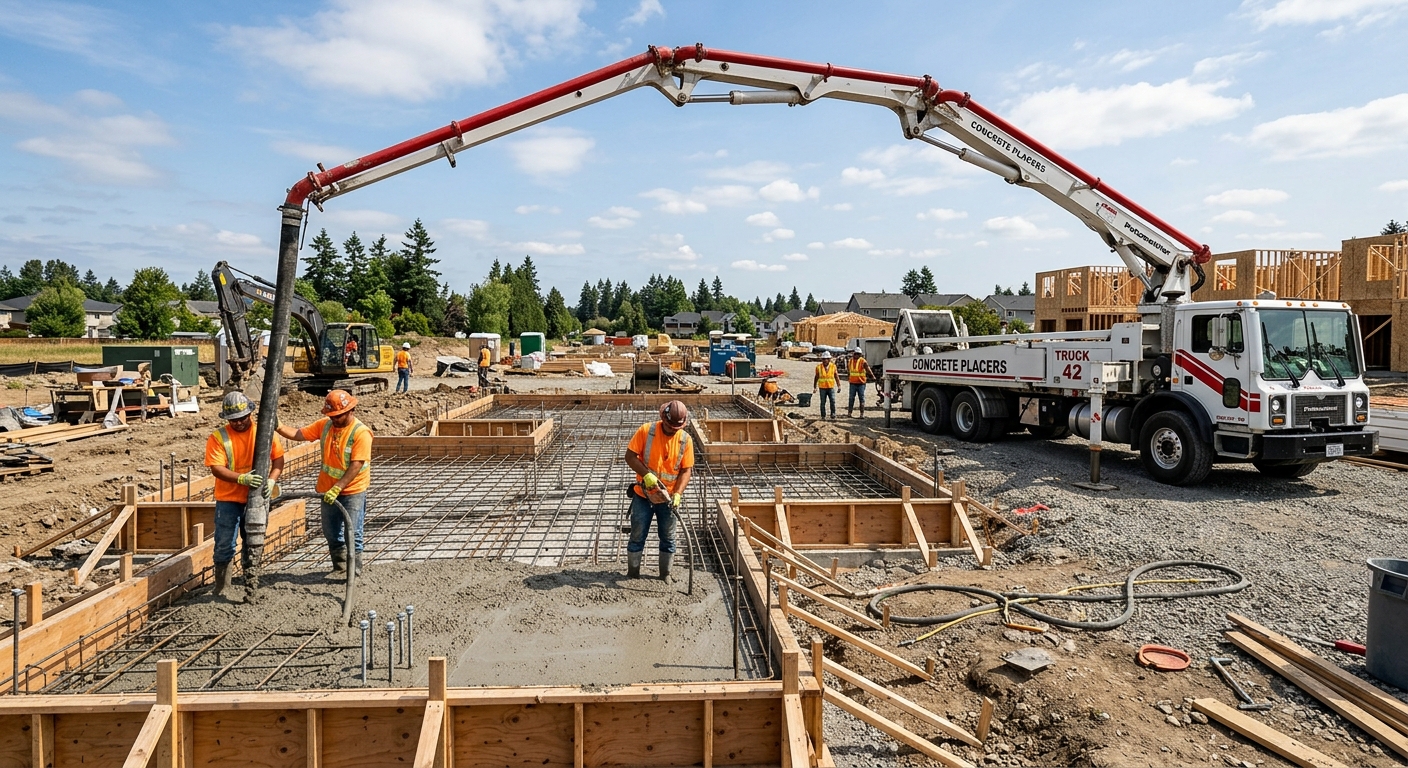
Concrete work options and costs in Willingdon Heights
In Willingdon Heights, concrete flatwork is one of the most common upgrades on owner-operated homes and renovations, especially where families want low-maintenance surfaces that stand up to Lower Mainland–Southwest rain and freeze–thaw cycling. With a population of 12,443 (Statistics Canada, 2021 Census), the local demand is steady, and that matters for scheduling—good crews get booked faster in peak dry windows. The market here also leans heavily toward detached housing stock, so driveways, patios, and entry walkways are frequent “first calls” when people update curb appeal or replace aging asphalt.
Pricing is shaped by our coastal-wet climate and a shallow but real frost depth. Local practice typically designs footings and thickened edges to sit below an assumed frost depth around 450 mm / 18" to reduce frost heave risk. That means base prep, drainage attention, and air-entrained mixes are not optional on exterior work. Rainy stretches can also slow production because concrete must be protected from surface drying and temperature drops during early curing.
In Willingdon Heights, you’ll often see the highest demand for driveway replacement and patio work around the more established residential pockets near Government Road and the surrounding local streets, where lot access, existing landscaping, and drainage details vary from home to home. That’s why your contractor’s site assessment drives the final number.
Use the table below to compare typical scopes and price ranges, then we’ll break down the biggest cost drivers that create the swings between bids.
| Application |
Typical Size |
Key Spec |
Finish Option |
Price Range |
| Concrete driveway (standard broom finish) |
400 sq ft (about 20' x 20') |
4" slab, compacted base, air-entrained concrete, control joints |
Broom finish |
$8,000–$11,200 |
| Exposed aggregate driveway |
400 sq ft (about 20' x 20') |
4" slab, compacted base, air-entrainment, proper drainage |
Exposed aggregate (washed) |
$10,000–$14,400 |
| Stamped concrete driveway or patio |
300 sq ft (about 15' x 20') |
4" slab, air-entrained mix, integral color, release/dry-shake options |
Stamped patterns (stone/brick/wood look) |
$9,000–$13,500 |
| Plain concrete patio or walkway |
200 sq ft (about 10' x 20') |
4" slab, compacted base, control joints |
Smooth/plain or light broom |
$3,200–$5,200 |
| Garage floor (interior slab) |
240 sq ft (about 20' x 12') |
4" slab, vapour retarder if required, reinforced where needed |
Power-trowel finish (standard) |
$6,000–$9,600 |
| Foundation footings (structural, below frost) |
Typical home footing budget |
Below-frost excavation, reinforced concrete, engineered plan |
Structural concrete only (no decorative finish) |
$9,000–$17,000 |
Prices are estimates only and vary by project scope, site access and material selection.
What affects the price of concrete work in Willingdon Heights
In the Lower Mainland–Southwest, it’s not unusual to see quotes for the “same” concrete driveway differ by 30–50%. The reasons are usually technical and site-driven: some bids include proper drainage and granular base depth, while others cut corners; some include air-entrained mix design and the right joint layout; and some plan concrete truck timing and curing protection for wet weather. Because Willingdon Heights sits within the same broader Vancouver–Surrey–Abbotsford pricing climate, the best comparables come from contractors who build to the same specs.
Frost line depth and freeze–thaw cycles dictate every exterior specification. Even though Lower Mainland–Southwest frost is relatively shallow (often designed around a ~450 mm / 18" design frost depth), exterior footings and thickened edges still need to be placed below that level to avoid frost heave. Air-entrained concrete is essential for slabs exposed to wetting and drying. In colder parts of BC and across Canada, contractors also face a shorter pour season and cold-weather curing precautions—blankets, temperature monitoring, and sometimes heating—raising costs. Locally, coastal rainfall and cool nights can be enough to require extra curing care so the slab reaches design strength and durability.
Two quick examples from typical Willingdon Heights jobs: (1) If the driveway ties into existing stonework or needs a proper transition and regrading for water runoff, excavation and forming time can add hundreds to the total; and (2) moving from a broom finish to stamped concrete can add labour and tooling, but if your goal is curb appeal, the added cost can be justified—stamped concrete is commonly priced in the desktop range of $22–$36 per sq ft in this tier. By comparison, a standard concrete driveway typically lands in the $18–$28 per sq ft range when base prep and air-entrainment are correctly included.
| Price Factor |
Why It Matters |
Cost Impact |
| Frost line depth — determines footing depth and form height |
Footings and exterior thickened edges must sit below the design frost depth to limit frost heave |
Can raise excavation/forming cost if the site has poor drainage or high water table |
| Site preparation — excavation, grading, compacted granular base |
Concrete performance depends on the subgrade being stable and drained, especially with coastal rainfall |
Missing granular depth or under-compaction can cut cost short-term but increases failure risk |
| Reinforcement — rebar or wire mesh requirement |
Controls cracking and improves load capacity where needed (driveways, garage floors, some patios) |
Higher rebar labour/material if required by the slab design or anticipated loads |
| Mix design — air-entrainment and compressive strength spec |
Air-entrainment manages freeze–thaw scaling; specified strength supports long-term durability |
Proper mix typically adds a modest material cost but reduces spalling/scaling call-backs |
| Finish type — broom vs. stamped vs. exposed aggregate |
Finishes require different processes, labour time, and materials (colour hardeners/release/wash) |
Stamped/exposed finishes often cost more per sq ft than standard broom |
| Pour size and concrete truck access to site |
Smaller pours and difficult access increase handling time and may require extra crew |
Limited access can add hourly labour and additional logistics |
| Cold-weather curing precautions — heating and blankets |
Cool nights and humidity slow curing; protection helps achieve design strength and surface quality |
Can add labour/material cost during shoulder seasons |
| Control joint pattern and sealing cost |
Joint spacing reduces random cracking; sealing improves stain resistance and helps manage salt exposure |
Well-detailed jointing/sealer is usually a small cost compared to repairs |
Permits & regulations in British Columbia
In British Columbia, many concrete projects are straightforward, but the permitting rule depends on what you’re building and how it affects the structure and lot servicing. Structural concrete work—such as footings, foundation walls, grade beams, and other load-bearing foundation elements—requires a building permit, and engineered drawings are commonly reviewed by the municipality. For concrete flatwork (driveways, patios, and walkways), permits often aren’t required by default, but they may be required if the work affects lot grading, stormwater drainage, impervious surface limits, or the municipal right-of-way near the curb/sidewalk.
For a Willingdon Heights homeowner, the practical step is to confirm with your local authority before excavation, especially if you’re changing drainage routes or modifying curbside areas. Also verify your contractor is properly insured: ask for liability insurance and confirmation they carry the required workplace coverage (WSB/WCB coverage where applicable) so you’re not exposed if something goes wrong on site.
To check credentials step-by-step, request the contractor’s documentation before scheduling: (1) look up their BC business or contractor credentials via the province’s online registry; (2) review the certificate of insurance for active coverage and matching business name; and (3) ask for a clearance letter/coverage proof relevant to their workers. Finally, confirm they can provide references on similar-scale projects in your area and explain how they handle drainage, air-entrainment, and curing in wet weather.
Getting concrete right in Willingdon Heights's freeze-thaw climate
Concrete failures in Willingdon Heights are usually about water and temperature—rain saturates soil, freeze–thaw cycles expand and contract moisture within the slab and sub-base, and salts from traction products can worsen surface spalling if the mix and curing aren’t right. The way to spec the job is to treat it as a system: base prep, correct air content, joints, curing, and sealing. If any one part is weak, you’ll often see cracking patterns you didn’t expect, scaling at the surface, or uneven settlement at the edges.
Start with (1) base preparation: compacted granular sub-base to the right depth for local soil and the frost-related design assumptions. (2) Use a mix design with air-entrainment—exterior flatwork commonly targets about 5–7% air content—plus minimum 32 MPa compressive strength, so the paste resists freeze–thaw damage. (3) Add control joints to limit random cracking; the joint pattern should match the slab layout and the shrinkage behaviour of the pour. (4) Curing matters: plan for at least 7 days of proper curing conditions. In cold or damp stretches, contractors may use curing blankets and temperature monitoring so you reach design strength rather than “looking set” too early. (5) Apply a penetrating sealer only after full cure (often around 28 days) to help repel moisture and manage de-icing salt impact.
That’s how you avoid the most common technical mistake: inadequate air-entrainment. A homeowner might see a lower line item price on paper, but if the mix isn’t right, you pay later for grinding, patching, or full replacement. As a budget example, moving from a basic broom driveway to an exposed aggregate or stamped system can change pricing by several thousand dollars—often justified when you want enhanced durability and appearance—but only if the base and air-entrained mix are included from the start.
| Spec |
Why It Matters in Willingdon Heights |
What to Ask For |
Impact if Skipped |
| Compacted granular base (depth?) |
Stable support reduces settlement and helps drainage during coastal rainfall and wet periods |
Granular depth and compaction method based on your soil and slab thickness |
Edge settling, cracking, and water pooling that accelerates freeze–thaw wear |
| Air-entrained concrete mix (target air %?) |
Freeze–thaw scaling control is critical in Willingdon Heights’s wet/cool cycles |
Target air content (commonly 5–7% for exterior flatwork) and mix documentation |
Surface scaling/spalling even if the slab “looks fine” initially |
| Compressive strength (MPa rating) |
Ensures the slab reaches the durability and load capacity needed over time |
Minimum 32 MPa rating for typical exterior flatwork scopes |
Reduced strength gain, higher cracking risk, and faster surface deterioration |
| Control joints (spacing per ACI guidelines) |
Manages shrinkage cracking so cracks occur where planned, not randomly |
Planned joint spacing and layout matching slab dimensions and traffic areas |
Random cracking, trip hazards, and more difficult long-term patching |
| Minimum 7-day curing period |
Curing quality controls strength development in cool, humid, or rainy conditions |
How they protect the pour (blankets/sealer-on-delay) during your expected weather window |
Weak surface, dusting, reduced durability, and higher long-term maintenance |
| Penetrating sealer (when applied after cure) |
Helps repel moisture and reduces damage potential from wetting and salt exposure |
Penetrating sealer plan applied after cure (often around 28 days), with product choice |
More staining, faster surface wear, and increased vulnerability to moisture-driven damage |
How to choose a concrete work contractor in Willingdon Heights
Choosing the right contractor in Willingdon Heights comes down to proof: proof they can build the spec you want, proof they’re insured for the work they perform, and proof they’ll stand behind the finish. Start by verifying British Columbia credentials: confirm their registration/licence information via the provincial online registry. Next, request liability insurance documents in your name/business match and confirm active coverage. For labour-side protection, ask for proof of workplace coverage (WSB/WCB coverage where applicable) so you’re not left holding the risk if a worker is injured. If they hesitate or can’t produce documentation promptly, treat that as a serious warning.
Then get 2–3 itemised quotes—ideally with a breakdown of labour and materials, not just a single lump sum. Make sure the scope is comparable: excavation depth, whether granular base is included and to what thickness, reinforcement type (mesh vs rebar), joint plan, thickness, finish type, and curing/blanketing. Clarify exclusions: is demo and disposal included? Is hauling accounted for? Is there a permit pull included where required for structural work?
Quality should show up in warranty terms. Ask for workmanship warranty length, whether it’s specific to cracking/spalling issues, and whether product warranties are provided by the manufacturer and are transferable if you sell the home. For payment, never pay more than 10–15% upfront; hold back a portion until completion and final cleanup. Finally, request a start date and realistic completion estimate in writing, including how rain or cold snaps will be handled.
- Ask for itemised labour/materials (not only a total price)
- Confirm slab thickness and base/granular depth in writing
- Require the mix design basics: air-entrainment and minimum strength
- Get the joint layout described (spacing and locations)
- Confirm reinforcement type and where it’s installed
- Clarify curing method and whether blankets/sealer-on-delay are used in cool wet weather
- Ask what finish you’re getting (broom direction, seeding pattern, stamped release system)
- Check whether demolition and disposal are included
- Confirm truck access and how they’ll protect landscaping/sidewalk surfaces
- Review warranty terms for workmanship and product/system components
- Verify insurance and workplace coverage before any scheduling
- Use a payment schedule with a holdback until final inspection/cleanup
Concrete red flags I see too often in Willingdon Heights include: quotes that omit base prep depth or compaction details, “no problem” answers about air-entrainment, unclear joint spacing, pressure to pay most of the cost upfront, and no written curing plan for rainy/cool conditions—especially for exterior driveways and patios.
Frequently asked questions — concrete work in Willingdon Heights
How long does a concrete driveway last?
In Willingdon Heights, a properly built concrete driveway commonly lasts decades, especially when the contractor uses air-entrained concrete, designs proper drainage, and includes control joints. The climate here is mild compared to interior BC, but freeze–thaw cycles still occur and coastal rainfall keeps surfaces wet longer, so mix design and curing matter. If your driveway is built to a typical exterior spec (often 4" slab with compacted granular base and correct jointing), many homeowners see long service life without major repairs. Pricing-wise, driveway work in this tier is usually in the $18–$28 per sq ft range for standard broom finishes—so the “cheap” bid is often the one that skips base depth details or doesn’t verify air-entrainment and curing protections.
What is air-entrained concrete and why does it matter here?
Air-entrained concrete is a mix designed with tiny air bubbles that provide space for freezing water to expand without rupturing the cement paste. In British Columbia’s Lower Mainland–Southwest, Willingdon Heights still experiences wetting, cool nights, and freeze–thaw cycles, which is why exterior slabs need air-entrainment to resist scaling and spalling. If a contractor uses a non-air-entrained mix or can’t document the mix design, the surface can deteriorate even when the slab doesn’t crack right away. Ask your contractor what air content is targeted (often 5–7% for exterior flatwork) and confirm it’s included in their quote, not just mentioned casually.
How do I prepare the base for a concrete slab?
Base preparation in Willingdon Heights starts with correct excavation, grading, and drainage planning—especially because saturated soils and rainfall can keep sub-base layers wet. A good crew removes unsuitable material, installs compacted granular base to the required depth, and compacts in lifts to achieve stability. For exterior slabs, the goal is to prevent water from sitting under the concrete so freeze–thaw doesn’t push moisture into the slab and edges. In a typical driveway or patio quote, base prep should be described (depth, compaction approach, and drainage intent). If someone gives you a “low per-sq-ft” number but can’t clearly explain granular depth and compaction, that’s usually where risk hides.
How do I compare concrete quotes?
To compare concrete quotes in Willingdon Heights, make sure the bids cover the same scope and specs. Don’t just compare totals—compare slab thickness, granular base depth, reinforcement type (mesh vs rebar), mix design (air-entrainment and minimum strength), joint layout, and finishing method. Confirm whether demolition and disposal are included and whether the contractor accounts for truck access limitations. For example, a stamped driveway often lands in the $22–$36 per sq ft range in this tier, so if one quote is far below that while claiming the same finish, you should ask what’s different—often it’s missing colour system, reduced prep, or limited curing protection. Better bids are itemised and explain what changes if weather delays affect curing.
Can concrete be poured in cold weather in Willingdon Heights?
Yes, concrete can be poured in cold weather in Willingdon Heights, but the contractor must use cold-weather curing precautions. Lower Mainland–Southwest winters are milder than inland regions, yet cool nights and high humidity still slow cement hydration and can impact final strength if protection isn’t used. A responsible contractor will monitor temperatures, protect the pour with blankets or insulation where needed, and manage curing so the slab reaches design strength. Ask the contractor how they plan curing protection during your expected pour date and whether they adjust mix or protection for night-time temperatures. If a quote doesn’t mention curing blankets/heating when temperatures are near freezing, treat it as incomplete for exterior slabs.
How do I maintain concrete in Willingdon Heights's freeze-thaw climate?
Maintenance in British Columbia should focus on water control and surface protection. Keep drainage routes clear so water doesn’t pond near edges. For exterior flatwork, consider a penetrating sealer once the concrete is fully cured (often around 28 days) so moisture and salt stay out of the surface pores. Reapply on a realistic schedule based on wear, especially if you use de-icing products in winter. Avoid harsh, abrasive cleaning that can damage the surface texture. During freeze–thaw periods, promptly remove snow and avoid repeated heavy salt dumping in one area. If your driveway or patio ever shows early scaling, don’t ignore it—surface damage can spread quickly when wet conditions repeat.