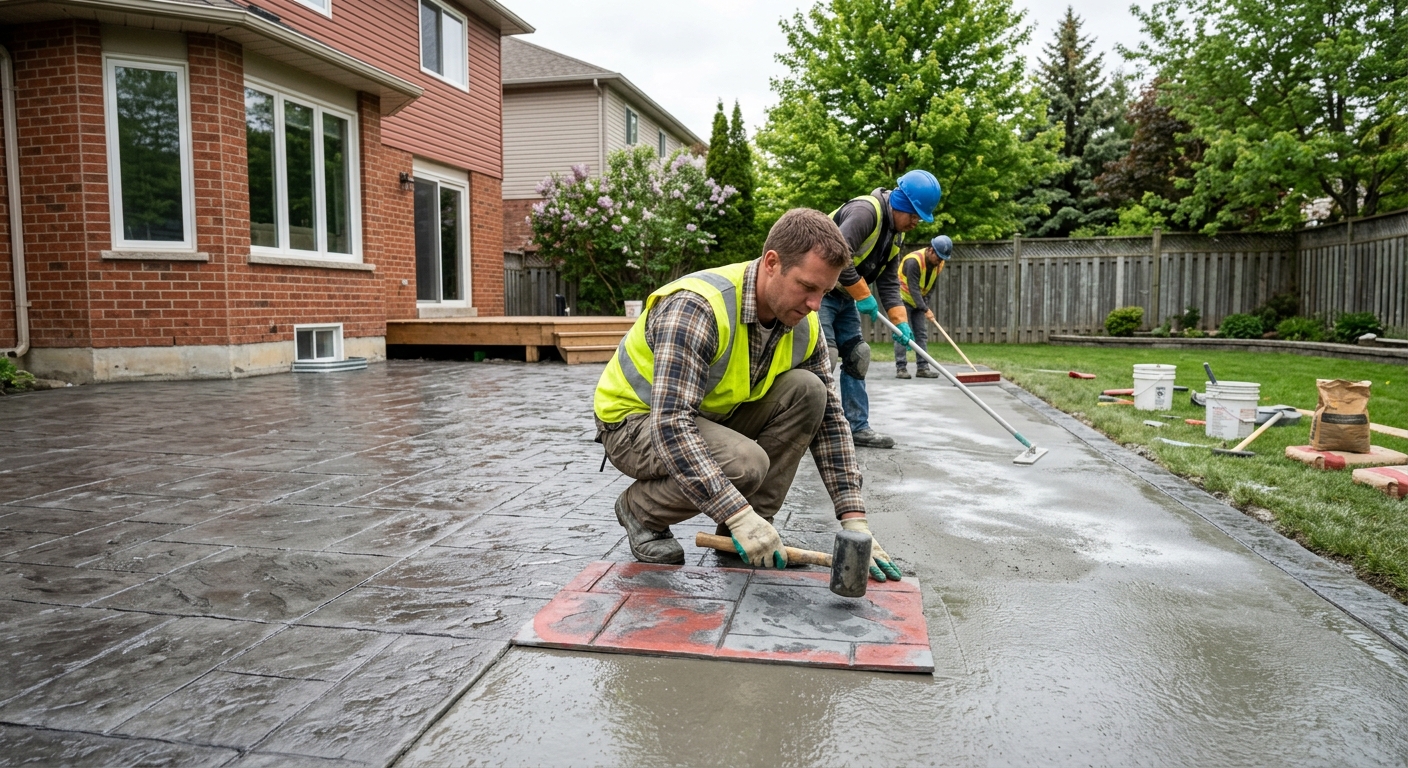
Concrete work options and costs in Esquimalt
Concrete work in Esquimalt ranges from simple flatwork to structural foundation elements, and the right choice usually comes down to how the slab will be used and how it will perform in our Vancouver Island freeze–thaw conditions. In this market, single-detached homes make up 23.2% of dwellings, so driveway, patio and walkway work is a daily part of the trade. With 4,185 homeowner households (48.9% of households own), a lot of projects are owner-planned upgrades—often tied to curb appeal or improving drainage around older properties.
Vancouver Island and the Coast typically has a relatively shallow frost line compared with inland provinces, but we still see frequent wetting and freezing that stresses exterior concrete. That’s why contractors price in air-entrained mixes, good granular base prep, and a control-joint plan; it’s also why cool temperatures and saturated soils can extend cure protection time. In older housing areas—Esquimalt’s longstanding neighbourhoods near the village core—contractors often replace worn walkways and re-slope entry paths because settlement and poor drainage show up sooner on older lots.
To help you compare quotes apples-to-apples, here are realistic, locally priced ranges for the most common concrete options in Esquimalt. Use these as a starting point before you decide on finish upgrades like stamping or exposed aggregate.
| Application |
Typical Size |
Key Spec |
Finish Option |
Price Range |
| Concrete driveway (standard broom finish) |
300–480 sq. ft. |
Reinforced slab, granular base, control joints |
Broom finish, edged profile |
$6,000–$12,000 |
| Exposed aggregate driveway |
300–480 sq. ft. |
Same structural prep; higher labour/finishing time |
Exposed aggregate (wash) |
$8,500–$16,500 |
| Stamped concrete driveway or patio |
250–450 sq. ft. |
Reinforced slab, integral colour option |
Stamp + colour hardener/sealer |
$7,000–$15,000 |
| Plain concrete patio or walkway |
150–300 sq. ft. |
Proper drainage slope, reinforced where needed |
Broom or light float |
$2,400–$6,600 |
| Garage floor (interior slab) |
300–520 sq. ft. |
Vapour barrier, fibre or mesh, burnished/float options |
Light broom or trowel-finish (per spec) |
$7,000–$14,500 |
| Foundation footings (structural, below frost) |
Varies by house footprint |
Engineered sizing, below design frost depth |
Structural concrete (no decorative finish) |
$14,000–$28,000 |
Prices are estimates only and vary by project scope, site access and material selection.
What affects the price of concrete work in Esquimalt
In Esquimalt, two quotes for the “same” concrete project can easily differ by 30–50% once you factor in preparation, reinforcement, and finishing complexity. That gap shows up across Vancouver Island and Coast because weather windows affect labour efficiency, and because contractors must build in contingencies for freeze–thaw durability: air-entrained concrete, granular base quality, drainage details, and a joint/sealer approach. Add to that the labour demand in Victoria-area pockets and the fact that some sites require pump trucks or more excavation, and you’ll see wider pricing than homeowners expect.
Every spec starts with frost line requirements and freeze–thaw performance. Exterior footings must sit below the local design frost depth to limit heave and cracking; in coastal BC that’s typically around 0.5–1.2 m, while colder Canadian regions push higher. For exterior slabs and driveways, air-entrained mixes are not optional here—an exterior slab without the right air entrainment is more likely to scale and spall under repeated wetting/freezing. In cooler seasons, contractors also plan for curing protection (blankets, temperature management), and that extends labour time. De-icing salt accelerates surface damage on under-specified mixes, so sealing is often treated as part of the durability plan.
In practice, cost moves up or down fast: a driveway over poorly compacted fill may require deeper granular excavation and more sub-base, while a simple 10 ft. by 20 ft. walkway on firm ground can stay near the basic patio/walkway band of $14–$22 per sq. ft. If you want a stamped driveway or patio, you’re paying for formwork complexity, textures and colour/sealer labour—often closer to the stamped band of $22–$35 per sq. ft. for the finish premium. For older homes (70.3% built before 1981), subgrade issues like drainage routing and settlement are more common, which is why excavation and base replacement can become a bigger line item.
| Price Factor |
Why It Matters |
Cost Impact |
| Frost line depth — determines footing depth and form height |
Footings must be placed below design frost to limit heave and structural cracking |
Higher depth increases excavation, forming, and concrete volume |
| Site preparation — excavation, grading, compacted granular base |
Concrete lasts only as long as the subgrade can support it under drainage and freeze–thaw |
Extra removal/replacement can add substantial labour and material |
| Reinforcement — rebar or wire mesh requirement |
Controls cracking and improves load performance, especially for driveways and garage slabs |
Material and placement labour can noticeably increase cost |
| Mix design — air-entrainment and compressive strength spec |
Exterior durability depends on proper air content for freeze–thaw resistance |
Upgraded mix typically adds cost but reduces premature spalling |
| Finish type — broom vs. stamped vs. exposed aggregate |
Finishes require different labour time, tools, and sealing timelines |
Stamped/exposed finishes usually add the highest per-sq.-ft. premium |
| Pour size and concrete truck access to site |
Smaller access-limited pours may require hand placement or pump truck |
Pumping/access fees can swing the total project price |
| Cold-weather curing precautions — heating and blankets |
Cool, wet conditions slow strength gain and increase surface risk |
Blankets/heating extend schedule and add labour |
| Control joint pattern and sealing cost |
Joints manage shrinkage cracking; sealing improves resistance to de-icing salts |
Better detailing costs more upfront but reduces future repairs |
Permits & regulations in British Columbia
In British Columbia, structural concrete work—such as footings, foundation walls, grade beams, and other load-bearing elements—usually requires a building permit and may involve engineered drawings reviewed by the municipality. Concrete flatwork like patios, walkways, and driveways typically does not require a permit unless it affects lot grading, stormwater/impervious surface limits, or municipal right-of-way conditions. Because every lot is different in Esquimalt, always confirm with the local authority before breaking ground, especially if you’re changing slopes, adding drainage, or expanding hardscape coverage.
Before work starts, verify the contractor carries liability insurance and WSIB/WCB coverage (or the applicable equivalent for the business structure). Step-by-step, here’s what I recommend for homeowners: (1) Ask for the certificate of liability insurance and confirm it covers concrete operations; (2) Request proof of WSIB/WCB coverage for workers (not just the owner) and check that it’s current; (3) Ask for their business licence/registration details if applicable and the contractor’s professional contact information; (4) Look for clearance letter(s) or coverage verification documents when provided; (5) Compare the written scope so you can see whether disposal, saw-cutting, and any permit-related items are included or excluded. Finally, check references on similar-size jobs in the Vancouver Island and Coast market—driveway and walkway performance there is all about proper base and freeze–thaw durability.
Getting concrete right in Esquimalt's freeze-thaw climate
Concrete fails in Esquimalt most often for predictable reasons: water gets under or through a poorly prepped base, freeze–thaw cycles attack the surface, and weak curing leads to early wear. To spec the job correctly, start with the sub-base. You want compacted granular material to the right depth for local soil conditions so the slab can drain and won’t heave. For the mix, require air-entrained concrete for exterior work; a target of 5–7% air content helps resist freeze–thaw damage, and you should also specify a minimum compressive strength of 32 MPa. Next, control joints: they provide predetermined crack locations so shrinkage cracks don’t become random, unsightly fractures across the driveway or walkway.
Curing is just as important. Plan for at least 7 days of proper curing conditions; in cool, wet spells, contractors may need blankets or other protection to keep the surface from being damaged before strength gain catches up. Then seal: for exterior slabs exposed to de-icing salts and road grit, use a penetrating sealer applied after the cure (commonly around 28 days post-pour) to repel moisture and help prevent scaling.
If you’re choosing between options, the price difference should align with durability. For example, upgrading from a basic broom-finished patio/walkway (often around $14–$22 per sq. ft.) to stamped concrete (often $22–$35 per sq. ft.) is justified when you’re also getting correct base prep, air-entrained mix, and proper sealing—because the finish is only “pretty” if the slab survives freeze–thaw.
| Spec |
Why It Matters in Esquimalt |
What to Ask For |
Impact if Skipped |
| Compacted granular base (depth?) |
Supports the slab and controls drainage so water doesn’t freeze under it |
“What depth of granular sub-base will you compact to, and to what spec?” |
Settlement, cracking, and heaving in wet/cold conditions |
| Air-entrained concrete mix (target air %?) |
Improves freeze–thaw durability in Vancouver Island wet winters |
“Confirm air content target (5–7% for exterior flatwork).” |
Spalling/scaling, especially at edges and traffic areas |
| Compressive strength (MPa rating) |
Strength gain reduces surface wear and supports loads |
“Specify minimum 32 MPa at the required age.” |
Premature surface failure and reduced long-term performance |
| Control joints (spacing per ACI guidelines) |
Controls where shrinkage cracks happen under temperature swings |
“What joint spacing pattern will you use, and will you saw-cut promptly?” |
Random cracking, trip hazards, and water infiltration |
| Minimum 7-day curing period |
Cool, saturated conditions can slow curing and increase surface risk |
“How will you protect curing in cold snaps (blankets/heating if needed)?” |
Reduced strength and increased scaling/edge damage |
| Penetrating sealer (when applied after cure) |
Helps repel moisture and de-icing salt exposure |
“When will sealer be applied (commonly ~28 days) and what product?” |
Faster staining, scaling, and surface breakdown |
How to choose a concrete work contractor in Esquimalt
Choosing the right contractor in Esquimalt is mostly about verifying coverage and insisting on an itemised scope. In British Columbia, confirm the contractor can legally carry out the work and that they have liability insurance and WSIB/WCB coverage where required. How to check: (1) Ask for a current certificate of liability insurance and verify the insured parties and coverage level; (2) Request proof of workers’ compensation coverage (WSIB/WCB equivalent documentation) so you’re not left exposed if someone is injured; (3) If you can, ask for the contractor’s business registration details and read their paperwork carefully for effective dates.
Then get 2–3 itemised, written quotes—avoid lump-sum-only pricing. A good quote should break down labour and materials (excavation/grading, granular base, reinforcement, concrete supply, forming, finishing, saw-cutting, disposal, and sealing). Read the scope for exclusions: Is soil haul-away included? Are permit pulls included for structural work? Is saw-cutting and joint sealing included? Is there a warranty on workmanship and how long does it last?
Payment schedule matters: never pay more than 10–15% upfront. Hold back a portion until the job is complete and surfaces are protected. Finally, insist on a written timeline with a start date and completion estimate; on Vancouver Island, weather can affect cure protection, and that planning should be reflected in the schedule.
- Ask whether they use air-entrained concrete for exterior slabs and driveways.
- Confirm granular base type, depth, and compaction method.
- Request the reinforcement plan (mesh vs. rebar, placement/cover).
- See the control joint plan: spacing and whether joints are saw-cut on time.
- Get the curing/protection approach for cool, wet days.
- Ask when sealer is applied (commonly after full cure, around 28 days).
- Ensure disposal/hauling is clearly included or excluded.
- Confirm equipment access: truck/pump requirements and any extra fees.
- Require an itemised quote (labour + materials + finishing steps).
- Check insurance certificate dates before work starts.
- Verify workers’ compensation coverage documentation (WSIB/WCB applicable).
- Review warranty terms: workmanship length, transferability, and exclusions.
Concrete red flags in Esquimalt include: skipped air-entrainment “to save cost,” vague “we’ll prep the base” language without depth/compaction details, no mention of control joints or sealing, refusing to provide proof of liability coverage/worker coverage, and offering large early deposits without a clear milestone schedule.
Frequently asked questions — concrete work in Esquimalt
How long does concrete take to cure?
In Esquimalt, curing time depends on temperature and rain exposure, but there are two practical milestones homeowners should know. Concrete typically gains significant strength in the first 24–48 hours, and for many scopes contractors plan on at least 7 days of proper curing conditions before treating the surface as fully durable. However, cold snaps and wet weather on Vancouver Island can slow strength gain, so good contractors protect the slab with blankets or other measures when needed. Sealing is often scheduled after full cure—commonly around 28 days post-pour—so the sealer has the best chance to penetrate and repel moisture and de-icing salt. If you’re budgeting, a driveway in the $16–$25 per sq. ft. range is only “worth it” when curing/protection is included in the workmanship.
Do I need a permit for concrete work in British Columbia?
In British Columbia, permit requirements usually depend on whether the concrete is structural or affects grading/drainage. Structural concrete such as footings, foundation walls, and grade beams typically requires a building permit and often engineered drawings reviewed by the municipality. Concrete flatwork like patios, walkways, and many driveways usually does not require a permit by default, unless it changes lot grading, relates to impervious surface/lot coverage rules, or impacts municipal right-of-way conditions. For Esquimalt homeowners, this matters because older lots often need re-slope work for drainage—so confirm early if your project includes modifying slopes, adding drainage, or expanding hardscape area. A reputable contractor will tell you clearly whether a permit is expected in your specific case before they start.
Concrete vs pavers for a patio in Esquimalt?
Concrete and pavers both work well in Esquimalt, but they fail differently in freeze–thaw climates. Concrete patio slabs are typically priced with less labour to install per square foot, and they perform best when the base is correctly prepared and joints are planned. Plain concrete patios/walkways often land around $14–$22 per sq. ft., while pavers can cost more once you factor in excavation, bedding sand, and edge restraints. Pavers can look great and allow easier partial repairs, but weeds and movement can become issues if drainage and compaction aren’t done properly. If your patio area experiences ponding water or heavy de-icing salt use, concrete with air-entrained mix, proper slopes, and sealing can be a straightforward durability choice. The key is to ask both installers for their base depth, joint/edge approach, and curing or compaction methods—not just the finish look.
How long does a concrete driveway last?
A well-installed concrete driveway in Esquimalt can last for decades, but longevity depends on the details that handle freeze–thaw: proper granular base prep, correct air-entrainment, reinforcement where needed, and a control joint plan. In the Vancouver Island and Coast market, the bigger enemies are water management and surface scaling from repeated wetting/freezing and de-icing salt. That’s why we commonly recommend air-entrained exterior mixes and sealing as part of a durability approach. In practical terms, if you build it right, you’re looking at long service life; if you build it cheaply by skipping base prep or air, early cracking and scaling can show up sooner, sometimes within just a few winters. When you compare quotes, don’t just compare the per-sq.-ft. price—compare whether curing protection and sealing are included, especially when you’re near the $16–$25 per sq. ft. driveway band.
What is air-entrained concrete and why does it matter here?
Air-entrained concrete is mixed with tiny, intentionally created air bubbles that give freeze–thaw water somewhere to expand instead of damaging the paste. In Esquimalt’s coastal climate, we still get frequent freeze–thaw cycles due to repeated wetting and cold snaps, which is exactly where non-air-entrained concrete tends to scale and spall. This is one of the most important durability specs you should insist on for any exterior slab, including driveways and walkways. When a contractor says they’re using the right mix design, ask them to specify the target air content (commonly 5–7% for exterior flatwork) and confirm it’s an exterior-rated mix. The cost is usually small compared with the total job, especially relative to rework costs. If a quote is dramatically cheaper, it can be a sign the air-entrainment or curing protection steps were reduced or omitted.
How do I prepare the base for a concrete slab?
Concrete base prep is where most performance is won or lost. For Esquimalt, you want a compacted granular sub-base sized for your site conditions so the slab doesn’t pump, settle, or trap water that later freezes. Ask your contractor what depth of granular material they will install and what compaction standard they’ll follow. The goal is stable support with proper drainage slope, along with removal of topsoil/unsuitable fill. Reinforcement placement matters too: mesh or rebar should be properly supported to achieve correct cover. For exterior work, good preparation is paired with an air-entrained exterior mix and correct curing protection, because even a strong mix won’t save a slab built on soft or poorly drained subgrade. If you’re comparing quotes around the $14–$22 per sq. ft. patio/walkway band, make sure the base scope is identical—otherwise the cheaper quote can be misleading.