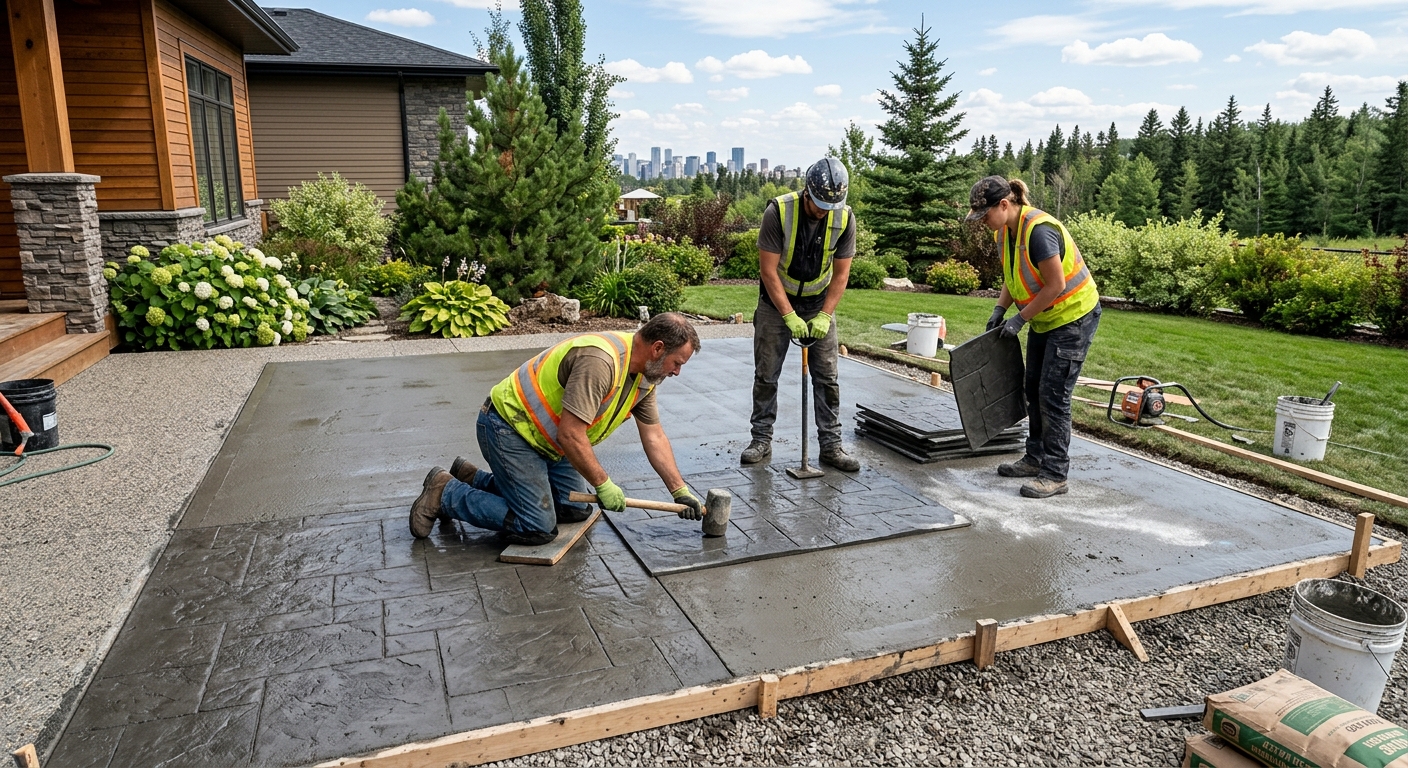
Concrete work options and costs in Pleasantside
Pleasantside homeowners typically choose concrete because it’s durable, low-maintenance, and well-suited to the Lower Mainland–Southwest’s wet coastal weather and shallow frost depth. With a population of 2,671 (Statistics Canada, 2021 Census), the local market is small enough that scheduling matters—good crews can book out around busy driveway and patio seasons. Most concrete flatwork here supports the housing stock: Pleasantside is dominated by single-detached and ground-oriented homes, and that’s exactly where driveways, patios, sidewalks, and garage slabs see the most demand.
In this region, even “mild” winter conditions still bring freeze–thaw cycles. That drives the spec: footings and thickened edges are placed below the design frost depth (commonly assumed around 450 mm / 18" in Lower Mainland practice), and exterior slabs require air-entrained concrete plus proper control joints to reduce cracking and surface scaling. Rain can also disrupt scheduling—cool nights and high humidity mean contractors plan curing protection (blankets and seal strategies) so the slab can reach strength reliably.
In Pleasantside, concrete work is especially in demand around the residential pockets near the more established neighbourhoods along the broader “town” corridor where trades already have repeat customers. If you’re comparing options, it helps to understand typical price bands—driveways often land in the $18–$28 range per square foot/m² equivalent pricing structures, while patios commonly sit in the $16–$26 range. Below is a quick side-by-side of common applications and specs to set expectations before you request a quote.
| Application |
Typical Size |
Key Spec |
Finish Option |
Price Range |
| Concrete driveway (standard broom finish) |
480 sq. ft. |
Reinforced slab on compacted granular base |
Broom finish, control joints, sealer recommended |
$12,000 – $19,500 |
| Exposed aggregate driveway |
480 sq. ft. |
Reinforced slab with proper drainage plane |
Exposed aggregate with broom/brush wash |
$14,500 – $22,500 |
| Stamped concrete driveway or patio |
320 sq. ft. |
Reinforced slab, release agent + stamping |
Stamped patterns, colour hardener, sealed |
$14,500 – $25,500 |
| Plain concrete patio or walkway |
240 sq. ft. |
Reinforced where required, compacted base |
Float + light broom, straight edges |
$4,300 – $6,900 |
| Garage floor (interior slab) |
520 sq. ft. |
Vapour/ground prep as applicable, reinforced |
Steel trowel finish or broom finish (choice) |
$9,000 – $15,000 |
| Foundation footings (structural, below frost) |
Typical 24 lf x 2 pours |
Excavation, formwork, rebar, pour below design frost |
Structural concrete (not decorative) |
$2,400 – $4,200 |
Prices are estimates only and vary by project scope, site access and material selection.
What affects the price of concrete work in Pleasantside
In the Lower Mainland–Southwest, it’s normal to see 30–50% quote differences for what looks like the “same” concrete job. In practice, the scope that’s hard to see—excavation depth, granular base thickness, drainage details, reinforcement type, and curing protection—changes the cost a lot. On top of that, the Vancouver–Surrey–Abbotsford corridor can be busy, so labour availability and mobilization time affect rates more than many people expect.
Frost line depth and freeze–thaw cycles dictate every spec here. Footings must extend below the local design frost depth (coastal BC practice is often about 0.5–1.2 m depending on site conditions), and exterior slabs need air-entrained concrete to manage freeze–thaw damage. When the weather turns, contractors may use cold-weather curing precautions—heating enclosures, insulated blankets, and longer protection time—to hit the design strength safely. De-icing salt also accelerates surface scaling if the surface isn’t sealed or if the mix isn’t right, which is a frequent “hidden” cost driver in winter-exposed driveways.
Two examples from Pleasantside that commonly swing the final price: (1) a slightly soft or wet driveway base requiring extra granular and drainage can push a standard broom driveway from the lower end of the $18–$28 band up toward the mid/high end; and (2) homeowners who want stamped or exposed finishes (often in the $22–$36 decorative range for material-and-labour heavy options) may still pay less than expected if the crew can pour efficiently without rework or rain delays.
Also consider timing and housing age. Older homes often have settled approaches, broken curbs, or under-dimensioned drainage—correcting that during demo can add thousands. As a rough budgeting anchor, a plain patio might start around the $16–$26 band, while stamped concrete is typically higher because it’s labour-intensive and needs tighter curing control.
| Price Factor |
Why It Matters |
Cost Impact |
| Frost line depth — determines footing depth and form height |
Protects from frost heave and seasonal movement |
Can add several days of excavation + forming; typically +5% to +20% |
| Site preparation — excavation, grading, compacted granular base |
Controls settlement and slab performance under wet coastal soils |
Major variable; typically +10% to +35% on problem sites |
| Reinforcement — rebar or wire mesh requirement |
Reduces cracking risk and improves load capacity |
Material + labour; commonly +3% to +12% |
| Mix design — air-entrainment and compressive strength spec |
Air-entrainment is critical for freeze–thaw durability |
Often modest per cubic metre but essential; typically +2% to +8% |
| Finish type — broom vs. stamped vs. exposed aggregate |
Decorative work increases labour, materials, and timing |
Stamped/exposed can add +25% to +60% vs broom/float finishes |
| Pour size and concrete truck access to site |
Limits crew time and pumping/line adjustments |
Poor access can add +5% to +25% |
| Cold-weather curing precautions — heating and blankets |
Protects strength gain during cool, humid spells |
Can add +5% to +20% depending on protection needs |
| Control joint pattern and sealing cost |
Controls cracking and reduces scaling from salts and moisture |
Often +$0.50 to +$3.00 per sq. ft.; total +3% to +10% |
Permits & regulations in British Columbia
In British Columbia, structural concrete work—such as footings, foundation walls, and grade beams—usually requires a building permit and typically engineered drawings that the municipality reviews before work starts. If you’re doing anything that impacts the structural system or the building envelope (for example, foundation upgrades), confirm the permit path before excavation begins. That’s especially important in Pleasantside because exterior drainage and grading conditions can affect how structural elements are designed.
Concrete flatwork (driveways, patios, and walkways) often does not require a permit by default, unless it triggers lot grading or affects impervious surface coverage limits, or if it interferes with municipal right-of-way edges like boulevard interfaces. If your project changes how water drains off your property—such as adding a new driveway approach, lowering grade, or redirecting runoff—ask the local authority what approvals are required.
When hiring a concrete contractor in Pleasantside, verify coverage and credentials in a practical sequence. First, ask for their Certificate of Insurance (liability) naming you as applicable and confirm policy limits. Second, ask about workers’ compensation coverage (WCB) and confirm clearance or account status. Third, check that they carry proper general liability and are insured for the scope being performed. Finally, request references on similar-size exterior slab projects in the Lower Mainland–Southwest (driveways and patios that dealt with wet subgrade and freeze–thaw exposure). Always confirm requirements directly with the local authority—don’t assume “no permit needed” until you’ve checked.
Getting concrete right in Pleasantside's freeze-thaw climate
Concrete failures in Pleasantside are almost always about moisture management, durability specs, and curing. The biggest risk is freeze–thaw scaling and spalling: water enters the surface, expands in cold snaps, and—if the concrete mix isn’t properly air-entrained—micro-damage turns into flaking and rough, pitted surfaces. To spec the job correctly, start with base preparation: use compacted granular sub-base to the right depth for the local soil and frost protection strategy. Next, specify an air-entrained exterior mix (target 5–7% air content for typical exterior flatwork) and a minimum compressive strength of 32 MPa so the slab achieves designed performance under wet coastal exposure.
Control joints matter here because random cracking becomes a moisture pathway. Use a joint pattern that limits crack width and helps joints carry movement safely. Then plan curing: minimum 7 days of proper curing under suitable conditions, with added protection like curing blankets if nights are cool or weather is damp. Finally, seal the surface. A penetrating sealer applied after cure (commonly at about 28 days post-pour) helps repel de-icing salts and reduces moisture uptake—critical in winter when salts and rain combine.
If you’re choosing between options, pricing should reflect the real durability differences. For example, a stamped driveway typically costs more than a broom-finish driveway; that extra cost is justified when the contractor uses the correct mix, air content, and curing protection—otherwise the decorative surface can fail early. Ask technical questions early: “What air content are you targeting for exterior durability?” and “How do you protect the slab from rain and cool nights during cure?”
| Spec |
Why It Matters in Pleasantside |
What to Ask For |
Impact if Skipped |
| Compacted granular base (depth?) |
Prevents settlement and pumps water out of the slab area |
Confirm granular type, thickness, and compaction testing approach |
Uneven settling, cracking, and early surface deterioration |
| Air-entrained concrete mix (target air %?) |
Protects against freeze–thaw damage and scaling |
Target 5–7% air for exterior flatwork and document mix design |
Spalling, scaling, and rapid surface breakdown |
| Compressive strength (MPa rating) |
Ensures strength gain despite cool, humid cure conditions |
Minimum 32 MPa and curing plan tied to expected weather |
Soft surface, dusting, and reduced durability |
| Control joints (spacing per ACI guidelines) |
Controls crack locations to limit moisture pathways |
Joint spacing and timing (cut schedule) in your quote |
Random cracking and higher maintenance/patching risk |
| Minimum 7-day curing period |
Lets concrete reach usable strength in damp coastal conditions |
Protection method for rain/cool nights; curing duration stated |
Reduced strength and surface scaling risk |
| Penetrating sealer (when applied after cure) |
Repels salts and reduces water absorption |
Application timing after cure (commonly around 28 days) |
Faster spalling, staining, and salt scaling |
How to choose a concrete work contractor in Pleasantside
Choosing the right concrete contractor in Pleasantside is mostly about proof—proof they understand Lower Mainland–Southwest concrete durability, proof they can build on wet subgrades, and proof they’re properly insured. In British Columbia, verify licensing/credentials where applicable for the work being performed and make sure they carry liability insurance and workers’ compensation coverage (WCB/WCB clearance as applicable). Ask for a Certificate of Insurance and review the coverage limits and scope; then ask for WCB clearance or proof of account coverage for their workers.
Next, request 2–3 itemised written quotes. “Itemised” matters: you want line-by-line detail for excavation/grading, granular supply and compaction, reinforcement (and whether it’s rebar or mesh), concrete quantity, finishing steps, joint cutting, curing protection, sealing, disposal/demolition, and any permit support. Avoid lump-sum quotes that don’t explain what’s included. Clarify what’s excluded—like removing existing concrete, bringing fill to grade, or disposal fees—and whether permit pull (if needed) is included or charged separately.
Warranty should be in writing. Ask for the workmanship warranty length and what it covers (cracks, spalling, trip hazards, joint defects), and whether any product/manufacturer warranty applies and is transferable. For payment, don’t pay more than 10–15% upfront; hold back a portion until the finish is complete and cleanup is done. Lastly, get a start date and completion estimate in writing, including how rain days are handled.
- Ask for an itemised labour/material breakdown (not just “concrete supply + install”).
- Confirm sub-base thickness, granular type, and whether compaction testing is performed.
- Ask for the exterior mix design: air-entrainment target and 32 MPa (or the specified rating).
- Verify reinforcement details (rebar size/spacing or mesh type) and where it’s required.
- Get the joint plan: spacing, cutting timing, and how joints are sealed (if included).
- Confirm curing protection for cool nights and rain (blankets/sealers strategy).
- Require a clear finish description (broom pattern, stamp pattern + colour system, aggregate wash method).
- Clarify sealing scope and timing (often after cure, not immediately after pour).
- Confirm disposal/removal and site restoration are included or listed as add-ons.
- Check liability insurance limits and request a copy for your records.
- Verify WCB coverage/clearance for workers on site.
- Ask for similar-project references in the Lower Mainland–Southwest (driveways/patios on wet soils).
Red flags I often see in Pleasantside include: quotes that omit base preparation details, “one-size-fits-all” mix claims without air-entrainment, no mention of joints and curing protection, requests for large upfront payments, and contractors who won’t provide insurance documents or written scope (especially around rain scheduling and sealing timing).
Frequently asked questions — concrete work in Pleasantside
How long does a concrete driveway last?
A well-built concrete driveway in Pleasantside—properly reinforced, installed on a compacted granular base, and finished with exterior-appropriate mix (including air-entrainment)—commonly lasts decades. In this Lower Mainland–Southwest climate, the durability hinges on freeze–thaw resistance, drainage, and surface protection from winter salts. If the contractor includes sealing after cure (often around 28 days) and correct joint spacing, you generally reduce scaling and spalling risk significantly.
Pricing varies with spec and finish. A standard broom driveway typically lands in the broader $18–$28 band, while decorative options like stamped concrete usually cost more, but the same durability rules still apply. If you see a quote that’s unusually low and doesn’t mention air content, joints, or curing protection, that’s where long-term lifespan tends to fall apart. (Statistics Canada, 2021 Census)
What is air-entrained concrete and why does it matter here?
Air-entrained concrete is designed to include tiny, evenly distributed air bubbles in the mix. Those bubbles give water expansion space as temperatures swing, which is critical in British Columbia’s freeze–thaw cycles—especially on exterior slabs like driveways and patios in the Lower Mainland–Southwest. Without correct air content, water entering the surface can expand during cold snaps, causing scaling and spalling.
In Pleasantside, you’ll often hear this framed as “salt + moisture + temperature changes.” That combination makes sealing important, but sealing is not a substitute for a properly air-entrained mix. Ask your contractor what air content they’re targeting for exterior flatwork (commonly 5–7%) and confirm they’re using an exterior-rated mix. When the mix design is right, your base prep, joint plan, and curing become the final pieces that protect your investment.
How do I prepare the base for a concrete slab?
Base prep is the foundation (literally) of a durable slab. In Pleasantside, preparation typically starts with excavation to the required elevation, followed by grading to drain, then placing compacted granular sub-base to the depth required for local soil conditions and frost protection strategy. The goal is to create a stable, well-draining layer under the concrete—not a “thin topping” over unsuitable fill.
When you get quotes, ask for the thickness of the compacted granular, what granular material is used, and how compaction is verified. If the site is wet, contractors may recommend improved drainage details before pouring. These steps can affect pricing—base prep is one reason quotes can vary 30–50% for the same slab footprint. A project that stays closer to the plain patio band (often $16–$26) usually means the site prep is straightforward; complicated drainage or deeper excavation pushes costs upward.
How do I compare concrete quotes?
The easiest way to compare quotes is to ensure they’re comparing the same scope and the same specifications. In Pleasantside, quote differences often come from hidden items like granular base depth, reinforcement type, air-entrainment targets, curing protection, and whether sealing is included. If one quote says “concrete supply and install” without stating mix and curing details, you can’t truly compare it to a quote that does.
Ask each contractor for an itemised breakdown: demolition/removal, excavation and disposal, granular and compaction, reinforcement, concrete quantity, finishing steps, joint cutting plan, curing/blankets, and sealing timing. Also check exclusions like permit support (if required), site access, and how rain days are handled. As a benchmark, a standard driveway in the $18–$28 band should include exterior durability specs; if a quote is far below that and doesn’t talk about air-entrainment and joints, treat it as a risk.
Can concrete be poured in cold weather in Pleasantside?
Concrete can often be poured in cold weather in Pleasantside, but only if the contractor controls temperature and curing conditions. The Lower Mainland–Southwest climate still includes cool nights and weather that can slow curing, and you don’t want concrete exposed to conditions that prevent proper strength gain. A competent crew will use cold-weather curing precautions—like heated enclosures where needed and insulated curing blankets—so the slab reaches required strength before exposure.
Ask your contractor what temperature triggers the need for protection and what steps they’ll take on forecasted cool/rain days. Also ask about how long they keep blankets on and how curing is protected. A good quote will specify curing duration (commonly at least 7 days for proper curing) and note any additional labour for protection. Cutting corners on cure time is one of the fastest ways to undermine durability and increase future cracking and surface scaling.
How do I maintain concrete in Pleasantside's freeze-thaw climate?
Maintenance in Pleasantside is about reducing moisture and protecting the surface from salt-related damage. First, seal the concrete at the right time—typically after the slab has cured (often around 28 days). A penetrating sealer helps repel water and reduces salt intrusion, which lowers the risk of scaling and spalling during freeze–thaw cycles.
Second, keep drainage functioning. If water is ponding or running toward joints, it will accelerate wear. That means keeping edges clear, ensuring downspouts and grading direct water away from the slab, and addressing any low spots early. Third, when using de-icing products, don’t overuse them; choose concrete-friendly de-icers when possible and sweep off residue after heavy winter weather.
Finally, inspect joints and cracks. Small issues are cheaper to address early. On many Pleasantside projects, the difference between a mid-band driveway ($18–$28) and a longer-lasting one is often the sealing and the quality of joint planning—not just the decorative finish choice.