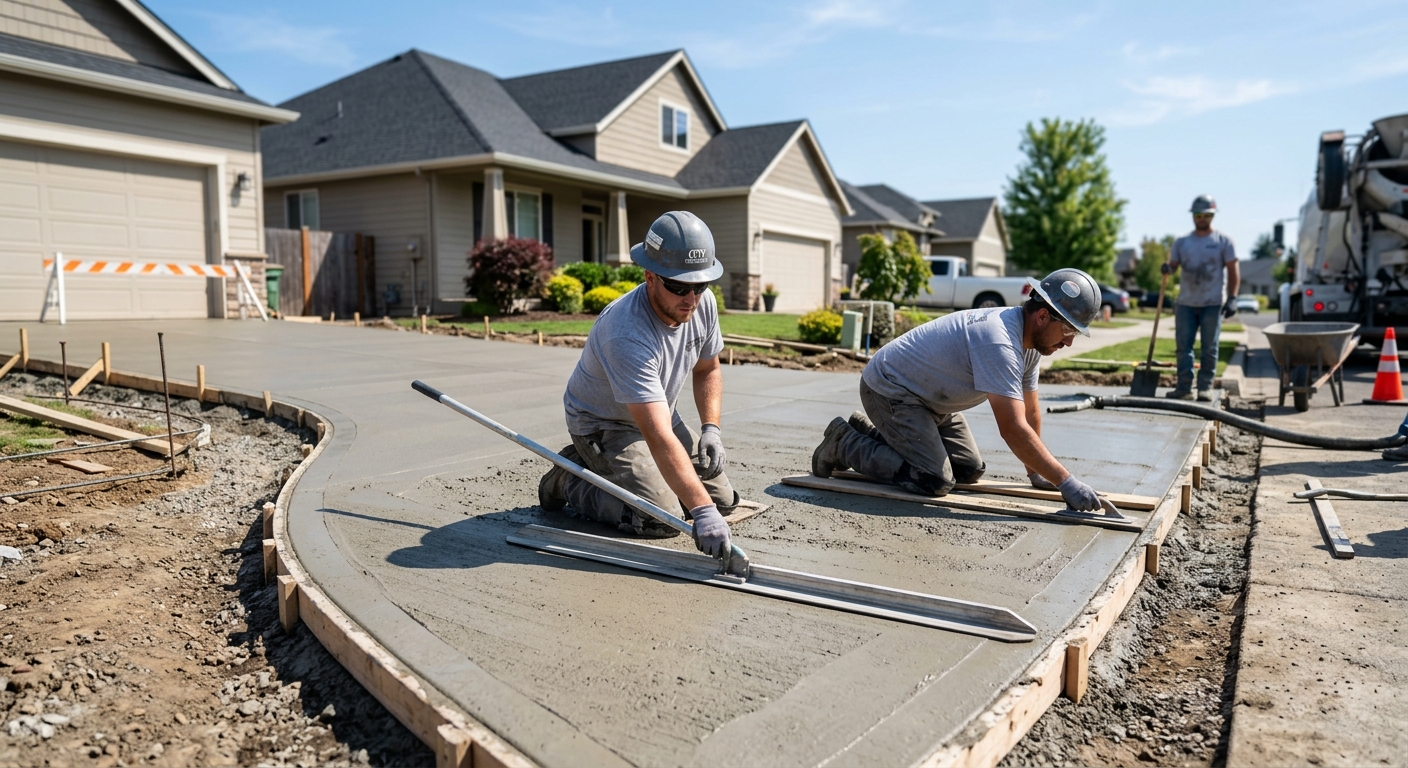
Concrete work options and costs in Nanaimo
Nanaimo homeowners typically choose concrete for driveways, patios and walkways because the island’s mix of older housing stock and wet winters makes durable surface design a priority. In Nanaimo, single-detached homes make up about 51.5% of dwellings (Statistics Canada, 2021 Census), which lines up well with the demand we see for new flatwork and replacement of cracked/uneven slabs. It also helps that 39.1% of homes were built before 1981 (Statistics Canada, 2021 Census), when many older driveways and steps were installed with thinner bases and less attention to freeze–thaw durability.
On Vancouver Island and the Coast, the climate isn’t as brutally cold as interior BC, but the freeze–thaw cycle still shows up frequently—especially after rainy periods followed by cold snaps. That combination drives the specs: air-entrained mixes for exterior slabs, proper granular base preparation, and well-planned control joints to reduce random cracking and scaling. Costs can also be affected by the local labour market—when contractors are booked after major rainy windows, scheduling and site protection (tarps, curing blankets, better drainage detailing) can add value, even if the price looks higher.
In Nanaimo’s North Nanaimo and North Jingle Pot areas, we often see heavier replacement work because older lanes and drive approaches tend to have drainage issues. Next, use the table below to compare typical sizes, specs and finishes—then we can tighten the numbers once we know your access, subgrade condition and desired look.
| Application |
Typical Size |
Key Spec |
Finish Option |
Price Range |
| Concrete driveway (standard broom finish) |
300–400 sq. ft. (typical 12' x 26') |
Air-entrained mix, reinforced where required, control joints |
Broom-finished |
$5,000 – $9,000 |
| Exposed aggregate driveway |
300–450 sq. ft. |
Air-entrained mix, consistent aggregate exposure, sealed surface |
Exposed aggregate |
$6,500 – $12,500 |
| Stamped concrete driveway or patio |
200–350 sq. ft. |
Colour hardener, release agent, air-entrained mix |
Stamped pattern (e.g., slate/stone look) |
$6,000 – $13,000 |
| Plain concrete patio or walkway |
120–250 sq. ft. |
Proper base, air-entrained mix, joints as needed |
Float and broom/score texture |
$2,000 – $5,500 |
| Garage floor (interior slab) |
400–600 sq. ft. |
Vapour barrier, fibres or mesh, sealed where desired |
Plain trowel/smooth or light broom |
$7,000 – $14,000 |
| Foundation footings (structural, below frost) |
Varies by plan (often 2'–3' wide) |
Below-frost depth, rebar as required, excavation & disposal |
Concrete only (structural) |
$9,000 – $25,000 |
Prices are estimates only and vary by project scope, site access and material selection.
What affects the price of concrete work in Nanaimo
In Nanaimo, the same “standard” concrete job can end up 30–50% apart between quotes because concrete pricing bundles several hard-to-see variables: ground conditions, frost depth/spec, reinforcement, finish complexity and weather protection. On Vancouver Island and the Coast, we design for a relatively shallow frost line compared to interior BC, but not shallow enough to ignore. The real driver is freeze–thaw performance—exterior slabs must use air-entrained concrete to help resist scaling and spalling when the surface repeatedly wets and freezes.
Footings and foundations must sit below the local design frost depth. In coastal BC, that often falls in the approximate 0.5–1.2 m band, and the contractor has to plan excavation, forming height and granular backfill accordingly. For exterior flatwork, air entrainment (and correct curing) is non-negotiable, even when winters seem mild. When cold snaps hit during scheduling, contractors may need insulated blankets or curing protection to keep the slab gaining strength properly. That can change labour time and material costs, even if the slab size stays the same.
Two local examples that commonly move the price up or down in Nanaimo: first, if subgrade is saturated clay or organic topsoil (common near older neighbourhood fill), excavation and replacement with compacted granular base adds cost before any concrete is poured. Second, if you want a decorative finish like stamped concrete, the cost jump is justified because colour hardener, stamps and extra finishing time typically run higher than broom-finished work (for reference, stamped & decorative concrete is often priced around $22 – $35 per square foot in this tier, while basic concrete flatwork is lower). If your driveway is accessible for a concrete truck and you have straightforward drainage, a standard broom-finish pour can land closer to the driveway range of $16 – $25 per square foot.
| Price Factor |
Why It Matters |
Cost Impact |
| Frost line depth — determines footing depth and form height |
Below-frost placement helps prevent frost heave and long-term movement |
Extra excavation and forming can add significant labour and disposal costs |
| Site preparation — excavation, grading, compacted granular base |
Wrong subgrade causes settlement, voids, and early cracking |
More haul-off and imported base increases both time and material |
| Reinforcement — rebar or wire mesh requirement |
Reinforcement improves slab performance over weak soils and loads |
Higher material cost and labour for placement/tie-in |
| Mix design — air-entrainment and compressive strength spec |
Air entrainment improves durability through freeze–thaw cycles |
Mix upgrades can raise cost per cubic yard, but reduce failure risk |
| Finish type — broom vs. stamped vs. exposed aggregate |
Decorative finishes require colour systems and more finishing steps |
Labour and materials increase—often the biggest visible difference in quotes |
| Pour size and concrete truck access to site |
Access affects pumping, labour, and how efficient the pour is |
Restricted sites can require extra handling and longer crew time |
| Cold-weather curing precautions — heating and blankets |
Strength gain slows in cool, wet conditions |
Blankets/insulation and monitoring add labour and rental costs |
| Control joint pattern and sealing cost |
Proper joints reduce random cracking; sealing helps protect against de-icing salt impacts |
Material and layout time increase, especially on complex shapes |
Permits & regulations in British Columbia
In British Columbia, structural concrete work generally requires more formal review than concrete flatwork. For Nanaimo homeowners, the key distinction is this: foundation and engineered structural elements—such as footings, foundation walls, and grade beams—typically require a building permit, and plans are often reviewed through the municipal permitting process with engineering documentation where applicable. Concrete flatwork (driveways, patios, walkways) usually does not need a permit unless it affects lot grading, stormwater drainage, or impervious surface coverage limits, or if it touches municipal right-of-way or requires traffic/sidewalk impacts.
Before breaking ground, take three practical steps. First, confirm the contractor carries liability insurance and the applicable workers’ compensation coverage (in BC, that’s WCB/WorkSafeBC). Second, request a copy of the certificate of insurance and verify the coverage limits match the job size. Third, ask for references on projects similar in scope (especially exterior slabs with freeze–thaw durability specs). If the project is structural, ensure the permit is pulled by the party responsible per the municipal requirements—your contractor should tell you whether they will handle it or if your designer/owner’s role applies.
To verify credentials, start by checking the contractor’s licensing/registration details through the appropriate online registry, then ask for the COI documentation. Finally, look for a clearance letter or proof of coverage status if available—this is often the difference between a credible crew and one that can’t legally access job sites.
Getting concrete right in Nanaimo's freeze-thaw climate
Concrete failure in Nanaimo almost always traces back to a few predictable gaps: insufficient base prep, wrong mix (especially air content), missing or poorly spaced control joints, and curing shortcuts during cool or damp weather. The island’s wetting-and-freezing pattern means exterior surfaces can experience repeated expansion and contraction. If the slab surface can’t tolerate that movement, you’ll see scaling, spalling and random cracks long before you’d expect.
To spec the job correctly, focus on five areas. (1) Base preparation: use a compacted granular sub-base to the correct depth for your soil and drainage conditions, then build the slab on a stable, well-drained base. (2) Mix design: for exterior flatwork, target air entrainment in the typical 5–7% range and specify a minimum 32 MPa compressive strength (unless your engineer specifies higher for special structural loads). (3) Control joints: plan joint spacing to limit random cracking and ensure joints are cut/placed while the slab is workable. (4) Curing: plan for at least 7 days of proper curing; cold, saturated conditions slow strength gain, so protection is critical. (5) Sealing: apply a penetrating sealer after the slab fully cures—commonly around 28 days—to improve resistance to salt and moisture attack.
When comparing options, a clear example is stamped concrete: if decorative finishes tempt you to cut corners on base and air entrainment, it won’t perform any better than broom-finish over the long term. The “right” approach is to pay for durable specs first, then spend on appearance. If your driveway is priced nearer the standard tier of $16 – $25 per square foot, that’s the baseline for durability; adding stamping or exposed aggregate shifts the per-square-foot pricing toward the higher decorative tier of $22 – $35 per square foot.
| Spec |
Why It Matters in Nanaimo |
What to Ask For |
Impact if Skipped |
| Compacted granular base (depth?) |
Stable base reduces settlement and heave during freeze–thaw events |
State target base depth and compaction method; confirm drainage plan |
Uneven slab, cracked edges, faster deterioration |
| Air-entrained concrete mix (target air %?) |
Air voids protect concrete from freeze–thaw scaling |
Confirm target air content (typical exterior range 5–7%) |
Spalling/scaling after a few winters |
| Compressive strength (MPa rating) |
Strength affects durability and surface wear |
Confirm minimum 32 MPa for flatwork (or higher per design) |
Surface wear, reduced long-term performance |
| Control joints (spacing per ACI guidelines) |
Controls cracking to predictable lines |
Request joint spacing and timing for sawing/cutting |
Random cracking and aesthetic failure |
| Minimum 7-day curing period |
Curing supports strength gain in cool, damp coastal weather |
Ask how they protect the slab and how curing temperature is managed |
Reduced strength, surface damage and scaling risk |
| Penetrating sealer (when applied after cure) |
Helps repel moisture and de-icing salt effects |
Penetrating sealer after cure—commonly around 28 days post-pour |
Faster moisture ingress and surface breakdown |
How to choose a concrete work contractor in Nanaimo
Choosing the right contractor matters in Nanaimo because exterior slabs live through Vancouver Island’s freeze–thaw cycles, not just one season. Start by verifying British Columbia coverage and eligibility. Ask for (1) proof of liability insurance (certificate of insurance with limits), (2) proof of workers’ compensation coverage (WorkSafeBC clearance status or documentation), and (3) confirmation of the contractor’s applicable registration/licensing for the work they’re performing. You can usually confirm the licensing/registration details through the relevant online registry, then match the company name and address to the quote documents so you’re not dealing with a mismatch.
Next, get 2–3 itemised written quotes. You want a breakdown that distinguishes labour, excavation/site prep, granular base and reinforcement, concrete supply/mix design, forming and finishing, and any sealing. Avoid quotes that only provide a single lump sum without showing what’s included. Make sure you understand exclusions: is haul-away/disposal included? Who supplies curing blankets or protective coverings if weather turns? Is the permit handling included if it’s required for structural work?
Warranty should be clear and specific: ask for a workmanship warranty length and whether product/manufacturer warranties apply. Confirm if anything is transferable if you sell your home. On payment terms, never pay more than 10–15% upfront; hold back a portion until completion and final cleanup. Finally, insist on a written timeline with start date and a completion estimate.
- Ask for proof of liability insurance and confirm policy limits fit the project scale.
- Verify WorkSafeBC/WCB coverage is active before work starts.
- Check the contractor’s registration/licensing details from the online registry using their legal name.
- Request an itemised quote (labour + materials + prep + finishing).
- Confirm whether excavation, disposal, and granular base replacement are included.
- Ask what mix design is used and whether it’s air-entrained for exterior work.
- Ask about reinforcement (mesh vs. rebar) and where it’s placed.
- Confirm control joint layout and timing (especially for driveways and patios).
- Get the curing plan in writing, including cold-weather protection if needed.
- Clarify whether sealing is included, and when it will be applied (after cure).
- Check warranty terms: workmanship duration and what defects are covered.
- Set payment milestones (max 10–15% upfront; hold back until final acceptance).
Concrete red flags in Nanaimo include: crews who won’t discuss air entrainment or joint spacing, quotes that skip base depth/compaction details, “too-good-to-be-true” pricing for stamped work without explaining mix and colour systems, no written curing plan for cool or rainy periods, and vague scopes that don’t list disposal, protection and sealing.
Frequently asked questions — concrete work in Nanaimo
Stamped vs broom-finish concrete — cost difference?
In Nanaimo, stamped concrete costs more than broom-finish because it needs extra labour and materials (colour hardener, release agent, stamps, and more detailed finishing). For this region, standard driveway concrete is commonly priced around $16 – $25 per square foot, while decorative/stamped work often lands higher, roughly $22 – $35 per square foot. That premium is usually justified when the contractor still builds the right durability specs: air-entrained mix for exterior, proper granular base, and a control joint plan. If a quote offers “stamped” pricing but can’t explain mix and joint specs for freeze–thaw, that’s when you should slow down. On Vancouver Island, appearance matters, but durability is what prevents spalling and random cracking after the next cold snap.
When is the best time to pour concrete in Nanaimo?
The best time to pour in Nanaimo is when temperatures stay consistently above the contractor’s minimum curing threshold and you can protect the slab from cold, wind and heavy rain. While the season is longer than interior BC, our freeze–thaw cycle can still interrupt early curing after wet weather. Many crews prefer late spring through summer, and they’ll schedule fall pours only with a clear weather-protection plan (curing blankets, protection time, and monitoring). If your pour is near a driveway approach or in a shaded area, timing matters even more because cool surfaces can slow strength gain. Ask your contractor what the plan is for saturated ground and overnight temperature dips, and make sure those contingencies are included in the quote.
How long does concrete take to cure?
Concrete strength gain is not instant. In everyday terms, you’ll typically see formwork removal much sooner, but durable performance requires proper curing conditions. For flatwork in Nanaimo, plan for at least 7 days of curing under appropriate protection, especially when the forecast includes cool or damp periods. Full design strength can take longer, and that’s why sealing is commonly scheduled after the slab is fully cured—often around 28 days for penetrating sealers. If you seal too early, you can trap moisture or reduce penetration. Your contractor should explain how they’ll protect the slab during the first week and whether they’ll extend curing time if temperatures drop or if the site is saturated after rain.
Do I need a permit for concrete work in British Columbia?
In British Columbia, it depends on what you’re building. Structural concrete work—such as footings, foundation walls and grade beams—typically requires a building permit, often with engineered drawings reviewed through the municipal process. Concrete flatwork like patios, walkways and driveways usually does not require a permit unless it affects lot grading, stormwater/drainage, impervious surface coverage limits, or a project involves municipal right-of-way impacts. For Nanaimo homeowners, the safest approach is to confirm with the local authority (or your contractor if they’re experienced with that municipality’s process) before breaking ground. Also, ask the contractor whether permits are included in their scope for structural work, and ensure they have liability coverage and workers’ compensation coverage in place before starting.
Concrete vs pavers for a patio in Nanaimo?
Concrete and pavers can both work well in Nanaimo, but the decision usually comes down to budget, maintenance expectations and how your patio handles drainage. Concrete patios are typically a simpler install and can be priced in the local tier around $14 – $22 per square foot, depending on thickness, base prep, and finish. Pavers can be more forgiving if you have future minor soil movement, because individual units can be replaced—however, labour can be higher and the pattern/edge detailing demands careful installation. In Vancouver Island and Coast conditions, a well-prepared compacted base and proper drainage are critical for both systems. If your area gets frequent wetting and freeze–thaw, ask how each system prevents water from pooling and how joints (or between-paver gaps) are managed to reduce heave and weed growth.
How long does a concrete driveway last?
A properly built Nanaimo driveway often lasts for decades, but the “how long” depends on base prep, air entrainment, joint pattern and curing—not just the concrete age. Concrete that’s installed on a weak or poorly drained base, without adequate air content, is where we see early scaling and spalling after several winters of freeze–thaw. When contractors build for durability—compacted granular base, exterior air-entrained mix, correct control joints, and curing protection—the slab typically performs well even with wet coastal weather. If you’re comparing quotes, ask what the contractor includes for base depth/compaction, reinforcement, mix design and whether they plan to seal if you’ll be dealing with salt and moisture. Paying for the durability steps is usually cheaper than replacing a driveway prematurely.