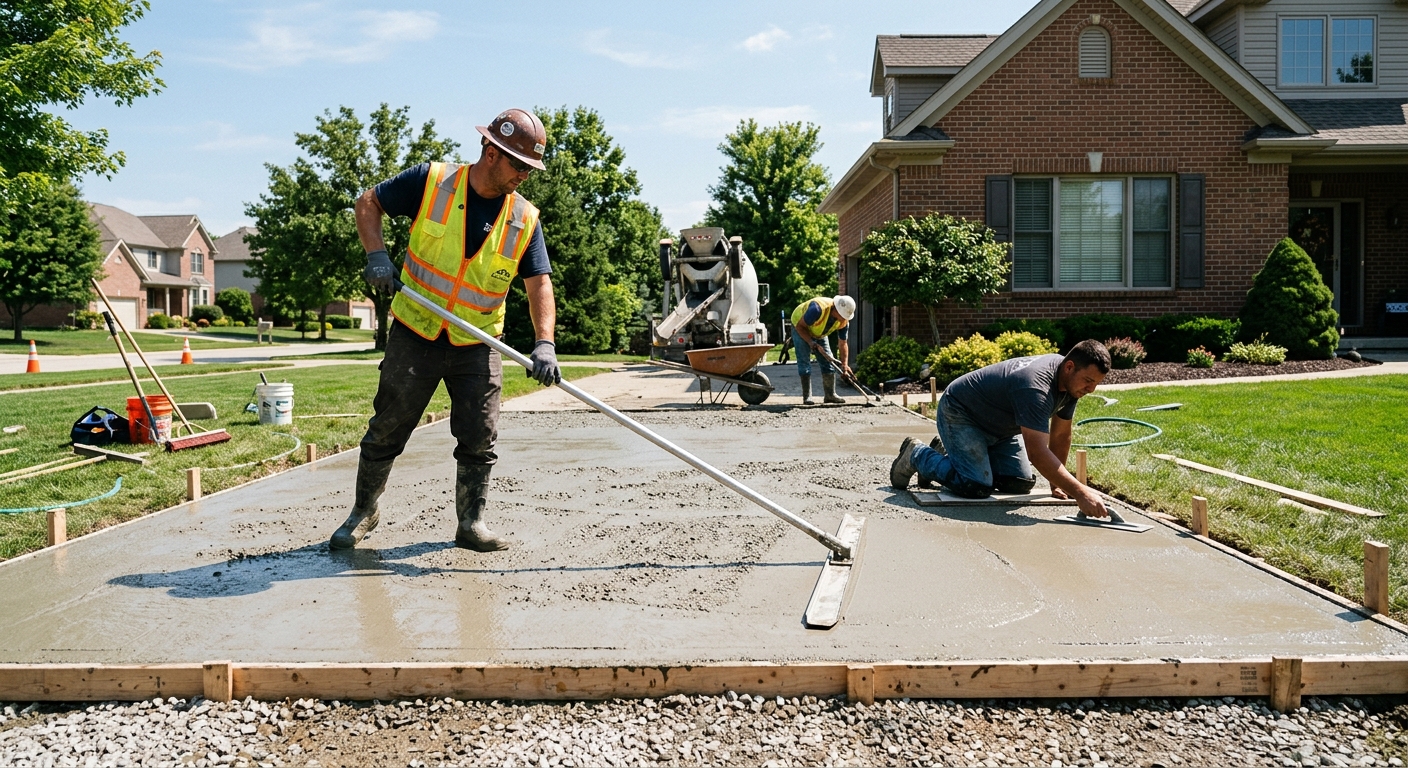
Concrete work options and costs in Cape Horn
Cape Horn, British Columbia is a great place for clean concrete flatwork, but it’s also a place where the weather does the cost math. With a population of 12,680 (Statistics Canada, 2021 Census), there’s steady demand for driveways, patios, and foundations—especially around the Lower Mainland–Southwest, where housing density keeps crews busy. In this part of BC, many homeowners are retrofitting exteriors on older lots, and the area’s mix of single-detached homes and long-term residence drives repeat concrete needs: driveway replacement, backyard patios, and foundation repairs after drainage issues. (Statistics Canada, 2021 Census)
Lower Mainland–Southwest pricing is shaped by mild winters paired with a shallow-but-real frost line (commonly designed around roughly 450 mm / 18"). Even though that’s shallower than interior and northern BC, we still protect exterior concrete from freeze–thaw cycling. That means footings and thickened edges go below the design frost depth, base prep includes compacted granular and drainage attention, and exterior slabs use air-entrained mixes plus properly placed control joints. Coastal-wet conditions also affect scheduling and finishing: cool nights and prolonged rain can slow curing, so contractors often plan around moisture and use curing blankets or sealers to get the durability you want from concrete patios and driveways.
If you’re comparing options—standard broom finishes versus exposed aggregate or stamped work—use the table below as a practical baseline for Cape Horn projects, then we’ll break down what actually moves quotes up or down.
| Application |
Typical Size |
Key Spec |
Finish Option |
Price Range |
| Concrete driveway (standard broom finish) |
400–600 sq. ft. |
Air-entrained exterior mix, compacted granular base, control joints |
Broom finish, light sealer |
$18,000–$28,000 |
| Exposed aggregate driveway |
400–600 sq. ft. |
Air-entrained mix, proper base drainage, aggregate selection and wash timing |
Exposed aggregate (wash finish) |
$22,000–$34,000 |
| Stamped concrete driveway or patio |
300–500 sq. ft. |
Air-entrained mix, saw cuts for jointing, release agent and curing plan |
Stamped pattern with border/texture |
$22,000–$36,000 |
| Plain concrete patio or walkway |
200–350 sq. ft. |
Air-entrained exterior mix, compacted base, slope to drain |
Float/trowel top, broom or light texture |
$16,000–$26,000 |
| Garage floor (interior slab) |
400–600 sq. ft. |
Vapour barrier as needed, control joints, steel reinforcement as required |
Light trowel + densifier/optional sealer |
$18,000–$30,000 |
| Foundation footings (structural, below frost) |
Typical 1–2 storey footing layout |
Excavation to frost-protected depth, formwork, reinforcement, concrete pours |
Structural concrete (not decorative) |
$200–$350 |
Prices are estimates only and vary by project scope, site access and material selection.
What affects the price of concrete work in Cape Horn
If two quotes look “for the same concrete,” it’s usually the hidden items that cause the swing—often 30–50% across the Lower Mainland–Southwest and other parts of British Columbia. The big drivers are how deep we must go for frost protection, how prepared the base is, what air-entrainment and reinforcement spec you’re buying, and how the contractor manages curing in coastal-wet conditions. In Cape Horn, that shallow frost design depth (commonly around 450 mm / 18") still requires proper footing and thickened-edge placement below the design line to control frost heave. Exterior slabs also need air-entrained concrete to survive freeze–thaw cycles without scaling or spalling.
Quotes can widen further because colder regions force longer, more complicated cold-weather curing (heating, insulating blankets, and tighter scheduling), while coastal rain can extend cure time and increase labour for protection. Another common variable is de-icing: in coastal BC, homeowners still use salts in winter, and salts can accelerate surface deterioration if the concrete isn’t sealed at the right time.
For real Cape Horn examples: (1) a driveway “replacement” that includes full removal of poor subgrade and drainage often lands near the upper band, while patchwork over marginal base can come in cheaper but fails sooner; (2) an exposed aggregate driveway costs more because it demands tighter wash timing, labour, and mix consistency—but it’s often worth it for traction and longevity; (3) stamped concrete can jump into the $22–$36 range when you need borders, pattern tooling, and careful jointing. Plain patios typically stay closer to the $16–$26 band when reinforcement and drainage are straightforward.
Housing-stock age also matters. Older homes commonly have tight lot lines, older drain tiles, and settled slopes—so excavation and base rebuild can add hundreds to thousands. The work isn’t just “pour concrete”; it’s “build a durable system” for Cape Horn’s wet/cool cycles.
| Price Factor |
Why It Matters |
Cost Impact |
| Frost line depth — determines footing depth and form height |
Footings and thickened edges must extend below the design frost depth to prevent frost heave |
More excavation and formwork can add significant labour and equipment time |
| Site preparation — excavation, grading, compacted granular base |
Freeze–thaw damage accelerates when water sits under slabs; base must be compacted and drained |
Extra hours for haul-off, regrade, and granular placement move the quote upward |
| Reinforcement — rebar or wire mesh requirement |
Helps control cracking and improves load capacity in driveways and interior slabs |
Material and placement labour vary by slab thickness and design loads |
| Mix design — air-entrainment and compressive strength spec |
Exterior slabs need air-entrained concrete for durability under freeze–thaw cycles |
Premium mix + quality control can raise costs, especially on larger pours |
| Finish type — broom vs. stamped vs. exposed aggregate |
Finish complexity affects labour time and crew skill during finishing |
Stamped/exposed aggregate typically adds cost versus plain broom-finished concrete |
| Pour size and concrete truck access to site |
Small access restrictions increase handling time and may require a different placement plan |
Longer placement effort and possible equipment adders can increase price |
| Cold-weather curing precautions — heating and blankets |
Cool nights and damp conditions can delay strength gain and surface durability |
Blankets/heaters add daily costs and can affect scheduling and overtime |
| Control joint pattern and sealing cost |
Jointing limits random cracking; sealing protects against moisture and de-icing salt impacts |
Correct saw-cut timing + sealant adds line-item costs but reduces long-term failure |
Permits & regulations in British Columbia
In British Columbia, structural concrete work typically needs a building permit—especially when it involves footings, foundation walls, grade beams, and other elements that carry building loads. In practice, municipalities often require engineered drawings for these structural components, then review the documentation before construction. If your project touches drainage under a foundation or changes grading close to the building, that can also trigger additional review. Concrete flatwork (patios, walkways, and many driveways) usually does not require a permit unless it affects lot grading, impervious surface coverage limits, or work impacts municipal right-of-way conditions (for example, new or altered access tied to curb/sidewalk areas).
For a homeowner in Cape Horn, verify a contractor step-by-step before any ground is broken:
- Licence/registration: check the appropriate provincial business credentials and any trade registration the contractor claims (use the contractor’s legal name, not just a trade slogan).
- Liability insurance: request a current certificate of insurance showing the effective dates and coverage limits.
- Workers’ coverage: ask for proof of workers’ compensation coverage (clearance letter or equivalent proof, as applicable).
- References: look for similar-scale projects in BC, ideally in coastal-wet conditions where curing protection matters.
- Written scope: confirm permit responsibility and whether the contractor will submit anything to the municipality if required.
Always call the local authority with your address and proposed scope. If your plan is truly “flatwork only,” it’s often straightforward—but if it’s structural or alters drainage/grade near a foundation, expect permitting and documentation.
Getting concrete right in Cape Horn's freeze-thaw climate
Concrete failure in Cape Horn usually comes down to water movement, weak base prep, and insufficient durability specs. Even with a shallow frost depth (commonly designed around 450 mm / 18"), freeze–thaw cycling and saturated soils can push cracks wider and pop surface layers if the slab isn’t built as a system. When we spec work for Cape Horn and the Lower Mainland–Southwest, we focus on five steps: base preparation, mix design, control joints, curing, and sealing.
1) Base preparation: compacted granular sub-base to the correct depth for local soil support and drainage. We keep the base dry and stable so the slab doesn’t float or settle. 2) Mix design: air-entrained concrete typically targeting about 5% to 7% air for exterior flatwork, and a minimum compressive strength around 32 MPa. 3) Control joints: saw cuts placed to limit random cracking—then jointing is sealed later where appropriate. 4) Curing: plan for at least 7 days of proper curing conditions; in cool, humid periods, crews may use blankets or curing protection so strength keeps developing. 5) Sealing: apply a penetrating sealer after the concrete has cured (commonly around 28 days) to help repel de-icing salts and reduce scaling.
Here’s where price choices can be justified: If a homeowner chooses plain broom-finish concrete (often in the $16–$26 band for patios/walkways) but skips proper air-entrainment or delays curing protection, the “savings” can cost more later. A concrete driveway option that lands closer to $18–$28 may cost more upfront, yet durable base + correct mix and jointing reduces early spalling risk—especially important in Cape Horn’s wet/cool winters.
| Spec |
Why It Matters in Cape Horn |
What to Ask For |
Impact if Skipped |
| Compacted granular base (depth?) |
Prevents pumping and supports the slab during freeze–thaw and heavy coastal rainfall |
Confirm granular type, placement thickness, and compaction requirements |
Settlement, edge deterioration, and accelerated cracking |
| Air-entrained concrete mix (target air %?) |
Air bubbles help resist scaling during repeated wet/freezing cycles |
Ask for target air content (typically 5–7% for exterior flatwork) |
Surface spalling and scaling even if the slab looks fine at first |
| Compressive strength (MPa rating) |
Higher strength improves durability and long-term performance under winter traffic and moisture |
Minimum 32 MPa for exterior work (verify spec on the pour ticket) |
Richer chance of premature wear and reduced abrasion resistance |
| Control joints (spacing per ACI guidelines) |
Controls where cracking happens as the slab contracts/expands |
Ask for a joint layout with spacing consistent with ACI practices |
Random cracking patterns and wider crack development |
| Minimum 7-day curing period |
Strength gain depends on temperature and moisture; Cape Horn’s cool/humid days can slow progress |
Confirm curing method and protection plan for cool nights/rain |
Reduced strength, higher cracking risk, weaker surface durability |
| Penetrating sealer (when applied after cure) |
Helps repel moisture and de-icing salt impacts common in BC winters |
Apply penetrating sealer after full cure (often around 28 days) |
Faster surface deterioration and deeper salt/moisture intrusion |
How to choose a concrete work contractor in Cape Horn
Choosing the right contractor in Cape Horn is mostly about verifying details before you sign. Start with British Columbia coverage and credentials: ask for proof of liability insurance (certificate of insurance) and proof of workers’ compensation coverage (clearance letter or equivalent). Don’t accept “we’re covered” as a verbal statement—request documents with current effective dates and confirm the contractor’s legal business name matches the paperwork.
Next, get 2–3 itemised written quotes rather than lump sums. You want separate line items for excavation/disposal, base preparation and compaction, reinforcement, concrete supply and placement, forms, finishing, saw cutting/joint sealing, and any curing blankets or protection. For example, a driveway quote can look similar until you compare whether air-entrained exterior mix and joint sealing are included.
Read the scope carefully: what’s excluded (old slab removal, disposal, permitting, snow/lock-off for truck access)? Is disposal included in the removal price? Will the contractor handle permit applications if structural work requires it? Ask about warranty terms: workmanship warranty length and what it covers, plus any product/manufacturer warranty. Clarify whether any warranty is transferable if you sell your home.
Payment schedule matters. Never pay more than 10–15% upfront; use a holdback until the job is complete and deficiencies are corrected. Also get the start date and completion estimate in writing, and ask how they’ll manage rain/cold nights so curing targets are met in Cape Horn’s coastal-wet climate.
- Request COI (liability) showing limits and effective dates.
- Request clearance/proof for workers’ compensation coverage.
- Ask for 3 recent references with similar BC coastal conditions.
- Require itemised quotes (labour + materials), not “all-in” pricing.
- Confirm concrete mix spec: air-entrained for exterior and minimum strength.
- Confirm base build: compacted granular depth and drainage approach.
- Ask about reinforcement plans (mesh/rebar based on design).
- Confirm joint layout and saw-cut timing before random cracking occurs.
- Ask how they protect curing in cold nights and rainy periods.
- Confirm sealing: penetrating sealer timing after cure (often ~28 days).
- Check exclusions: disposal, haul-away, debris, and access/parking impacts.
- Use a payment schedule with a holdback until full completion.
Red flags in Cape Horn: contractors who won’t show mix/ticket specs for air-entrainment, who ignore joint spacing and curing protection, who quote “cheap” without explaining base prep or drainage, who ask for large deposits (over 15%) before work starts, and who provide only a vague scope that doesn’t list sealing, saw cuts, or disposal.
Frequently asked questions — concrete work in Cape Horn
What is a concrete overlay and is it suited to Cape Horn?
A concrete overlay is a bonded layer of new concrete (often polymer-modified or resurfacing mix) placed over an existing slab. In Cape Horn and throughout British Columbia, overlays can be a fit when the original driveway is mostly sound—meaning it’s not extensively delaminated, lifting, or severely cracked—and when surface preparation can achieve strong bond. If the slab has active water intrusion, poor drainage, or widespread cracking, an overlay may hide the problem instead of fixing it. Because Cape Horn sees freeze–thaw cycles and coastal moisture, any trapped water under the slab accelerates scaling and failure at the edges. If your goal is durability, it’s sometimes better to remove and rebuild properly (base, drainage, and air-entrained mix). As a rough cost reality check, resurfacing is often priced below full replacement, but if you’re close to the full replacement range (like $18,000–$28,000 for many driveway builds), a proper rebuild can be the more reliable long-term option.
How do I seal concrete to protect it in Cape Horn?
Sealing in Cape Horn is about timing and the right product. For exterior slabs—driveways, patios, and walkways—use a penetrating sealer designed to repel moisture and help reduce damage from de-icing salts. The key is cure time: many sealers are intended after the concrete has cured sufficiently, often around 28 days, or after the concrete meets the manufacturer’s moisture requirements. If you seal too early, moisture can get trapped and reduce effectiveness. Before sealing, clean the surface so the sealer can actually penetrate; pressure wash and allow full dry time. Because Lower Mainland–Southwest conditions are often cool and humid, contractors typically build in dry windows and may use fans or extended cure/protection steps. If you’re quoted work that includes sealing in the same season, ask what type of sealer it is and what day it will be applied relative to pour date.
What is the difference between concrete and cement?
Cement is one ingredient; concrete is the full mix. Cement is the powdered binder that reacts with water to create strength. Concrete is cement plus water, sand/fine aggregate, and stone/course aggregate, and for many exterior jobs in Cape Horn it also includes admixtures like air-entrainment. That matters because exterior concrete in British Columbia needs the correct air content to resist freeze–thaw scaling. When you see specs like “minimum 32 MPa” or target air percentage for exterior flatwork, that’s describing the concrete performance, not cement alone. Homeowners often assume “cement brand” drives longevity, but in the Lower Mainland–Southwest the real durability wins come from correct mix design (air-entrainment), proper base prep and drainage, correct curing, and properly placed control joints. A contractor who can’t explain the concrete spec—air %, strength, jointing, and curing—usually isn’t quoting the real durability factors.
How much does concrete work cost in Cape Horn?
In Cape Horn, concrete costs depend mainly on scope, access, base prep, and finish level—especially because exterior concrete must be built for freeze–thaw and moisture. For practical budgeting, driveway and flatwork pricing commonly lands in the bands used across the Lower Mainland–Southwest: concrete driveways are often in the $18–$28 range, plain patios/walkways commonly fall in the $16–$26 range, and stamped or decorative concrete is typically more like $22–$36 depending on area and complexity. Foundation/footings are usually quoted differently because they’re structural and go below frost; for budgeting, footings are often estimated around $200–$350 per unit in typical pricing frameworks, but your exact total depends on your footing layout and depth. If you’re comparing quotes, ensure each includes the same base build, air-entrained exterior mix, reinforcement (if required), jointing, and whether sealing is included—those items can move a price by 30–50% even when the dimensions look similar.
How deep must footings be for Cape Horn's frost line?
Footing depth is determined by the design frost depth for the area and the frost-protection requirements in Canadian practice. In the Lower Mainland–Southwest, a commonly assumed frost depth is around 450 mm / 18", but footings and thickened edges are placed below that design line to help prevent frost heave. The exact depth depends on soil conditions, drainage, and engineering requirements for your foundation design. That’s why a proper site assessment (and engineered drawings where required) matters: saturated soils and poor drainage can still create problems even with a shallow frost depth. If you’re planning foundation work in Cape Horn, ask your contractor to confirm the planned excavation depth relative to the design frost protection line and to describe how they’ll treat subgrade drainage. For safety and performance, structural concrete work should be permitted where required and installed to match the engineered plan rather than guessing based only on “18 inches.”
Why does concrete crack in Cape Horn and how is it prevented?
Cracking in Cape Horn is usually normal concrete behavior amplified by moisture and temperature changes—especially freeze–thaw cycles and wet/dry periods. Concrete shrinks as it cures, expands and contracts with temperature, and can crack randomly if there aren’t control joints in the right locations. Prevention is about controlling where cracks occur and reducing surface deterioration. Start with correct base preparation so the slab can’t flex or settle. Use an exterior air-entrained mix to reduce scaling/spalling under freeze–thaw. Then add a jointing plan: saw cut control joints at appropriate spacing and timing so shrinkage cracks follow those lines. Curing is also critical—at least 7 days of proper curing—because early strength gain affects later durability. Finally, sealing helps protect the surface from moisture and de-icing salt impacts. When you compare quotes in British Columbia, ask whether the contractor includes air-entrainment, a control joint layout, curing protection for cool nights/rain, and sealing—not just “a broom finish.”