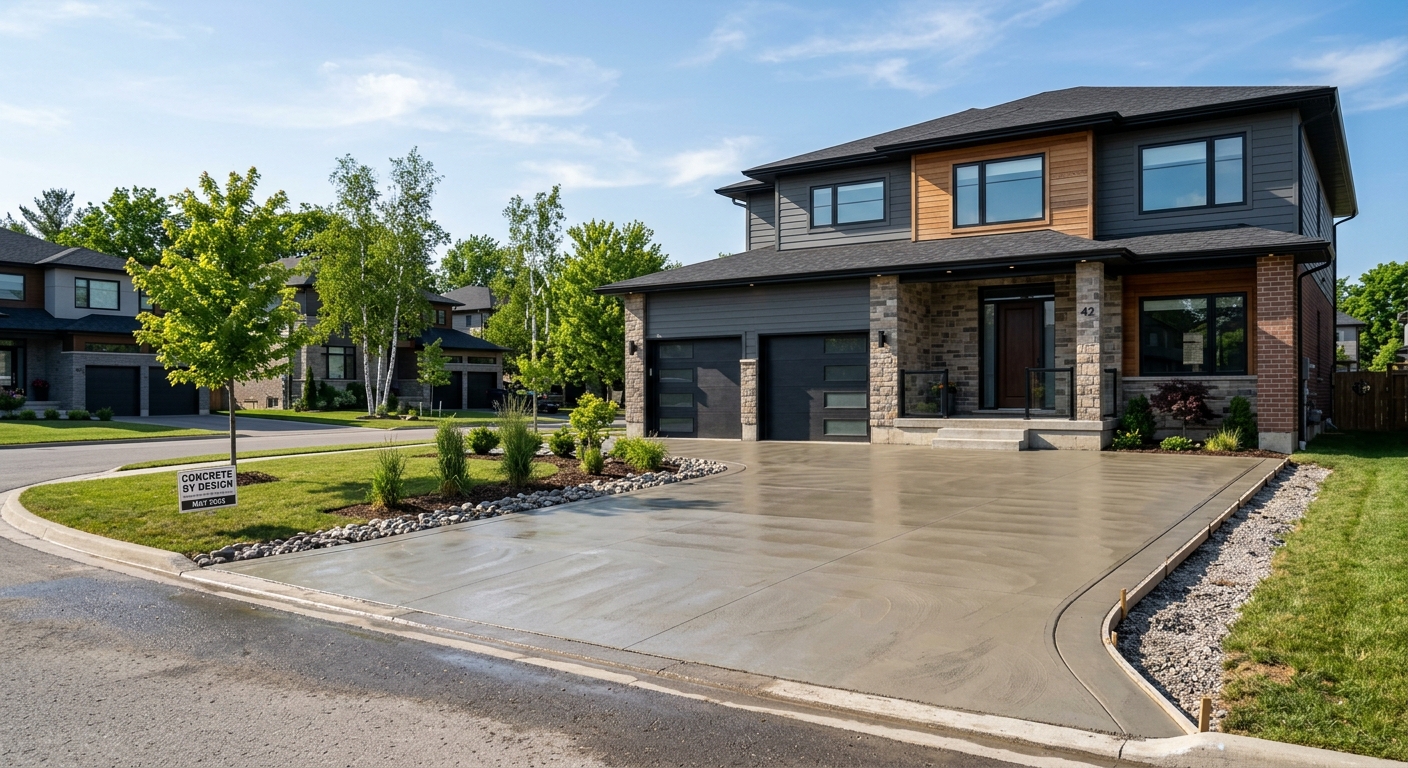
Concrete work options and costs in British Properties
In British Properties, concrete work is a practical choice for homeowners who want durable flatwork that can handle the Lower Mainland–Southwest’s coastal-wet conditions and frequent freeze–thaw cycles. British Properties is a relatively small market (population 3,800, Statistics Canada, 2021 Census), so the most in-demand work—driveways, patios, and steps—often gets scheduled quickly when crews are available in the Vancouver–Burnaby corridor. In this neighbourhood, many properties are higher-end lots where access, staging, and careful base prep matter as much as the concrete itself; you’ll typically see concrete flatwork tied to single-detached home renovations and upgrades, where replacing a worn asphalt driveway or expanding patio space is common.
Pricing here is shaped by the region’s shallow-but-critical frost depth assumptions (practice typically targets around 450 mm / 18" design frost protection), which means exterior footings and thickened edges must sit below that frost zone to reduce frost heave. Even with mild winters, the freeze–thaw cycling and saturated soils drive the need for air-entrained mixes, proper drainage, and longer curing plans during cool, humid stretches. That’s why two quotes for the same driveway can differ: one contractor may include engineered subgrade prep, correct mix design, and rain-ready curing protection, while another may not.
If you’re comparing options, it helps to start with realistic per-scope ranges. For British Properties, demand is especially high in the Oakridge–Upper Caulfeild style hillside pockets where slopes and drainage are common—so base preparation and access costs tend to show up in the fine print. Use the table below as your baseline, then we’ll break down what moves the price up or down.
| Application |
Typical Size |
Key Spec |
Finish Option |
Price Range |
| Concrete driveway (standard broom finish) |
400 sq. ft. |
Air-entrained exterior mix, compacted granular base |
Broom finish, control joints, seal-ready surface |
$7,200–$11,200 |
| Exposed aggregate driveway |
400 sq. ft. |
Air-entrained mix, proper curing and wash timing |
Exposed aggregate, slip-resistant texture |
$9,000–$13,800 |
| Stamped concrete driveway or patio |
300 sq. ft. |
Air-entrained exterior mix, integral color (typ.) |
Stamp patterns + release color + seal |
$9,000–$14,700 |
| Plain concrete patio or walkway |
200 sq. ft. |
Compacted granular base, control joints |
Float/trowel + broom edge (as applicable) |
$3,400–$5,200 |
| Garage floor (interior slab) |
500 sq. ft. |
Vapour barrier (as needed), wire mesh or fibres (typ.) |
Smooth finish + sealer (optional) |
$7,500–$14,000 |
| Foundation footings (structural, below frost) |
Per project allowance |
Below-design frost depth, reinforced concrete |
N/A (structural work) |
$12,000–$21,000 |
Prices are estimates only and vary by project scope, site access and material selection.
What affects the price of concrete work in British Properties
In British Properties and across the Lower Mainland–Southwest, it’s common to see concrete quotes for “the same” driveway or patio come in 30–50% apart from one contractor to another. The difference is usually not the concrete itself—it’s the items that protect performance: base depth and compaction, drainage detailing, correct air-entrainment, reinforcement choices, curing control, and whether rain scheduling is planned. Contractors also price labour differently depending on crew availability in the Vancouver–Surrey–Abbotsford corridor, and whether they include disposal, sawcutting, and seal-ready surface prep.
Frost line depth and freeze–thaw cycles dictate nearly every spec in this region. Exterior footings must extend below the design frost depth (in coastal BC that’s often around 0.5–1.2 m depending on site and design), and all exterior slabs generally use air-entrained concrete mixes to survive repeated wetting and cooling. When you’re farther inland or on colder hillside exposures, you may need deeper excavation and additional weather-protection steps—like insulating blankets or heated enclosures—which raises costs during pour season. De-icing salts (on steps, edges, and driveway approaches) also accelerate surface scaling if the surface isn’t sealed; good sealing and crack control joint planning cost more upfront but reduce expensive repairs later.
Here are a few real-world examples that move price in British Properties: replacing a failing driveway on a tight, sloped lot can add haul/disposal and staging time; a stamped or exposed-aggregate finish typically adds colour, stamping, wash timing, and extra labour compared with plain work (for context, stamped options often land in the $22–$36 per sq. ft. band, while basic patio/work is closer to $16–$26 per sq. ft.). Conversely, a simple flat walkway on firm, well-drained soil can land near the lower end, especially if forms and access are straightforward. Older housing stock and mature landscaping also matter—tree root removal and regrading can add hundreds to the thousands.
| Price Factor |
Why It Matters |
Cost Impact |
| Frost line depth — determines footing depth and form height |
Footings and thickened edges must be below frost to prevent heave. |
Can add substantial excavation and forming time. |
| Site preparation — excavation, grading, compacted granular base |
Proper base prevents settlement, pumping, and premature cracking. |
Major swing factor, especially on sloped or soft soils. |
| Reinforcement — rebar or wire mesh requirement |
Controls cracking and improves slab capacity under loads. |
Costs more material labour; reduces long-term repair risk. |
| Mix design — air-entrainment and compressive strength spec |
Air content and strength protect against freeze–thaw and scaling. |
Small material increase, big performance difference. |
| Finish type — broom vs. stamped vs. exposed aggregate |
Finish systems require more steps and tighter workmanship timing. |
Stamped/exposed typically costs more per sq. ft. |
| Pour size and concrete truck access to site |
Smaller, broken pours and limited access increase labour and mobilization. |
Can add pump/placing labour and extra setup charges. |
| Cold-weather curing precautions — heating and blankets |
Maintains strength gain when nights are cool or damp. |
Adds materials and labour; prevents weak surfaces. |
| Control joint pattern and sealing cost |
Joints manage shrinkage cracking; sealing protects against salts and water. |
Sealer and careful sawcutting add cost but reduce failures. |
Permits & regulations in British Columbia
In British Columbia, structural concrete work—such as footings, foundation walls, and grade beams—typically requires a building permit and often involves engineered drawings reviewed by the municipality. Concrete flatwork (patios, walkways, and driveways) usually does not require a permit when it’s staying within normal lot drainage practices, but permits can become necessary if the work affects lot grading, changes impervious surface coverage, or touches municipal right-of-way conditions (for example, if the scope includes boulevard work, curb modifications, or reconfiguring drainage paths). Before breaking ground in British Properties, confirm requirements with the local authority and ensure your contractor documents the scope correctly in writing.
Also verify the contractor’s coverage. Ask for proof of liability insurance and confirmation they have the proper workplace coverage for their crews (WSIB/WCB coverage, depending on the nature of the work and the employer setup). Then, request references from similar-scale concrete jobs—especially exterior flatwork in coastal-wet climates—so you can judge finishing, jointing, and drainage details.
Step-by-step verification (what to do before you sign): (1) Ask for their contractor registration details and licence information; check online using the appropriate provincial/registry search tools. (2) Request a certificate of insurance and verify dates and that general liability limits are appropriate for the project size. (3) Ask for their WSIB/WCB clearance/coverage letter or equivalent proof of standing. (4) Confirm the quote includes permit responsibility (if needed), protection measures for adjacent landscaping, and disposal/hauling. If they can’t provide documents quickly, treat it as a red flag.
Getting concrete right in British Properties's freeze-thaw climate
Concrete can fail in British Properties most often due to water management and freeze–thaw exposure: saturated subgrade, weak or non-air-entrained concrete, and delayed or improper curing lead to scaling and spalling—especially on driveway edges, steps, and shaded patio corners. To spec the job correctly, you want five layers of protection: base preparation, mix design, jointing, curing, and sealing.
First, base prep: use a compacted granular sub-base to the right depth for the site’s frost and soil conditions. Even with a shallow frost depth target in coastal BC (typical practice uses around 450 mm / 18" as a design reference), footing and thickened sections must be placed below the design frost zone to prevent frost heave. Second, mix design: for exterior flatwork, specify air-entrainment (commonly 5–7% air by design) and a minimum 32 MPa compressive strength. Third, control joints: plan spacing so shrinkage cracks form where they’re meant to. Fourth, curing: plan a minimum 7-day curing period under proper conditions; in cool, humid weather, contractors often add curing blankets or sealers to protect surface strength gain. Fifth, sealing: apply a penetrating sealer after the slab has cured (commonly around 28 days) to repel de-icing salts and reduce water intrusion.
To avoid the most common failure—spalling caused by inadequate air-entrainment—ask your contractor to state the mix air target and show how they’ll protect the pour from rain and cool nights. A quick dollar example: if a plain broom driveway quote at about $18–$28 per sq. ft. seems “too cheap,” the savings may be coming from omitting air-entrainment controls or skimping on base prep. In that case, you may end up paying again sooner—often a bigger cost than the difference between finishes like broom vs. stamped.
| Spec |
Why It Matters in British Properties |
What to Ask For |
Impact if Skipped |
| Compacted granular base (depth?) |
Correct thickness and compaction prevent settlement and keep the slab stable through wet seasons. |
Base depth tied to site conditions and drainage, with compaction testing (where appropriate). |
Uneven slabs, early cracking, pooling water, and faster deterioration. |
| Air-entrained concrete mix (target air %?) |
Air voids help concrete resist freeze–thaw scaling in coastal-wet cycles. |
Air-entrainment target typically 5–7% for exterior flatwork. |
Surface scaling and spalling, especially near edges and shaded areas. |
| Compressive strength (MPa rating) |
Strength gain supports durability under moisture and load. |
Specify minimum 32 MPa (or higher if engineered drawings require). |
Lower durability and higher risk of damage during curing and early use. |
| Control joints (spacing per ACI guidelines) |
Joints provide a predictable place for shrinkage cracks to occur. |
Joint spacing plan matching slab thickness and dimensions; sawcut timing described. |
Random cracking across the visible surface, leading to costly repairs. |
| Minimum 7-day curing period |
Proper curing is crucial in cool, humid weather to reach strength gain safely. |
Minimum 7-day curing plan; what happens if rain/cool nights occur. |
Weak surface, early wear, and reduced resistance to freeze–thaw damage. |
| Penetrating sealer (when applied after cure) |
Sealers reduce water and de-icing salt penetration, improving long-term durability. |
State sealer type and apply after cure (commonly ~28 days). |
Faster scaling/spalling and more frequent maintenance. |
How to choose a concrete work contractor in British Properties
Choosing a concrete contractor in British Properties comes down to verification, scope clarity, and workmanship accountability. Start with British Columbia licensing and documentation: ask for the contractor’s licence/registration details and confirm they carry liability insurance. For workers on the job, request proof of WSIB/WCB coverage (or equivalent clearance documentation) so you aren’t exposed to payroll/workplace claims. Don’t rely on verbal assurances—ask for certificates and screenshots of clearance status, then review the dates before work starts.
Next, get 2–3 quotes that are itemised. You want a breakdown that shows labour and materials separately (excavation/grading, granular base, reinforcement, formwork, concrete supply, finishing, sawcutting, and sealing). Avoid lump sums without a description of excluded work. Specifically ask: is permit pulling included if required, who pays for disposal/hauling, and who handles protection for lawns, drainage features, and existing steps/retaining edges?
Warranty matters: confirm a workmanship warranty length and what it covers (often cracking due to control joint planning and delamination issues due to curing). Ask whether the product/manufacturer warranty is included and whether it’s transferable if you sell the home. Payment schedule should be conservative—never pay more than 10–15% upfront; use a holdback until completion and walkthrough sign-off. Finally, get a start date and a completion estimate in writing, with weather contingency language for cool or rainy periods.
- Confirm provincial licence/registration details before scheduling the pour.
- Verify liability insurance certificate (limit, effective dates, jobsite/project name).
- Request WSIB/WCB coverage proof or clearance documentation.
- Ask for 2–3 references from similar exterior flatwork in coastal-wet conditions.
- Get itemised quotes: labour, materials, equipment, disposal, and finishing steps.
- Confirm concrete mix spec: air-entrainment target and minimum compressive strength.
- Ask about base prep: granular depth and compaction approach for your soil.
- Ensure joint plan is included: spacing, sawcut timing, and where joints will fall.
- Clarify curing protection for rain/cool nights (blankets, sealers, covering plan).
- Ask whether sealing is included, and when it will be applied after cure.
- Confirm truck access plan (placement method, pumping/follow-up costs if needed).
- Use a payment schedule with a holdback until final cure/cleanup and walkthrough.
Concrete red flags in British Properties include: quotes that omit air-entrainment specs for exterior slabs, refusing to discuss base depth/compaction or drainage details, providing a vague “one price” without jointing/cure/sealer scope, asking for large upfront payments (over 10–15%), and inconsistent timelines with no rain/cold-weather contingency plan.
Frequently asked questions — concrete work in British Properties
What is the difference between concrete and cement?
Concrete is the final building material you see and walk on—it’s a mix of cement, water, sand, and gravel (aggregate), plus other additives when needed. Cement is one ingredient inside concrete. For exterior work in British Properties, the concrete recipe matters because it must resist coastal-wet conditions and freeze–thaw cycles. That’s why contractors specify things like air-entrainment and a minimum compressive strength (often minimum 32 MPa for typical exterior flatwork). If a quote only says “concrete” without discussing the mix design, air target, and curing plan, you’re missing key performance details. A good contractor will be able to explain the mix selection for driveways, patios, and foundation work—especially where saturated soils and cool nights can cause early surface scaling.
How much does concrete work cost in British Properties?
Concrete pricing in British Properties generally depends on finish type, access, and base preparation—not just square footage. For context, driveway and slab work commonly ranges about $18–$28 per sq. ft. for standard concrete, while stamped/decorative systems often land closer to the $22–$36 per sq. ft. band. Patios and walkways are often around $16–$26 per sq. ft. The biggest movers in this area are excavation depth for drainage and frost protection details, compacted granular base, reinforcement needs, and whether the contractor includes sealing and a rain/cool-weather curing plan. As a reference point, a 400 sq. ft. standard broom driveway might land around the middle of the driveway band, while a stamped patio could come in much higher due to colour and additional labour. Always compare quotes that list what’s included—especially sealer, joints, and curing protection.
How deep must footings be for British Properties's frost line?
In British Columbia’s Lower Mainland–Southwest area, design and construction practice typically assumes a frost depth around 450 mm / 18" for frost protection concepts, but actual footing depth is determined by engineered requirements and local geotechnical conditions. For footings and structural foundations in British Properties, the critical principle is that they must be placed below the design frost zone to reduce frost heave risk. Because soil type, drainage, and slope exposure vary widely across the neighbourhood, your contractor should follow the design package provided by the engineer and the municipal requirements (when structural work is permitted). If there’s no engineering or geotechnical basis in place, that’s a concern—footings should not be guessed. Ask your contractor how they’re determining depth below frost for your specific site conditions and whether an engineer is involved for structural foundation elements.
Why does concrete crack in British Properties and how is it prevented?
Concrete cracks in British Properties mainly due to shrinkage and movements driven by moisture and temperature changes. Coastal-wet cycles and freeze–thaw exposure also contribute when water isn’t managed well. The prevention strategy is to control where cracking happens and to reduce water pathways: build the correct compacted granular base, use air-entrained concrete for exterior durability, and design a control joint layout that matches slab dimensions and thickness. Timing matters—sawcuts need to be placed at the right point so shrinkage cracks form in the joints rather than randomly. Proper curing also improves early strength and surface integrity. Finally, sealing after cure helps reduce water and de-icing salt intrusion. A common mistake is skipping joint planning or using the wrong mix; the result can be random cracking and accelerated surface scaling, especially on driveways and edges exposed to wetting and later freezing.
Stamped vs broom-finish concrete — cost difference?
Stamped concrete typically costs more than broom-finish because it adds multiple extra steps: formwork and base prep still apply, but you also have integral colour (or topping colour), a stamping operation, release agents, and additional finishing/timing coordination. In British Properties, stamped concrete often falls in the $22–$36 per sq. ft. band, while standard broom-finish driveway work is commonly around $18–$28 per sq. ft. The difference is usually justified when you’re covering a larger visible area (driveways, patios, and entries) where the decorative finish adds value and you can maintain the slab with sealing and joint discipline. If a quote for stamped work is close to broom-finish pricing, ask what’s excluded—sometimes the contractor doesn’t include full staining/release, correct curing/seasonal protection, or sealer. Always insist on the mix spec and joint plan in both options; finish alone doesn’t protect against freeze–thaw damage.
When is the best time to pour concrete in British Properties?
The best time to pour concrete in British Properties is during periods with stable temperatures and manageable rain risk—typically late spring through early fall—when crews can achieve proper curing without needing heavy weather protection. Even though the Lower Mainland–Southwest has mild winters compared to interior and northern BC, cool nights and high humidity are still enough to slow curing and increase surface risk if not managed. For exterior slabs, contractors plan around precipitation and temperature swings, often using curing blankets, sealers, and longer cure timelines to reach the required strength. If you must pour in colder or damp stretches, the contractor should describe cold-weather precautions (insulating blankets, heating where appropriate, and how they protect the slab from rain during the early set). Ask your contractor how they schedule pours and what their plan is if rain or cool nights occur—this is one of the biggest drivers of long-term durability.