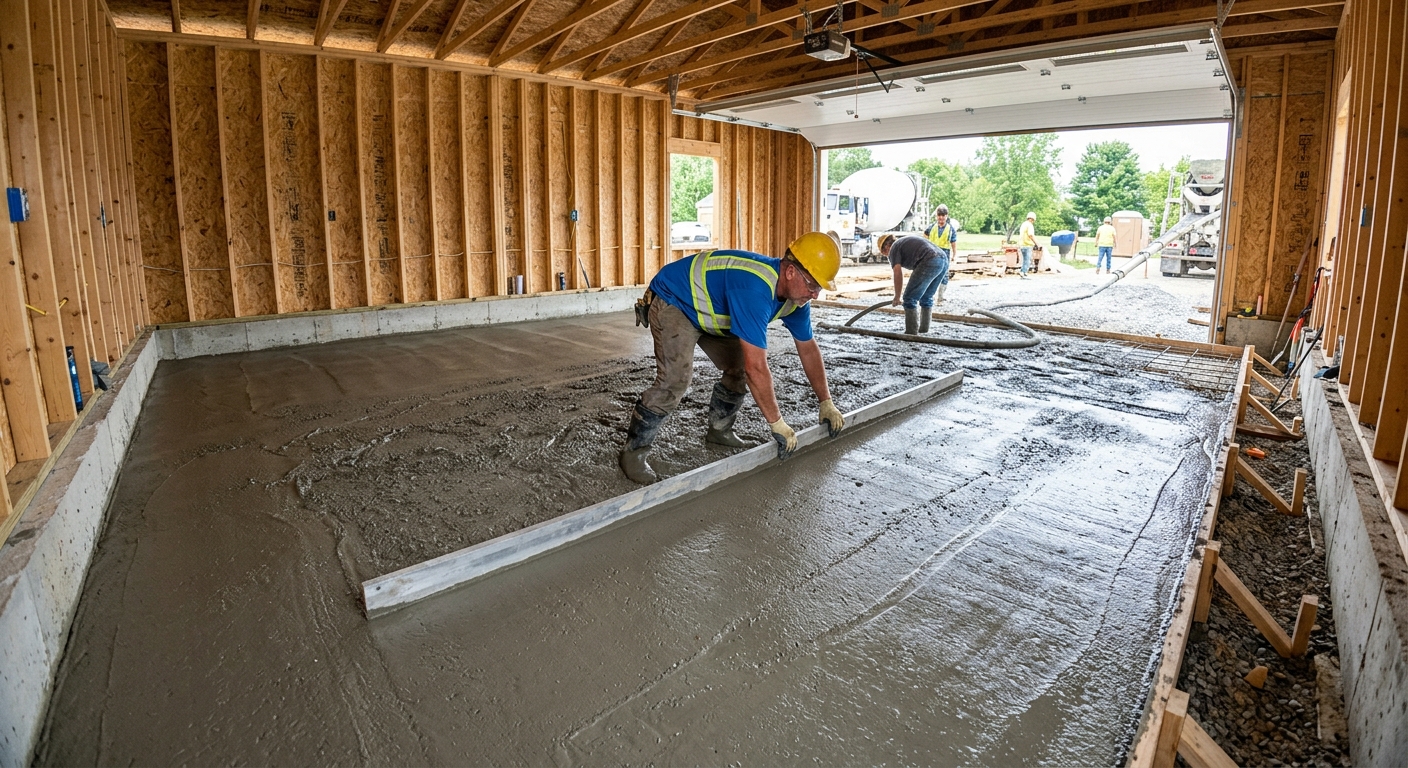
Concrete work options and costs in West Clayton
In West Clayton, concrete flatwork and foundations are a big part of day-to-day home improvements—especially as the neighbourhood’s housing mix grows and property owners upgrade curb appeal. With a population of 13,102 (Statistics Canada, 2021 Census), the Lower Mainland–Southwest keeps a steady demand for driveways, patios, and foundation work in the Vancouver–Surrey–Abbotsford corridor. In this area, concrete contractors are busiest in the spring and early fall, when scheduling is easier and weather windows are more reliable.
Pricing is influenced by our coastal-wet climate and the shallow-but-real frost exposure. Even though frost depth in coastal BC is typically about 0.5–1.2 m, we still design footing and thickened edges to sit below the design frost depth to reduce freeze–thaw heave risk. That means the “same size” job can cost meaningfully more if your soil conditions require deeper excavation, improved drainage, or additional granular base. Frequent freeze–thaw cycles, saturated soils, and cool, humid curing conditions drive mix selection (typically air-entrained for exterior slabs) and longer protection/curing time—so labour and materials aren’t a quick plug-in.
In West Clayton, trades are especially in demand around the more established residential pockets near 20 Avenue and the surrounding streets, where homeowners commonly replace older cracked aprons and add patios for backyards. Below is a comparison of typical concrete options, then we’ll walk through what drives pricing up or down.
| Application |
Typical Size |
Key Spec |
Finish Option |
Price Range |
| Concrete driveway (standard broom finish) |
400–500 sq. ft. |
Air-entrained exterior mix, compacted granular base |
Broomed surface + control joints |
$7,200–$12,500 |
| Exposed aggregate driveway |
400–500 sq. ft. |
Air-entrained exterior mix, retarder/stone exposure process |
Exposed aggregate + seal-ready finish |
$9,500–$15,800 |
| Stamped concrete driveway or patio |
300–450 sq. ft. |
Air-entrained exterior mix, colour hardener/antichrome as needed |
Stamp texture + integral colour |
$9,000–$16,200 |
| Plain concrete patio or walkway |
200–350 sq. ft. |
Air-entrained exterior mix, compacted sub-base |
Float finish + light broom edge |
$3,500–$7,900 |
| Garage floor (interior slab) |
450–600 sq. ft. |
Vapour barrier, edge insulation as required, standard curing |
Broom/steel trowel finish + saw cuts |
$7,500–$13,500 |
| Foundation footings (structural, below frost) |
~1,000–2,000 lin. ft. (project dependent) |
Below frost depth, reinforced, engineered as required |
Concrete/steel foundation work |
$200–$350 |
Prices are estimates only and vary by project scope, site access and material selection.
What affects the price of concrete work in West Clayton
In the Lower Mainland–Southwest, two quotes for the same concrete project can differ by 30–50% because concrete is less about “pouring” and more about design details that protect the slab and foundation through our cycles of coastal moisture and freeze–thaw. Contractors in this region price base prep, mix design, reinforcement, curing protection, and access as a system—then schedule it within limited pour windows when rain and cool nights are manageable. That’s why you may see a plain patio bid differently than a decorative stamped job even when the square footage looks similar.
Frost line depth and freeze–thaw cycles dictate nearly every exterior spec in our region. Footings must extend below the design frost depth (in coastal BC commonly around 0.5–1.2 m) to prevent frost heave. All exterior slabs typically use air-entrained concrete mixes to survive freeze–thaw scaling risk. Colder regions force deeper excavations and add cold-weather curing precautions; here in West Clayton we still need the right curing plan because cool, humid weather can slow strength gain. De-icing salts also accelerate surface spalling—so sealing and proper jointing matter for longevity.
Cost differences also show up in practical, West Clayton examples. If your driveway ties into an older apron with poor drainage, base reconstruction can add labour and granular costs quickly—often pushing you toward the higher end of the driveway range (for example, $18–$28 per sq. ft. for a typical driveway / slab). If you want stamped concrete, the added finishing time and materials (stain/colour system, stamps, release agents) usually land in the higher decorative band (often $22–$36 per sq. ft.), but it’s justified when you’re also replacing the full surface rather than patching. On patios and walkways, simpler broom-finish work can stay near the lower band (e.g., $16–$26 per sq. ft.), provided the base is rebuilt correctly.
| Price Factor |
Why It Matters |
Cost Impact |
| Frost line depth — determines footing depth and form height |
Footings must be below design frost to reduce frost heave in freeze–thaw cycles |
Higher excavation depth increases labour and concrete quantity |
| Site preparation — excavation, grading, compacted granular base |
Saturated soils and coastal rainfall require proper subgrade drainage and compaction |
Over-excavation and hauling can add significant cost |
| Reinforcement — rebar or wire mesh requirement |
Reinforcement controls cracking and improves durability in exterior slabs |
More steel + tying time increases material and labour |
| Mix design — air-entrainment and compressive strength spec |
Air-entrainment helps exterior concrete resist scaling from freeze–thaw |
Specified mix can cost more and may require longer batching lead times |
| Finish type — broom vs. stamped vs. exposed aggregate |
Decorative systems require extra labour steps and materials |
Stamped/exposed finishes raise costs relative to broom finishes |
| Pour size and concrete truck access to site |
Limited access increases labour for wheelbarrows/pumping and can limit pour timing |
Pumping, extra crew time, or smaller batch logistics add cost |
| Cold-weather curing precautions — heating and blankets |
Cool nights and humidity can slow strength gain and increase surface damage risk |
Blankets/heating labour and materials can add dollars per day of protection |
| Control joint pattern and sealing cost |
Jointing limits random cracks; sealing helps with de-icing salts and water exposure |
Better joint layout and sealer are often small cost items with big payback |
Permits & regulations in British Columbia
In British Columbia, structural concrete work usually needs a building permit, and municipalities often expect engineered drawings for foundations. This includes footings, foundation walls, grade beams, and other load-bearing structural elements. For concrete flatwork like patios, walkways, and driveways, permits are typically not required unless the work affects lot grading, changes drainage/impervious surface coverage limits, or involves municipal right-of-way areas. Because local requirements can vary, confirm with the local authority before you break ground in West Clayton.
For your contractor, it’s equally important to verify insurance and worker coverage before any excavation starts. Structural work should be done by a contractor carrying liability insurance, and the company should have the appropriate WCB/WSIB coverage (as applicable in BC) for its workers. Don’t accept “we’re covered” without proof.
Step-by-step homeowner checklist in BC:
- Ask for the contractor’s business name, then confirm licensing/standing through the BC online registry or the appropriate provincial listing for their trade class.
- Request a current certificate of insurance (COI) showing liability coverage and dates.
- Request proof of coverage for workers (WCB/worker protection documentation) and verify it is current.
- If structural elements are involved, ask whether engineered drawings are being reviewed/used and whether the permit is being pulled under the project.
- Ask for references from similar-scale concrete jobs in the Lower Mainland–Southwest, especially wet-climate exterior work.
Getting concrete right in West Clayton's freeze-thaw climate
Concrete failures in West Clayton are usually about water management and freeze–thaw protection, not about “bad luck.” Exterior slabs can spall or scale when the mix isn’t properly air-entrained, when joints are missing or incorrectly spaced, or when the base wasn’t compacted and drained for local soils. With coastal-wet weather and frequent wetting, water finds weak points—edge conditions, around forms, and at joints—then expands during cool nights. That’s why a correct spec focuses on base prep, mix design, joints, curing, and sealing as a full package.
To spec the job correctly, start with (1) base preparation: excavate to the right depth for compacted granular sub-base, then compact in lifts so it doesn’t pump or settle later. (2) Use a mix design with air-entrainment (commonly 5–7% air content for exterior flatwork) and a minimum 32 MPa compressive strength spec where required for durability. (3) Control joints should be placed to limit random cracking, especially on driveways and patios exposed to repeated moisture. (4) Curing is critical: plan for at least 7 days of proper curing, and in cool or rainy stretches use protective measures so strength gain isn’t interrupted. (5) Seal with a penetrating sealer after the concrete has cured—typically around 28 days—so water and de-icing salts don’t penetrate.
Here’s a practical dollar example: if one quote offers a broom-finish driveway at the low end of the range (around $18 per sq. ft.) but skips proper air-entrainment and jointing details, you may save money upfront yet pay later for patching, lifting, or resurfacing. A well-specified driveway—especially when you’re replacing the full slab—often lands closer to the mid band (up to $28 per sq. ft.), but it’s the difference between “looks good at handover” and “holds up through seasons.”
| Spec |
Why It Matters in West Clayton |
What to Ask For |
Impact if Skipped |
| Compacted granular base (depth?) |
Reduces settlement and helps manage saturated subgrade from coastal rainfall |
Confirm excavation depth, granular type, lift thickness, and compaction testing/targets |
Cracking, surface unevenness, and premature failures |
| Air-entrained concrete mix (target air %?) |
Improves resistance to scaling and spalling during freeze–thaw |
Request air content target (typically 5–7% for exterior flatwork) and confirm mix is air-entrained |
Spalling, flaking, and loss of surface durability |
| Compressive strength (MPa rating) |
Strength gain supports durability in damp, cool conditions |
Specify minimum 32 MPa (or project-required rating) and curing conditions |
Higher risk of surface damage and reduced long-term performance |
| Control joints (spacing per ACI guidelines) |
Controls where cracks happen as the slab shrinks and expands |
Ask for joint spacing plan and whether saw cuts will be timed properly |
Random cracking and wider cracks that admit water |
| Minimum 7-day curing period |
Cool nights can slow strength gain and increase early-age damage risk |
Ask for curing method (blankets/sealers/curing compound) during the first week |
Weaker concrete, surface deterioration, and joint edge breakdown |
| Penetrating sealer (when applied after cure) |
Helps repel water and de-icing salt intrusion common in exterior driveways |
Confirm application after cure (commonly around 28 days) and product type |
Faster water absorption, staining, and salt-related deterioration |
How to choose a concrete work contractor in West Clayton
Start by verifying British Columbia licensing/standing and insurance before you compare prices. A valid business listing helps you avoid fly-by-night crews, but it’s the documentation that matters most: request a current certificate of liability insurance and confirm it covers the specific work scope (driveways, patios, foundations) and the dates of service. For worker coverage, ask for proof of worker protection coverage for their crew (WCB/WSIB documentation as applicable in BC) so you’re not stuck if someone is injured on your property.
Then get 2–3 itemised written quotes. You want a breakdown that separates labour and materials and clearly lists inclusions like excavation, disposal, compacted granular base, reinforcement, concrete mix type (air-entrained for exterior), joints, curing plan, and sealing. Avoid “all-in” numbers with vague line items—on concrete jobs, scope gaps are where costs blow up. Ask: is the permit pull included (for structural work), is disposal included, and who handles trenching/drainage improvements if the subgrade is unstable?
Warranty should be in writing. Clarify workmanship warranty length (for example, crack control and spalling related to the concrete installation) and whether manufacturer product warranties apply to any sealers/admixtures and if they’re transferable to you. For payment, never pay more than 10–15% upfront. Hold back a portion until the forms are removed, joints are cut, and the final curing/sealing steps are complete. Finally, require a start date and completion estimate in writing, because wet weather in the Lower Mainland–Southwest can shift schedules quickly.
- Ask for proof of insurance (COI) with coverage limits and project dates.
- Request worker coverage proof (WCB/WSIB documentation as applicable).
- Confirm the contractor’s BC business listing/licensing standing.
- Get itemised labour + materials quotes (not one lump-sum line).
- Check that exterior work specifies air-entrained mix for freeze–thaw durability.
- Confirm base prep details: excavation depth, granular type, compaction approach.
- Verify reinforcement requirements (mesh/rebar) are included where needed.
- Ask about control joint plan and saw-cut timing.
- Confirm curing method (blankets/sealer/curing compound) for cool nights.
- Ask if penetrating sealer is included (and when it’s applied after cure).
- Review exclusions: disposal, rerouting downspouts, minor grading/landscaping ties.
- Use a payment schedule with a holdback until the final walkthrough.
Concrete red flags in West Clayton include: (1) quotes that don’t mention air-entrainment or jointing details, (2) no written curing plan for cool/wet weeks, (3) large upfront payments (beyond 10–15%), (4) “poured yesterday, no saw cuts until later” timelines, and (5) vague scope language like “prep as needed” without excavation/base specs.
Frequently asked questions — concrete work in West Clayton
Stamped vs broom-finish concrete — cost difference?
In West Clayton and across the Lower Mainland–Southwest, stamped concrete costs more mainly because of the extra finishing steps (colour systems, release agents, stamping, and more labour time). A broom-finished driveway typically sits in the standard driveway/slab band of about $18–$28 per sq. ft., while stamped decorative concrete commonly falls into the $22–$36 per sq. ft. range depending on pattern complexity and whether it’s a driveway or patio. If you’re comparing quotes, ensure both include similar base prep, air-entrained concrete for exterior durability, and the same joint/sealing approach—otherwise the cheaper bid may be leaving out the parts that protect against freeze–thaw scaling.
When is the best time to pour concrete in West Clayton?
The best time is when you have stable temperatures and manageable rain—usually late spring through early fall—because cool nights and prolonged wet weather slow curing and increase risk to fresh concrete surfaces. In coastal BC, you can still pour earlier or later, but crews need protective measures like curing blankets and careful scheduling. Ask contractors how they plan around rain forecasts, high humidity, and any temperature drops that could affect early strength gain. For driveways and patios, aiming for a weather window that allows proper curing (at least 7 days) is what protects the slab’s long-term performance, not just the calendar date.
How long does concrete take to cure?
Concrete strength develops over time. For day-to-day protection and risk management, most exterior work expects at least 7 days of proper curing under the right conditions, with better durability as curing continues. Full design strength can take longer, which is why sealing is typically planned after the concrete has cured sufficiently—commonly around 28 days—especially if you get de-icing salts and wet driving conditions in British Columbia. If a contractor wants to open traffic early, or if they skip curing blankets when nights are cool, you can end up with a surface that looks fine but performs poorly through the region’s freeze–thaw cycles.
Do I need a permit for concrete work in British Columbia?
In British Columbia, structural concrete such as footings, foundation walls, and grade beams typically requires a building permit and often engineered drawings reviewed by the municipality. Concrete flatwork—like patios, walkways, and most driveways—usually does not require a permit unless it changes lot grading, drainage, impervious surface coverage, or involves right-of-way impacts. For West Clayton homeowners, the safest move is to confirm with your local authority before work starts, especially if you’re altering drainage, adding substantial new surfaces, or tie-ins to existing foundations. A reputable contractor should also be clear about whether they’re pulling permits where required and who is responsible for the paperwork.
Concrete vs pavers for a patio in West Clayton?
Concrete and pavers can both be good in West Clayton, but they solve the climate problem differently. Concrete patios are usually faster to build and can be very durable when you have correct base prep, air-entrained mix, well-planned control joints, and proper curing. Pavers can be easier to repair section-by-section if a localized area shifts, but the base still needs to be built correctly to avoid uneven settling in wet soils. In terms of typical pricing, a plain concrete patio or walkway often falls around $16–$26 per sq. ft., while stamped decorative concrete can run higher (often $22–$36 per sq. ft.) depending on the finish. Your best choice depends on whether you want a monolithic surface with joint lines or a modular system that can be lifted and reset.
How long does a concrete driveway last?
A well-built concrete driveway in the Lower Mainland–Southwest often lasts many years, but longevity depends heavily on what’s underneath. For West Clayton, the key durability factors are: air-entrained exterior concrete for freeze–thaw scaling resistance, a properly compacted granular base with good drainage, and correctly spaced control joints plus sealing after cure. If the contractor cuts corners—like using a non-air-entrained mix, skipping base rebuild, or failing to seal—the driveway can start showing surface scaling or cracking much sooner, especially with wet coastal conditions and de-icing salt exposure. If you’re choosing between bids, compare the specs. A driveway in the $18–$28 per sq. ft. band can last well when built right; the “cheap” end that misses critical details may cost more over time.