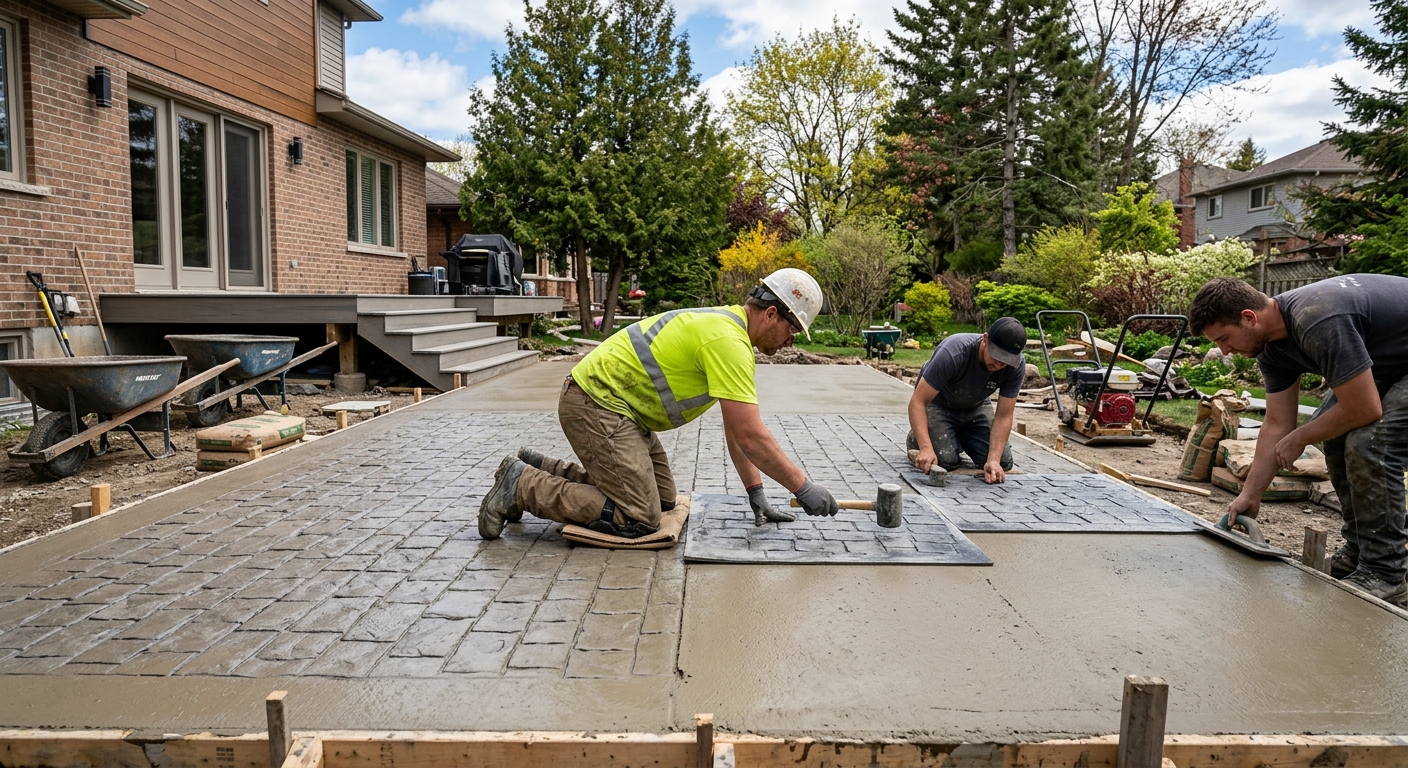
Concrete work options and costs in South Slope
In South Slope, concrete is one of the most common exterior upgrades, especially for homeowners in the Lower Mainland–Southwest where weather swings and coastal moisture put real stress on slabs. South Slope has a population of 12,782 (Statistics Canada, 2021 Census), and the housing stock here is heavily oriented toward single-detached family homes—exactly the type of property that drives demand for driveways, patios and walkways. That demand shows up most in areas around Grandview Highway and the South Slope neighbourhood core, where renovations and new builds compete for the same crews and concrete trucks.
Pricing is shaped by our local freeze–thaw cycle and shallow frost line (typical design practice assumes about 450 mm / 18" in this part of BC). Footings, piers and thickened edges still need to sit below frost to manage freeze heave, and exterior flatwork needs air-entrained concrete plus proper control joints to reduce scaling and cracking. Coastal-wet conditions also affect scheduling and curing: prolonged rain, cool nights and high humidity often mean longer cure times, curing blankets or sealers to protect surfaces from moisture and de-icing salts. That’s why the same driveway can land 10–20% apart depending on access, subgrade drainage, and whether the job can be poured and kept on-grade during a dry window.
Below are practical, homeowner-facing options and typical cost bands for South Slope. Use these ranges as the backbone when comparing proposals, then tighten the scope in the site-visit details.
| Application |
Typical Size |
Key Spec |
Finish Option |
Price Range |
| Concrete driveway (standard broom finish) |
400–600 sq. ft. |
Compacted granular base, air-entrained concrete |
Broom finish, control joints, optional sealer |
$18,000 – $28,000 |
| Exposed aggregate driveway |
400–600 sq. ft. |
Air-entrained mix, properly cured before wash |
Exposed aggregate (sandblasted/wash system) |
$22,000 – $33,000 |
| Stamped concrete driveway or patio |
300–550 sq. ft. |
Air-entrained, integral colour, release system |
Stamp pattern + protective sealer |
$22,000 – $36,000 |
| Plain concrete patio or walkway |
150–350 sq. ft. |
Air-entrained exterior slab, drainage-minded base |
Float + broom or light broom finish |
$16,000 – $26,000 |
| Garage floor (interior slab) |
400–650 sq. ft. |
Vapour barrier (if specified), engineered base build-up |
Steel trowel finish, saw-cut joints |
$12,500 – $22,000 |
| Foundation footings (structural, below frost) |
Varies by house plan |
Excavation to frost depth, rebar mat/bars as required |
Structural concrete, formwork + inspection-ready |
$8,000 – $35,000 |
Prices are estimates only and vary by project scope, site access and material selection.
What affects the price of concrete work in South Slope
In the Lower Mainland–Southwest, quotes for “the same” concrete job can swing by 30–50% because the hidden costs are usually in base prep, reinforcement, and weather scheduling—not just the concrete itself. Concrete is a commodity; the expensive part is the build-up beneath it: removing unsuitable soils, handling groundwater, compacting granular base to the right depth, and building forms and steel to the spec that survives South Slope’s wet winters and freeze–thaw cycles.
Frost depth and freeze–thaw cycles dictate the design. In colder regions, footings and thickened edges must go deeper than in coastal BC to prevent frost heave. For Lower Mainland projects, typical practice assumes around 450 mm / 18" design frost depth, but that still means footings and piers must be placed below frost for exterior structural elements. Exterior slabs also need air-entrained concrete to resist scaling and micro-cracking as temperatures swing. When weather is cool and rainy, crews plan around prolonged dampness and shorter cure windows; cold-weather curing precautions (insulating blankets, sometimes heat) add cost when pours can’t proceed in a favourable stretch. Surface durability matters too: de-icing salts accelerate spalling if the mix air content and curing aren’t right—so sealing becomes part of the “real” cost for driveways.
Two practical examples from South Slope: (1) A standard broom driveway might land in the $18–$28 per sq. ft. backbone, but if your soil is wet or springy, excavation and a properly drained granular base can push the job toward the higher end. (2) Stamped concrete can be costlier in the $22–$36 range, and that price difference is justified when the prep includes correct base thickness, integral colour, and a proper sealing schedule—otherwise the surface can look great day one and fail prematurely.
| Price Factor |
Why It Matters |
Cost Impact |
| Frost line depth — determines footing depth and form height |
Footings must be below design frost to limit freeze heave. |
Higher excavation and formwork when depths increase. |
| Site preparation — excavation, grading, compacted granular base |
Wet or poor subgrade leads to settlement and early cracking. |
Adds truck time, disposal and labour; can shift quote by 15–25%. |
| Reinforcement — rebar or wire mesh requirement |
Reduces cracking and controls slab movement under loads. |
Steel and tying/walk-back time increase material and labour. |
| Mix design — air-entrainment and compressive strength spec |
Air entrainment helps resist freeze–thaw scaling and surface damage. |
Higher-spec mix may cost more but improves longevity. |
| Finish type — broom vs. stamped vs. exposed aggregate |
Finishes require different labour, timing and curing discipline. |
Stamped/exposed typically cost more than plain broom. |
| Pour size and concrete truck access to site |
Long carries reduce efficiency; tight access needs planning. |
May add pump/placement time or change scheduling. |
| Cold-weather curing precautions — heating and blankets |
Cool nights slow strength gain and can weaken early durability. |
Can add crews/equipment time during rain/cool spells. |
| Control joint pattern and sealing cost |
Joints control where cracks form; sealing protects from salt/moisture. |
Correct spacing can reduce callbacks; sealer is a line item. |
Permits & regulations in British Columbia
In British Columbia, structural concrete work generally requires a building permit, and many projects also depend on engineered drawings that get reviewed by the municipality. That includes concrete for foundation walls, grade beams, grade-appropriate footings, and load-bearing foundation elements. For concrete flatwork like driveways, patios and walkways, permits are often not required unless the work affects lot grading, drainage, impervious surface coverage limits, or the municipal right-of-way (for example, work that ties into a curb/gutter or changes runoff pathways).
To verify a contractor in South Slope, step through this checklist before you sign:
- Ask for their BC business/contractor registration information and confirm they’re operating legally.
- Request liability insurance (certificate of insurance) and ensure coverage limits are appropriate for concrete work at residential sites.
- Confirm WCB coverage (workers’ compensation) status or clearance letter, as applicable to their workforce.
- Verify they understand local drainage and slab control-joint requirements for our freeze–thaw climate.
- Check references on similar South Slope projects (driveways/patios in coastal-wet conditions).
If the scope includes structural elements, confirm permit responsibility in the contract (who pulls it, who pays, and who schedules inspections). If it’s flatwork, confirm whether any municipal approvals are needed due to drainage or right-of-way proximity.
Getting concrete right in South Slope's freeze-thaw climate
Concrete fails in South Slope when freeze–thaw cycles and moisture find weak points in the system—usually at the surface or the slab edge. The right way to spec the job is to treat base preparation, concrete mix, joints, curing and sealing as one package. First, base preparation must build a stable, compacted granular foundation to the depth that matches local soil conditions and provides correct frost protection below exterior elements. Second, specify an air-entrained mix for exterior flatwork (target about 5–7% air content) and a minimum compressive strength such as 32 MPa so the concrete achieves durability in our wet, temperature-fluctuating winters. Third, control joints should be laid out to limit random cracking; if joints are skipped or placed randomly, cracks will choose their own path. Fourth, curing matters: plan for at least 7 days of proper curing conditions, and if cold or rainy weather slows strength gain, curing blankets or other cold-weather measures may be needed.
Finally, sealing helps repel water and de-icing salts. A penetrating sealer is typically applied around 28 days after the pour (once curing is complete), which is a big deal for driveways and walkways exposed to winter maintenance.
When you’re comparing options, ask yourself where the price difference is truly justified. For instance, moving from a plain patio/sidewalk toward stamped concrete in the $22–$36 band isn’t about the mould—it’s about the added labour, integral colour steps, and the sealing discipline required for a long-lasting surface in coastal-wet conditions. The cheaper quote that skips air-entrainment or rushes curing can cost more later in patching or premature scaling.
| Spec |
Why It Matters in South Slope |
What to Ask For |
Impact if Skipped |
| Compacted granular base (depth?) |
Stable base controls settlement and protects exterior edges during freeze–thaw. |
Granular type, compaction method, and target lift depth for your soil. |
Premature cracking, uneven slab, edge failures. |
| Air-entrained concrete mix (target air %?) |
Air voids improve freeze–thaw resistance and reduce scaling/spalling risk. |
Confirm target air content (commonly 5–7% for exterior flatwork). |
Surface scaling and spalling, especially after winter de-icing. |
| Compressive strength (MPa rating) |
Ensures early and long-term performance under moisture and traffic loads. |
Minimum 32 MPa and curing plan to reach strength. |
Soft surface, reduced durability, increased patching. |
| Control joints (spacing per ACI guidelines) |
Controls where cracks occur in wet, temperature-cycling conditions. |
Joint layout plan and saw-cut timing. |
Random cracking patterns and unsightly, uneven repair needs. |
| Minimum 7-day curing period |
Strength gain is slower in cool nights and damp weather. |
Protection plan for rain/cold and curing blanket/sealer coordination. |
Lower strength, higher permeability and freeze damage. |
| Penetrating sealer (when applied after cure) |
Repels water and helps manage salt exposure on exterior surfaces. |
“Penetrating sealer after cure” at ~28 days (or per product spec). |
Faster deterioration and staining/roughness that reduces curb appeal. |
How to choose a concrete work contractor in South Slope
Start by verifying the basics, then move into scope and paper proof. In British Columbia, confirm the contractor’s licence/registration status (as applicable to their business activity) and ask for a certificate of insurance for liability coverage. For the workforce, request documentation showing WCB coverage (clearance letter or equivalent proof). Don’t rely on verbal assurances—read the COI details and ensure the named insured matches the contractor you’re hiring.
Next, get 2–3 itemised written quotes rather than a single lump sum. Look for a labour/material breakdown that shows the concrete mix spec (air-entrainment and strength), base preparation scope (excavation and compacted granular), reinforcement (rebar or mesh), forming and finishing, and whether sealing is included. Concrete jobs are sensitive to weather; a good quote should also mention how they schedule pours in the rainy, cool stretches typical of South Slope.
Read exclusions carefully: is permit pulling included where required, who handles disposal and trucking offsite, and what’s included for site access (forms, pump if needed, saw cutting, and joint sealing)? Ask about the warranty: workmanship coverage length, whether it covers cracks/spalling tied to mix or curing, and whether any product/manufacturer warranty is included and transferable.
Payment schedule matters. For residential concrete, don’t pay more than about 10–15% upfront. Holdback until completion and final curing/sealer steps are finished. Also insist on a start date and completion estimate in writing so rain delays don’t become cost increases without a change order.
- Ask for proof of WCB coverage and liability insurance before work starts.
- Request prior project photos in South Slope-like coastal-wet conditions.
- Demand an itemised quote showing base prep, reinforcement, mix spec and finishing.
- Confirm whether the concrete will be air-entrained for exterior flatwork.
- Check that control joint layout and saw-cut timing are included.
- Verify curing protection procedures for cool nights and rainy weather.
- Clarify if penetrating sealer is included and when it will be applied.
- Confirm excavation disposal, trucking distance and backfill/compaction responsibilities.
- Ask what’s excluded: existing concrete removal, grading changes, drainage ties.
- Ensure timelines reflect realistic curing (minimum 7 days) and not just the pour day.
- Review warranty details in writing, including what triggers service.
- Keep payment staged with a final holdback until punch list is cleared.
Concrete red flags in South Slope: a quote that doesn’t mention air-entrainment or curing protection, vague “we’ll fix it” warranty language, lowball pricing that omits base compaction or reinforcement, pressure to pay the full amount upfront, and schedules that ignore rain/dampness (no curing plan, no blankets/sealer timing).
Frequently asked questions — concrete work in South Slope
What is rebar and when is it required in British Columbia?
Rebar (reinforcing steel bars) strengthens concrete by adding tensile capacity where concrete is naturally weak in tension. In British Columbia, whether rebar is required depends on the structural design and the loads involved. For foundation elements like footings and foundation walls, rebar is commonly specified by engineers to meet strength and crack-control needs below frost. For flatwork like patios and driveways, rebar may be required when the slab is exposed to heavier loads or when the design includes specific reinforcement requirements (often influenced by thickness, soil conditions and span between edges). Because South Slope has a shallow frost depth but still experiences freeze–thaw cycles and wet saturation, the reinforcement decision should be tied to base preparation and slab thickness—not just tradition. Ask your contractor to state the reinforcement type (rebar vs. mesh), bar size, spacing, and cover requirements in the written scope.
How long does a concrete project take in South Slope?
Project duration in South Slope depends on scope and weather. Excavation and base prep typically take 1–3 days for standard residential flatwork, while forming, reinforcing and finishing can add another 1–2 days depending on access and finish complexity. The pour itself is usually a single day, but the job isn’t “done” until curing is protected and joints are completed. For exterior flatwork, plan for at least 7 days of curing before you treat the slab as fully serviceable. Rain can extend timelines: cool nights and high humidity slow strength gain, so crews may use curing blankets or protective coverings to manage schedule risk. If you’re comparing quotes, a stamped concrete driveway (often in the $22,000 – $36,000 band) usually needs extra time for integral colour, stamping workflow and careful curing discipline compared with a plain broom finish (often in the backbone $18–$28 range). Always get a written start date and completion estimate.
What is a concrete overlay and is it suited to South Slope?
A concrete overlay is a new concrete layer poured over prepared existing concrete, typically after grinding/chipping and cleaning, sometimes with bonding methods. It can be a good option when the original slab is structurally sound and only the surface is worn or uneven. In South Slope, overlay performance depends heavily on the condition of the original slab, drainage, and joint condition. Freeze–thaw cycles and coastal moisture can worsen problems if the underlying concrete already has active cracking, poor base support, or water intrusion pathways. If the old slab is pumping, sinking, or has widespread cracking, an overlay may fail prematurely because the new layer follows the old slab’s movement. For homeowners, overlays can be cheaper than full replacement when done correctly, but you should ask the contractor to inspect for lifting, spalling, and subgrade issues before budgeting. If sealing and drainage are poor, the overlay won’t fix the root cause.
How do I seal concrete to protect it in South Slope?
In South Slope and the Lower Mainland–Southwest, sealing is a practical protection step because wet winters, freeze–thaw cycles and de-icing salts can accelerate surface roughening and scaling. The key is timing and product choice. You generally want a penetrating sealer applied after the concrete has cured properly—commonly around 28 days post-pour, or per the sealer manufacturer’s instructions. Before sealing, the surface should be clean, dry and free of dust or curing residue. Ask your contractor what sealer they use and whether they’ll include surface prep in the scope (power washing/grinding and drying time). Sealing works best when the job already includes air-entrainment, correct curing, and properly spaced control joints; sealing can’t compensate for poor mix design. If you choose a finish like exposed aggregate or stamped concrete in the $22–$36 band, sealing also helps maintain the look and reduces water absorption that can dull colour over time.
What is the difference between concrete and cement?
Cement is a single ingredient—typically Portland cement—that acts as the binder. Concrete is the finished composite made from cement plus water, sand, gravel (coarse aggregate), and sometimes admixtures (like air-entrainment agents). Homeowners often hear “cement” used casually when they mean “concrete,” but what matters in a contractor’s quote is the performance of the concrete mix and how it’s placed and cured. In South Slope’s coastal-wet freeze–thaw climate, the concrete mix must be specified for exterior exposure, including air-entrainment for durability and a minimum compressive strength (commonly 32 MPa for many exterior scopes). Also, curing conditions and joint layout matter as much as the ingredient list. If a quote only says “good concrete” without confirming air content and strength spec, it’s not giving you the technical details that affect long-term spalling resistance.
How much does concrete work cost in South Slope?
Concrete pricing in South Slope varies with base prep, reinforcement, finish type and how weather affects scheduling and curing. As a starting point, typical backbone pricing for the area is roughly $18–$28 per sq. ft. for a concrete driveway/ slab and $16–$26 per sq. ft. for patios and walkways. Stamped and decorative work typically runs higher, around $22–$36 due to added steps like colouring, stamping workflow and finish protection. A standard broom-finished driveway may land in that $18–$28 backbone if the site soil is stable and access is straightforward. If excavation is deeper due to saturated subgrade or if drainage improvements are needed, costs can climb within the same finish category. For structural foundation footings, the structural scope is often quoted differently because dimensions depend on the engineered foundation design; your contractor should break down what “below frost” means for your specific house. Always compare itemised quotes so you’re not comparing concrete cost against different base and drainage scope.