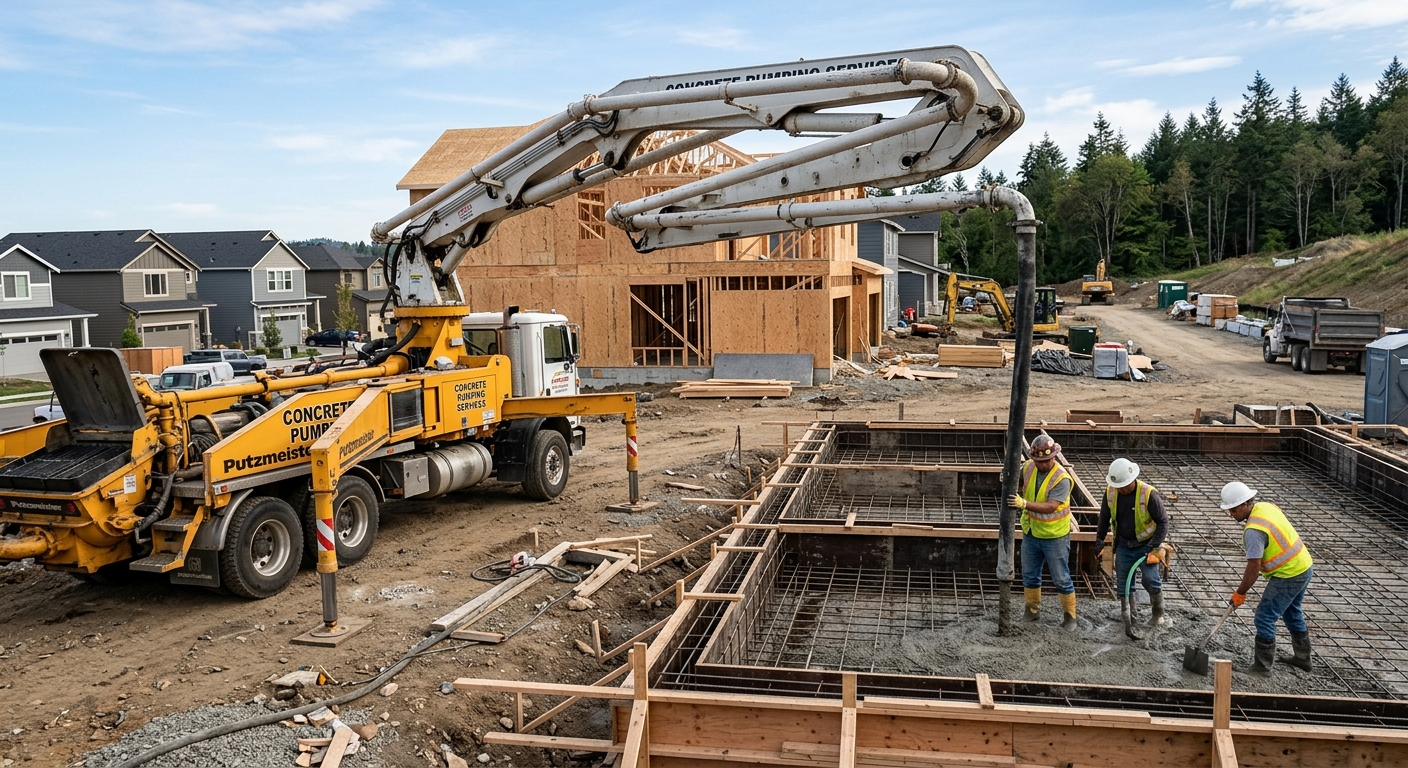
Concrete work options and costs in Heritage Mountain
In Heritage Mountain, British Columbia, homeowners typically choose concrete for driveways, patios and foundations because it’s durable, predictable, and easy to maintain—especially in a coastal-wet climate with periodic freeze–thaw cycles. With a population of 4,664 (Statistics Canada, 2021 Census), the area has a steady base of owner-occupied homes and renovations, and a housing stock that includes many single-detached properties (Statistics Canada, 2021 Census). That matters because flatwork and entry upgrades are among the most common homeowner projects that concrete contractors get called for.
In the Lower Mainland–Southwest, mild winters and a relatively shallow frost line help compared to interior/northern BC, but the design still expects a frost depth around 450 mm / 18". That means footings, piers and thickened edges must be set below frost to reduce freeze heave risk. Pricing is also influenced by frequent rain, cool nights, and high humidity—concrete crews often plan around longer curing/covering time, use curing blankets or sealers, and build drainage/air-entrainment into the mix specs. Labour availability in the Vancouver–Surrey–Abbotsford corridor can tighten during busy seasons, and that can move costs even when material prices look similar. For customers in the Heritage Mountain area, driveway and patio work is especially in demand around the more established residential lanes where vehicle access and drainage improvements are top priorities.
To compare typical project types, use the ranges below as a practical starting point for discussions with contractors, then confirm exact scope and site conditions before you decide.
| Application |
Typical Size |
Key Spec |
Finish Option |
Price Range |
| Concrete driveway (standard broom finish) |
400–600 sq. ft. |
6" slab, compacted granular base, air-entrained mix |
Broomed edges, typical control joints |
$18,000–$28,000 |
| Exposed aggregate driveway |
400–600 sq. ft. |
6" slab, drainage attention, air-entrained mix |
Exposed aggregate with curing/blinding |
$22,000–$34,000 |
| Stamped concrete driveway or patio |
300–550 sq. ft. |
6" exterior slab, reinforcement as needed, air-entrained |
Stamp texture and colour integral/tones |
$22,000–$36,000 |
| Plain concrete patio or walkway |
200–450 sq. ft. |
4"–5" slab, compacted granular base, air-entrained |
Float/screed with light broom (or smooth finish) |
$16,000–$26,000 |
| Garage floor (interior slab) |
300–520 sq. ft. |
4" slab, vapour barrier, reinforcement as specified |
Light broom, trowel-finish options |
$14,000–$24,000 |
| Foundation footings (structural, below frost) |
Varies by home size |
Engineered sizing below design frost depth, rebar per plans |
Structural concrete |
$200–$350 |
Prices are estimates only and vary by project scope, site access and material selection.
What affects the price of concrete work in Heritage Mountain
In the Lower Mainland–Southwest, it’s common to see quotes for the “same” concrete job land 30–50% apart once you compare the real specs: frost protection depth, base build-up, mix design, reinforcement, and curing/finish expectations. Across British Columbia, contractors also price labour differently depending on season length and how often they must protect fresh concrete from cool nights and wet weather. Even within the region, two crews can price differently if one includes drainage detailing and proper air-entrainment while the other keeps the work closer to minimums.
Here’s what drives the numbers in this market. First, frost line depth and freeze–thaw cycles dictate every exterior spec: footings must extend below the design frost depth (in coastal BC this is often around 0.5–1.2 m, depending on site conditions and design), and exterior slabs need air-entrained concrete so the surface doesn’t scale or spall after repeated wetting and freezing. Second, colder regions in BC usually have a shorter pour season and require cold-weather curing precautions (insulating blankets, tenting, heating), which adds cost; Heritage Mountain may be milder than inland BC, but cool, damp spells still affect scheduling and cure time. Third, de-icing salt (common on driveways) accelerates surface wear—so sealing becomes more than “cosmetic” if you want long-term durability.
In Heritage Mountain specifically, a typical cost swing comes from site preparation and access. A driveway with limited truck access or heavy slope may add excavation, retaining/grading work and extra base materials—pushing standard broom-driveway budgets closer to the top of the $18–$28 band. Conversely, a straightforward patio with good drainage and easy access might land nearer $16–$26. If you’re moving into stamped or exposed aggregate, cost rises because of forms, texture tooling, and colour execution; that’s why stamped work often overlaps the $22–$36 range when the job is done to a consistent look.
| Price Factor |
Why It Matters |
Cost Impact |
| Frost line depth — determines footing depth and form height |
Footings and thickened edges must be below design frost to resist heave. |
+Material and +form/labour; deeper excavations increase cost. |
| Site preparation — excavation, grading, compacted granular base |
Correct base depth and compaction reduce settlement and cracking. |
Can add 10–25% for difficult grades, soft soils or haul-off. |
| Reinforcement — rebar or wire mesh requirement |
Helps control cracking and supports loads (especially garage floors and driveways). |
+Steel and labour; increases if engineered or thicker slab is required. |
| Mix design — air-entrainment and compressive strength spec |
Exterior durability in freeze–thaw needs air-entrainment; strength impacts long-term performance. |
Higher-spec mix and testing adds material cost but reduces failures. |
| Finish type — broom vs. stamped vs. exposed aggregate |
Finish complexity changes labour time and materials (stamps, mats, agents, aggregates). |
Stamped/exposed typically lifts cost toward the upper band. |
| Pour size and concrete truck access to site |
Access affects pump/fall distance, scheduling, and crew productivity. |
Restricted access can increase labour and equipment fees. |
| Cold-weather curing precautions — heating and blankets |
Protection is needed to reach strength in cool, wet conditions. |
May add tenting/blankets and extra labour during shoulder seasons. |
| Control joint pattern and sealing cost |
Joints manage shrinkage cracking; sealing reduces salt-driven surface damage. |
Small line items that can prevent expensive rework. |
Permits & regulations in British Columbia
In British Columbia, structural concrete work almost always needs the right approvals before the first shovel goes in. That typically includes footings, foundation walls, grade beams and any structural elements that support the home, because these are tied to engineering and the building permit process. For those jobs, you’ll usually see engineered drawings reviewed by the municipality (or processed as part of the permit package), and inspections are commonly part of the workflow.
Concrete flatwork—such as driveways, patios and walkways—often does not require a building permit by default. However, permits may become relevant if the work affects lot grading, drainage, or the placement of impervious surfaces where local requirements apply (for example, runoff management and right-of-way constraints). Also, if your project involves any rework that ties into foundation drainage or changes how water flows around the building, you should check with the local authority beforehand.
Step-by-step, here’s how a Heritage Mountain homeowner can verify a contractor properly in BC: (1) confirm their legal business details and registration through the province’s online construction-related registry tools, (2) ask for a current Certificate of Insurance showing general liability and applicable endorsements, (3) confirm WSIB/WCB coverage documentation for workers, and (4) request references for projects similar in scope (exterior slabs and base prep, not just “generic” concrete). Then keep everything in writing—scope, specs, curing plan, and exclusions—so the permit and inspection expectations don’t become your problem later.
Getting concrete right in Heritage Mountain's freeze-thaw climate
Concrete problems in Heritage Mountain usually start with water and movement, not with “bad concrete.” In our Lower Mainland–Southwest conditions, saturated soils, coastal rainfall, and freeze–thaw cycles can cause scaling and spalling if the slab isn’t built on a properly drained, compacted base and if the mix isn’t designed for exterior exposure. To spec the job correctly, start with the foundation of the work.
(1) Base preparation: specify compacted granular sub-base to the right depth and a base that matches the subgrade and drainage conditions. Poor compaction or missing drainage is a common reason driveways develop depressions that collect water. (2) Mix design: exterior flatwork should use air-entrained concrete—typically targeting about 5–7% air content—plus a minimum 32 MPa compressive strength. That combination helps concrete survive freeze–thaw by providing room for freezing water. (3) Control joints: spacing needs to limit random cracking, and joints must be cut/formed at the right time. (4) Curing: plan for a minimum 7-day curing period under proper conditions; during cool, humid weather, curing blankets or seal protection are often necessary to reach design strength. (5) Sealing: for driveway durability, apply a penetrating sealer after cure (commonly at 28 days) to repel de-icing salts and reduce water uptake.
Ask your contractor pointed questions: “Will you use air-entrainment for exterior exposure?” and “What’s your joint timing and sealing schedule?” If someone cuts corners here, spalling risk rises—especially with winter salt and wet surface conditions.
On price: choosing a sealed, properly air-entrained driveway may cost more than the absolute low quote, but it’s usually cheaper than replacement. For example, if a basic broom driveway comes in around $18,000–$28,000 and a higher-spec option lands closer to the top end, that difference is often justified by better base prep, correct mix, and a sealing step that protects the surface.
| Spec |
Why It Matters in Heritage Mountain |
What to Ask For |
Impact if Skipped |
| Compacted granular base (depth?) |
Reduces settlement and controls moisture under the slab in a wet coastal climate. |
Specify base thickness and compaction method (e.g., engineered granular depth). |
Low spots, cracking, and premature surface deterioration. |
| Air-entrained concrete mix (target air %?) |
Air bubbles help concrete resist freeze–thaw damage. |
Confirm air content target around 5–7% for exterior flatwork. |
Higher chance of scaling/spalling during winter cycles. |
| Compressive strength (MPa rating) |
Strength gain supports durability and load performance. |
Ask for minimum 32 MPa specification. |
Soft surface, increased wear and long-term cracking risk. |
| Control joints (spacing per ACI guidelines) |
Limits random shrinkage cracking on slabs and drive lanes. |
Request joint spacing and whether joints are saw-cut on schedule. |
Uncontrolled cracking that can let water in and worsen freeze–thaw. |
| Minimum 7-day curing period |
Cold/damp conditions can slow strength gain. |
Confirm curing blankets/sealer protection plan when nights are cool or rainy. |
Reduced final strength and surface durability. |
| Penetrating sealer (when applied after cure) |
Helps repel de-icing salts and reduces water penetration. |
Ask for schedule—commonly ~28 days after pour when cure is complete. |
Faster scaling and staining; more costly maintenance. |
How to choose a concrete work contractor in Heritage Mountain
Start with the contractor’s credentials, then move into the details that affect long-term performance. In British Columbia, verify the contractor’s licensing/registration status using provincial online tools, because you want to hire a company that is properly set up for construction contracting. Next, ask for a Certificate of Insurance showing general liability and ensure it’s current for your project period. Finally, confirm WSIB/WCB coverage for workers—don’t accept “we have someone insured” without documentation. If they can’t provide these items quickly, it’s a red flag.
When you request quotes, avoid lump sums only. Ask for 2–3 itemised written quotes with a labour + materials breakdown so you can compare base prep, reinforcement, concrete mix and finish steps. Read the scope carefully: what’s excluded (haul-off, saw-cutting existing concrete, drain tie-ins, disposal)? Is the permit pull included where needed? Are control joints and sealing included for exterior flatwork? Make sure the quote reflects the work you actually want—not a generic “concrete job” line.
Warranty matters too. Request a workmanship warranty length in writing and confirm what it covers (cracks from shrinkage and workmanship issues vs. normal cosmetic variation). Ask about product/manufacturer warranties for sealers or decorative systems and whether they’re transferable. For payment, never pay more than 10–15% upfront; hold back until the work is complete and cured as specified. Also require a start date and completion estimate in writing so rain delays and curing protection are planned—not improvised.
- Provide a current Certificate of Insurance and confirm it matches your scope.
- Confirm WSIB/WCB coverage with documentation before signing.
- Verify their BC construction registration status using official provincial tools.
- Request itemised quotes (base prep, reinforcement, mix spec, finish, sealing).
- Ask for the air-entrainment and compressive strength spec for exterior work.
- Confirm excavation, grading and compacted granular base depth are included.
- Ask whether reinforcement is included (and where) vs. “as needed” only.
- Clarify joint cut timing and spacing to control shrinkage cracking.
- Confirm curing plan (blankets/sealer protection) for cool nights/rain.
- Ask whether sealing is included and when it will be applied (~28 days).
- Check site access: truck approach, hose/pump needs, and disposal/haul-off.
- Review warranty terms and what triggers claims; get it in writing.
In Heritage Mountain, concrete contractor red flags include: refusing to state air-entrainment targets for exterior slabs, vague “we’ll figure it out” joint/curing language, missing insurance/coverage paperwork, hiding base prep details behind a low lump-sum price, and scheduling pours without addressing rain/cool-weather protection. If you see multiple issues, step back and request revisions to the scope and specs.
Frequently asked questions — concrete work in Heritage Mountain
How long does concrete take to cure?
In Heritage Mountain and across British Columbia, concrete curing timelines depend on temperature, rain exposure, and the mix design. For most exterior flatwork, contractors plan for at least 7 days of curing under proper conditions before you treat the slab as reasonably stable for normal light use. Full strength gain continues well beyond that—so patios and driveways should be protected from heavy loads and aggressive de-icing practices until the cure has progressed. For example, a driveway in the $18,000–$28,000 band is often sealed only after the recommended cure period (commonly around 28 days) so the sealer can better repel water and salt in our freeze–thaw conditions. If rain is expected during the first days, ask how they’ll cover/temper curing to avoid strength setbacks.
Do I need a permit for concrete work in British Columbia?
Often, concrete flatwork like driveways, patios and walkways doesn’t require a building permit in British Columbia, unless the project changes lot grading, impacts impervious surface coverage limits, or affects drainage and runoff requirements. Structural concrete—such as footings, foundation walls and grade beams—typically requires a building permit, and engineered drawings are commonly reviewed as part of the approval process. For homeowners in Heritage Mountain, the safest approach is to confirm with the local authority before breaking ground, especially if you’re altering drainage, tying into a foundation system, or changing slopes that affect where water goes during coastal rainfall. Also confirm your contractor’s process: will they coordinate any required inspections for structural elements and provide proof of insurance/coverage before work starts?
Concrete vs pavers for a patio in Heritage Mountain?
Both can work in Heritage Mountain, but they fail differently. Concrete is usually less expensive upfront for a straightforward patio because it’s a single monolithic slab with a controlled finish and can be designed with air-entrainment and control joints. Pavers can be more forgiving if one unit settles, because you may replace sections without tearing out the whole surface. In our Lower Mainland–Southwest conditions—wet weather plus freeze–thaw—concrete durability hinges on proper base prep and air-entrainment; skipping those details can lead to surface scaling. Pavers rely heavily on base compaction and drainage to prevent frost-related movement. If you’re comparing costs, plain concrete patios often land around $16,000–$26,000 depending on size and access, while decorative options like stamped concrete move toward the $22,000–$36,000 range. The “better” choice comes down to your drainage plan and how much maintenance you’re comfortable with.
How long does a concrete driveway last?
A well-built concrete driveway in British Columbia commonly lasts decades. In Heritage Mountain’s climate, the main longevity factors are base preparation, mix design (especially air-entrainment), joint placement, curing quality, and whether you seal the surface after cure. Freeze–thaw cycles plus salted winter traction can accelerate wear, so a penetrating sealer applied after curing (often around 28 days) helps reduce water uptake and salt-related spalling risk. If drainage is poor, the driveway can develop low spots that trap water and worsen freeze–thaw damage. Conversely, a correctly built driveway with a compacted granular base and the right exterior mix has a much better chance of staying serviceable for a long time. When comparing quotes in the $18,000–$28,000 range for standard broom finishes, ask what’s included for air-entrainment, curing protection, joints, and sealing—those details are what determine real lifespan.
What is air-entrained concrete and why does it matter here?
Air-entrained concrete is designed for exterior exposure where water can freeze inside the material. It includes tiny, evenly distributed air bubbles that give freezing water a place to expand, which reduces internal pressure and helps prevent surface scaling and spalling. In Heritage Mountain and the Lower Mainland–Southwest, we don’t have the same deep frost as inland or northern BC, but we still experience cycles that can be hard on unprotected concrete—especially when the slab gets saturated from coastal rainfall and then cools at night. That’s why exterior slabs and driveways should be made with air-entrained mixes and the right joint strategy and sealing plan. If a quote is “cheaper” but doesn’t specify air-entrainment for exterior work, it’s a common reason for early deterioration. For reference, homeowners paying toward the $18,000–$28,000 band for driveways are paying for those durability specs, not just the concrete itself.
How do I prepare the base for a concrete slab?
Base prep is where most concrete performance is won or lost. For a slab in Heritage Mountain, contractors typically remove topsoil, excavate to the required elevation, and install a compacted granular base to support the slab and manage moisture. The depth and compaction target depend on soil conditions, drainage, and the slab type, but the goal is a stable, firm base that drains and resists movement. In our wet coastal climate, proper grading matters as much as thickness: water should not pond under or beside the slab. For exterior slabs, the base build-up also works together with correct frost considerations (even with a shallower frost depth in coastal BC) so edges and footings sit below frost where required. When you review quotes, make sure they specify base depth, whether they include compacted granular, and how they address drainage. You should also ask about reinforcement and control joints since those pair with base prep to reduce cracking and long-term damage.