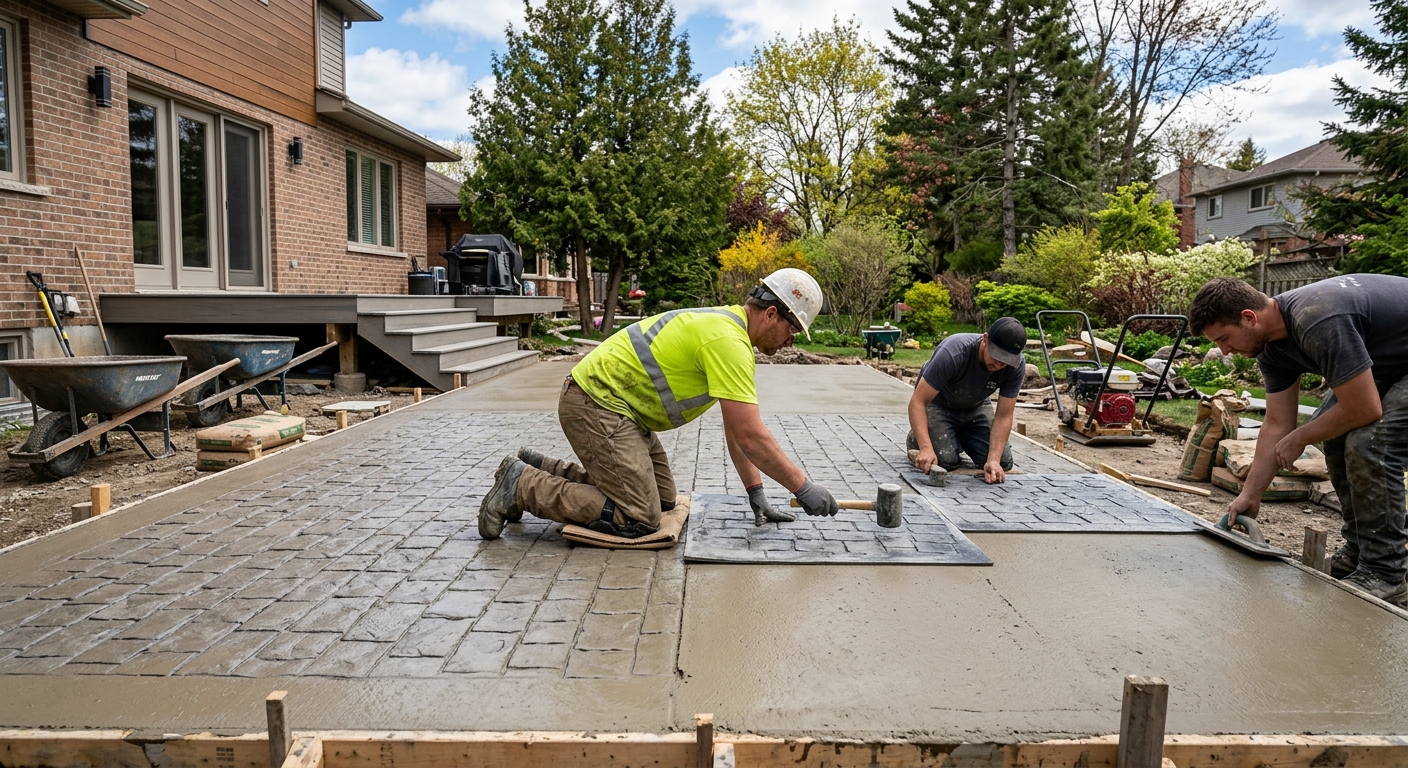
Concrete work options and costs in Sentinel Hill
Concrete contractors in Sentinel Hill see a steady mix of driveways, patios, walkways and foundation repairs, mainly because this is a small community with a housing stock typical of the Lower Mainland–Southwest: many homes are owner-occupied and the demand for durable flatwork is constant. With a population of 1,060 (Statistics Canada, 2021 Census), projects tend to be less “builder-volume” and more owner-driven, so scheduling and crew availability can affect lead times. Many households also plan upgrades for curb appeal and weather protection, especially around high-use outdoor areas.
In the Lower Mainland–Southwest, costs are shaped by mild winters—but not “easy” concrete. The design frost depth is typically treated around 450 mm / 18", so footings, piers and thickened edges are built below that to reduce frost heave risk. At the same time, frequent freeze–thaw cycles, saturated soils, and coastal rain drive more detailed base prep and drainage. That means proper compacted granular, air-entrained mixes, and careful jointing/curing—not just “pour and go.” Trades activity is often strongest in nearby growth corridors and service areas such as the Fraser Valley edge and Abbotsford-area pockets, where contractors are busy and may price travel and mobilization into small Sentinel Hill jobs.
Below are typical price ranges for common options so you can compare quotes line-by-line. (Your final cost will depend on site access, excavation depth, reinforcement needs, and finish choice.)
| Application |
Typical Size |
Key Spec |
Finish Option |
Price Range |
| Concrete driveway (standard broom finish) |
300 sq ft (approx. 24' x 12') |
Air-entrained mix; compacted granular base; control joints as required |
Broom finish |
$6,000 – $8,400 |
| Exposed aggregate driveway |
300 sq ft (approx. 24' x 12') |
Same structural base requirements; surface retarder/exposure; sealing recommended |
Exposed aggregate |
$7,800 – $10,800 |
| Stamped concrete driveway or patio |
250 sq ft (approx. 25' x 10') |
Air-entrained mix; thicker sections at edges; colour integral or hardener system |
Stamped pattern + release + sealer |
$7,000 – $12,000 |
| Plain concrete patio or walkway |
160 sq ft (approx. 16' x 10') |
Air-entrained mix; compacted base; joints/edge protection |
Floating + broom or smooth trowel (as specified) |
$2,600 – $4,200 |
| Garage floor (interior slab) |
420 sq ft (approx. 21' x 20') |
Vapour barrier as needed; proper thickness; saw-cut joints |
Plain finished slab |
$7,500 – $12,000 |
| Foundation footings (structural, below frost) |
Per project allowance (typ. 80–140 linear ft) |
Excavation to design depth below frost; rebar; concrete volume based on spec |
Structural forming + rebar cage |
$16,000 – $28,000 |
Prices are estimates only and vary by project scope, site access and material selection.
What affects the price of concrete work in Sentinel Hill
In the Lower Mainland–Southwest, you can see the same driveway or patio quoted 30–50% differently, even when the drawings look similar. The biggest swing usually comes from what’s included in base preparation (excavation depth, granular amount, compaction, drainage), how the mix is engineered for the freeze–thaw environment, and whether the contractor is sizing labour around seasonal curing constraints. In other parts of BC, deeper frost protection requirements and harsher winter conditions can also shorten the pour season, which raises excavation, forming and heating costs versus milder coastal regions. Within BC’s broader market, those differences are reflected in unit labour rates, truck scheduling, and material premiums.
Frost line depth and freeze–thaw cycles dictate nearly every exterior spec here. Footings and thickened edges must extend below the design frost depth to limit frost heave, and exterior slabs should use air-entrained concrete mixes to survive repeated wetting and freezing. In Sentinel Hill, that typically means planning around a frost depth commonly treated near 450 mm / 18" and then designing below it as required. If a contractor doesn’t properly account for air entrainment and jointing, you may pay less up front but face premature scaling and spalling.
Two examples that show how cost shifts in this area: (1) If your soil is saturated and needs extra drainage and thicker compacted granular, a “$18–$28 per sq ft” driveway can move toward the higher end; (2) choosing stamped concrete raises labour and surface detailing, often justifying the step-up—especially when you’re comparing a broom-finish driveway at the lower band versus stamped & decorative at the higher band (because patterns, colour systems, and finishing time increase).
| Price Factor |
Why It Matters |
Cost Impact |
| Frost line depth — determines footing depth and form height |
Footings and thickened edges must be below the design frost depth to prevent frost heave |
Higher excavation/forming if the spec requires deeper sections |
| Site preparation — excavation, grading, compacted granular base |
Freeze–thaw damage accelerates when base is unstable or poorly drained |
Can add significant labour/materials where soils are wet or soft |
| Reinforcement — rebar or wire mesh requirement |
Controls cracking and improves load capacity for drives, slabs and structural elements |
Additional steel, chairs/tie wire, and placement time |
| Mix design — air-entrainment and compressive strength spec |
Exterior durability depends on correct air content for scaling resistance in freeze–thaw cycles |
May increase material cost but reduces early surface failure risk |
| Finish type — broom vs. stamped vs. exposed aggregate |
Finishes require different labour steps and curing/sealer planning |
Stamped and exposed aggregate typically cost more per sq ft |
| Pour size and concrete truck access to site |
Smaller or hard-access sites may require extra labour for placement and shorter batching windows |
Mobilization, waiting time, and handwork can raise price |
| Cold-weather curing precautions — heating and blankets |
Cool, damp conditions slow strength gain and increase surface risk if not managed |
Adds insulation/blankets and sometimes temporary heating |
| Control joint pattern and sealing cost |
Proper joints limit random cracking; sealing helps repel de-icing salts |
Small line item that can materially extend surface durability |
Permits & regulations in British Columbia
In British Columbia, structural concrete work generally requires a building permit. That includes footings, foundation walls, and grade beams, especially where they support the home’s structural frame. In many cases, you’ll also need engineered drawings reviewed through the permit process. For concrete flatwork—driveways, patios and walkways—permits are often not required by default, unless the work affects lot grading, triggers impervious surface coverage limits, involves municipal drainage/right-of-way issues, or requires changes that impact setbacks or service access. Even when a permit isn’t typically required, it’s still smart to confirm with the local authority before breaking ground.
Before construction starts in Sentinel Hill, verify your contractor can legally and responsibly build: request (1) a current certificate of insurance for liability, (2) proof of coverage for workplace safety (WSBC coverage where applicable), and (3) references for similar-scale concrete work in the Lower Mainland–Southwest.
Step-by-step homeowner checks: first, ask for their COI and confirm the insured party matches the business name on the quote. Next, look up the contractor online through the province’s business/licensing resources (where available) and compare the spelling/address to the quote. Then, request a current clearance/coverage confirmation letter for worksite protection (or written proof of coverage, as provided). Finally, confirm they’ve handled permits/engineered reviews in similar foundation projects so you’re not stuck mid-process.
Getting concrete right in Sentinel Hill's freeze-thaw climate
Concrete fails in Sentinel Hill most often from a combination of saturated soils, freeze–thaw cycles, and thin/poorly prepared bases that let water get under slabs. When water freezes, it expands; when it thaws, it weakens support and can lead to settlement, cracking, and surface scaling. That’s why “cheapest concrete” usually shows up as spalling and rough patches within a few seasons—especially for driveways and steps where de-icing salts and tire wear are common.
To spec the job correctly, start with (1) base preparation: compacted granular sub-base at the correct depth for your soil and frost considerations. If the contractor can’t explain how they’ll evaluate grade and compaction, that’s a warning. (2) mix design: exterior concrete should be air-entrained (commonly 5–7% air content for exterior flatwork) and meet a minimum 32 MPa compressive strength so it performs through wet/cold swings. (3) control joints: plan joint spacing to limit random cracking—then seal after the surface has fully cured. (4) curing: even with mild winters, aim for a minimum 7-day cure under proper conditions; when temperatures drop, blankets or curing aids may be necessary to reach design strength. (5) sealing: apply a penetrating sealer about 28 days post-pour to repel de-icing salts and reduce scaling risk.
A practical dollar example: if a broom-finish driveway lands around the lower end of the typical pricing ($18–$28 per sq ft), spending a bit more on correct base depth, air entrainment, and sealing often costs less than resurfacing later. On the other hand, stamped concrete (commonly in the $22–$36 per sq ft range) is worth the premium when you want the aesthetic—just make sure the durability specs match the look.
| Spec |
Why It Matters in Sentinel Hill |
What to Ask For |
Impact if Skipped |
| Compacted granular base (depth?) |
Provides stable support and drainage so water doesn’t undermine the slab through freeze–thaw cycles |
Granular type and compacted depth based on site conditions; compaction method/targets |
Settlement, heaving, cracking, and premature surface failure |
| Air-entrained concrete mix (target air %?) |
Air voids help resist scaling and spalling during wetting/freezing |
Declared air content (typically 5–7% for exterior flatwork) and exposure class if provided |
Surface scaling and spalling in a few seasons |
| Compressive strength (MPa rating) |
Ensures the concrete reaches design strength despite cool, humid curing conditions |
Minimum 32 MPa (or higher where specified) and mix design confirmation |
Lower durability and higher risk of cracking and abrasion wear |
| Control joints (spacing per ACI guidelines) |
Controls where cracks form so they’re predictable, not random |
Joint layout plan and saw-cut timing to achieve effective cracking control |
Uncontrolled cracking across the slab |
| Minimum 7-day curing period |
Strength gain slows in cool weather; proper curing reduces surface weakness |
Curing method for cool/rainy periods (blankets/sealers/temperature management) |
Reduced strength, surface dusting, and durability loss |
| Penetrating sealer (when applied after cure) |
Repels moisture and de-icing salts that drive freeze–thaw scaling |
Sealer type and application timing (commonly around 28 days post-pour) |
Faster staining, scaling, and surface breakdown |
How to choose a concrete work contractor in Sentinel Hill
Start by verifying your concrete contractor is properly set up for work in British Columbia and can stand behind the project. Ask for their liability insurance certificate and confirm the business name and address match the quote. For worksite safety coverage, request proof of WSBC coverage (or the appropriate written confirmation/clearance documentation that applies to their registration and your jobsite requirements). If they can’t provide paperwork promptly, move on—this is often the fastest way to avoid delays and disputes.
Next, get 2–3 itemised written quotes that break down labour and materials (excavation/granular, reinforcement, concrete supply, forming, finishing, joints, and sealing). Avoid “all-in” pricing that doesn’t explain exclusions. Carefully check what’s not included: disposal/hauling, concrete cutting/saw time, truck waiting time, protection of landscaping, and whether a permit pull (when required) is included in structural work. In Sentinel Hill, drainage and base prep are where corners are most likely cut—make sure the quote describes compaction steps and how they handle wet or saturated soils.
On warranty, look for a written workmanship warranty (and what it covers) plus any product/manufacturer warranty terms. Confirm whether the warranty is transferable if you sell your home. For payments, never pay more than about 10–15% upfront; hold a portion until the job is complete and cleaned up. Finally, request a written start date and completion estimate, because rainy windows and curing requirements can shift timelines.
- Insurance certificate on request (liability) with correct legal business name
- Proof of WSBC coverage/clearance documentation for the jobsite
- At least two references for projects with similar size and exposure (exterior flatwork or foundation)
- Itemised quote: excavation, granular, reinforcement, concrete, finishing, joints, sealer
- Clear scope of exclusions (disposal, patching, tree/root removal, replacement of subgrade, permits)
- Describes base preparation and compaction method/targets
- States air-entrainment and compressive strength spec for exterior concrete
- Joint layout included (pattern and saw-cut timing) and sealing responsibilities defined
- Weather/curing plan for cool nights or prolonged rain
- Written warranty terms for workmanship and surface treatments
- Payment schedule with a final holdback until walkthrough completion
- Schedule and pour/cure logistics in writing, including truck access plan
Concrete red flags I see around Sentinel Hill: crews promising “no joints” (or ignoring joint layout), skipping air-entrained mix for exterior slabs, offering sealed “later” with no date/spec, not describing base depth/compaction for your soil, or starting without confirming access, drainage, and curing conditions—then blaming weather for cracks that are really spec/design issues.
Frequently asked questions — concrete work in Sentinel Hill
How deep must footings be for Sentinel Hill's frost line?
In Sentinel Hill and across the Lower Mainland–Southwest, concrete design practice typically assumes a frost depth around 450 mm / 18" for planning. The key point is that footings must extend below the design frost depth to reduce frost heave risk. In many cases, that means contractors excavate deeper than the visible grade—especially where soil is wet or inconsistent, or where engineering/structural drawings specify additional requirements. For structural work like footings and foundation walls, your permit package and/or engineered foundation plan is what truly governs footing depth. If a contractor quotes a foundation depth “by guess,” ask for the engineer/structural drawings they’re building from. In real jobs, this depth affects excavation and forming, so it can swing your foundation budget quickly—often from the lower end of foundation allowances to higher numbers depending on linear footage and complexity. (Statistics Canada, 2021 Census)
Why does concrete crack in Sentinel Hill and how is it prevented?
Cracking in Sentinel Hill is usually about restrained shrinkage, settlement, and freeze–thaw movement—especially where water can reach the slab. Even with air-entrained concrete, you can get random cracks if joints aren’t planned and control isn’t managed. Prevention starts below the surface: a properly compacted granular base with drainage reduces differential movement. Then, use a correct joint pattern (typically saw-cut or tooled joints planned at appropriate spacing) so shrinkage cracks form in the intended locations rather than randomly. Finally, correct curing matters—cool, damp weather slows strength gain, so contractors should use curing protection when temperatures drop. If de-icing salts are used, surface sealing after cure helps slow scaling. For exterior projects, this is why two quotes for the same driveway can differ by 30–50%: one may include the full base, joint plan, and curing/sealer steps, while the other may not.
Stamped vs broom-finish concrete — cost difference?
Stamped concrete costs more than a broom-finish largely because of extra labour and materials—colour systems, stamp mats, release agents, additional finishing care, and typically a robust sealing approach. In the Lower Mainland–Southwest, homeowners often see driveway/flatwork pricing bands like $18–$28 per sq ft for standard broom-finished concrete versus $22–$36 per sq ft for stamped & decorative concrete, depending on size and base prep. The important part is that the durability specs should be the same quality: air entrainment, correct base depth, proper jointing, and adequate curing. If a contractor tries to “save money” on the base or mix to offset the decorative steps, that’s when you can get premature scaling under the fancy finish. When you compare quotes, ask whether the stamped option includes the same compacted granular foundation, the same minimum strength, and a defined sealer plan.
When is the best time to pour concrete in Sentinel Hill?
The best time to pour concrete in Sentinel Hill is when temperatures are workable for curing and when you can manage rain exposure and cool nights. Even though the Lower Mainland–Southwest has mild winters, the project still needs protection from prolonged damp conditions and cold spells that slow strength gain. Contractors generally schedule exterior flatwork for periods with predictable weather so they can keep curing consistent and reduce finishing problems from surface moisture. If you’re pouring in cooler stretches, reputable crews plan cold-weather precautions such as curing blankets/insulating protection and they manage timing so joints are cut properly. This is also why quotes can vary seasonally and by crew availability: fewer workable days means higher labour pressure and more material handling costs. Ask your contractor to describe their weather plan, including how they will protect the slab and how long they’ll allow for curing before removing protection or opening to traffic.
How long does concrete take to cure?
Concrete curing is often misunderstood. While many people think “it hardens quickly,” performance depends on time and conditions. For typical residential work in British Columbia, plan for a minimum 7-day curing period for strength development under proper conditions, with longer timelines when it’s cool, humid, or rainy. Surface readiness and project sequencing (walking, driving, or applying coatings/sealers) may require additional time depending on mix design and weather. For example, penetrating sealer is commonly applied about 28 days post-pour after the concrete has cured enough to accept treatment and to maximize durability against de-icing salts and moisture. If a contractor rushes curing, you can end up with a weaker surface that dusts, scuffs more easily, or shows scaling sooner during Sentinel Hill freeze–thaw cycles. Always ask what curing plan they follow and whether they include protective blankets or curing aids when nights get cold.
Do I need a permit for concrete work in British Columbia?
In British Columbia, the permit requirement depends on what you’re building. Structural concrete work typically needs a building permit—this includes footings, foundation walls, and grade beams—and often engineered drawings are reviewed as part of that process. Concrete flatwork like driveways, patios, and walkways often does not require a permit by default, but it can require one if the work affects lot grading, impervious surface considerations, drainage, right-of-way issues, or setback/service impacts. For Sentinel Hill projects, confirm with the local authority before you dig, even if your scope feels “routine.” When choosing a contractor, ask whether permit pull (when required) is included in the scope, and request written confirmation of who is responsible. Good contractors also carry liability insurance and maintain proper workplace coverage documentation (WSBC) so you’re protected if something goes wrong during excavation and forming.