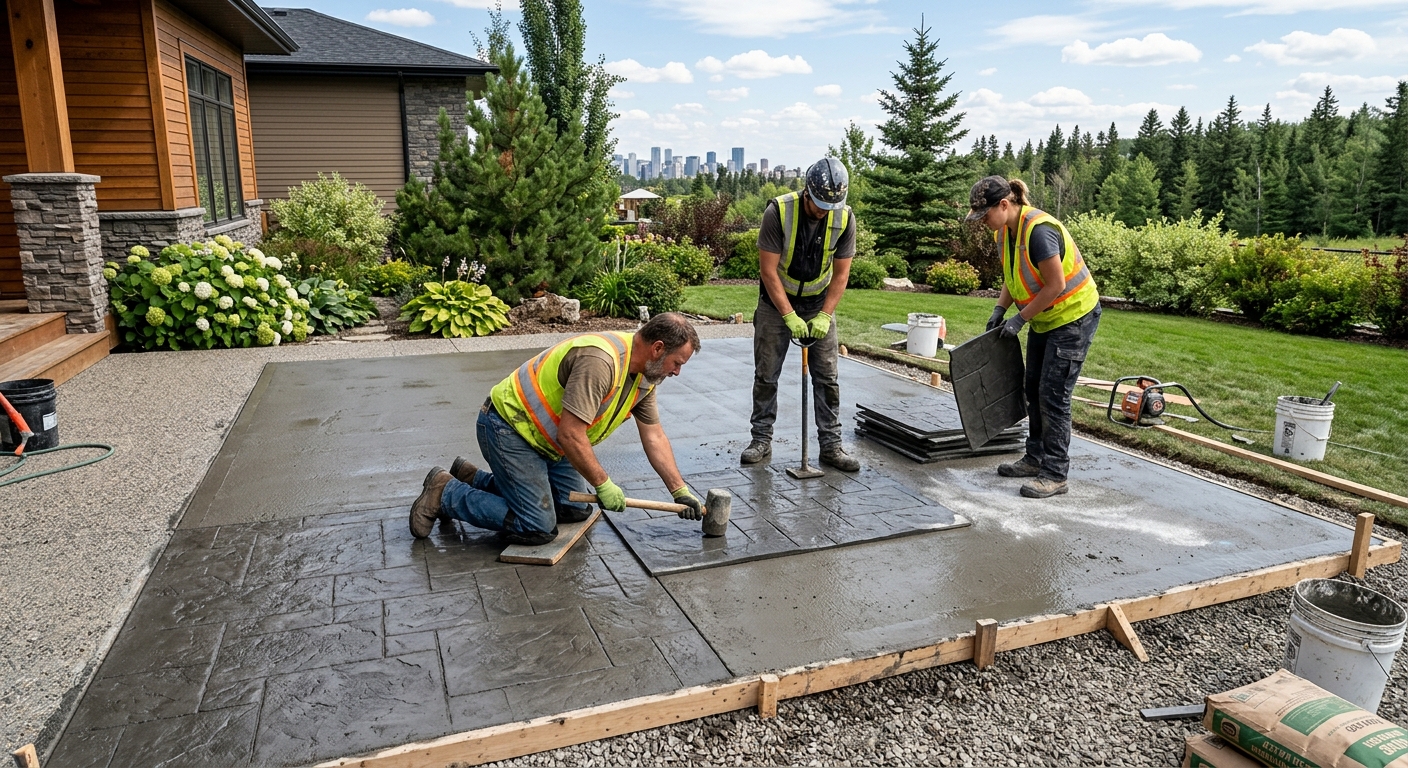
Concrete work options and costs in English Bay
Concrete work is a common home improvement in English Bay, British Columbia, especially for properties where weather durability matters as much as curb appeal. With a population of 14,225 (Statistics Canada, 2021 Census), the Lower Mainland–Southwest has steady demand from homeowners and small builders, and a large share of the local housing stock is single-detached, which drives frequent requests for driveway replacements, patios, and walkway rebuilds. That matters because flatwork performance depends on correct base prep, freeze–thaw resilience, and careful scheduling—less flashy, but it’s what keeps a slab looking good for years.
In our coastal-wet climate, concrete faces repeated moisture exposure, cool nights, and frequent freeze–thaw cycles near the surface. Even with mild winters compared with inland BC, practice is built around a design frost depth of about 450 mm / 18". Contractors therefore place footings and thickened edges below that depth and build exterior slabs with air-entrained concrete, proper drainage, and control joints to manage cracking and scaling. Work also tends to be planned around prolonged rain and humidity, so curing protection (blankets/sealers) can affect labour timing.
As a result, costs in the Vancouver–Surrey–Abbotsford corridor can move notably by complexity and finish. Decorative options like exposed aggregate or stamped surfaces are especially popular in areas where owners want a “high-end” look while maintaining durability—commonly around the West Vancouver–style hillside homes and higher-traffic neighbourhood pockets closer to the waterfront and hillside streets in/near English Bay.
Below is a practical comparison of common concrete options and realistic budget ranges, so you can map your scope to a starting point before you request itemised quotes.
| Application |
Typical Size |
Key Spec |
Finish Option |
Price Range |
| Concrete driveway (standard broom finish) |
400–600 sq. ft. |
Air-entrained mix, compacted granular base, control joints |
Broom finish |
$7,200–$13,500 |
| Exposed aggregate driveway |
400–600 sq. ft. |
Air-entrained mix, proper curing, drainage/grade attention |
Exposed aggregate |
$10,000–$18,000 |
| Stamped concrete driveway or patio |
300–500 sq. ft. |
Reinforcement as required, colour hardeners, sealant |
Stamped & coloured |
$9,000–$17,000 |
| Plain concrete patio or walkway |
200–400 sq. ft. |
Air-entrained exterior mix, compacted base, joints |
Float/steel trowel with broom edging |
$3,500–$8,500 |
| Garage floor (interior slab) |
300–500 sq. ft. |
Vapour barrier if required, mesh/reinforcement, proper thickness |
Light broom or smooth finish |
$6,000–$11,500 |
| Foundation footings (structural, below frost) |
Varies by footing layout |
Below design frost depth (typ. ~450 mm / 18" concept), engineered rebar |
Structural concrete |
$3,000–$6,800 |
Prices are estimates only and vary by project scope, site access and material selection.
What affects the price of concrete work in English Bay
In the Lower Mainland–Southwest, two quotes for the “same” concrete job can differ by 30–50% because the real variables are hidden in the site conditions and technical specs. A thicker slab, a properly engineered base, more reinforcement, longer curing protection, and improved drainage can quickly raise costs—but they also prevent premature cracking and surface scaling in English Bay’s wet, cool conditions. Availability also plays a role: in peak seasons, labour scheduling and concrete truck logistics can increase pricing.
Frost line depth and freeze–thaw cycles dictate every exterior spec. In coastal BC, the frost depth is shallower than Ontario and Alberta, but it is still enough to cause damage when water saturates soil and then freezes near the slab edges. As a result, footings and thickened edges must extend below the design frost depth (in coastal BC, often in the ~0.5–1.2 m range depending on conditions), and all exterior slabs should use air-entrained concrete to survive freeze–thaw cycles. Colder regions typically need deeper excavations and may have shorter pour seasons; that’s why the work in English Bay can be somewhat more predictable than interior BC, but coastal rainfall still affects curing time and surface durability.
De-icing salt is another local factor. When salt hits unsealed concrete, surface spalling accelerates, and the repair often costs more than sealing would have. For example, if you choose a broom-finished driveway at roughly $18–$28 per sq. ft., the base and joints drive most of the long-term performance. Upgrading to exposed aggregate or stamped concrete (often around $22–$36 per sq. ft. for decorated finishes) can be justified for appearance and wear resistance—provided the drainage, air-entrainment, and curing plan remain correct.
On older English Bay properties, excavation can also be more complex because existing grades, landscaping, and service lines may require careful removals and reinstatement. Even within the same neighbourhood, a slight change in slope can alter drainage and drainage-granular requirements, which is why foundation and footing scopes (commonly budgeted as $200–$350 per linear foot depending on design) can swing based on access and engineered rebar density.
| Price Factor |
Why It Matters |
Cost Impact |
| Frost line depth — determines footing depth and form height |
Prevents frost heave and edge movement during freeze–thaw cycles |
Higher excavation and forming labour can add noticeable cost |
| Site preparation — excavation, grading, compacted granular base |
Correct base reduces settlement and cracking |
Poor access or unstable soils increases removal and granular tonnage |
| Reinforcement — rebar or wire mesh requirement |
Controls cracking and improves slab performance |
More steel/tying time increases materials and labour |
| Mix design — air-entrainment and compressive strength spec |
Air entrainment helps resist freeze–thaw scaling/spalling |
Exterior-spec mix can cost more, but it reduces failure risk |
| Finish type — broom vs. stamped vs. exposed aggregate |
Surface texture affects traction, sealing, and aesthetics |
Decorated work typically costs more per sq. ft. |
| Pour size and concrete truck access to site |
Limits pump/line-set and labour staging time |
Hard-to-access sites can increase labour and equipment charges |
| Cold-weather curing precautions — heating and blankets |
Protects strength gain when nights are cool |
More protection time/permits and materials for winter or shoulder-season pours |
| Control joint pattern and sealing cost |
Joints manage shrinkage; sealing protects from moisture and de-icing salts |
Proper jointing adds saw-cut/time; sealing is a separate materials step |
Permits & regulations in British Columbia
In British Columbia, the permitting rules depend on what you’re building and how it affects the lot. Structural concrete work—such as foundation walls, grade beams, footings for new or altered foundations, and other load-bearing concrete components—typically requires a building permit and, in many cases, engineered drawings that are reviewed by the municipality. Concrete flatwork like patios, walkways, and driveways usually does not require a building permit, unless the work triggers issues with lot grading, impervious surface coverage limits, drainage, or the municipal right-of-way (for example, if you alter the approach or frontage and it impacts water management).
Before breaking ground in English Bay, confirm requirements with the local authority so you don’t get stuck mid-job. Also verify the contractor carries liability insurance and has the required worker protection coverage (commonly WSBC/WCB) before any demo or excavation starts.
Step-by-step homeowner checks:
- Check licensing/registration using the province’s public registry (search the contractor name and business entity).
- Ask for a current certificate of insurance (liability) and confirm it’s valid for your dates of work; keep a copy.
- Ask for proof of worker coverage (WSBC/WCB clearance or documentation, as applicable) and verify it covers the workers on your site.
- Request references for similar flatwork or foundation scopes and ask who the concrete superintendent/crew was.
- Ensure the quote clarifies whether permit paperwork (if required) is the homeowner’s responsibility or included under the contractor’s scope.
Getting concrete right in English Bay's freeze-thaw climate
Concrete fails in English Bay when water gets into the wrong places, freezes, expands, and then repeats the cycle—especially at slab edges, poorly drained interfaces, and surfaces exposed to de-icing salts. The most common failure we see is spalling (surface scaling and flaking), which is closely tied to inadequate air-entrainment and rushed curing. In practical terms, the fix isn’t “stronger cement” alone; it’s a full specification: correct base preparation, the right air content, a sensible control joint layout, and curing/sealing timed to the local weather.
To spec the job correctly for Lower Mainland–Southwest conditions:
- Base preparation: use compacted granular to the design depth for your subgrade and drainage. Poor base support leads to settlement cracks that open pathways for water.
- Mix design: for exterior flatwork, target air-entrainment around 5–7% for freeze–thaw durability and specify a minimum 32 MPa compressive strength.
- Control joints: place joints to limit random cracking; the spacing should match the slab thickness and geometry in your plan.
- Curing: plan for at least 7 days of curing under suitable conditions. In cool, damp stretches, contractors often need curing blankets or seal-curing protection so the mix reaches strength.
- Sealing: apply a penetrating sealer after the concrete has cured (commonly around 28 days) to repel moisture and reduce salt damage.
Ask these questions directly, because a “cheap” broom-finish driveway can still fail if the air-entrainment or base thickness is under-spec. As a dollar example, if one contractor comes in near $18–$28 per sq. ft. but can’t explain air entrainment and joints, it may be saving money on the very components that protect the surface during English Bay’s wet winters. Meanwhile, a properly specified driveway at the higher end is often buying you a longer-lasting surface that doesn’t require early resurfacing.
| Spec |
Why It Matters in English Bay |
What to Ask For |
Impact if Skipped |
| Compacted granular base (depth?) |
Supports the slab and reduces water pumping and frost-related movement |
Confirm design thickness based on soil/subgrade and drainage plan |
Settlement cracks and edge deterioration, especially in wet cycles |
| Air-entrained concrete mix (target air %?) |
Air voids help concrete resist freeze–thaw scaling in coastal-wet winters |
Target 5–7% air for exterior flatwork, documented on mix tickets |
Higher risk of spalling and surface scaling over 3–7 years |
| Compressive strength (MPa rating) |
Strength gain supports durability and load capacity |
Minimum 32 MPa specified for exterior flatwork applications |
Premature wear, cracking, and reduced long-term performance |
| Control joints (spacing per ACI guidelines) |
Controls shrinkage cracking so it happens in the intended locations |
Joint spacing aligned to slab thickness and geometry; include saw-cut plan |
Random cracks that allow water ingress and repeated freeze–thaw damage |
| Minimum 7-day curing period |
Ensures strength development despite cool nights and humidity |
Clarify curing method (blankets/sealer curing protection if needed) |
Weaker early surface and higher risk of scaling |
| Penetrating sealer (when applied after cure) |
Repels moisture and helps protect from de-icing salts and rainfall |
Confirm a penetrating sealer applied after full cure (commonly ~28 days) |
Faster surface breakdown and higher maintenance/resurfacing costs |
How to choose a concrete work contractor in English Bay
Choosing a concrete contractor in English Bay comes down to checking three things before you sign: qualifications, documentation, and how clearly they price the technical scope. First, confirm the contractor is properly registered/licensed for the work they’re doing and carries liability insurance in force for your project. Then verify worker coverage (WSBC/WCB clearance, as applicable) so you’re not exposed if a worker is injured on your property. Finally, ask for recent references on similar jobs—driveways with air-entrained exterior mix specs, patios with correct jointing, and any foundation work done below frost depth concepts.
Next, request 2–3 itemised written quotes instead of lump sums. The better quotes break out labour and materials (demo, excavation, forms, granular base, reinforcement, concrete supply, finishing, saw-cutting, sealing, and disposal). Read the scope for exclusions: is permit work included (if required), is disposal of old concrete included, and is pump/line-setting or equipment access accounted for? A “low price” often shows up as missing base prep or missing curing/sealing steps, which is where English Bay owners pay later.
For warranty, ask for the workmanship warranty length in writing and whether any manufacturer warranty for concrete products/sealers applies. Clarify whether the warranty is transferable if you sell your home.
Payment schedule matters too. Never pay more than about 10–15% upfront, and hold back a portion until the final walk-through and documentation are complete. Get a start date and completion estimate in writing, because rain-heavy days can affect curing protection in the Lower Mainland.
- Provide a written scope with thickness assumptions and air-entrainment/mix notes for exterior work.
- List reinforcement (mesh/rebar) and spacing where applicable.
- Include base prep and compaction method, not just concrete supply.
- Specify joint spacing and saw-cut timing.
- Explain curing plan for cool/wet periods (blankets/sealers) and expected cure duration.
- Confirm whether penetrating sealer is included and when it will be applied.
- Show disposal/recycling details for demo concrete.
- Clarify site access (truck/pump/line distance) and any extra equipment charges.
- List schedule constraints (rain windows, minimum cure/strength before backfill).
- Require mix tickets on request and document the finish steps (broom/exposed/stamped).
- Provide insurance certificate and proof of worker coverage before work begins.
- Offer a written warranty stating who to contact and what is covered for how long.
Concrete red flags in English Bay include: promises of “stronger concrete” without discussing air-entrainment, skipping or delaying saw-cut control joints, vague curing/sealing timelines, refusal to show insurance/coverage documentation, and quotes that don’t itemise base prep, reinforcement, or disposal.
Frequently asked questions — concrete work in English Bay
What causes concrete to spall in English Bay winters?
Spalling in English Bay is most often driven by freeze–thaw cycles combined with water and de-icing chemicals. When concrete isn’t properly air-entrained, the freeze–thaw pressure disrupts the surface paste and causes scaling/flaking. Even if the mix is reasonably strong, repeated wetting (coastal rainfall), saturated base conditions, and poorly drained edges can pump water into micro-cracks. Salt then accelerates deterioration by increasing moisture movement and chemical attack at the surface.
To reduce spalling, specify exterior air-entrained concrete (commonly targeting 5–7% air), correct compaction and drainage in the base, and a control joint plan. After the slab cures, apply a penetrating sealer around 28 days post-pour to repel moisture and reduce salt impact. If you’re comparing quotes, a driveway priced near the $18–$28 per sq. ft. band can still perform well—if the air-entrainment, joints, and curing/sealing are included.
What is rebar and when is it required in British Columbia?
Rebar (reinforcing steel) is used to increase a concrete structure’s ability to handle tension and reduce cracking. In British Columbia, whether you need rebar depends on the application (foundation/footings versus a slab), the structural design, and the slab thickness and loading. For structural concrete such as foundation footings and grade beams, engineered drawings typically specify rebar size, spacing, cover, and development length. For exterior flatwork like driveways and patios, reinforcement may still be specified based on thickness, subgrade conditions, and intended loads (for example, heavier vehicles), but it’s not always as “one-size-fits-all” as a foundation.
In English Bay’s climate, reinforcement is only part of durability. You still need air-entrainment for exterior freeze–thaw exposure and proper joints to control crack locations. When a contractor cuts corners by skipping reinforcement or by reducing slab thickness to hit a lower price, you can end up with cracking pathways that bring in water and speed up freeze–thaw damage.
How long does a concrete project take in English Bay?
The timeline in English Bay depends on site access, curing conditions, and weather. A typical flatwork job (like a patio or driveway) can often be completed in 1–3 days for demo, excavation/forming, pour, and finishing, but the total schedule is longer because curing and sealing require time. Concrete needs adequate strength gain before you remove forms, backfill, or allow heavier use. In practice, you should plan for a minimum 7 days before full normal use, with better durability outcomes when curing protections are used during cool, damp periods.
Rain-heavy days can also affect scheduling because poor surface conditions can interfere with finishing and increase risk of laitance or uneven curing. For decorated finishes like stamped or exposed aggregate, the process has extra steps and can be more sensitive to timing. If you’re budgeting, remember that the “price band” difference (for example, standard broom-driveway pricing around $18–$28 per sq. ft. versus decorative options closer to $22–$36 per sq. ft.) often reflects both materials and the added labour steps and protection needed for finish quality.
What is a concrete overlay and is it suited to English Bay?
A concrete overlay is a new concrete layer placed over an existing concrete surface—often used when the existing slab is mostly intact but has cosmetic issues, minor scaling, or worn look. Overlays can be suited to English Bay when the substrate is sound (not severely spalled, not heavily cracked, and properly prepared). If the old slab is failing due to water ingress and freeze–thaw damage, an overlay can mask the problem temporarily but may not stop ongoing deterioration below.
For English Bay’s wet coastal climate and freeze–thaw conditions, the key is prep: thorough cleaning, appropriate bonding method, and a drainage-aware approach at edges and joints. You should also consider whether sealing and proper jointing are addressed in the overlay system. If your existing driveway is actively spalling, it may be more cost-effective long-term to remove and rebuild, particularly because exterior durability depends on air-entrainment and base quality—not just surface thickness.
Ask contractors how they confirm the existing slab’s condition and what bonding system and air/mix specs they use for exterior exposure.
How do I seal concrete to protect it in English Bay?
In English Bay, sealing is a practical protection step because coastal rainfall and winter de-icing salts can damage unsealed concrete surfaces over time. The standard approach is to apply a penetrating sealer after the concrete has cured—commonly around 28 days post-pour—so the sealer can actually work within the concrete pores. Applying too early can trap moisture and reduce the effectiveness of the product.
Before sealing, the surface should be clean, dry, and free of contaminants like dust or curing residues. Contractors often wash, allow drying time, and then apply the sealer evenly. For driveways where salts are used, we focus on penetrating sealers that help repel moisture movement rather than just forming a surface film.
When comparing quotes in the $18–$28 per sq. ft. standard driveway band versus decorative pricing closer to $22–$36 per sq. ft., check whether sealing is included and what product type/timing is proposed. A well-built slab with sealing usually holds up better through repeated wet winters.
What is the difference between concrete and cement?
Concrete and cement are related but not the same. Cement is one ingredient—a binder made from processed materials—that reacts with water to form paste. Concrete is the finished building material that includes cement plus aggregates (sand and stone), water, and often additives such as air-entrainment for durability in freeze–thaw climates. In other words, cement is inside concrete; concrete is the product you pour.
For English Bay exterior work, the mix design is what matters most: air-entrainment, water-cement ratio targets, and the overall compressive strength specification (often minimum 32 MPa for exterior flatwork) determine how well the surface resists freeze–thaw scaling and spalling. Choosing “better cement” alone doesn’t guarantee performance if air content, curing, and joints aren’t right.
If you’re getting quotes, ask for the mix design details (including air entrainment) and how curing and sealing will be handled. That’s where quality shows up—not in vague descriptions.