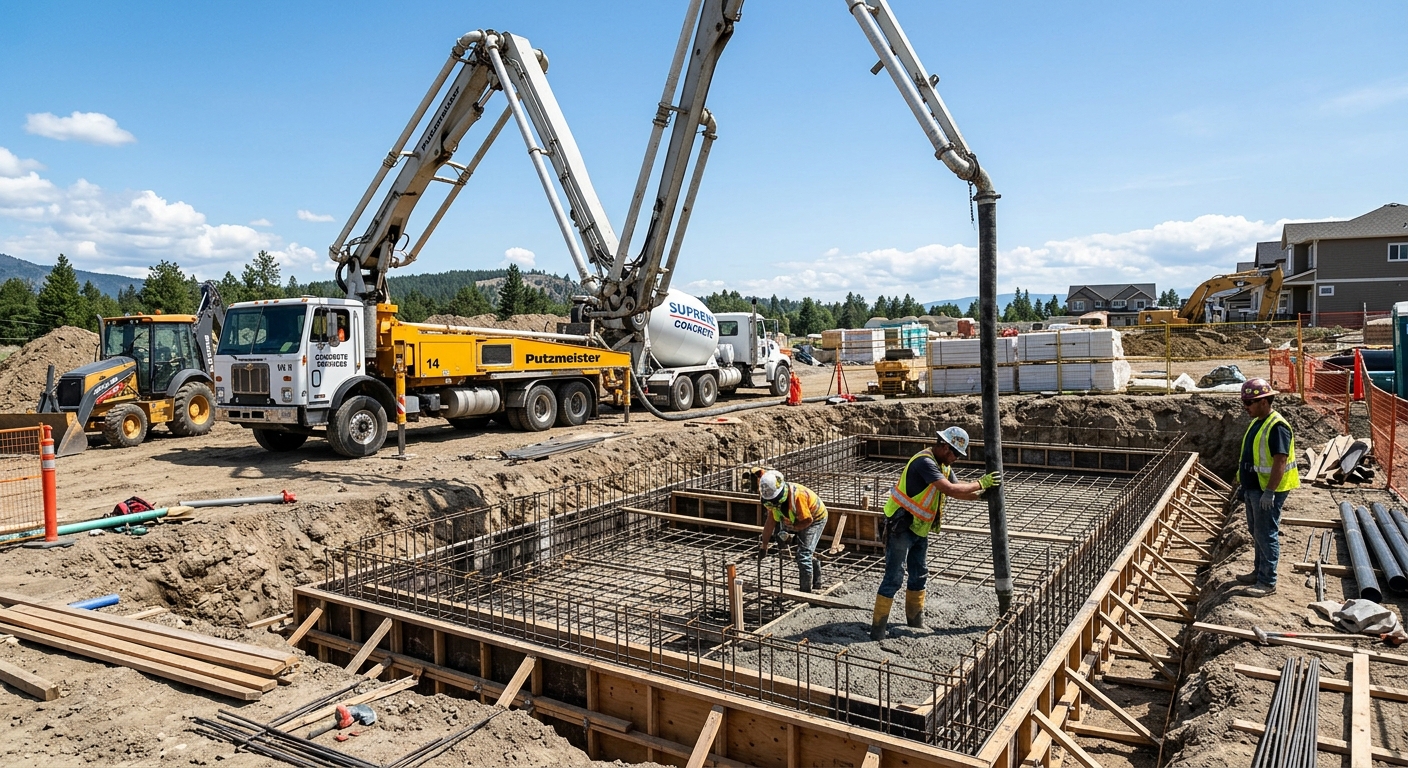
Concrete work options and costs in Hanceville
In Hanceville, concrete work is a practical choice for driveways, patios and foundations, especially in a market shaped by owner-occupied housing. With a population of 10,000 (Statistics Canada, 2021 Census), the town’s service radius is tight, so reliable crews can be booked quickly once the weather window opens. In most Lower Mainland–Southwest neighbourhoods around the region—including the more established residential pockets where lot re-levels and driveway widening are common—concrete flatwork demand stays steady because it’s durable under wet winters and salt use. That matters for your budget because the Lower Mainland–Southwest climate (mild winters but frequent wetting and freeze–thaw cycles) changes concrete specifications, not just the final appearance.
Contractors typically design for a shallow frost line with footings and thickened edges placed below the frost depth (commonly assumed around 450 mm / 18" in practice). Even when frost depth is less than interior BC, repeated freeze–thaw, saturated soils, and heavy rainfall drive the cost of base prep, drainage and air-entrained concrete. Scheduling also affects labour costs: rain, cool nights and high humidity can extend curing time, and that can shift crews to the next available slot. Compared with much colder parts of BC, you often avoid the most expensive deep-excavation scenarios, but you still pay for correct base build-up, mix design and proper jointing to keep cracks and surface scaling under control.
Below are realistic Hanceville price ranges so you can compare options side-by-side before you request quotes.
| Application |
Typical Size |
Key Spec |
Finish Option |
Price Range |
| Concrete driveway (standard broom finish) |
400–600 sq. ft. |
Air-entrained exterior mix, compacted granular base, control joints |
Broom finish |
$18,000 – $28,000 |
| Exposed aggregate driveway |
400–600 sq. ft. |
Air-entrained exterior mix, proper curing for clean aggregate exposure |
Exposed aggregate |
$22,000 – $34,000 |
| Stamped concrete driveway or patio |
250–450 sq. ft. |
Air-entrained mix, integral colour or overlay colouring, jointing plan |
Stamped + colour |
$22,000 – $36,000 |
| Plain concrete patio or walkway |
180–300 sq. ft. |
Compacted base, wire mesh or rebar where required, joints |
Broom/smooth finish (site-dependent) |
$16,000 – $26,000 |
| Garage floor (interior slab) |
400–600 sq. ft. |
Vapour control and slab thickness per intended use, joints as specified |
Steel-trowel finish or broom finish |
$18,000 – $30,000 |
| Foundation footings (structural, below frost) |
Typical footing perimeter 120–220 linear ft. |
Excavation to frost-protected depth, reinforced concrete footings |
Structural concrete (no decorative finish) |
$200 – $350 |
Prices are estimates only and vary by project scope, site access and material selection.
What affects the price of concrete work in Hanceville
In the Lower Mainland–Southwest, two quotes for what looks like the same concrete job can differ by 30–50% once you price in the details that protect the slab in our wet-and-freeze–thaw conditions. That’s the difference between “we pour concrete” and “we build a system”: frost-protected excavation, a designed base, correct air-entrainment, reinforcement where needed, and a curing plan that actually reaches design strength. In British Columbia, pricing can also swing with labour availability and seasonal scheduling—cool, rainy weeks stretch timelines and can raise labour hours and equipment costs even when the concrete quantity hasn’t changed.
Frost line depth and freeze–thaw cycles dictate nearly every spec. In cooler regions, footings must extend below the design frost depth to prevent frost heave, and exterior slabs require air-entrained mixes to resist scaling and spalling. When the air temperature drops, cold-weather curing precautions (insulating blankets, temperature monitoring and sometimes heating) add cost and planning time. De-icing salts in winter are another factor: they speed up surface wear if the surface is unprotected, so sealing becomes a best-practice upgrade for driveways and steps. In Hanceville specifically, the cost drivers you’ll feel most are base prep (especially drainage and compaction), air-entrained mix and jointing, and rain management during pours.
Concrete options also change price, but the “extra cost” is sometimes justified. For example, upgrading a standard broom driveway to an exposed aggregate finish may add material and labour—often pushing you from the driveway band of $18,000 – $28,000 toward $22,000 – $34,000—yet you gain a tougher, lower-slip surface that can hold up better on rainy approaches. Conversely, choosing a highly decorative stamp without improving base drainage and joints can cost more while still leading to random cracking and early patching.
| Price Factor |
Why It Matters |
Cost Impact |
| Frost line depth — determines footing depth and form height |
Footings and thickened edges must sit below frost to reduce heave risk |
Can raise excavation/formwork time substantially on frost-sensitive sites |
| Site preparation — excavation, grading, compacted granular base |
Proper drainage and compaction prevent settlement and water pooling |
Often the #1 reason bids differ when soil and access vary |
| Reinforcement — rebar or wire mesh requirement |
Controls cracking potential and improves load performance for driveways |
Adds materials and labour; required in higher-load areas |
| Mix design — air-entrainment and compressive strength spec |
Air entrainment helps exterior concrete survive freeze–thaw cycles |
Costs more per cubic metre but improves durability and reduces premature scaling |
| Finish type — broom vs. stamped vs. exposed aggregate |
Complex finishes need more labour, tools and careful curing |
Decorative options typically add premium labour and finishing time |
| Pour size and concrete truck access to site |
Smaller or hard-to-access sites increase handling and staging time |
Can increase labour and short-load surcharges |
| Cold-weather curing precautions — heating and blankets |
Protects early strength gain when nights are cool or damp |
Adds equipment and labour; may extend the schedule |
| Control joint pattern and sealing cost |
Joints manage shrinkage cracking; sealing reduces salt and water damage |
Minor to moderate added cost that prevents expensive repairs |
Permits & regulations in British Columbia
In British Columbia, concrete that forms part of a structure usually needs a building permit, and foundation work often requires engineered drawings reviewed by the municipality. Structural concrete includes footings, foundation walls, grade beams and other load-bearing foundation elements. For these projects, plan review may include rebar details, dimensions and frost-protected design.
Concrete flatwork—driveways, patios and walkways—often does not require a permit on its own, provided it doesn’t affect lot grading, drainage to neighbouring properties, or trigger impervious-surface and right-of-way considerations. In practice, some upgrades require municipal coordination if you’re changing elevations, creating new drainage routes, adding retaining elements, or working near sidewalks/drive approaches. Always confirm with the local authority before excavation.
For contractor compliance in BC, start by verifying they carry liability insurance and Workers’ compensation coverage (WSIB/WCB as applicable). Then ask for references on similar-scale jobs in the Lower Mainland–Southwest. To verify step-by-step: (1) ask the contractor for a current certificate of insurance (COI) showing liability and dates, (2) request proof of their workers’ compensation coverage, (3) confirm their contractor licensing details through the appropriate BC online registry for trades involved in concrete formwork/placement as applicable, and (4) look for photos and references that match your scope—especially exterior slabs designed for air-entrained mixes and proper drainage. If a contractor can’t provide paperwork quickly, that’s a red flag.
Getting concrete right in Hanceville's freeze-thaw climate
Concrete fails in Hanceville when water enters the slab or base and then freezes, expanding and breaking up the material near the surface. In a Lower Mainland–Southwest environment with frequent wetting, cool nights and freeze–thaw cycles, the “weak link” is usually the base prep, insufficient drainage, or concrete mix without proper air entrainment. To spec the job correctly, build the system from the ground up: (1) compacted granular base placed to the right depth for local soil and frost protection, (2) an air-entrained exterior mix (commonly 5–7% air for freeze–thaw durability) with minimum compressive strength targets, (3) control joints designed to limit random shrinkage cracking, and (4) curing that reaches adequate early strength under damp/cool conditions, typically extending protection when it’s cold. Finally, (5) apply a penetrating sealer after curing (often at 28 days) to repel de-icing salts and reduce moisture ingress.
When you’re comparing options, ask where the dollars go. A standard broom finish driveway may start around the region’s driveway band (about $18,000 – $28,000 for typical sizes), while stamped or exposed premium finishes can land higher—often climbing toward $22,000 – $36,000 depending on size and detailing. That difference can be justified for appearance and surface texture, but it’s not a substitute for durability specs. If the base drainage is poor or air entrainment is skipped, you risk spalling and scaling that lead to grinding, patching and premature resealing—costly in the long run.
Use these details to avoid the most common failure in exterior concrete here: spalling caused by inadequate air-entrainment and poor curing, especially after a rainy pour followed by cool nights.
| Spec |
Why It Matters in Hanceville |
What to Ask For |
Impact if Skipped |
| Compacted granular base (depth?) |
Controls settlement and keeps water from saturating the slab bottom |
Base depth to frost-protected design and engineered drainage/grade plan |
Uneven cracking, pumping fines, early deterioration |
| Air-entrained concrete mix (target air %?) |
Freeze–thaw durability for exterior surfaces in BC’s coastal-wet conditions |
Air-entrainment typically 5–7% for exterior flatwork (per spec) |
Scaling and spalling during winter freeze–thaw |
| Compressive strength (MPa rating) |
Ensures enough strength gain for traffic and durability |
Minimum 32 MPa (or project-specific rating per design) |
Surface wear, reduced longevity and weaker performance |
| Control joints (spacing per ACI guidelines) |
Limits random cracking and channels shrinkage stresses |
Joint spacing plan and saw-cut timing instructions |
Random cracks that invite water and freeze–thaw damage |
| Minimum 7-day curing period |
Cold/rainy stretches slow strength gain and can trap moisture |
Minimum 7 days cured under proper conditions (blankets/sealer timing plan) |
Higher risk of surface scaling, dusting and weaker slab edges |
| Penetrating sealer (when applied after cure) |
Repels salts and reduces moisture entry |
Penetrating sealer applied after cure (commonly around 28 days) |
Faster de-icing salt damage and more frequent resealing/patching |
How to choose a concrete work contractor in Hanceville
Choosing the right contractor in Hanceville starts with paperwork and clarity. In British Columbia, verify licensing for the trade(s) involved in your scope, then confirm liability insurance with a current certificate of insurance (COI) showing coverage limits and effective dates. Next, confirm workers’ compensation coverage (WSIB/WCB as applicable) so you’re not left holding the risk. Ask for the COI and coverage details before work begins; a reputable contractor provides this easily.
Then get 2–3 written, itemised quotes instead of one lump sum. The quote should break down labour and materials (concrete volume, rebar/wire mesh, forms, excavation and disposal, base material, vapour barriers if applicable, finishing and sealing). Read the scope for exclusions: Is permit pulling included where required for structural work? Is excavation spoil disposal included? Are overhead power/footings adjustments handled? Clear specs matter because exterior concrete in our climate depends on air-entrained mix, base compaction and jointing—skipping any one item can underbid the job and lead to expensive callbacks.
For warranty, ask for the workmanship warranty length and whether it covers labour for repairs, not just materials. Confirm whether product/manufacturer warranties apply to sealer or admixtures and whether they’re transferable to you as the homeowner. Payment schedule should be sensible: never pay more than 10–15% upfront; hold back a portion until completion and walk-through acceptance. Finally, request the start date and completion estimate in writing, and ask how rain or cold nights will affect timing.
- Request COI for liability insurance with effective dates
- Confirm workers’ compensation coverage (WSIB/WCB as applicable)
- Verify relevant BC licensing/trade registration for the exact scope
- Ask for itemised labour/material breakdown (not only total cost)
- Confirm concrete mix is air-entrained for exterior freeze–thaw durability
- Ask for reinforcement details: wire mesh vs rebar where required
- Require a base prep plan: granular type, thickness, compaction method
- Confirm control joint spacing and saw-cut timing
- Ask about curing plan for cool nights and prolonged rain
- Clarify disposal/haul-away included or excluded
- Confirm sealing: who applies, product type, and timing after cure
- Set payment milestones tied to inspection points and completion
Concrete red flags I see in Hanceville include: vague specs like “standard concrete” with no air-entrainment statement, skipping jointing details, promising pours during cold/rain windows without a cold-weather curing plan, charging most of the total upfront, and providing an unitemised quote that doesn’t specify base thickness, reinforcement, or sealing.
Frequently asked questions — concrete work in Hanceville
Can concrete be poured in cold weather in Hanceville?
Yes, but only with the right controls in British Columbia. In Hanceville, cold spells often come with damp conditions, so the key is protecting early strength gain—especially for exterior slabs that will face freeze–thaw cycles. A good contractor will monitor temperatures, use cold-weather curing precautions (insulating blankets, temperature management, and curing protection as needed), and schedule around rain so the slab isn’t left saturated during initial set. If you’re budgeting, cold-weather measures can add cost, which is why quotes can move upward by a noticeable margin even if concrete volume stays the same. For context, a standard broom driveway may land around the $18,000 – $28,000 band, but cold-weather curing can nudge you higher if blankets and extended curing are required. Always ask for the curing plan in writing.
How do I maintain concrete in Hanceville's freeze-thaw climate?
Maintenance in Hanceville is about reducing moisture and salt contact—because the freeze–thaw cycle punishes water trapped at the surface or in the base. Start with sealing: a penetrating sealer applied after the slab has cured (often around 28 days) helps repel de-icing salts and slows surface wear. Keep joints clean and check them seasonally so water doesn’t migrate into cracks. Avoid using harsh salts in large quantities; if you must de-ice, use products recommended for concrete and brush off excess after storms. For small surface scaling, don’t ignore it—address early with patching so it doesn’t turn into deeper freeze–thaw spalling. If you chose decorative finishes (like stamped or exposed aggregate), maintenance still matters; the texture can hide early damage until it widens.
What causes concrete to spall in Hanceville winters?
Spalling in Hanceville is usually a freeze–thaw durability failure. The most common causes are inadequate air entrainment (too little air for exterior exposure), weak or improperly cured concrete during early strength gain, and water infiltration through random cracks that weren’t managed by the right control joint pattern. If the base drainage is poor, water saturates the slab’s lower zones, then freezes and expands, breaking off the surface. De-icing salts can accelerate the damage once moisture is present at the surface. That’s why a durable driveway spec in this Lower Mainland–Southwest market isn’t just about finish—it’s air content, base prep, jointing and curing. If your contractor only quotes appearance (“broom finish” or “stamped”) and doesn’t specify mix and joints, it’s a risk for spalling.
What is rebar and when is it required in British Columbia?
Rebar is steel reinforcement placed inside concrete to help resist cracking and improve structural performance. In British Columbia, whether you need rebar depends on the design and the loading. For structural foundation elements like footings and grade beams, reinforcement is typically required by design and engineering. For exterior flatwork such as driveways and patios, some projects use wire mesh, while others require rebar—especially where the slab will see heavier loads, thicker design requirements, or where soil conditions and slab thickness call for it. In Hanceville, where freeze–thaw and drainage are key, reinforcement alone won’t “fix” bad base prep or missing air-entrainment, but it can help control cracking. When getting quotes, ask what reinforcement is proposed and where it’s placed (location and cover thickness), and ensure it matches the engineering/design if structural work is involved.
How long does a concrete project take in Hanceville?
Timing depends on size, access, and weather. For typical Hanceville exterior work, you might spend a day or two on layout and excavation/base prep, a short period for reinforcement/forming, then one main day for the pour. After that, curing and protection matter. Even when the slab “sets” quickly, crews often treat curing as a multi-day requirement; many exterior projects benefit from minimum 7-day protection before full stress, and sealing decisions are often made after full curing (commonly around 28 days for penetrating sealers). If weather is rainy or cool, curing protection (blankets and longer schedule buffers) adds time and can shift the completion date. As a practical example, a driveway in the $18,000 – $28,000 band might take about a week from start to usable access, assuming good weather and straightforward site access.
What is a concrete overlay and is it suited to Hanceville?
A concrete overlay is a layer of new cementitious material placed over an existing concrete slab to improve surface appearance and correct minor wear. It can be suited to Hanceville when the existing slab is structurally sound—meaning it isn’t heaving, badly cracked, or failing at the base. Overlays usually don’t solve major drainage problems or deep structural issues, and if the existing concrete is already allowing moisture intrusion, freeze–thaw can continue working under the overlay. For the Lower Mainland–Southwest climate, the key is surface preparation and bonding system selection, plus addressing water flow and joint/edge issues. Cost-wise, overlays can sometimes be cheaper than full replacement, but they’re not automatically the best choice. If the driveway is scaling/spalling significantly or joints are failing, a full rebuild with proper air-entrained mix, base compaction and control joints is often the more durable investment.