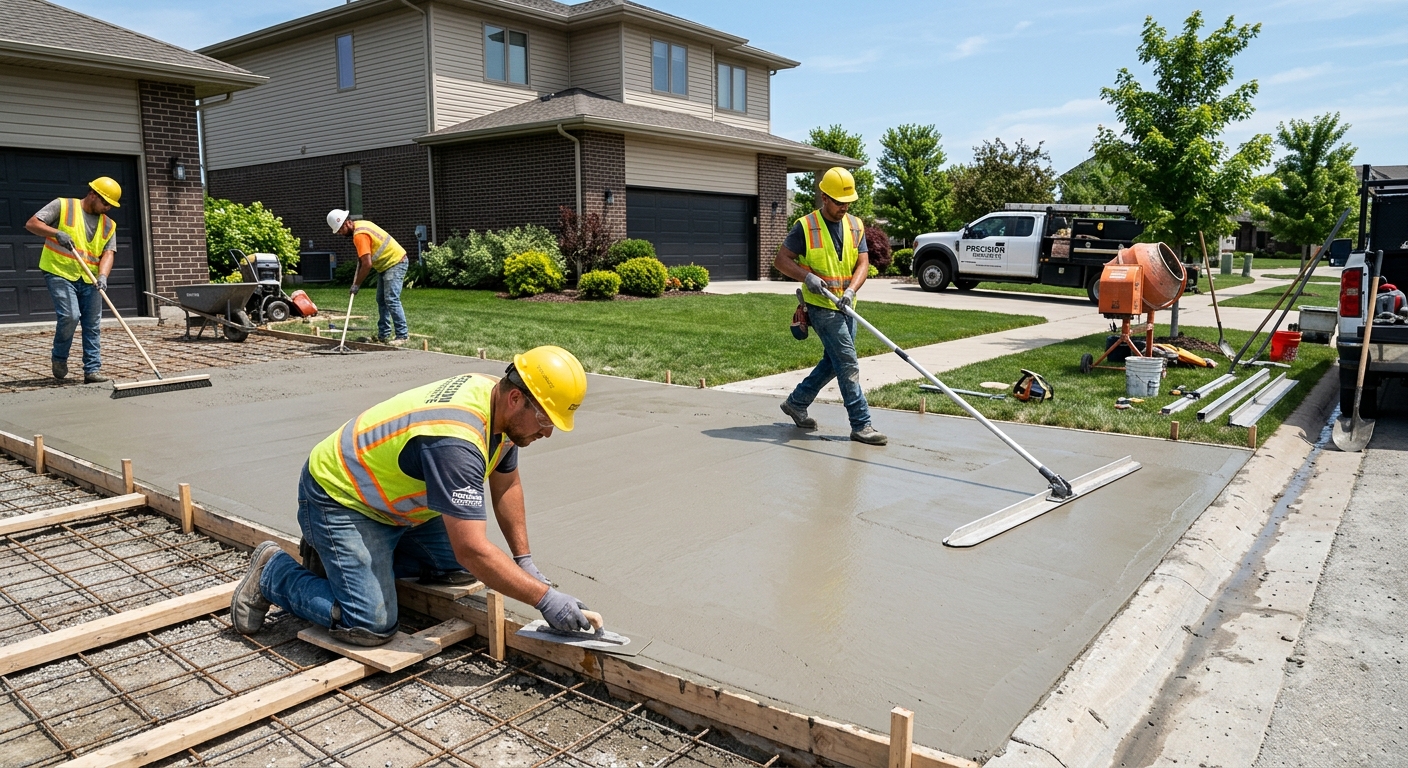
Concrete work options and costs in Sicamous
Sicamous homeowners typically choose concrete because it’s low-maintenance and handles the Thompson–Okanagan freeze–thaw grind better than many alternatives when it’s built correctly. In a community where about 63.5% of dwellings are single-detached homes (Statistics Canada, 2021 Census), driveway slabs, patios, and walkways are among the most common concrete upgrades—especially around the North Shuswap area and closer to the waterfront where sites can be tighter and drainage details matter. You’ll also see a lot of replacement work because about 51.0% of homes were built before 1981 (Statistics Canada, 2021 Census), and older lots often need re-grading or improved base prep before new flatwork will perform.
Concrete pricing in the Thompson–Okanagan can move more than people expect because frost depth and frequent freeze–thaw cycles dictate the specs from the ground up. Local crews assume footings and foundation elements need to sit below the design frost depth (often in the ~0.5–1.2 m range in interior BC for many designs, depending on soil and exposure), and exterior slabs need air-entrained mixes plus proper drainage. Also, our practical pour season is shorter than in milder BC regions, so when temperatures swing into shoulder seasons, heating/blankets and careful curing become part of the cost and the schedule.
Below are realistic cost bands for common Sicamous projects. Use them to compare quotes—then confirm the contractor’s base thickness, mix air content, reinforcement, and joint/seal plan before you decide.
| Application |
Typical Size |
Key Spec |
Finish Option |
Price Range |
| Concrete driveway (standard broom finish) |
10 m x 3 m (30 m²) |
Air-entrained exterior mix; compacted base; control joints |
Broom finish |
$7,500–$9,500 |
| Exposed aggregate driveway |
10 m x 3 m (30 m²) |
Air-entrained exterior mix; wash/expose timing; sealed surface |
Exposed aggregate |
$9,500–$13,000 |
| Stamped concrete driveway or patio |
40 m² |
Air-entrained mix; colour hardener/antiquing (as applicable); joints |
Stamped pattern |
$10,500–$15,200 |
| Plain concrete patio or walkway |
25 m² |
Compacted granular base; air-entrained mix; jointing |
Broom or smooth-trowel edge |
$3,500–$6,000 |
| Garage floor (interior slab) |
20 m² |
Vapour barrier; compacted base; reinforcement as specified |
Smooth or light broom |
$3,800–$6,200 |
| Foundation footings (structural, below frost) |
Typical 1-storey perimeter & piers |
Excavation to frost; rebar cage; engineered dimensions |
Reinforced concrete (no decorative finish) |
$22,000–$36,000 |
Prices are estimates only and vary by project scope, site access and material selection.
What affects the price of concrete work in Sicamous
In the Thompson–Okanagan, it’s common to see the “same” concrete job come back 30–50% apart once you compare real specs, not just the finish. A broom-finish driveway might sound identical across quotes, but the price swings when one contractor sizes the footing depth correctly for local freeze risk, includes proper base preparation, and uses the right air-entrained mix and joint pattern. Availability can also differ—when the pour season tightens, truck schedules, labour timing, and curing support (blankets/heating) affect cost and turnarounds.
Frost line depth and freeze–thaw cycles dictate every critical layer. Exterior slabs need air-entrained concrete so the surface doesn’t scale and spall under repeated melt/freeze. Footings and foundation elements must extend below the design frost depth so the ground won’t heave and stress the structure—this is why “minimum footing depth” rules of thumb often don’t hold up in interior BC. Cold-weather curing precautions also matter: in shoulder seasons, protecting pours from rapid drying or early freezing can add labour and materials, and that pushes pricing toward the higher end of regional driveway and patio bands (for example, many stamped jobs often land closer to $24–$38 per square foot equivalent pricing logic, while standard broom work commonly sits nearer the $18–$28 per unit band).
Two quick Sicamous examples: a slope or soft shoulder near the lake may require deeper excavation and more granular replacement to reach firm, compactable subgrade—easy to overlook, but it raises costs quickly. Conversely, a flat, accessible driveway replacement where demolition and forms are straightforward can keep you nearer the lower end, even with air-entrained mix and good reinforcement. Finally, if your home is from the pre-1981 era (about 51.0% of housing stock, Statistics Canada, 2021 Census), expect more lot rework—old subgrades and drainage routes often need correction before new concrete will last.
| Price Factor |
Why It Matters |
Cost Impact |
| Frost line depth |
Determines footing depth and form height to prevent heaving and cracking |
High impact: deeper excavations and taller forms |
| Site preparation |
Excavation, grading, and well-compacted granular base control settlement |
Moderate to high impact: hauling, compaction time |
| Reinforcement |
Rebar or mesh helps control cracking in slabs and supports structural loads |
Moderate impact: material and labour installation |
| Mix design |
Air-entrainment and strength spec improve freeze–thaw durability |
Moderate impact: higher-performance cement/mix logistics |
| Finish type |
Broom vs. stamped vs. exposed aggregate changes labour and materials |
Low to high impact depending on decorative system |
| Pour size and concrete truck access to site |
Small access problems can force pumps/extra handling or extra trips |
Moderate impact: equipment and scheduling |
| Cold-weather curing precautions |
Heating/insulating blankets protect strength gain and prevent early freezing |
Moderate to high impact during shoulder season |
| Control joint pattern and sealing cost |
Proper jointing manages movement; sealing reduces water and de-icer damage |
Low to moderate impact; often skipped but critical |
Permits & regulations in British Columbia
In British Columbia, the key line is whether your concrete work is considered structural or whether it’s flatwork that mainly affects walking/driving surfaces. Structural concrete—typically footings, foundation walls, grade beams, and other load-bearing elements—usually requires a building permit and often engineered drawings that are reviewed through the municipal process. Concrete flatwork like patios, sidewalks/walkways, and driveways often does not require a permit by itself, but you still must confirm triggers such as changes to lot grading, drainage direction, or impervious surface/coverage rules, and whether any work touches municipal right-of-way.
Step-by-step for a Sicamous homeowner before you hire:
- Ask the contractor what permit (if any) they expect to pull and whether they will handle it.
- Verify liability insurance: request a Certificate of Insurance showing general liability with current dates.
- Confirm WSIB/WCB coverage (in BC this is the provincial workers’ compensation coverage for the trades). Ask for clearance or proof of coverage, and keep a copy for your records.
- Check the contractor’s business details and licensing status through BC’s appropriate online resources (and confirm the certificate matches the legal company name on your quote/invoice).
- Request references from similar-scale BC jobs (driveway replacements and exterior slabs in freeze–thaw conditions are the most relevant).
If a contractor refuses to provide insurance/coverage details or won’t clarify the permit plan for structural elements, that’s a red flag—especially for foundation and footing work.
Getting concrete right in Sicamous's freeze-thaw climate
Concrete failures in Sicamous are rarely “bad concrete” alone—they’re usually spec and execution gaps that get punished by freeze–thaw cycles. The most common problem I see is spalling (surface scaling and flaking) caused by inadequate air-entrainment and poor curing, followed by cracking from settlement where the base wasn’t compacted to the correct depth. In the Thompson–Okanagan, you should assume frost and ground movement are part of the design basis, so the concrete system needs to manage both moisture and temperature swings.
To spec your project correctly, focus on five areas. First is base preparation: use a compacted granular sub-base to the right depth for your site and frost conditions, with proper drainage so water doesn’t pool under the slab. Second is mix design: for exterior flatwork, air-entrainment should typically target around 5–7% air, and the concrete strength should meet at least 32 MPa (or the project engineer’s spec for structural work). Third is control joints: set a joint spacing plan to limit random cracking and keep cracking where it can be maintained and sealed. Fourth is curing: plan for at least 7 days of proper curing conditions; cold-weather pours may require insulating blankets or other approved protection. Fifth is sealing: a penetrating sealer applied after the concrete has cured (commonly after 28 days) helps repel de-icing salts and reduces moisture cycling at the surface.
Here’s a dollar example from real driveway decisions: stepping up from a basic broom-finish plan to a stamped system may add several thousand dollars (decorative tools, labour time, and colour materials). That difference is justified when you also keep the same critical freeze–thaw specs—air-entrained mix, correct base, joints and sealing. If the “cheap” quote cuts those essentials, you’re paying twice later.
| Spec |
Why It Matters in Sicamous |
What to Ask For |
Impact if Skipped |
| Compacted granular base (depth?) |
Controls settlement and keeps frost effects from translating into cracks |
Granular type and thickness stated in mm; compaction testing/verification approach |
Uneven settling, early cracking, joint failure |
| Air-entrained concrete mix (target air %?) |
Protects against freeze–thaw surface scaling and spalling |
Air content target (typically 5–7% for exterior flatwork) and mix description on quote |
Spalling and surface deterioration within winters |
| Compressive strength (MPa rating) |
Ensures strength gain and durability for the service environment |
At least 32 MPa for typical exterior flatwork unless engineer specifies otherwise |
Reduced durability and higher cracking risk |
| Control joints (spacing per ACI guidelines) |
Directs cracking into planned locations during temperature and moisture movement |
Joint spacing and layout drawing in your contract; saw-cut timing plan |
Random cracking and wider repairs later |
| Minimum 7-day curing period |
Cold snaps and drying winds can stop strength gain if curing is rushed |
Confirm curing method and protection if temps are near freezing |
Weak surface, increased scaling and strength shortfalls |
| Penetrating sealer (when applied after cure) |
Helps manage salt and water ingress through the surface |
Sealer product and timing (commonly after the cure period; often ~28 days) |
Faster salt damage and uneven weathering |
How to choose a concrete work contractor in Sicamous
Start by verifying the contractor’s paperwork—before you compare numbers. In British Columbia, ask for proof of general liability insurance (Certificate of Insurance) and ask how their workers’ compensation coverage is handled for site workers (WSIB/WCB equivalent coverage in BC). For licence checks, confirm the business details match your quote and invoice, and review the contractor’s standing through BC’s relevant online resources. If a contractor can’t provide insurance/coverage documentation quickly, don’t “assume it’s fine.”
Next, get 2–3 itemised written quotes instead of one lump sum. You want a labour and materials breakdown that clearly shows what’s included: excavation and disposal, granular base depth, reinforcement type, concrete mix details (including air-entrainment for exterior work), jointing method, curing/protection steps, and sealing.
Read your scope for exclusions: is the permit included (if required for structural work)? Is site access and concrete truck placement included? Who hauls waste? Are there additional charges for rain/snow stoppages or cold-weather protection? A solid warranty should cover workmanship (often for at least one year, and specify what’s included) and explain whether any product/manufacturer warranties apply and whether they’re transferable to you. Payment terms should be conservative: never pay more than 10–15% upfront, and hold back a portion until the job is complete and clean.
Finally, insist on a written timeline with a start date and completion estimate. In Sicamous, weather shifts can affect pours, but your contractor should communicate contingencies in advance.
- Confirm general liability insurance with current dates (request COI).
- Verify workers’ compensation coverage status and ask for proof/clearance.
- Ask if the quote includes permit pull for structural concrete work (footings/foundation walls/grade beams).
- Request concrete mix details, including air-entrainment for exterior slabs.
- Confirm base prep: granular type and minimum compacted thickness.
- Get reinforcement specs (mesh vs. rebar, size, spacing) written into the quote.
- Ask for joint plan: spacing, saw-cut timing, and how joints will be sealed.
- Confirm curing method and cold-weather protection plan if temperatures drop.
- Clarify sealing: product and timing after curing (especially for driveways).
- Ensure cleanup and disposal (spoils/old concrete) are explicitly included.
- Limit upfront payment to 10–15% and hold a completion holdback.
- Require start date and estimated completion window in writing.
Concrete red flags in Sicamous: quotes that don’t mention air-entrainment for exterior work, vague base depth (“we’ll just prep it”), no plan for joints/sealing, pressure to pay large deposits up front, and crews who pour in freezing conditions without blankets/heating or a curing protocol.
Frequently asked questions — concrete work in Sicamous
How much does concrete work cost in Sicamous?
In Sicamous, pricing depends on frost-appropriate design, base prep, finish type, and how much work your site needs. As a guide, many homeowners see concrete driveway costs land in the $18–$28 band for standard broom-finish work, while patios/walkways often fall in the $14–$24 range depending on thickness and site conditions. If you choose decorative finishes like stamped concrete, the cost typically rises into the $24–$38 band because of colour systems, forms/templates, and extra labour. Projects can swing higher when the lot is soft or sloped (extra excavation and granular replacement) or when shoulder-season temperatures require heating/blankets for curing.
How deep must footings be for Sicamous's frost line?
For Sicamous and interior Thompson–Okanagan conditions, footings are typically designed to sit below the local design frost depth, with the exact depth depending on soil type, drainage, and how the engineer/drawing specifies exposure. Rather than using a one-size “minimum footing depth” rule, reputable contractors build to the project’s design so the ground won’t heave and crack the foundation. In colder interior pockets, deeper footings and correct base conditions are a big reason quotes differ across BC—one contractor may include the frost-appropriate depth and proper excavation, while another may underestimate it. If you’re building or replacing foundation elements, ask for the footing elevation, footing widths, and whether the drawings reflect below-frost design.
Why does concrete crack in Sicamous and how is it prevented?
Concrete cracking in Sicamous is usually a combination of shrinkage, temperature movement, and—most importantly for exterior slabs—freeze–thaw effects plus settlement if the base wasn’t prepared correctly. You prevent a lot of cracking by using a properly compacted granular base to the right depth, specifying air-entrained concrete for exterior exposure, and installing control joints on a planned spacing schedule so cracks happen where you can manage them. Curing also matters: rushing strength gain in cold or wet weather increases the chance of surface weakness. Sealing after cure helps limit salt and moisture cycling. If your quote doesn’t mention joints and the mix (air-entrainment), it’s not a like-for-like comparison.
Stamped vs broom-finish concrete — cost difference?
Stamped concrete costs more than broom-finish because you’re paying for decorative materials (release agents, colour systems, stamping mats) and additional labour time to place and texture the slab correctly before it sets. In Sicamous, the practical difference often shows up as moving from the standard driveway pricing band ($18–$28) toward the decorative band ($24–$38). The key point: the price should rise for the finish, not for cutting corners on the structure. A good stamped quote still uses air-entrained exterior mix, proper base prep, reinforcement where needed, and jointing and sealing. If a “cheap stamped” quote doesn’t address freeze–thaw specs, it’s likely to fail faster in our winters.
When is the best time to pour concrete in Sicamous?
The best time is when you can maintain safe curing conditions for at least the first week. In Sicamous, that usually means avoiding hard freezes and keeping protection in place during cold snaps—especially in shoulder seasons when temperatures can swing quickly. Your contractor should plan pour dates around the weather and be ready with insulating blankets or approved heating methods if cold conditions are expected. If you’re doing exterior work like driveways and patios, ask how they’ll protect the slab if overnight temperatures approach freezing. Quality concrete work in interior BC is as much about timing and protection as it is about materials.
How long does concrete take to cure?
Concrete needs time for strength gain, and curing conditions matter. For typical projects, plan for a minimum 7-day curing period under proper conditions, with the understanding that colder or windy weather may require extra protection to keep curing effective. Even after the concrete is walkable, surface durability—especially for exterior slabs exposed to de-icing salts—improves with full curing. That’s why penetrating sealers are commonly applied after cure (often around 28 days) so the surface is ready to repel water and salt. If you’re comparing quotes in British Columbia, ask what curing method is included (blankets, curing compound, protection against rapid drying/freezing) and whether sealing is included in the scope.