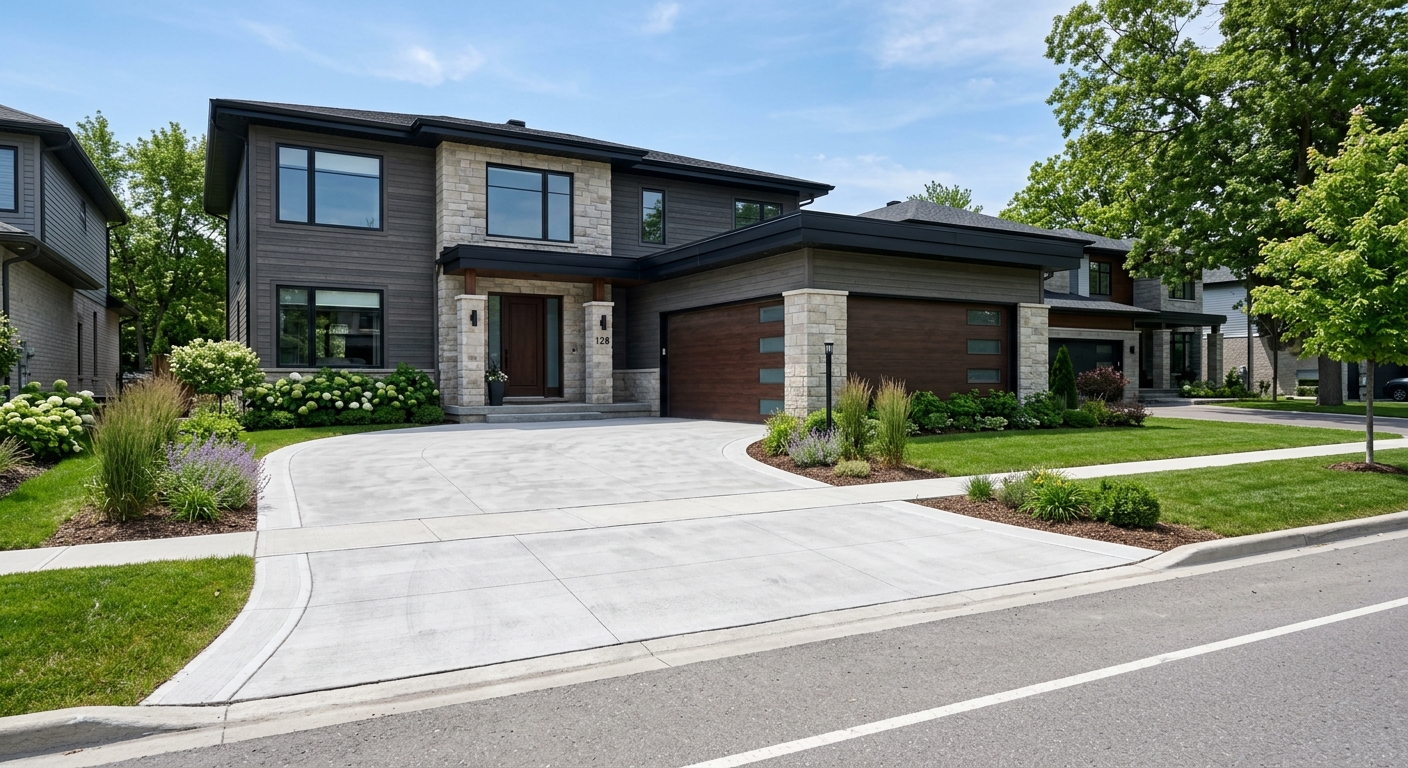
Concrete work options and costs in Chinatown
In Chinatown, British Columbia, homeowners typically choose concrete flatwork—especially driveways, patios, and walkways—because it holds up to the Lower Mainland–Southwest’s coastal-wet weather and frequent freeze–thaw cycles. With a population around 24,000 in 2021 (Statistics Canada, 2021 Census), the neighbourhood has a steady stream of repair and replacement work on older homes where exterior surfaces were poured decades ago. In this area, concrete demand is often highest around main-lane access routes and denser blocks near East Pender Street, where people want durable surfaces without frequent rework.
Lower Mainland pricing is shaped by a shallow frost depth (local practice often assumes about 450 mm / 18") and the need to protect slabs and foundations below that line to reduce frost heave. Even though winters are mild compared to interior or northern BC, saturated soils, heavy rainfall, and cool nights still drive costs: contractors factor drainage and compacted granular base prep, specify air-entrained concrete for exterior work, and plan curing/cover strategies when rain and humidity linger. That’s why two quotes for “the same driveway size” can differ—one crew may build a stronger base and use the right mix design, while another may cut corners and risk scaling or cracking sooner.
To compare apples to apples, use the ranges below for typical Chinatown projects and finishes, then discuss your site conditions and desired durability with your contractor.
| Application |
Typical Size |
Key Spec |
Finish Option |
Price Range |
| Concrete driveway (standard broom finish) |
12' x 20' (240 sq. ft.) |
Air-entrained exterior mix, compacted granular base |
Broom finish + control joints |
$4,300–$6,700 |
| Exposed aggregate driveway |
12' x 20' (240 sq. ft.) |
Air-entrained exterior mix, proper curing to set texture |
Exposed aggregate + sealer-ready surface |
$5,200–$8,400 |
| Stamped concrete driveway or patio |
10' x 20' (200 sq. ft.) |
Air-entrained mix, stencilled pattern, colour hardener (typ.) |
Stamped pattern + integral colour (as specified) |
$4,800–$7,200 |
| Plain concrete patio or walkway |
8' x 16' (128 sq. ft.) |
Air-entrained exterior mix, compacted granular base |
Steel trowel/brush finish as requested |
$2,200–$4,000 |
| Garage floor (interior slab) |
20' x 20' (400 sq. ft.) |
Minimum 32 MPa (project dependent), vapour considerations if required |
Broom finish or smooth finish |
$6,500–$11,500 |
| Foundation footings (structural, below frost) |
Per project basis (typ. per linear ft.) |
Designed depth below frost line, engineered rebar if required |
Structural concrete |
$200–$350 |
Prices are estimates only and vary by project scope, site access and material selection.
What affects the price of concrete work in Chinatown
In the Lower Mainland–Southwest, concrete quotes for the “same” driveway or patio can swing by 30–50% across different crews and parts of British Columbia because price is driven by hidden work: excavation and drainage, base thickness and compaction, mix design (especially air-entrainment), reinforcement choices, and how crews handle curing during cool, humid, rain-prone periods. A contractor who includes proper granular base prep and correct exterior mix design will often land toward the higher end of the range, while a cheaper quote may assume thinner base, less control over curing, or a less durable finish.
Here, the frost line depth and freeze–thaw cycles dictate nearly every specification. Exterior slabs and walkways need air-entrained concrete to withstand repeated expansion/contraction. Footings are typically placed below the design frost depth (often around 450 mm / 18" in local practice) to reduce frost heave risk. When weather turns colder or the site stays damp, we also account for cold-weather curing precautions—blankets, wind protection, and sometimes added measures to help concrete reach strength—because shortened pour windows and higher scheduling demands increase labour and overhead.
Two practical Chinatown examples: (1) a standard broom-finished driveway can come in around the lower end of the concrete driveway band (about $18–$28 per sq. ft.), while stamped concrete (roughly $22–$36 per sq. ft.) costs more because it needs extra colour steps, texture labour, and tighter workmanship tolerances; (2) if your site has saturated soil or poor drainage, drainage fixes and thicker compacted base can add cost, but they often prevent premature cracking and scaling that would otherwise force a future re-pour.
| Price Factor |
Why It Matters |
Cost Impact |
| Frost line depth — determines footing depth and form height |
Footings must sit below design frost to prevent heave |
Higher depth/formwork can add material + labour per linear ft. |
| Site preparation — excavation, grading, compacted granular base |
Base compaction and drainage reduce settlement and cracking |
More excavation/disposal and thicker base raises cost |
| Reinforcement — rebar or wire mesh requirement |
Controls cracking and improves load performance |
Rebar tying, supports, and layout add labour |
| Mix design — air-entrainment and compressive strength spec |
Air-entrainment helps resist freeze–thaw scaling/spalling |
Specified mix typically costs more and needs strict handling |
| Finish type — broom vs. stamped vs. exposed aggregate |
More decorative finishes require more steps and skilled crews |
Stamped/exposed options usually increase per-sq.-ft. cost |
| Pour size and concrete truck access to site |
Smaller, constrained sites may need extra equipment/crews |
Limited access can increase labour and pour logistics cost |
| Cold-weather curing precautions — heating and blankets |
Concrete must reach design strength and durability |
Extra equipment/materials extend schedule and labour |
| Control joint pattern and sealing cost |
Joints manage cracks; sealing improves resistance to salts |
Proper layout and materials add cost but reduce future repairs |
Permits & regulations in British Columbia
In British Columbia, structural concrete work—such as footings, foundation walls, and grade beams—typically requires a building permit and often engineered drawings. Municipal reviewers expect the design to account for loads, reinforcement, and site conditions, especially in freeze–thaw environments where proper footing depth and drainage matter. For concrete flatwork (patios, walkways, and driveways), permits are usually not required by default unless your project affects lot grading, impervious surface coverage limits, or ties into the municipal right-of-way (for example, a driveway approach or work that changes drainage flow). Because Chinatown projects can be tight and interconnected with drainage paths and neighbouring properties, it’s smart to confirm with the local authority before breaking ground.
Before hiring anyone, verify three basics: licensing, liability insurance, and WCB coverage (or equivalent coverage arrangements where applicable). Step-by-step for a Chinatown homeowner: (1) ask the contractor for their current business/contractor information and check it against the online registry for the applicable BC licence/registration; (2) request a Certificate of Insurance showing general liability (and endorsements if relevant) and confirm the coverage is active and matches the job address; (3) ask for proof of WCB coverage—often provided as a clearance letter or documentation showing account status and coverage details; (4) call 1–2 references on similar-scale work in Vancouver/Lower Mainland conditions, not just indoor projects.
Getting concrete right in Chinatown's freeze-thaw climate
Concrete fails in Chinatown winters mainly when water gets in and the surface or base cycles through freezing and thawing. The biggest culprits are inadequate base preparation, poor drainage, and—most commonly—missing or incorrect air-entrainment. When exterior concrete isn’t properly air-entrained and joints aren’t managed, moisture expands, pushing at the surface and causing scaling and spalling, especially where de-icing salts splash up from sidewalks and driveways.
To spec the job correctly for Lower Mainland–Southwest conditions, start with base preparation: remove unsuitable soil, place compacted granular sub-base to the proper depth for your soil and the slab thickness, and ensure drainage directs water away from the slab edge. Next, demand a mix design: for exterior flatwork, target air-entrainment around 5–7% and set a minimum compressive strength of 32 MPa (project dependent). Add control joints with a spacing plan that limits random cracking, and plan curing—aim for minimum 7 days in proper conditions, with curing blankets or wind/rain protection during cool weather. Finally, seal once cure time is achieved: apply a penetrating sealer after the proper cure period (often around 28 days) so the surface resists de-icing salt damage and water uptake.
Is paying more always worth it? For example, if stamped concrete is roughly in the $22–$36 per-sq.-ft. band while a broom-finished driveway sits near $18–$28, the added cost can be justified for aesthetics if the contractor still uses the correct air-entrained mix, base prep, and joint/sealer strategy. Skipping those makes any finish—plain or decorative—more likely to fail early in our wet-cool freeze–thaw swings.
| Spec |
Why It Matters in Chinatown |
What to Ask For |
Impact if Skipped |
| Compacted granular base (depth?) |
Controls settlement and keeps the slab edge from holding water |
Base depth and compaction method for your soil conditions |
Cracking, uneven surface, and premature edge breakdown |
| Air-entrained concrete mix (target air %?) |
Protects exterior concrete from freeze–thaw scaling/spalling |
Air-entrainment target of 5–7% for exterior flatwork |
Surface scaling and spalling, especially near joints |
| Compressive strength (MPa rating) |
Ensures long-term durability and resistance to abrasion |
Minimum 32 MPa (confirm in the mix design) |
Weaker surface layer and higher chance of early deterioration |
| Control joints (spacing per ACI guidelines) |
Limits random cracking patterns as the slab moves |
Proposed joint layout and saw-cut timing plan |
Wider random cracks and moisture paths under the slab |
| Minimum 7-day curing period |
Cold nights and humidity slow strength gain |
Curing plan for rain/cool weather (blankets/sealer timing) |
Slower strength development and weaker, more permeable surface |
| Penetrating sealer (when applied after cure) |
Helps repel water and de-icing salt intrusion |
Type of penetrating sealer and application timing (often ~28 days) |
Higher water uptake, staining, and faster salt-related wear |
How to choose a concrete work contractor in Chinatown
Choosing the right concrete contractor in British Columbia comes down to proof and process, not just the lowest number. First, verify licensing/registration that applies to the work they claim to do (ask them what category they’re operating under and check it on the appropriate BC registry). Next, confirm liability insurance by requesting a current Certificate of Insurance showing general liability limits and the jobsite address; for larger pours or higher-risk access, ask whether additional insured endorsements are provided. Finally, ask for WCB coverage documentation—typically a clearance letter or proof showing the account is in good standing.
Then get 2–3 itemised written quotes, not “lump sum only” numbers. You want a breakdown that shows labour and materials for: excavation, granular base, reinforcement, concrete supply, forming, finish, saw-cutting/joints, curing, and disposal/haul-off (if included). Read the scope for what’s excluded: street sweeping, cleanup, permit/locate responsibilities, off-haul disposal, changing soil conditions, and weather holds.
For warranty, ask for (1) the workmanship warranty length, (2) whether any product/manufacturer warranty applies (like sealer or decorative materials), and (3) whether coverage is transferable if you sell the home. For payment, never sign up for a schedule that demands most of the money up front; keep deposits in the 10–15% range and hold back the remainder until the job is complete and accepted. Finally, insist on a written start date and completion estimate so you’re not guessing around rain delays and curing time.
- Ask for a written scope that includes base prep thickness and drainage direction.
- Confirm the concrete mix is air-entrained for exterior work and ask the supplier spec details.
- Require joint layout drawings or a written joint plan (where, how many, and timing).
- Ask whether reinforcement (rebar/wire mesh) is used and how it’s supported off the base.
- Get disposal/haul-off confirmed in writing (included or extra).
- Verify insurance expiry dates and that coverage matches your project type.
- Request WCB clearance/proof before work starts.
- Check whether permit pulling (if needed) is included and who is responsible.
- Ask what weather triggers suspend work and how curing is protected if rain hits.
- Confirm the sealer type and application timing if sealing is part of the scope.
- Make sure traffic control, protection of adjacent property, and cleanup are included.
- Review references for similar Chinatown/Lower Mainland conditions (wet, constrained access).
Concrete contractor red flags I watch for in Chinatown: crews that won’t discuss air-entrainment or joints, quotes that omit granular base/compaction details, “one price fits all” pricing without site-specific allowances, rushing curing without blankets/protection in cool wet weather, and refusing to provide insurance/WCB proof before scheduling.
Frequently asked questions — concrete work in Chinatown
What causes concrete to spall in Chinatown winters?
Spalling in Chinatown, British Columbia is usually caused by water getting into the concrete and then freezing during our frequent cool nights and freeze–thaw cycles. If exterior concrete isn’t air-entrained to the right spec, the repeated expansion of freezing water damages the paste and loosens the surface, first as scaling and then as flakes (spalls). De-icing salt adds another layer—salt solution attracts moisture and can accelerate deterioration at the surface. The fix isn’t just “patching”: you need proper base prep and drainage, correct mix design, and a joint layout that controls cracking. If you’re comparing quotes, a higher-scope exterior job might cost closer to the upper end of a driveway band (for example, around $18–$28 per sq. ft.), but it typically includes the ingredients that prevent the failure.
What is rebar and when is it required in British Columbia?
Rebar (reinforcing bar) is steel placed inside concrete to help it resist tension and control cracking, especially in structural elements and slabs designed for heavier loads. In British Columbia, whether rebar is required depends on the engineered design and the type of work: structural items like foundation footings, grade beams, and walls generally require reinforcement per drawings. For concrete flatwork like driveways and patios, reinforcement may be required based on slab thickness, soil support, and load expectations (e.g., vehicles, garage doors, or areas prone to settlement). Some projects use wire mesh; others use rebar tied on supports. The practical takeaway for Chinatown homeowners: ask your contractor to state what reinforcement is proposed, why it’s needed for your thickness and soil, and who determined the spec (engineer or in-house design).
How long does a concrete project take in Chinatown?
Project duration depends on access, site prep, and curing conditions. For a driveway or patio, the excavation and base build can take 1–3 days, while forming, reinforcing, and the pour itself is often a day (or a half-day for smaller areas). The concrete then needs curing—commonly at least 7 days under proper conditions—before you treat it as fully set and load it according to the contractor’s instructions. Decorative work (like stamped concrete) often adds time for texture and curing control, which is why stamped items typically price in the higher range (often comparable to $22–$36 per sq. ft.). In Chinatown’s Lower Mainland–Southwest climate, rain and cool nights can shift schedules, so ask for a written plan for weather holds and curing protection blankets if temperatures drop.
What is a concrete overlay and is it suited to Chinatown?
A concrete overlay is a new concrete layer placed over an existing slab (or sometimes over suitable prepared surfaces) to improve appearance or restore a worn driving surface. It can be suited to some Chinatown properties when the existing slab is still structurally sound, stable, and properly prepared—meaning joints and cracks aren’t actively moving, and the surface can bond. However, overlays won’t fix underlying settlement, major base failures, or poor drainage that caused the original cracking. Because freeze–thaw cycles and moisture control are key in British Columbia, any overlay must be paired with sound base conditions and (if exterior) the right air-entrained mix and joint approach. If your existing surface is scaling/spalling, a full replacement may be the better long-term choice even if the initial price is higher.
How do I seal concrete to protect it in Chinatown?
Sealing helps protect concrete in Chinatown by reducing water and salt intrusion, which is important when freeze–thaw cycles repeatedly stress the surface. The best practice is to wait until the concrete has cured adequately—often about 28 days—so you don’t trap moisture beneath the sealer. Use a penetrating sealer (not just a surface film) and apply it only when the weather is suitable (no immediate heavy rain). Ask your contractor to include sealing in the scope and specify the product type. Don’t confuse decorative sealing with “making it last”—air-entrainment, joint control, and base drainage are still the core defence against scaling and spalling. If you’re budgeting, sealing is usually much cheaper than redoing a driveway; it’s one reason some homeowners choose the finish and durability packages toward the upper end of the driveway bands (such as $18–$28 per sq. ft. depending on specs).
What is the difference between concrete and cement?
In everyday speech, people say “cement” and “concrete” interchangeably, but they’re not the same. Cement is a key ingredient—typically Portland cement powder—that, when mixed with water, helps form the binding paste. Concrete is the finished building material: cement plus water plus aggregates (sand and gravel) and, in exterior work like driveways and patios in British Columbia, additives such as air-entrainment for freeze–thaw durability. That difference matters because the performance you feel—like resistance to scaling—depends on the full concrete mix design, not just the cement. For example, for Chinatown’s Lower Mainland–Southwest climate, a contractor should specify air-entrained concrete for exterior slabs and the required compressive strength (commonly minimum 32 MPa for durable exterior work). Always ask what the mix includes, not just what “cement” they’re using.