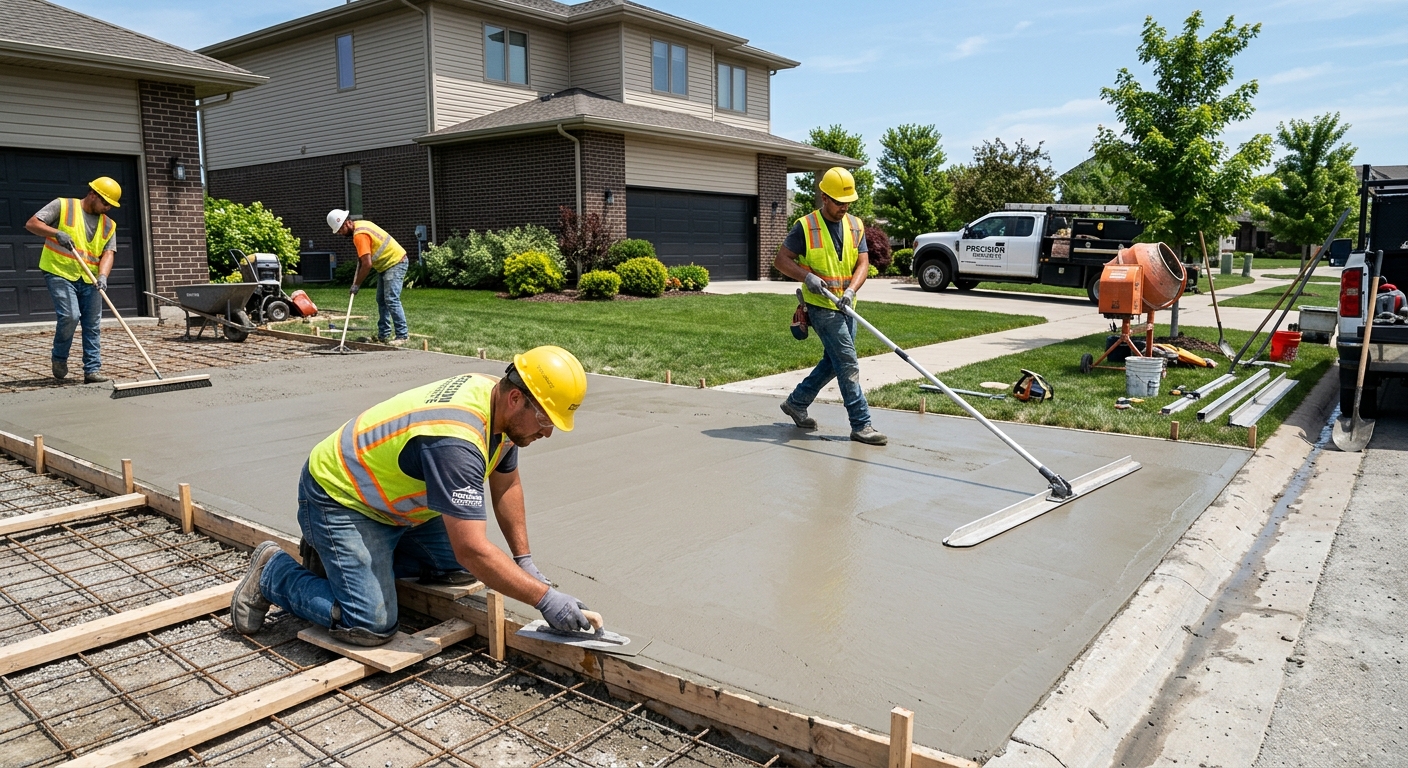
Concrete work options and costs in Creston
Creston is a great place for durable concrete flatwork, but the costs can feel different job-to-job because the Kootenays swing hard between wet valley conditions and cold snaps. With 74.0% of local dwellings being single-detached homes, most concrete work demand is for driveways, patios, walkways, and garage slabs that match older house lots and established grades. Homeowner households make up 76.2% of households, and many of those properties were built before 1981 (57.5%), so we often see older sub-bases, drainage issues, or settlement that adds preparation time before any concrete can go down.
In the Kootenays around Creston, the frost line pushes footing bottoms well below grade, and exterior slabs need air-entrained mixes to handle freeze–thaw cycles. Frequent winter cycling also means we spec control joints tightly for driveways, slabs, and walks to reduce random cracking. Contractors in the Creston area typically schedule fewer pours during the short cold-weather window, and winter protection (blankets, insulation, sometimes temporary enclosures) can increase unit costs. On top of that, de-icing salts can accelerate surface scaling, so sealing choices matter more here than in milder BC pockets.
If you’re comparing options, use the ranges below as a backbone: the more decorative the surface (stamped or exposed aggregate) and the more complex the excavation/base, the higher the total. For many homeowners in Creston—especially near the downtown core and the newer servicing corridors where access is tighter—finishing and prep decide the final number.
| Application |
Typical Size |
Key Spec |
Finish Option |
Price Range |
| Concrete driveway (standard broom finish) |
20 ft x 10 ft (200 sq. ft.) |
Air-entrained exterior mix, control joints |
Broom finish |
$3,600 – $5,600 |
| Exposed aggregate driveway |
20 ft x 10 ft (200 sq. ft.) |
Air-entrained mix, proper surface retarder |
Exposed aggregate (medium stone) |
$4,200 – $6,200 |
| Stamped concrete driveway or patio |
16 ft x 12 ft (192 sq. ft.) |
Air-entrained mix, release agent + stamping |
Stamped pattern with integral/overlay colour |
$4,800 – $7,700 |
| Plain concrete patio or walkway |
12 ft x 10 ft (120 sq. ft.) |
Air-entrained mix, minimum 4 in thickness |
Screeded + light broom |
$1,700 – $2,900 |
| Garage floor (interior slab) |
24 ft x 22 ft (528 sq. ft.) |
Vapour barrier (as required), control joints |
Float finish, optional sealant |
$9,000 – $13,200 |
| Foundation footings (structural, below frost) |
Typical 2-storey footprint (varies) |
Engineer/structural design, below frost depth |
Reinforced concrete footings |
$7,000 – $13,500 |
Prices are estimates only and vary by project scope, site access and material selection.
What affects the price of concrete work in Creston
In Creston and across the Kootenays, you can see the same “concrete job” quoted 30–50% apart because the real cost drivers are hidden in preparation and specifications. One contractor might include proper over-excavation and drainage, while another assumes native soil is good enough. You’ll also notice differences in how they handle cold-weather protection, joint spacing, and finishing time—these details directly affect durability in the freeze–thaw cycle.
Frost line depth is a big one. Exterior footings and structural bases must extend below design frost depth to prevent frost heave, and in colder continental climates this pushes excavation and formwork deeper. For exterior slabs, all-weather durability depends on air-entrained concrete mixes sized for freeze–thaw exposure. Cold seasons also reduce the pour season, so scheduling and curing precautions—curing blankets, temporary heat, and tighter monitoring—can add cost even when the quantity of concrete looks similar. Finally, de-icing salt use is common in driveway areas; it can accelerate surface spalling if the mix and finishing aren’t right, which is why sealing is often recommended.
In Creston specifically, older homes (57.5% built before 1981) often sit on sites with changed drainage patterns, so site prep can either add cost (soft spots, poor drainage, hauling) or reduce it (good base already in place). For a typical driveway, the “standard broom” option might land around the $18 – $28 per sq. ft. band, while stamped or exposed finishes typically ride higher inside the $25 – $40 stamped/decorative band because of extra labour, forms, and surface prep. A driveway with tight access near the house or with tree-root interference usually costs more than an open, easy-to-load area.
| Price Factor |
Why It Matters |
Cost Impact |
| Frost line depth — determines footing depth and form height |
Deeper excavation increases concrete, rebar, and formwork labour |
Higher excavation + materials; can add thousands on foundations |
| Site preparation — excavation, grading, compacted granular base |
Proper base reduces settlement and random cracking |
Soft spots, haul-out/haul-in, drainage work increases cost |
| Reinforcement — rebar or wire mesh requirement |
Controls cracking for driveways, slabs and structural elements |
Additional material + placement labour |
| Mix design — air-entrainment and compressive strength spec |
Freeze–thaw survival depends on air content; strength affects durability |
Higher-spec mix and QC time; typically adds moderate cost |
| Finish type — broom vs. stamped vs. exposed aggregate |
Decorative finishes require longer crew time and tighter surface control |
Stamped/exposed generally increases unit price |
| Pour size and concrete truck access to site |
Smaller pours or limited access may require pumping or extra batching logistics |
Pumping/extra handling increases overall labour and equipment costs |
| Cold-weather curing precautions — heating and blankets |
Early freezing or poor curing can weaken concrete and increase scaling risk |
Heating, insulation, and monitoring can materially raise costs |
| Control joint pattern and sealing cost |
Joints control cracks; sealing helps resist de-icing salts |
More labour planning + add-on material costs |
Permits & regulations in British Columbia
In British Columbia, concrete work is usually straightforward for homeowners, but the permit trigger depends on what you’re building and whether it affects structural support, drainage, or lot grading. In most cases, structural concrete such as footings, foundation walls, and grade beams requires a building permit, and engineered drawings are commonly reviewed by the municipality/authority having jurisdiction. Concrete flatwork—driveways, patios, and walkways—often does not require a permit unless it impacts lot drainage, impervious surface coverage limits, or the municipal right-of-way (for example, if you’re changing access/culverts or work near a curb line). Because rules can vary with site conditions, confirm with the local authority before you break ground.
Before you hire anyone in Creston, verify they carry liability insurance and appropriate worker coverage. Step-by-step, do this:
- Check the contractor’s business credentials and registration/eligibility using the appropriate provincial online resources (search the contractor name).
- Request a Certificate of Insurance (general liability) and confirm the coverage is current and includes work at your address.
- Ask for proof of worker coverage (WSBC/WCB clearance documentation). If they can’t provide it, treat that as a red flag.
- Ask for references for similar-scale concrete work in the Kootenays (driveway/surface area and winter installs if applicable).
- Confirm who pulls any permits if your project affects grading or structural items.
For peace of mind, keep copies of everything you receive in writing.
Getting concrete right in Creston's freeze-thaw climate
Concrete failures in Creston’s climate usually come down to three things: weak or poorly cured concrete, inadequate base preparation, and missing freeze–thaw durability specs. First, base preparation matters—driveways and exterior patios need a properly excavated and compacted granular sub-base to the right depth for the local soil and frost exposure. If the base isn’t compacted or is poorly drained, water gets trapped and expands during freeze–thaw cycles, which leads to heave, settlement, and cracking.
Second, mix design is non-negotiable. For exterior flatwork, specify air-entrainment (target 5–7% air for typical exterior exposure) and minimum compressive strength (commonly 32 MPa for many residential flatwork specs, depending on design requirements). Without the right air content, you’ll see spalling and surface scaling sooner—especially where de-icing salt is used on driveways.
Third, control joints and curing prevent random cracking. Plan joint spacing so the slab cracks where you want it. In cold weather, curing must be protected: blankets, insulation, or heated enclosures may be required to keep concrete from freezing early. As for sealing, apply a penetrating sealer after the recommended cure (often around 28 days) to help repel de-icing salts and reduce surface deterioration.
To judge value, compare options honestly. For example, if stamped concrete costs roughly mid-way in the $25 – $40 decorative band, that premium is justified when the pattern reduces future landscaping repairs and you’re getting proper base and joints—stamping doesn’t “fix” a weak base. If a broom-finish driveway meets spec and has correct joints, it can outperform a poorly prepped decorative slab every time.
| Spec |
Why It Matters in Creston |
What to Ask For |
Impact if Skipped |
| Compacted granular base (depth?) |
Reduces settlement and water pumping under freeze–thaw |
“What sub-base thickness are you compacting to, and how is it moisture-conditioned?” |
Heave, rocking, and rapid cracking |
| Air-entrained concrete mix (target air %?) |
Air bubbles provide room for ice expansion |
“Confirm air content target—5–7% for exterior flatwork—and how it’s verified.” |
Spalling and scaling during winter cycles |
| Compressive strength (MPa rating) |
Ensures strength development under local curing conditions |
“What minimum compressive strength do you spec (e.g., 32 MPa) and is it documented?” |
Surface weakness, abrasion failure, reduced lifespan |
| Control joints (spacing per ACI guidelines) |
Limits random cracking by directing stress relief |
“What joint spacing and saw-cut timing will you use?” |
Uncontrolled cracks that collect water and salt |
| Minimum 7-day curing period |
Correct early-age curing prevents strength loss |
“How will you protect the slab in cold weather (blankets/heating) and for how long?” |
Early freezing risk, higher scaling and durability problems |
| Penetrating sealer (when applied after cure) |
Helps repel de-icing salt and water absorption |
“Which penetrating sealer and when will you apply it (after full cure, typically ~28 days)?” |
Faster deterioration at the surface |
How to choose a concrete work contractor in Creston
Choosing the right concrete contractor in Creston is mostly about verifying accountability and getting a scope you can compare. Start by confirming British Columbia licensing/registration where applicable, then verify liability insurance and worker coverage. Practically, ask for three documents: (1) a current Certificate of Insurance showing general liability for the work, (2) proof of worker coverage/clearance for their crews, and (3) evidence of their relevant trade experience (photos/references) for driveway, walkway, and any foundation work you’re considering.
Next, get 2–3 itemised written quotes. You want a labour + materials breakdown where possible—especially showing excavation/base prep, reinforcement, concrete supply and finishing. A quote that’s only a lump sum for “concrete supply and pour” without base and joint details will be hard to price fairly. Read the exclusions: is demo included? Is haul/disposal included? Are edges, forms, and proper drainage addressed? Will they pull permits if needed? Also ask about curing protection in cold weather—this is where Creston jobs can change cost quickly.
Warranty matters too: request the workmanship warranty length and what it covers (cracks due to improper curing/base are typically excluded unless you can prove spec compliance). Product/manufacturer warranties for sealers or decorative systems should be provided in writing. For payment, never pay more than 10–15% upfront; use progress payments and a holdback until completion and cleanup. Finally, insist on a written start date and realistic completion timeline.
- Ask for a detailed scope covering excavation, disposal, base material, compaction, and drainage.
- Confirm frost-related specs: below-frost footing requirements for structural work.
- Require air-entrained mix confirmation for exterior slabs/driveways.
- Get a clear reinforcement plan (rebar or mesh) and placement method.
- Confirm joint layout: spacing, saw-cut timing, and sealing plan.
- Ask how they protect curing in cold weather (blankets/heating/enclosures).
- Verify whether de-icing salt exposure is considered and sealing is offered.
- Make sure the quote includes all surface prep and finish requirements.
- Confirm truck access, distance to pour, and whether pumping is included.
- Review disposal: removal/haul-away of over-excavated material included or not.
- Check insurance documents are current and specific to the project scope.
- Use a payment schedule with holdback until punch list completion.
Concrete contractor red flags in Creston: vague “we’ll pour concrete” scopes with no base/air/joint specs; refusing to provide an itemised quote or proof of insurance/worker coverage; skipping cold-weather curing protections when temperatures are dropping; offering stamped/exposed finishes without detailing sealer, joints, and surface curing; and pressuring you for large upfront payments or a verbal-only timeline.
Frequently asked questions — concrete work in Creston
When is the best time to pour concrete in Creston?
In Creston and across the Kootenays, the best time to pour is typically late spring through early fall when temperatures stay consistently above freezing. That said, winter pours can happen if the contractor sets up proper cold-weather curing protection (insulation blankets and/or temporary heat) and monitors the slab temperature. Scheduling is also important because freeze–thaw cycles can start quickly once nights drop, and early freezing can weaken the surface—especially on exterior driveways where de-icing salt is used later. If your contractor proposes a pour with minimal protection when it’s already near or below freezing, ask for their method and expected protection duration. Timing can also affect pricing: cold-weather precautions can push jobs toward the higher end of local bands such as driveway flatwork in the $18 – $28 per sq. ft. range.
How long does concrete take to cure?
Concrete develops strength quickly at first, but full performance takes time. As a practical homeowner guideline in British Columbia, expect a minimum of about 7 days of curing for many residential slabs, with ongoing strength gain after that. In Creston’s freeze–thaw climate, the curing plan matters as much as the calendar date: if the slab is curing in cold weather, blankets or heat may be required to avoid early-age freezing and scaling. Finish work like sealing typically happens later—commonly after the slab has reached a suitable cure period (often around 28 days) so the sealer bonds properly and repels moisture and de-icing salt. Always ask your contractor what protection they’ll use during the first week and whether they’ll document the curing conditions.
Do I need a permit for concrete work in British Columbia?
For many concrete flatwork projects in Creston—patios, walkways, and typical driveways—a permit is often not required if you’re not changing lot grading, drainage, or right-of-way conditions. However, structural concrete like footings, foundation walls, and grade beams typically requires a building permit and often engineered drawings. Concrete work can also trigger permitting if it affects impervious surface limits, surface water routing, or access near the curb/right-of-way. The safest approach is to ask your contractor to confirm the scope with the local authority before pouring. Also verify that your contractor can provide proof of liability insurance and worker coverage, and that they clearly state whether permit pulling (if needed) is included in their quote.
Concrete vs pavers for a patio in Creston?
Concrete patios and pavers both work in Creston, but the decision usually comes down to maintenance and freeze–thaw tolerance. Concrete patios—when properly built on a compacted granular base and with correct joints—tend to last well and give a solid, monolithic surface. Pavers can look great and are easier to spot-repair if one area shifts, but freeze–thaw can lift or settle joints if the base and drainage aren’t right. Concrete options are typically cost-favourable for larger areas; for plain concrete patios/walkways, Creston pricing often falls around the $14 – $24 per sq. ft. band, while more decorative finishes cost more. If your soil is wet or drainage is marginal, ask either installer how they handle base compaction and water control before comparing overall value.
How long does a concrete driveway last?
With proper specs for Creston’s freeze–thaw winters—air-entrained concrete, correct base preparation, reinforcement when required, tight control joints, and curing protection—a driveway can last many years and often outperforms cheaper “thin and fast” installs. The real lifespan depends on how the slab was built and maintained, especially where de-icing salts and moisture exposure are heavy. Sealing after the recommended cure period can help slow surface deterioration. If you see uncontrolled cracking, poor drainage, or scaling/spalling at the edges, it usually points to base or mix issues rather than “just wear.” When comparing quotes, avoid choosing solely on the lowest number; a slightly higher bid within the $18 – $28 per sq. ft. band can be justified if it includes the right base depth, joints, and curing plan for winter durability.
What is air-entrained concrete and why does it matter here?
Air-entrained concrete includes tiny, evenly distributed air bubbles in the mix. In Creston, those microscopic voids give freezing water space to expand without breaking the concrete matrix, which is why air-entrainment is essential for exterior work exposed to repeated freeze–thaw cycles. Without it, the slab can develop surface scaling and spalling—particularly on driveways where de-icing salt is used and moisture sits. For typical exterior flatwork in this region, contractors often target roughly 5–7% air content (project specs can vary), then verify the mix meets the requirement and is placed and cured properly. When reviewing your quote, ask the contractor to specify the air-entrainment requirement and their cold-weather curing steps. It’s one of the most important durability line items you can control.