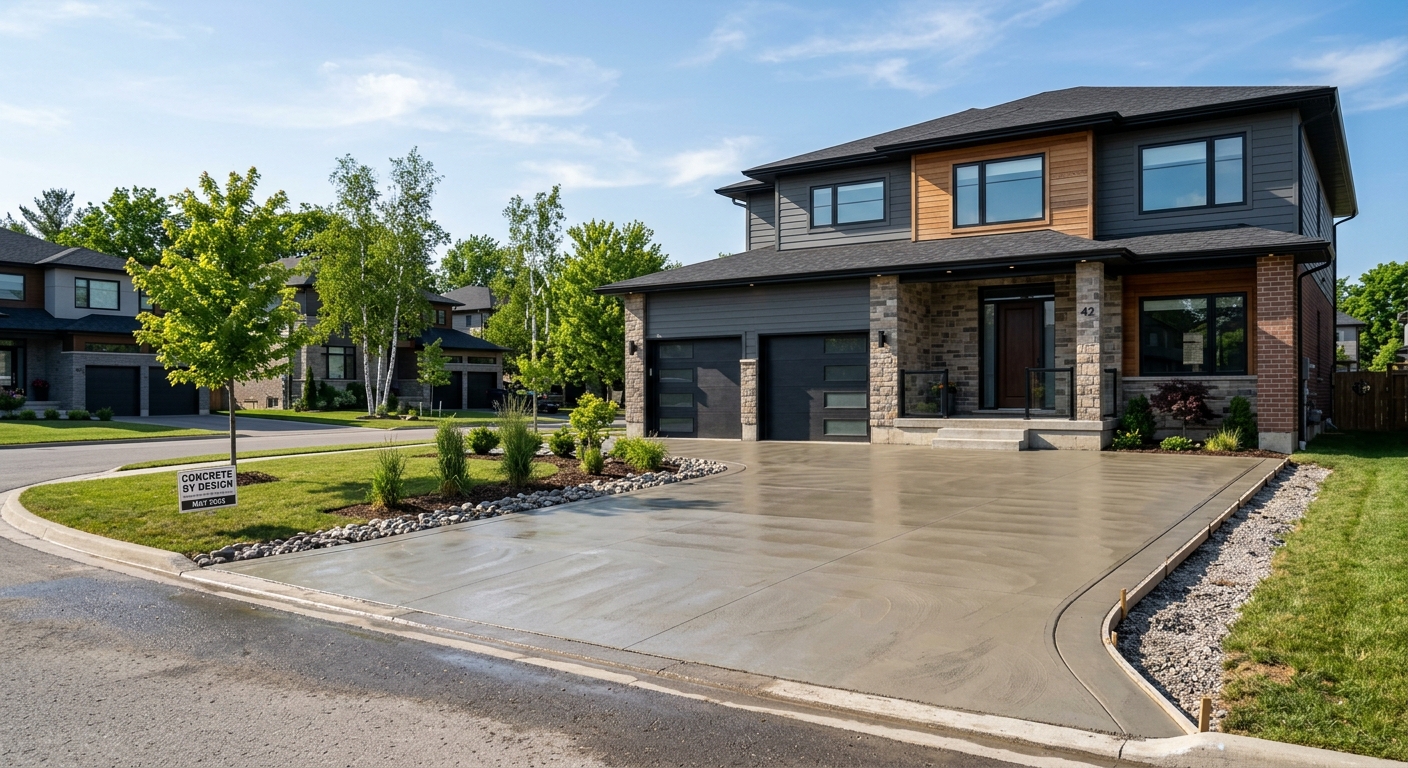
Concrete work options and costs in Kaleden
Kaleden is a small community in the Lower Mainland–Southwest, with a 2021 population of 1,186 (Statistics Canada, 2021 Census). In a market like this, most residential concrete flatwork—driveways, patios and walkway slabs—is built for single-family homes and their garages, where a long-lasting, low-maintenance surface matters. For homeowners, the good news is you can choose from a range of finishes and slab types without paying “commercial” pricing, but the climate still has a major say in the final cost.
Here in the Lower Mainland–Southwest, winters are generally mild, yet we still see shallow frost depth and freeze–thaw cycles that can punish concrete that isn’t built for exterior exposure. Local crews typically design footings and thickened edges around a frost depth of about 450 mm (18"), placing them below grade to reduce frost heave risk. Rain can be persistent and curing conditions can run cool and humid, so contractors often use curing blankets, sealers and longer cure windows to reach design strength and durability. That seasonal scheduling—and the limited number of crews available when the ground is workable—can tighten timelines and influence labour rates.
In Kaleden, concrete work is especially in demand around the Okanagan corridor near the downtown area and along commonly used access roads where homeowners routinely update aging driveways and add patios for summer use. With that in mind, here’s a practical comparison of typical sizes, specs and budget ranges you can use to line up quotes before your site visit.
| Application |
Typical Size |
Key Spec |
Finish Option |
Price Range |
| Concrete driveway (standard broom finish) |
400–600 sq. ft. |
Air-entrained mix, compacted granular base, control joints |
Broom finish (light broom) |
$18,000–$28,000 |
| Exposed aggregate driveway |
400–600 sq. ft. |
Air-entrained mix, proper curing for clean exposure |
Exposed aggregate (bush-hammering/wash exposure) |
$22,000–$35,000 |
| Stamped concrete driveway or patio |
250–500 sq. ft. |
Air-entrained mix, integral colour, release agent and sealer |
Stamped (patterned) surface |
$18,000–$40,000 |
| Plain concrete patio or walkway |
120–300 sq. ft. |
Reinforcement as needed, compacted base, control joints |
Float and broom or smooth trowel edge |
$2,000–$7,800 |
| Garage floor (interior slab) |
400–600 sq. ft. |
Vapour barrier, reinforcement, proper thickness for vehicles |
Plain broom/steel-trowel hybrid |
$14,000–$24,000 |
| Foundation footings (structural, below frost) |
Varies by design |
Depth below design frost (~450 mm in practice), engineered reinforcement |
Structural plain concrete |
$8,000–$22,000 |
Prices are estimates only and vary by project scope, site access and material selection.
What affects the price of concrete work in Kaleden
In the Lower Mainland–Southwest, it’s common to see quotes for the “same” concrete job swing by 30–50%—especially when one contractor includes proper base prep, reinforcement, or rain/cold-weather curing measures and another doesn’t. In British Columbia, these differences get amplified because crews are balancing short workable windows, cool nights, and saturated ground. Even when the finish looks identical, the specs underneath (granular base depth, air-entrainment, joint pattern, curing method) can be the whole cost driver.
Frost line depth and freeze–thaw cycles dictate every exterior spec. While Lower Mainland–Southwest design assumptions often reference around 450 mm / 18" frost depth, contractors still place footings and thickened edges below frost to prevent frost heave. Exterior slabs also need air-entrained concrete mixes so the freeze–thaw cycle doesn’t scale and spall the surface. Colder regions elsewhere in BC may require deeper excavations and cold-weather precautions; in Kaleden, you still pay attention to curing timing and surface protection when temperatures drop or when prolonged damp weather delays finishing.
Concrete examples that change cost in Kaleden: (1) a driveway that needs deeper base and improved drainage tends to land on the higher end; (2) stamped or exposed aggregate driveways cost more because of colour systems, finishing labour and typically higher sealer requirements; (3) if de-icing salts are used on walkways, sealing becomes less optional because salts accelerate surface breakdown on porous concrete.
As a practical reference, standard broom driveway work often aligns with the regional $18–$28 range, while stamped & decorative concrete commonly pushes closer to the $22–$36 per sq. ft. band when colour and finishing time are properly accounted for. Lastly, remember Kaleden’s housing stock: many homes have older compacted driveways and drainage patterns that need correction, and that’s where a “cheap” quote can suddenly rise once excavation and grading are truly measured.
| Price Factor |
Why It Matters |
Cost Impact |
| Frost line depth — determines footing depth and form height |
Footings must be placed below the design frost zone to reduce frost heave and movement. |
Can add significant excavation and forming labour; higher end on footings. |
| Site preparation — excavation, grading, compacted granular base |
Good base prep controls settlement and reduces voids that lead to cracking. |
Major swing factor; poor access or extra haul-off pushes cost up. |
| Reinforcement — rebar or wire mesh requirement |
Rebar/wire mesh helps control cracking and supports slab performance under loads. |
Material + labour; often small cost vs. long-term durability. |
| Mix design — air-entrainment and compressive strength spec |
Air-entrainment protects exterior concrete through freeze–thaw cycles. |
Higher-quality mix and QA can move pricing to the higher band. |
| Finish type — broom vs. stamped vs. exposed aggregate |
Finish systems require extra materials, timing and labour to execute cleanly. |
Stamped/exposed can add meaningful labour and add-on materials. |
| Pour size and concrete truck access to site |
Smaller pours or tight access can require more crew time and pump/extra handling. |
Shortens truck efficiency; can raise per-sq.-ft. cost. |
| Cold-weather curing precautions — heating and blankets |
Maintains strength gain when temperatures drop or nights are cool. |
Adds equipment and labour; often necessary for consistent results. |
| Control joint pattern and sealing cost |
Joints guide cracking; sealing improves resistance to water and de-icing salts. |
Relatively modest line item, but omitted specs increase failure risk. |
Permits & regulations in British Columbia
In British Columbia, structural concrete work—such as footings, foundation walls, and grade beams—generally requires a building permit, and engineered drawings are often reviewed by the municipality before construction. The focus is on safety and structural load paths, so if you’re building or altering foundations, expect permitting and inspections.
Concrete flatwork (typically patios, walkways and driveways) often does not require a permit by default. However, you should confirm with the local authority if your project affects lot grading, drainage patterns, impervious surface coverage limits, or anything near municipal right-of-way. Even without a building permit, there may be requirements for setbacks, drainage discharge and surface run-off management—especially in wet-season conditions.
Step-by-step for a homeowner in Kaleden:
- Verify the contractor’s business is active in British Columbia and ask for their company licence details and jobsite contact.
- Request a certificate of liability insurance showing coverage amounts and active dates; it should list your address or be suitable for your project.
- Confirm WSIB/WCB coverage (as applicable) and ask for proof before work begins.
- Ask for references on similar-size concrete flatwork and foundation-adjacent work.
- If any structural scope is proposed (foundation replacement, underpinning, or grade beams), confirm that the contractor will coordinate the permit/engineer documentation.
- Keep copies of the permit number (if applicable), drawings and inspection schedule—so you can verify work matches approved specs.
Getting concrete right in Kaleden's freeze-thaw climate
Concrete in Kaleden fails most often for predictable reasons: weak or poorly compacted base, inadequate air-entrainment, uncontrolled joints, and curing that’s rushed or done under cold/wet conditions. In the Lower Mainland–Southwest, even with a shallow frost line assumption, the freeze–thaw cycle and wet-season saturation can still damage exterior concrete surfaces. Your job is to spec it like an exterior exposure product, not like a basement slab.
To get it right, lock in five core areas. (1) Base preparation: require a compacted granular sub-base to the right thickness for your soil and the slab type, with drainage attention so water doesn’t sit under the slab. (2) Mix design: require air-entrained concrete and a minimum compressive strength target (commonly 32 MPa for durability-focused flatwork). Exterior air content is typically in the 5–7% range for freeze–thaw resistance. (3) Control joints: spacing should limit random cracking to predictable lines. (4) Curing: plan for at least 7 days of proper curing conditions, with blankets or curing aids if nights are cool. (5) Sealing: a penetrating sealer applied after cure (commonly after 28 days) helps repel water and can reduce salt-driven surface breakdown.
A key question to ask: “How are you preventing spalling from inadequate air-entrainment?” That’s the most common durability failure we see when a contractor trims cost by using the wrong mix or finishing too fast.
On cost justification: a broom-finish driveway budget aligns with the regional $18–$28 range, while stamped concrete often moves higher (stamped and decorative band is commonly $22–$36 per sq. ft.). In Kaleden, paying the difference can be justified when you want integrated colour and patterns—but only if the base, joints, and curing are also done to the same durability standard.
| Spec |
Why It Matters in Kaleden |
What to Ask For |
Impact if Skipped |
| Compacted granular base (depth?) |
Controls settlement and helps manage water under the slab during wet seasons and freeze–thaw cycles. |
Confirm base thickness and compaction method for your soil; include drainage/grading notes. |
Premature cracking, uneven slab, and water pumping through the slab edges. |
| Air-entrained concrete mix (target air %?) |
Improves freeze–thaw durability in exterior exposure common to Kaleden. |
Ask for air content targeting 5–7% for exterior flatwork (as per mix design). |
Higher risk of scaling and spalling, especially with de-icing salts. |
| Compressive strength (MPa rating) |
Ensures durability and long-term performance under vehicle loads and seasonal stresses. |
Confirm minimum 32 MPa compressive strength (or project-specific spec). |
Surface wear, reduced strength gain, and faster deterioration. |
| Control joints (spacing per ACI guidelines) |
Controls where cracks occur during shrinkage and seasonal movement. |
Ask for joint layout and spacing consistent with ACI guidance for slab thickness. |
Random cracking, wider cracks, and higher water infiltration at edges. |
| Minimum 7-day curing period |
Strength gain and surface durability depend on cure time in cool/humid conditions. |
Confirm curing plan and whether blankets/sealers are used in cool weather. |
Reduced strength, increased cracking, and weaker surface resistance. |
| Penetrating sealer (when applied after cure) |
Helps repel moisture and reduces the impact of salts during winter use. |
Ask about applying penetrating sealer after cure—commonly around 28 days. |
More porous surface, faster scaling, and higher maintenance sooner. |
How to choose a concrete work contractor in Kaleden
For concrete in Kaleden, your contractor choice is mostly about documentation and process—not just the price tag. Start by verifying British Columbia licensing details for the company (and that their workers are set up for the scope you’re hiring). Next, request liability insurance and check that it’s current (certificate of insurance) before any excavation starts. Then confirm WSIB/WCB coverage with proof of coverage for the trades involved. If they can’t provide certificates or they rush you to sign without documentation, that’s a major warning sign.
Get 2–3 itemised written quotes so you can compare apples to apples. A real quote should break out concrete supply, excavation and forming, reinforcement, finish work (and what’s included for sealing), plus disposal/haul-away and any permit coordination. Avoid “lump sum” quotes where critical items are missing—those omissions often show up later as change orders.
Read the scope carefully for exclusions: is permit pulling included if structural work triggers permitting? Is site disposal included or billed separately? Is compacted granular base depth specified? What’s the reinforcement type? Also confirm warranty terms: a workmanship warranty length, whether there are limits on cracks at joints, and how product/manufacturer warranty is handled. Finally, be strict with payment: do not pay more than 10–15% upfront; hold back until the job is complete and cured per spec. Ask for a start date and completion estimate in writing—concrete scheduling in the Lower Mainland–Southwest depends heavily on workable ground and curing conditions.
- Confirm BC licence/business status and jobsite contact.
- Request certificate of liability insurance (active dates, coverage limits).
- Verify WSIB/WCB coverage documentation before work starts.
- Ask for at least two recent references in BC with similar scope and finishes.
- Get itemised quotes: excavation, base, reinforcement, concrete supply, finishing, curing, sealing.
- Ensure the quote states base thickness and compaction expectations.
- Ask what air content and compressive strength are being ordered for exterior concrete.
- Confirm reinforcement spec (mesh vs. rebar, and slab thickness assumptions).
- Require a joint plan (where joints go and how they’re finished).
- Clarify cold-weather curing approach (blankets/heating if needed).
- Discuss disposal/haul-away included vs. excluded.
- Use a payment schedule with a holdback until final finish and curing are complete.
In Kaleden, concrete contractor red flags include: using the same mix for interior and exterior jobs without specifying air-entrainment; skipping base depth/compaction details; promising completion dates that ignore curing windows in cool, wet weather; “cheap” stamped work that doesn’t include proper release/colour and sealing; and quotes that don’t list reinforcement and joint spacing for exterior slabs.
Frequently asked questions — concrete work in Kaleden
Why does concrete crack in Kaleden and how is it prevented?
In Kaleden and across the Lower Mainland–Southwest, cracking is usually about shrinkage, movement and water—not “bad luck.” As concrete cures, it shrinks, and then seasonal temperature changes and freeze–thaw cycles encourage expansion/contraction. When a slab lacks a properly prepared base, or when reinforcement and control joints aren’t planned, cracks show up randomly and can widen as moisture moves in. The prevention is straightforward: build a compacted granular base, use a durable exterior mix (including air-entrainment for freeze–thaw resistance), and install control joints at the right spacing for your slab thickness. Sealing after cure helps reduce water and salt exposure. A well-detailed broom-finished driveway budget often sits near the regional $18–$28 range, but the real protection comes from the correct specs beneath the surface.
Stamped vs broom-finish concrete — cost difference?
Stamped concrete costs more than broom-finish because it uses additional materials and more skilled labour. With broom finish, the focus is on grading, floating, edge work and a consistent broom texture. With stamped concrete, the contractor also applies integral or surface colour, uses release agents, stamps the pattern, and then completes finishing and sealing suited to the decorative surface. In Kaleden, that difference often shows up as a shift from standard driveway pricing toward the stamped & decorative band (commonly $22–$36 per sq. ft. depending on scope). If your goal is durability first, broom finish is the value choice and still performs well when air-entrainment, joints and curing are done correctly. If you want curb appeal and a patterned look, pay for stamping—but insist the base, joints and curing meet the same exterior exposure requirements.
When is the best time to pour concrete in Kaleden?
The best time to pour in Kaleden is when ground conditions are workable and temperatures support proper curing. In the Lower Mainland–Southwest, we often manage mild winters, but cool nights and rainy stretches still affect finishing and strength gain. Contractors plan pours so concrete can be placed, finished and cured under conditions that reach design strength—if nights get cold, curing blankets and protective measures may be needed. Avoid scheduling that relies on “we’ll just keep working through the rain,” because excess surface moisture and delayed set can compromise the finish and durability. For homeowners, the practical approach is to schedule in the drier shoulder periods or early summer, and to ask your contractor how they handle curing during the wettest weeks. If you’re comparing quotes, ask whether cold-weather precautions are included; that can affect cost and long-term performance.
How long does concrete take to cure?
Concrete curing is often misunderstood. While concrete may be walkable after a short period, durability depends on the full curing process. For typical exterior flatwork in British Columbia, plan for at least 7 days of curing under proper conditions so the concrete can continue strength gain and reduce early cracking risk. For sealing, many homeowners choose a penetrating sealer applied after cure—commonly around 28 days—because that timing improves how well the sealer penetrates and performs against water and salts. The curing schedule matters more in Kaleden when cool, humid or damp weather slows strength gain. Ask your contractor for a curing plan (blankets or curing compounds if needed) and confirm how they’ll protect the slab during early days. That’s one reason two quotes can differ: the cheaper one may not include the real curing and protection steps.
Do I need a permit for concrete work in British Columbia?
In British Columbia, structural concrete work—like footings, foundation walls and grade beams—generally requires a building permit and often engineered drawings reviewed by the municipality. Concrete flatwork such as patios, walkways and driveways usually does not require a permit unless it affects lot grading, drainage outcomes, impervious surface limits, or impacts municipal right-of-way requirements. In Kaleden, the best move is to confirm with the local authority before starting, particularly if you’re changing drainage paths or reshaping the approach to the home. Also, make sure your contractor can show the right documentation: proof of liability insurance and WSIB/WCB coverage. If structural changes are included in the scope, don’t sign off on a quote until permit responsibility and engineered requirements are clearly stated in writing.
Concrete vs pavers for a patio in Kaleden?
Concrete and pavers both work well for patios in Kaleden, but the decision usually comes down to cost predictability, maintenance expectations, and how your site handles water. Concrete patios are typically continuous slabs with controlled joint patterns; they can be very cost-effective when you want a durable finish. Pricing for plain concrete patios and walkways often aligns with the $16–$26 band for the regional tier, depending on size and base prep needs. Pavers can be easier to repair locally if a section fails, and they provide a flexible look, but they usually require careful base design to prevent settlement and joint washout in wet conditions. In freeze–thaw weather, the base and drainage details matter for both options. If you regularly see standing water or you anticipate de-icing use, ask about drainage/granular specs first—finish is secondary to durability.