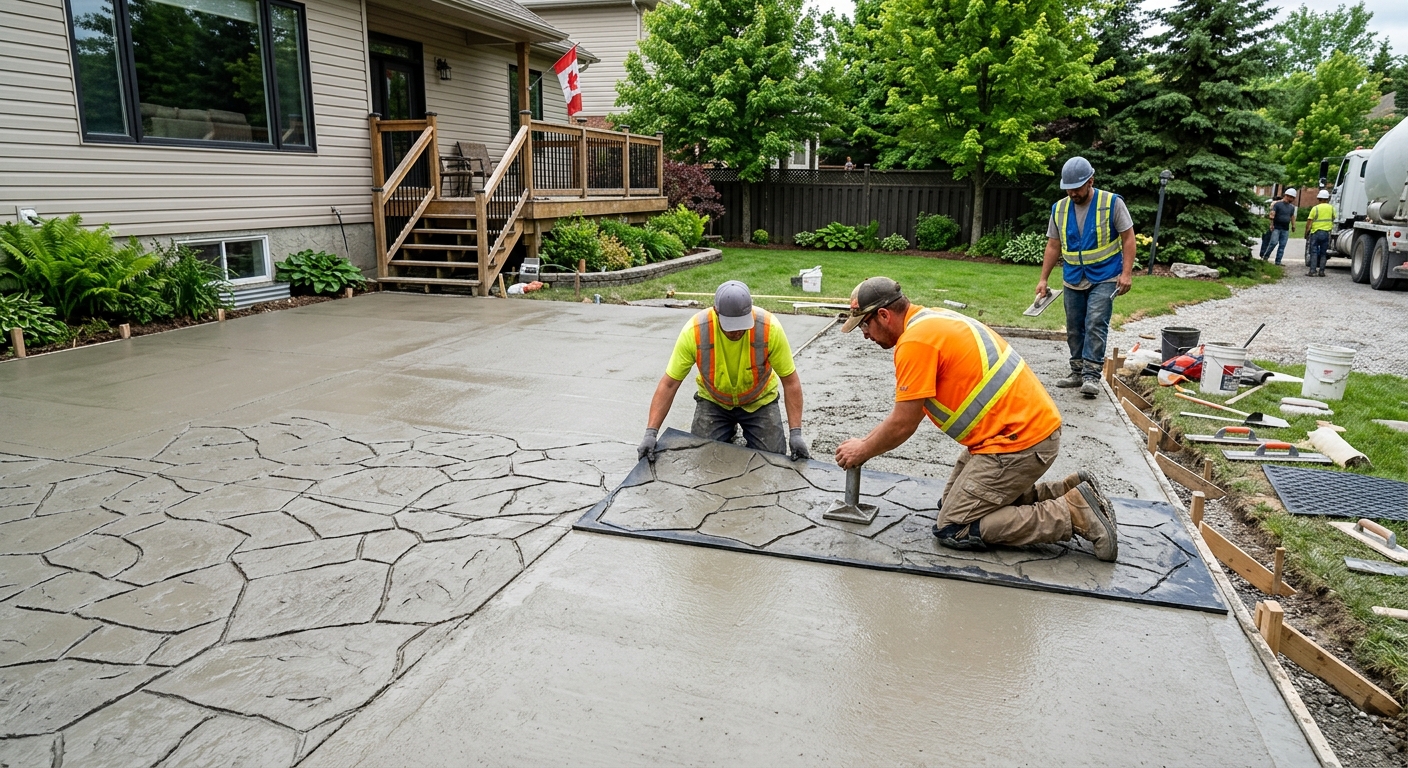
Concrete work options and costs in Victoria-Downtown
Victoria-Downtown homeowners typically hire concrete contractors for driveways, patios, walkways, garage floors, and foundation work that can hold up to Vancouver Island’s frequent wetting and freeze–thaw cycles. In this market, concrete flatwork is especially common because the housing stock is dominated by single-detached homes—(Statistics Canada, 2021 Census)—which often brings long-term plans for improved curb appeal and better drainage around the exterior. With a 2021 population of 46,309 (Statistics Canada, 2021 Census), the demand is steady, particularly around established neighbourhoods where access, tree cover, and existing grades create more preparation work.
On Vancouver Island and the Coast, our pricing is shaped by a relatively shallow frost line, but that doesn’t mean “less engineering.” Exterior slabs and walkways still need footings and sub-bases designed to sit below the local design frost depth, plus an air-entrained mix to survive freeze–thaw. Labour availability also affects turnaround time in busy seasons; trades often balance between new pours, repairs, and decorative work like exposed aggregate or stamped surfaces—so costs can move when scheduling gets tight.
Because cool temperatures slow strength gain, contractors in Victoria-Downtown often build weather contingencies into their bids: blankets, site protection, and drainage planning can add cost but reduce callbacks for scaling or random cracking. If you’re comparing options, the best way to start is with typical “all-in” ranges for common scopes, then tighten the quote based on your site access and finish selection.
| Application |
Typical Size |
Key Spec |
Finish Option |
Price Range |
| Concrete driveway (standard broom finish) |
400–600 sq. ft. |
Air-entrained mix, compacted granular base, control joints |
Broom finish |
$9,000–$15,000 |
| Exposed aggregate driveway |
400–600 sq. ft. |
Air-entrained mix, proper curing/protection, saw-cut pattern |
Exposed aggregate (light wash) |
$12,500–$20,000 |
| Stamped concrete driveway or patio |
250–500 sq. ft. |
Air-entrained mix, release agent system, integral colour (if selected) |
Stamp + colour |
$6,500–$16,000 |
| Plain concrete patio or walkway |
150–300 sq. ft. |
Air-entrained mix, granular base, edge forms, joints |
Broom/smooth trowel (non-slip broom where needed) |
$3,200–$7,500 |
| Garage floor (interior slab) |
400–650 sq. ft. |
Vapour control (if required), reinforcement (mesh/rebar as spec), finish trowel |
Power trowel + saw-cut joints |
$7,500–$16,500 |
| Foundation footings (structural, below frost) |
Variable (linear footage) |
Below frost bearing depth, concrete strength per engineer/spec, rebar placement |
Formed concrete footings |
$18,000–$45,000 |
Prices are estimates only and vary by project scope, site access and material selection.
What affects the price of concrete work in Victoria-Downtown
In Victoria-Downtown and across Vancouver Island and the Coast, the same concrete job can come in 30–50% apart depending on excavation conditions, reinforcement requirements, and how strictly the contractor builds for the freeze–thaw environment. Even when the finish looks similar, bids differ because exterior work demands air-entrained mixes and well-drained, compacted granular base—then the details (jointing, curing protection, and truck access) decide whether the slab lasts or starts scaling.
Frost line depth and freeze–thaw cycles drive the spec. Exterior footings must extend below the design frost depth (on the coastal BC side, typically around 0.5–1.2 m depending on local conditions) to prevent frost heave. All exterior slabs require air-entrained concrete mixes to survive repeated wetting and freezing, especially on driveways and walkways that get splashback from rain and meltwater. In colder scheduling windows, cold-weather curing precautions—insulating blankets and controlled curing—add labour and material time. Also, de-icing salts can accelerate spalling and surface scaling over time, so sealing is commonly priced as a durability upgrade.
Two examples show how local conditions change dollars. First, if your driveway ties into older sidewalks with poor drainage or soft subgrade, excavation and base replacement can move the project from the lower $16–$25 per sq. ft. driveway band toward the upper end. Second, a stamped driveway can be a smart value: while stamped and decorative work often carries the $22–$35 per sq. ft. equivalent pricing premium, it can reduce the need for cosmetic resurfacing later if the contractor also nails the base, joints, and curing plan.
| Price Factor |
Why It Matters |
Cost Impact |
| Frost line depth — determines footing depth and form height |
Below-frost placement prevents frost heave and early cracking |
+ $2,000–$10,000 depending on linear footage and depth |
| Site preparation — excavation, grading, compacted granular base |
Correct sub-base compaction prevents settlement and surface scaling |
+ $1,500–$8,000 for poor soils, tight access, or base replacement |
| Reinforcement — rebar or wire mesh requirement |
Controls cracking in slabs and improves durability under loads |
+ $800–$6,000 depending on thickness and structural spec |
| Mix design — air-entrainment and compressive strength spec |
Air entrainment protects against freeze–thaw deterioration |
+ $300–$2,500 (often small per sq. ft., high value) |
| Finish type — broom vs. stamped vs. exposed aggregate |
Decorative finishes add labour, colour materials, and workflow time |
+ $1,000–$9,000 based on pattern/colour/technique |
| Pour size and concrete truck access to site |
Shorter wheelbarrow distances reduce labour and schedule risk |
+ $500–$4,500 if access requires pumping or extra labour |
| Cold-weather curing precautions — heating and blankets |
Protects strength gain and reduces surface damage |
+ $500–$3,500 when cold snaps occur |
| Control joint pattern and sealing cost |
Joints manage cracking; sealing helps repel salt/splashwater |
+ $250–$1,800 depending on area and product chosen |
Permits & regulations in British Columbia
In British Columbia, permit requirements depend on what concrete work you’re doing. Structural concrete work—such as foundation walls, grade beams, and engineered footings—typically requires a building permit, and those projects are often reviewed with engineered drawings by the municipality. Concrete flatwork like patios, walkways, and driveways usually does not require a permit by default, but it can become regulated if it affects lot grading, drainage patterns, or municipal rules around impervious surface coverage and setbacks. Before breaking ground in Victoria-Downtown, confirm with the local authority whether your specific scope triggers a permit or inspection.
For contractor compliance, you should verify three things before signing: (1) the contractor’s liability insurance certificate, (2) coverage for workers under the applicable workplace program (commonly referred to as WCB coverage), and (3) that they are properly licensed/eligible to perform the scope in BC where applicable. Step-by-step: first, ask the contractor for a current Certificate of Insurance and ensure it lists your address as an affected party if offered, with the policy active for the project dates. Next, request proof of workers’ coverage and confirm it matches the contractor’s legal name. Finally, check the contractor’s licensing/registry listing through BC’s public directories (search the company name) and ask for references on similar-scale residential pours in Victoria.
Getting concrete right in Victoria-Downtown's freeze-thaw climate
Concrete often fails in Victoria-Downtown when it’s not spec’d and built for freeze–thaw durability. The most common issues we see are surface scaling and spalling (small flake-off areas) and random cracking from settlement or poor jointing. To spec the job correctly, start with base preparation: a compacted granular sub-base to the correct depth for your soil and frost conditions, with drainage that prevents water from sitting under the slab. Next, use a proven exterior mix design: air-entrainment in the range of 5–7% air content for exterior flatwork, along with a minimum 32 MPa compressive strength (per the project spec) to achieve predictable performance. Control joints should be planned to limit random cracking and to maintain a neat crack pattern, especially on driveways and walkways that experience repeated wetting.
Curing matters more here than many people expect. Concrete should cure a minimum of 7 days under proper conditions, and when colder weather hits, contractors may need blankets or additional protection to prevent early surface damage. After the cure, a penetrating sealer applied around 28 days post-pour helps repel de-icing salts and reduce water intrusion from rain splash and meltwater.
If you’re weighing options, the dollar difference can be justified by what you prevent. For example, upgrading to an exposed aggregate driveway typically costs more than a standard broom finish (often anchored in the $16–$25 per sq. ft. driveway band versus the higher end for textured/decorative work). That premium is most worthwhile when the contractor also does correct base prep, proper air entrainment, and a disciplined joint + curing plan—those are what reduce early scaling callbacks.
| Spec |
Why It Matters in Victoria-Downtown |
What to Ask For |
Impact if Skipped |
| Compacted granular base (depth?) |
Prevents settlement and reduces water retention that feeds freeze–thaw |
Minimum base depth based on soil, frost conditions, and slab thickness; compaction test approach |
Uneven cracking, heaving, premature surface failure |
| Air-entrained concrete mix (target air %?) |
Protects concrete paste from freeze–thaw stress |
Confirm target air content (typically 5–7% for exterior flatwork) |
Spalling and scaling, especially on shaded or water-prone sections |
| Compressive strength (MPa rating) |
Supports durability and predictable strength gain |
Minimum 32 MPa (or higher if required by engineer/spec) |
Lower wear resistance, faster deterioration under traffic and salt exposure |
| Control joints (spacing per ACI guidelines) |
Keeps cracking in predictable lines rather than random breaks |
Joint layout and spacing plan before the pour; method of sawing or forming |
Random cracking, ugly repairs, water infiltration through wider cracks |
| Minimum 7-day curing period |
Cool temperatures slow strength gain and increase surface vulnerability |
What protection will be used if temps drop; curing duration |
Surface weakness, scaling risk, reduced long-term durability |
| Penetrating sealer (when applied after cure) |
Repels water and helps reduce damage from de-icing salts |
Apply around 28 days post-pour (after adequate cure) |
More water intrusion, faster wear in winter conditions |
How to choose a concrete work contractor in Victoria-Downtown
Choosing the right concrete contractor in Victoria-Downtown comes down to proof and clarity. First, verify British Columbia compliance. Ask for the contractor’s liability insurance certificate and make sure it is current for the project dates and matches the company name on the contract. Next, confirm workers’ coverage (commonly through WCB coverage in BC) and request a letter or proof of account coverage. Then check the contractor’s licensing/registration status through BC’s online registry tools by searching the business name and any listed trade categories tied to the scope.
For pricing, get 2–3 itemised written quotes—not just a lump sum. You want labour and materials broken out, including excavation, granular base, reinforcement (mesh vs. rebar), concrete mix type (air-entrained for exterior), forming, finishing, saw cutting, disposal, and any sealing. Carefully review what’s excluded: for instance, is permit handling included (if needed for structural work), is debris/disposal included, and does the quote account for tree roots, tight access, or any subgrade remediation?
Warranty matters too. Ask for a clear workmanship warranty length and whether the manufacturer’s product warranty is separate (and how long it lasts). Find out if warranty coverage is transferable if you sell the home. For payments, never pay more than 10–15% upfront; use a holdback until the job is complete and deficiencies are corrected.
Finally, insist on a start date and completion estimate in writing, plus how they handle weather delays. On Vancouver Island’s rainy shoulder seasons, the best contractors schedule protection and curing resources—not just concrete delivery.
- Request liability insurance certificate with project dates and coverage limits
- Ask for proof of workers’ coverage (WCB) and verify it matches the contractor’s legal name
- Confirm the contractor’s registration/licensing status via BC’s public directories
- Get 2–3 itemised quotes (labour + materials; not one lump number)
- Require line items for excavation, compacted granular base, and disposal
- Ensure the exterior mix is explicitly air-entrained and suitable for freeze–thaw conditions
- Ask what reinforcement is included (mesh vs. rebar) and slab thickness assumptions
- Review the finish scope: broom vs. stamped vs. exposed aggregate, and colour/texture options
- Ask for the control joint plan (spacing and how/when joints are cut)
- Confirm curing and protection plan for cool or rainy periods
- Ask whether penetrating sealer is included and the timing (around 28 days post-pour)
- Use a payment schedule with a holdback until final inspection and close-out paperwork
Local red flags: (1) a quote that doesn’t mention air-entrained mix or jointing strategy, (2) unclear slab thickness and no granular base details, (3) high upfront payment without a holdback, (4) no written curing/weather plan for cold snaps, and (5) refusal to provide proof of insurance and workers’ coverage before starting in Victoria-Downtown.
Frequently asked questions — concrete work in Victoria-Downtown
What is rebar and when is it required in British Columbia?
Rebar is steel reinforcing bar placed inside concrete to help control cracking and improve strength, especially where slabs or structural members experience tension (bending) stresses. In British Columbia, whether rebar is required depends on the engineered design and the type of slab or structural element. For exterior flatwork like driveways, rebar may be specified for thicker slabs, specific load conditions, or larger pours, while many smaller residential patios and walkways may use wire mesh instead. For structural work (footings, foundation elements, grade beams), rebar is typically part of an engineered detail set and is not optional. If you’re in Victoria-Downtown, ask your contractor to state the reinforcement type and location in the quote, and confirm it matches the engineer’s drawings where applicable. This is one area where cutting corners can lead to wider cracks and early repairs—especially through freeze–thaw cycles.
How long does a concrete project take in Victoria-Downtown?
Timing depends on concrete type, weather conditions, and site access in Victoria-Downtown. A typical exterior flatwork pour (like a standard driveway) often moves quickly on pour day, but the overall timeline includes excavation, forming, base preparation, curing protection, and finishing. In mild stretches, some projects can be completed within about 1–2 weeks from start to finish, but colder or wetter weather can extend that schedule because contractors may need blankets or extra protection during curing. Decorative work—like stamped concrete—can also add days due to workflow and colour/texture steps. Even after the pour, curing is a minimum 7 days before normal use, and sealing is often planned closer to 28 days post-pour if included. If your contractor quotes you a finish date without talking about weather contingency, it’s a sign the schedule may be optimistic for Vancouver Island conditions.
What is a concrete overlay and is it suited to Victoria-Downtown?
A concrete overlay is a new layer of concrete placed over an existing slab to renew appearance and add surface capacity. It can be suited to Victoria-Downtown when the underlying concrete is structurally sound—no major settlement, deep spalling pockets, or widespread structural cracking. The key is preparation: the existing surface must be profiled properly, cleaned, and assessed for bond. In a freeze–thaw climate, overlays can perform well if water pathways are controlled and the mix design is appropriate, but if the original slab has drainage problems or inactive base support, an overlay can fail prematurely. For homeowners comparing costs, overlays can sometimes be cheaper than full replacement, but they aren’t always the best long-term option. If your current driveway is already scaling from winter exposure or has movement cracks, a full replacement with air-entrained concrete and correct base prep is often the more durable solution. Depending on scope, driveway replacement often starts around the $16–$25 per sq. ft. band rather than overlay pricing.
How do I seal concrete to protect it in Victoria-Downtown?
Sealing in British Columbia is mainly about reducing water intrusion and protecting against salt and splashwater impacts during winter freeze–thaw cycles. For Victoria-Downtown, the best practice is to apply a penetrating sealer after the concrete has cured sufficiently—commonly around 28 days post-pour. Before sealing, the surface should be clean and dry; contractors typically allow for proper drying time and may do a light wash or targeted cleaning depending on site conditions. Penetrating sealers are widely used for exterior slabs because they help repel moisture without creating a thick surface film that can fail under movement. Ask your contractor what sealer product they use, whether it’s breathable, and how they’ll address existing stains. If you’re seeing scaling or pitting already, sealing alone may not fix the underlying issue; base preparation, air entrainment, and jointing still determine whether the slab stays healthy.
What is the difference between concrete and cement?
Concrete is the full engineered material you get on site—cement plus water plus aggregates (sand and gravel), often with air-entrainment agents for freeze–thaw durability. Cement is only one ingredient within concrete, typically Portland cement, which binds everything together as it hydrates. In other words, contractors don’t “pour cement” for driveways; they pour concrete designed for the job. In Victoria-Downtown, the difference matters because exterior concrete needs air entrainment and correct strength development. If a contractor is vague about “the mix,” ask for the actual mix design details: air-entrainment target and compressive strength requirements. That’s what affects performance when wetting and freezing happen repeatedly. When homeowners compare quotes, clarity on mix spec is as important as the finish; a broom finish may look similar even when the durability is very different.
How much does concrete work cost in Victoria-Downtown?
Concrete pricing in Victoria-Downtown typically depends on size, site access, excavation and base prep, reinforcement, mix design, finish complexity, and weather protection. For reference, many driveways land in the $16–$25 per sq. ft. range for standard concrete work, while decorative stamped or exposed aggregate options often run higher, frequently aligned with the $22–$35 per sq. ft. band due to added labour and materials. Plain patios and walkways often sit around $14–$22 per sq. ft., depending on thickness and base requirements. Garage floors are variable, largely driven by whether reinforcement and additional vapour/finish requirements are included. Foundation footings are quoted differently (often by linear footage and engineered depth), and the structural work budget can be substantially higher than flatwork. Because Vancouver Island’s freeze–thaw cycles require air-entrained concrete, correct jointing, and proper curing protection, don’t choose solely on lowest price—those specs are where long-term costs are won or lost.