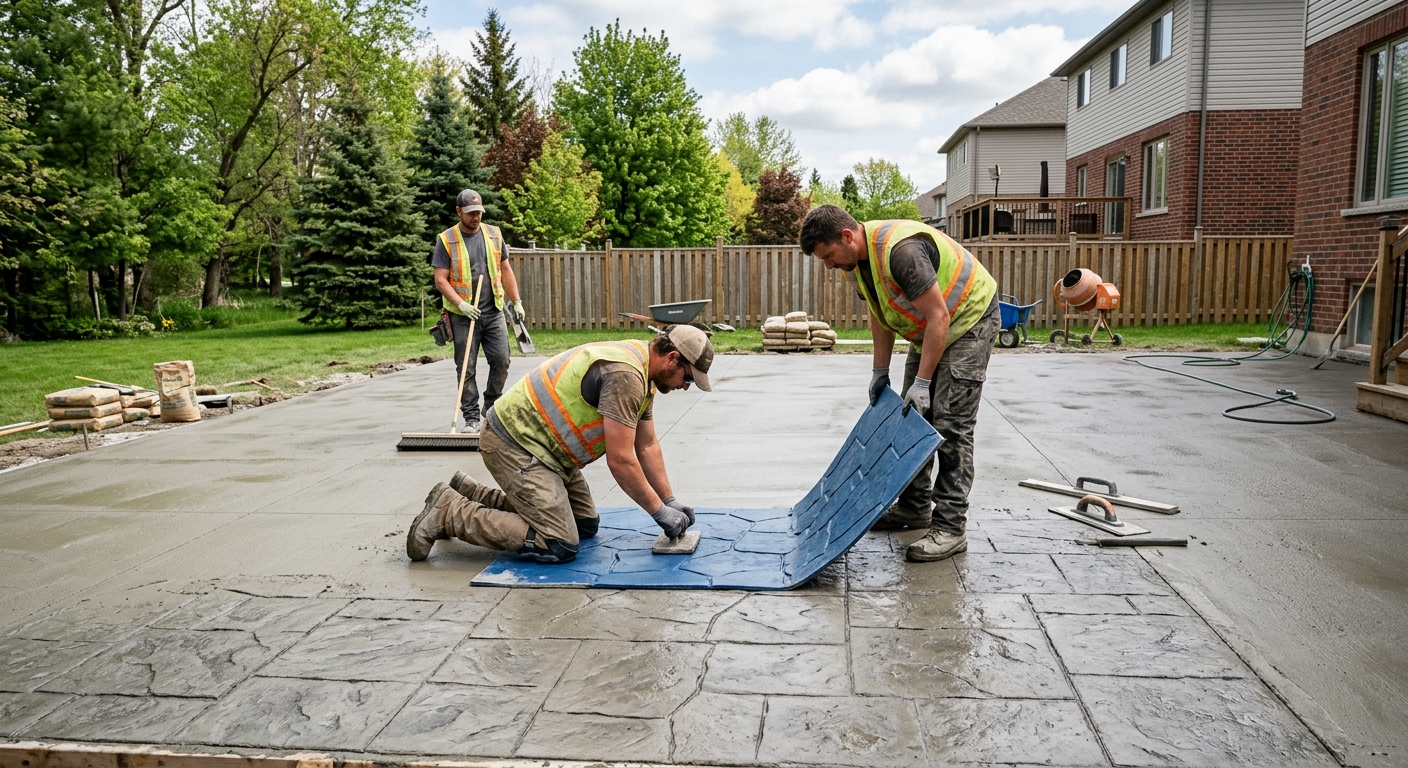
Concrete work options and costs in Tsawwassen
In Tsawwassen, concrete flatwork is a practical choice for homeowners because it handles daily moisture, coastal drizzle, and the region’s frequent freeze–thaw cycles with the right mix, joints and curing. With a 2021 population of 21,588 (Statistics Canada, 2021 Census), the Lower Mainland–Southwest continues to attract families and renovations—often concentrated around established streets near Centennial Beach and the Boundary Bay area, where driveways and patios get upgraded every few years. In this part of BC, many homes are detached or semi-detached, which keeps demand steady for driveway slabs, walkway work and outdoor patios.
Our regional pricing is shaped by design assumptions: practice typically targets frost depth around 450 mm / 18" for base and footing decisions, and exterior slabs are detailed to protect against frost heave and scaling. Even though winters are mild compared with the interior, cold nights and saturated soils mean base prep (excavation, drainage, compacted granular) and air-entrained concrete aren’t optional add-ons. Scheduling also matters—coastal rain and high humidity can stretch curing and surface finishing timelines, especially for patios and driveways.
Contractor availability in the Vancouver–Surrey–Abbotsford corridor is generally good in spring and early summer, but crews get booked quickly once weather windows open. That’s why it’s smart to compare “apples-to-apples” scopes: the same driveway can price differently based on truck access, reinforcement, joint layout, and finish selection. Use the table below as a budgeting range for common Tsawwassen concrete options.
| Application |
Typical Size |
Key Spec |
Finish Option |
Price Range |
| Concrete driveway (standard broom finish) |
400–600 sq. ft. |
Compacted granular base, air-entrained exterior mix, control joints |
Broom finish |
$18,000–$28,000 |
| Exposed aggregate driveway |
400–600 sq. ft. |
Compacted base, air-entrained mix, proper curing and surface retarder |
Exposed aggregate |
$22,000–$33,000 |
| Stamped concrete driveway or patio |
300–550 sq. ft. |
Air-entrained mix, integral colour or hardener, release agent |
Stamped pattern with sealer |
$22,000–$36,000 |
| Plain concrete patio or walkway |
200–400 sq. ft. |
Compacted base, air-entrained exterior mix, joints as required |
Float/straightedge and light broom |
$8,000–$18,000 |
| Garage floor (interior slab) |
350–600 sq. ft. |
Vapour barrier (if required), reinforced slab, air mix per spec |
Plain or lightly trowelled finish |
$10,000–$20,000 |
| Foundation footings (structural, below frost) |
Varies by design |
Footings set below design frost depth (typically ~450 mm / 18" concept) and engineered requirements |
Reinforced concrete |
$12,000–$25,000 |
Prices are estimates only and vary by project scope, site access and material selection.
What affects the price of concrete work in Tsawwassen
In Tsawwassen and the broader Lower Mainland–Southwest, you can see price swings of 30–50% for what looks like the “same” concrete job. The gap usually comes from deeper, non-obvious work: how much excavation is required, what base and drainage are needed, whether reinforcement is specified, and how the contractor plans for cool, wet curing conditions. In the wider British Columbia market, those variables shift with regional frost depth assumptions—coastal BC typically uses a shallower frost line concept than the interior, but you still have to protect against freeze–thaw damage and scaling. That’s why exterior flatwork commonly includes air-entrained concrete and careful jointing even in mild winters.
Concrete specs are directly tied to frost and temperature cycles. Footings must extend below the design frost depth (practice references typically place Ontario deeper at ~1.5–2.4 m, Alberta up to ~2.4 m, and coastal BC often around ~0.5–1.2 m). For Tsawwassen, exterior slabs also need air-entrainment and correct curing because repeated freezing and saturated subgrade lead to freeze–thaw deterioration. When crews have a short pour window due to rain and cool nights, cold-weather precautions can add labour and materials—blankets, curing control, and sometimes temporary protection—raising the total. De-icing salts in winter accelerate spalling on poorly specified surfaces, so sealing is a common durability step.
Two local examples: (1) a driveway on low, wetter soils near drainage ditches may require extra granular and subgrade improvement, pushing costs toward the higher end of concrete driveway budgets; (2) a simple broom-finish patio in a protected backyard can land closer to the lower band for plain patio/walkway work, while stamped or exposed aggregate usually justifies a higher finish cost because of colour, pattern tools, and surface finishing time. If your driveway estimate is sitting near the $18,000–$28,000 range, asking about base depth, joints, and truck access often explains the difference versus the mid-$20s.
| Price Factor |
Why It Matters |
Cost Impact |
| Frost line depth — determines footing depth and form height |
Footings and thickened edges must be placed below the design frost zone to prevent frost heave. |
Higher excavation and formwork can add several thousand dollars on foundations. |
| Site preparation — excavation, grading, compacted granular base |
Wet coastal soils and saturated subgrade require proper drainage and compacted base to support the slab. |
Can shift flatwork pricing by 15–30% depending on haul-away and base depth. |
| Reinforcement — rebar or wire mesh requirement |
Helps control cracking and increases durability for driveways and garage floors. |
Moderate materials and labour; often $1,000–$5,000 depending on size/spec. |
| Mix design — air-entrainment and compressive strength spec |
Exterior air-entrainment manages freeze–thaw scaling; strength requirements affect mix cost. |
Typically raises material cost but prevents early surface failure. |
| Finish type — broom vs. stamped vs. exposed aggregate |
Stamping and exposed aggregate require additional steps, materials and finishing time. |
Stamps/exposed can add significant labour; often moves the quote closer to upper bands. |
| Pour size and concrete truck access to site |
Small access issues mean longer pumping, more labour, or extra days for staging. |
Access problems can add $1,500–$6,000+ on larger pours. |
| Cold-weather curing precautions — heating and blankets |
Cool nights and humidity can slow strength gain, requiring protection and curing control. |
Adds labour/materials; more common in shoulder seasons. |
| Control joint pattern and sealing cost |
Correct joints reduce random cracking; sealing helps protect from salt and moisture. |
Generally small relative to the slab; prevents costly early repairs. |
Permits & regulations in British Columbia
In British Columbia, structural concrete work typically needs a building permit because it’s part of the primary load-bearing system. That includes footings, foundation walls, grade beams and other structural elements tied to the house’s framing and loads. For these jobs, municipalities often expect engineered drawings or stamped details before work begins and may review design and inspection plans as part of permit conditions.
Concrete flatwork—patios, walkways and driveways—usually does not require a permit on its own unless the scope affects lot grading, drainage, stormwater flows, impervious surface limits, or the municipal right-of-way. That can come up when you’re changing elevations, adding significant runoff pathways, or altering work near a curb/sidewalk.
For Tsawwassen homeowners, the practical step-by-step is: (1) ask the contractor for their licence/registration information and confirm it’s current, then (2) request a certificate of liability insurance that matches the jobsite address and covers the work being performed, and (3) confirm workers’ coverage (WSIB-style coverage in BC context is commonly requested as proof of statutory coverage). Next, request clearance/undertaking documentation if the contractor provides it for projects, and (4) verify recent references on similar-scale projects—driveways and footings behave differently due to base prep and frost protection. If you’re unsure whether your specific flatwork triggers permit requirements, contact the municipality before breaking ground and ensure the quote clearly states whether permits are included.
Tip: a good quote will explicitly list what inspections (if any) the contractor will schedule for permit-required work.
Getting concrete right in Tsawwassen's freeze-thaw climate
Concrete failures in Tsawwassen usually start long before the surface cracks. The region’s freeze–thaw cycles, cool nights, and coastal rainfall mean the slab and base are repeatedly exposed to moisture. If the base isn’t compacted correctly, water can sit under the slab and freeze—pushing and breaking up the surface over time. If the concrete mix isn’t properly air-entrained, water enters micro-pores and expands during freezing, driving spalling and scaling. That’s why “cheapest concrete” often costs more in repairs.
To spec the job correctly, focus on five areas. First, base preparation: use a compacted granular sub-base sized for local soil conditions and designed to protect against frost effects; drainage details should be included where soils are saturated. Second, mix design: for exterior flatwork, air-entrainment is typically targeted around 5–7% air content, and the concrete is commonly specified at a minimum 32 MPa compressive strength. Third, control joints: plan joint spacing to reduce random cracking and ensure water has a predictable place to go. Fourth, curing: plan for a minimum 7-day curing period under appropriate conditions; in cool, damp stretches, the contractor should use curing blankets or other protection so strength development isn’t delayed. Fifth, sealing: apply a penetrating sealer about 28 days after the pour (once cured) to help repel de-icing salts and reduce moisture uptake.
Where price differences are justified: a stamped patio typically costs more than a plain patio because of finishing time, colour/materials and additional steps; if the quote for stamped concrete is only slightly higher, confirm whether they’re still using the same air-entrained mix and curing protections. In Tsawwassen, skipping those basics—even on a “simple” broom finish—can turn a mid-band driveway budget (around the $18,000–$28,000 range) into early patching costs.
| Spec |
Why It Matters in Tsawwassen |
What to Ask For |
Impact if Skipped |
| Compacted granular base (depth?) |
Reduces pumping and freeze–thaw movement by keeping water from staying under the slab. |
Base thickness and granular type; subgrade drainage details. |
Settling, uneven surface, and premature cracking. |
| Air-entrained concrete mix (target air %?) |
Manages freeze–thaw scaling and spalling in exterior exposure. |
Air content stated (typ. 5–7% for exterior flatwork). |
Surface scaling, flaking and early durability failure. |
| Compressive strength (MPa rating) |
Ensures the slab reaches the strength needed for traffic and weather exposure. |
Minimum 32 MPa compressive strength at design age. |
Weak surface, increased wear and cracking risk. |
| Control joints (spacing per ACI guidelines) |
Limits random shrinkage cracking and gives cracks a planned path. |
Planned joint layout and cutting schedule. |
Random cracking, water intrusion and cosmetic failure. |
| Minimum 7-day curing period |
Strength gain is slower with cool nights and high humidity. |
How curing will be maintained during rain/cold; coverage plan. |
Reduced strength, surface dusting and patch failures. |
| Penetrating sealer (when applied after cure) |
Repels moisture and helps protect against de-icing salt exposure. |
Sealer type and application timing (around 28 days post-pour). |
Higher staining, salt damage and faster deterioration. |
How to choose a concrete work contractor in Tsawwassen
Choosing the right contractor matters in Tsawwassen because “concrete quality” is really a bundle of base prep, mix specification, finishing discipline and curing control. Start by verifying British Columbia licensing/registration for the trade they claim to perform, then ask for a certificate of liability insurance showing coverage limits appropriate to the project and that the certificate is current. Next, request proof of workers’ coverage (workers’ compensation coverage) and confirm they can provide clearance/undertaking documentation if required for the job type. Don’t accept a verbal statement—get documents before work starts.
Then, get 2–3 itemised written quotes, not one lump sum. The quote should break out labour, concrete supply, reinforcement, excavation/grading, disposal/haul-away, forms, and finishing. For Tsawwassen, confirm whether air-entrainment is included and whether the contractor budgets time for control joints and proper curing in wet weather. Also read exclusions carefully: is the base depth included? Is permit pulling included when structural work needs it? Is concrete truck access accounted for with pumping or labour staging?
For warranty, ask for a workmanship warranty length in writing, plus manufacturer coverage details for any sealers, admixtures, or special systems. Clarify whether any warranty is transferable to future owners.
Payment schedule should be conservative: never pay more than 10–15% upfront for materials and mobilization; hold back a portion until completion and final clean-up. In your timeline, request a written start date and completion estimate, and ask how weather windows are managed if rain or cool nights delay finishing.
- Ask whether the mix is air-entrained for exterior exposure and if the air content target is specified.
- Confirm minimum compressive strength (commonly 32 MPa) is written on the quote.
- Request the base prep section: excavation depth, granular type, and compaction method.
- Verify reinforcement (mesh/rebar) requirements for driveway and garage slabs.
- Get a joint plan: spacing and whether joints will be cut or formed on schedule.
- Ask how the contractor will protect curing concrete during rain/cool nights (blankets/coverage).
- Confirm whether sealing is included and the planned application timing (often after 28 days cure).
- Ensure disposal/haul-away is included if excavation is needed beyond topsoil removal.
- Check site access: truck routes, pumping allowance, and protection for landscaping.
- Make sure the quote includes forms, edges, and any thickened perimeter work.
- Verify insurance and workers’ coverage documents before the first payment.
- Get the warranty terms and exclusions in writing (and what triggers warranty service).
Concrete contractor red flags in Tsawwassen: (1) they won’t write air-entrainment or curing steps into the quote; (2) they rush joint cutting/cutting timing after pours; (3) they use vague “standard base” wording without depth and drainage; (4) they avoid insurance/proof of coverage questions; (5) they ask for large upfront payments (more than 10–15%) before any work begins.
Frequently asked questions — concrete work in Tsawwassen
How long does concrete take to cure?
Concrete needs time to gain strength, and the timeline in Tsawwassen is influenced by coastal humidity and cool night temperatures during rainier stretches. Most contractors plan for a minimum 7-day curing period before treating the slab as safer for light use, assuming proper curing conditions. Full design strength typically develops over about 28 days, which is why durability steps like sealing are often scheduled after cure. If cold conditions slow curing, a good crew will use curing blankets and protection to keep surface temperatures stable so strength development isn’t delayed. This matters especially for exterior flatwork that’s exposed to freeze–thaw cycles and de-icing salt—skimping on cure time can lead to scaling and early wear. If your project is budgeted around a concrete patio or driveway range (for example, broom-finish driveway pricing often falls near the $18,000–$28,000 band), ask how they’ll manage curing weather windows.
Do I need a permit for concrete work in British Columbia?
In British Columbia, whether you need a permit depends on what you’re building. Structural concrete work—such as footings, foundation walls and grade beams—typically requires a building permit and often engineered drawings reviewed through the municipal process. Concrete flatwork (patios, walkways and driveways) often does not require a permit by default, but permits can become necessary if your work affects lot grading, drainage, impervious surface coverage limits, or ties into municipal right-of-way changes (for example, altering elevations near a curb or sidewalk). The safest approach for Tsawwassen homeowners is to confirm the specifics with the municipality before you start and to ensure your contractor states in writing whether permits are included when they apply. Also verify the scope: structural jobs are inspected; flatwork may not be, but it still must meet drainage and installation practices to avoid frost-related problems.
Concrete vs pavers for a patio in Tsawwassen?
Concrete and pavers can both work well for a patio in Tsawwassen, but they perform differently with our coastal-wet conditions and freeze–thaw cycles. Concrete is usually less labour intensive to install as a monolithic slab, and with air-entrained mix, correct base prep, and control joints, it can provide a durable surface that drains predictably. Pavers offer flexible repair—if one unit settles, you can sometimes swap it—but pavers are more sensitive to base preparation and bedding depth, and weeds or surface movement can show up if drainage isn’t right. In terms of budget, plain concrete patios often sit closer to the lower end of typical patio pricing bands (for example, the $16,000–$26,000 range reference commonly used for patio/walkway work), while stamped concrete or decorative finishes are higher due to finishing steps. If you want low maintenance and a uniform look, concrete is often the simpler choice—just make sure sealing and curing are planned.
How long does a concrete driveway last?
A well-built concrete driveway can last decades, especially in the Lower Mainland–Southwest where maintenance is driven by moisture and salt exposure rather than extreme winter deep freeze. In Tsawwassen, the driveway’s lifespan depends heavily on base prep, air-entrainment, joint spacing, and curing—not just the thickness. A properly detailed driveway with a compacted granular base, air-entrained exterior mix, control joints, and a penetrating sealer applied after cure can resist scaling and spalling better during freeze–thaw cycles. If the surface gets heavy de-icing salt and isn’t sealed, spalling and surface deterioration can show up earlier, leading to costly patchwork. When comparing quotes, a driveway priced toward the mid band (often aligned with $18,000–$28,000 for many standard driveway projects) is usually more durable than a bargain bid that omits air-entrainment or shortens curing. Ask what’s included for joints and sealing—those two items often determine how “long-lasting” the driveway feels in real life.
What is air-entrained concrete and why does it matter here?
Air-entrained concrete is a mix designed with microscopic air bubbles that give expanding ice room to expand without cracking the concrete paste. In Tsawwassen and other parts of coastal BC, freeze–thaw cycles and persistent moisture make this critical for exterior slabs like driveways, sidewalks, and patios. Without proper air-entrainment, water infiltrates the concrete and repeatedly freezes, causing surface scaling and spalling—often visible as flaking, rough patches, and faster deterioration around edges and joints. That’s why reputable contractors specify air content (commonly around 5–7% air for exterior flatwork) and pair it with correct control joints and curing. If you’re considering decorative options like stamped concrete (often priced higher than plain work), air-entrainment still matters—decorative finishes don’t prevent freeze–thaw damage if the mix isn’t right. In short: air-entrainment is one of the biggest protections against the exact failure mode homeowners notice in our coastal-wet climate.
How do I prepare the base for a concrete slab?
Base preparation is the foundation of a slab’s performance, and in Tsawwassen it must address wet soils, drainage, and the region’s frost-heave risk. Start with excavation to the required depth, removing topsoil and soft or organic material, then grade the subgrade to a stable elevation. Next, install compacted granular base material in layers, ensuring proper moisture conditioning and compaction so the slab won’t settle unevenly. A good contractor will also build in drainage where needed—because saturated base layers freeze and thaw repeatedly. For exterior flatwork, this is typically paired with a mix that’s air-entrained and designed for freeze–thaw durability, plus control joints to reduce random cracking. When reviewing quotes, ask what base depth and granular type they’re using, and whether compaction testing or documented methods are included. If you’re budgeting a driveway or patio, base prep is where differences hide—work that lands in the mid-price band usually includes adequate excavation, granular, reinforcement, and proper curing rather than shortcuts.