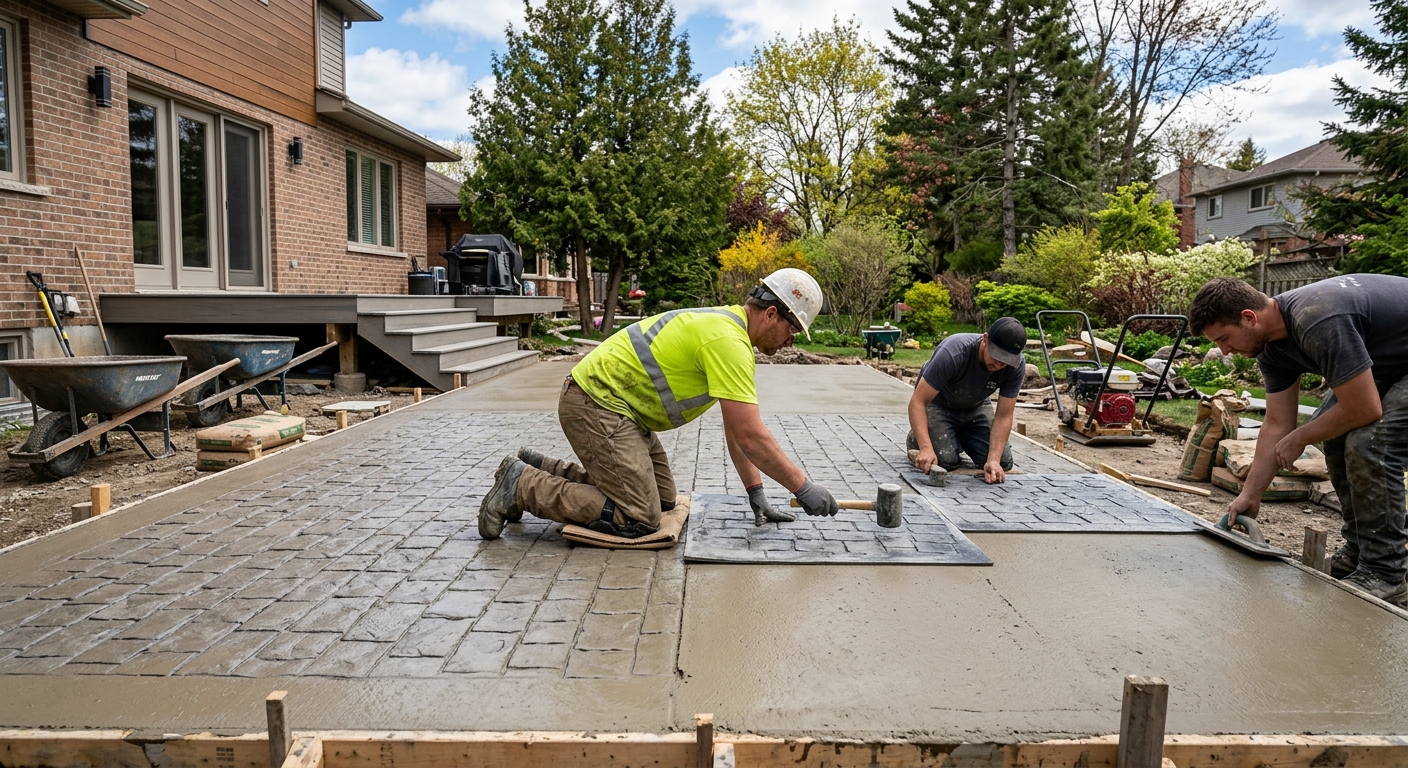
Concrete work options and costs in Shelbourne
Shelbourne homeowners typically choose concrete because it’s dependable, repairable, and—when it’s detailed for our coastal-wet, freeze–thaw winters—built for the long haul. Shelbourne has a population of 12,525 (Statistics Canada, 2021 Census), and most of the local residential flatwork demand comes from single-detached neighbourhoods, where driveways, patios, and walkways are among the most requested exterior upgrades. In the Lower Mainland–Southwest, concrete pricing is shaped by a shallow-but-real frost depth expectation (commonly planned around about 450 mm / 18"), plus frequent freeze–thaw cycles and heavy rainfall. That means base prep, drainage, air-entrained mixes, and curing protection are not “nice to have”—they’re where good contractors separate from the rest.
Concrete work is also available on a seasonal schedule. Even with milder winter temperatures, cool nights and high humidity can slow curing, and prolonged rain can interrupt excavation and forming. Contractors therefore cost in scheduling risk (labour availability, weather windows, and material transport) when you compare quotes. You’ll notice this most in high-demand pockets like the Saanich Peninsula / Victoria-area edge of the region, where crews rotate between residential flatwork jobs.
Below is a practical comparison of common options and what typically drives the price differences, followed by notes on why your final quote may land higher or lower.
| Application |
Typical Size |
Key Spec |
Finish Option |
Price Range |
| Concrete driveway (standard broom finish) |
400–600 sq. ft. |
Air-entrained exterior mix, compacted granular base, proper drainage |
Broom finish, light sealer |
$7,200–$14,000 |
| Exposed aggregate driveway |
400–600 sq. ft. |
Air-entrained mix, controlled wash timing, slip-resistant surface |
Exposed aggregate with protective sealer |
$9,000–$18,000 |
| Stamped concrete driveway or patio |
300–600 sq. ft. |
Stamped release system, air-entrained mix, colour hardeners |
Stamping + integral or topical colour |
$10,800–$21,600 |
| Plain concrete patio or walkway |
200–400 sq. ft. |
Air-entrained mix, slope to drain, control joints |
Broomed or smooth trowel (site-dependent) |
$3,200–$9,200 |
| Garage floor (interior slab) |
500–700 sq. ft. |
Vapour barrier, compacted base, mesh where required |
Light broom finish |
$7,000–$16,500 |
| Foundation footings (structural, below frost) |
Per linear footing ft. varies |
Designed footing size and embedment below design frost |
Structural concrete only |
$2,400–$6,500 |
Prices are estimates only and vary by project scope, site access and material selection.
What affects the price of concrete work in Shelbourne
In the Lower Mainland–Southwest, you can see quote differences of 30–50% for what seems like the “same” concrete job, because the real cost drivers are mostly below the surface: excavation and haulage, base compaction, frost-depth detailing, reinforcement, and curing logistics. In British Columbia more broadly, labour availability and weather scheduling can also shift costs—especially when cool, wet conditions slow production and force crews to adjust pour windows. Even when material prices are similar, contractors price risk: rain delays, truck scheduling, and the extra care needed for air-entrainment and jointing.
The biggest technical driver is frost and freeze–thaw. In coastal BC, the design frost depth is often roughly in the 0.5–1.2 m range (depending on local assumptions and soil/grade), but specs still require footings and piers to extend below the design frost depth to prevent frost heave. Exterior slabs also need air-entrained concrete to handle repeated wetting, freezing, and thawing, plus proper control joints. When the forecast turns cold, cold-weather curing precautions—blankets, sealers, or temporary heating—can add meaningful labour and equipment costs.
Two quick Shelbourne examples: (1) a broom-finished patio might land near the $16–$26/sq. ft. band, but adding thicker edges, denser reinforcement, and a better drainage layer typically moves it toward the top end; (2) a stamped patio can justify the $22–$36/sq. ft. range only if the base prep and curing are done correctly, otherwise the surface colour and joints don’t perform as intended.
On older housing stock—common across the region—you may find inconsistent subgrades or limited drainage. That’s where base depth and disposal fees jump, and the total can shift by thousands even before concrete is poured.
| Price Factor |
Why It Matters |
Cost Impact |
| Frost line depth |
Determines footing depth and form height |
Higher excavation and labour; can add several thousand dollars |
| Site preparation |
Excavation, grading, compacted granular base |
More removal/haulage or base thickness pushes costs up |
| Reinforcement |
Rebar or wire mesh requirement |
Material + labour time; typically a moderate but consistent increase |
| Mix design |
Air-entrainment and compressive strength spec |
Exterior-spec mix costs more, but prevents scaling and spalling |
| Finish type |
Broom vs. stamped vs. exposed aggregate |
Stamped/exposed adds colour materials and labour-intensive finishing |
| Pour size and concrete truck access to site |
Impacts placement rate and pumping needs |
Pumping, long carry distance, or multiple loads increases cost |
| Cold-weather curing precautions |
Heating and blankets |
Extra labour/equipment during shoulder seasons can be significant |
| Control joint pattern and sealing cost |
Reduces random cracking and repels de-icing salts |
Skipping joints/sealer often leads to earlier maintenance or repair |
Permits & regulations in British Columbia
In British Columbia, structural concrete work generally requires a building permit. That includes footings, foundation walls, grade beams, and other load-bearing structural elements. For these jobs, engineered drawings are commonly required, and the municipality reviews for compliance. Concrete flatwork—like driveways, patios, and walkways—usually does not require a permit, unless your project affects lot grading, surface drainage, impervious surface limits, or the municipal right-of-way. Because rules can vary based on how the work changes drainage patterns or site coverage, confirm with the local authority before breaking ground.
For homeowners in Shelbourne, verify coverage and legitimacy step-by-step. First, confirm the contractor’s business presence and credentials through relevant provincial listings (your contractor should be able to provide details readily). Next, request a Certificate of Insurance (liability) showing the coverage is active for the project term. Ask for proof of WCB coverage where applicable and/or any required worker coverage documents for the crew. Finally, request a clearance letter or current proof of coverage status—don’t accept “we’re covered” without documentation.
Also ask for 2–3 references on similar-scale projects in the region (exterior air-entrained concrete, proper curing), because flatwork performance in BC’s freeze–thaw climate depends heavily on execution.
Getting concrete right in Shelbourne's freeze-thaw climate
Concrete failures in Shelbourne are usually not “bad concrete”—they’re a spec and detailing problem. In our Lower Mainland–Southwest conditions, the repeat cycle of wetting and freezing, plus frequent coastal rain, can drive water into weak base preparation, poor drainage, or concrete that lacks the right air content. When the water freezes and expands, it can cause scaling and spalling, especially on exterior flatwork.
To spec the job correctly, focus on five areas. (1) Base preparation: compacted granular sub-base to the right depth for local soil and frost considerations, with drainage continuity so water doesn’t sit under the slab. (2) Mix design: exterior flatwork should use air-entrainment; a typical target is about 5–7% air content for many exterior applications, and a minimum 32 MPa compressive strength is commonly specified for durable exterior work. (3) Control joints: plan joint spacing to limit random cracking paths (and align them with traffic patterns). (4) Curing: aim for at least 7 days of proper curing; in cool, humid stretches, contractors may extend cure time or use curing blankets to protect temperature and moisture. (5) Sealing: apply a penetrating sealer after full cure (often around 28 days) to improve resistance to de-icing chemicals and moisture intrusion.
Ask technical questions like: “What air-entrainment target are you using for this exterior pour?” and “How will you protect the slab during cold nights?” That’s how you avoid the classic spalling scenario caused by inadequate air-entrained mix or rushed curing.
Dollar reality: if a stamped patio quote sits near the $22–$36/sq. ft. band, the premium is justified only when the contractor also provides correct base drainage, jointing, and curing protection. Cutting those corners can erase the value of the finish—repairs on stamped surfaces cost more than doing the foundation right the first time.
| Spec |
Why It Matters in Shelbourne |
What to Ask For |
Impact if Skipped |
| Compacted granular base (depth?) |
Reduces water retention and movement under freeze–thaw |
Confirm granular type and compacted thickness for your soil and grade |
Settlement, cracking, and faster surface deterioration |
| Air-entrained concrete mix (target air %?) |
Prevents scaling/spalling under repeated wet-freeze cycles |
Ask for the target air content (commonly 5–7% for exterior flatwork) |
Spalling and flaking, especially near joints and edges |
| Compressive strength (MPa rating) |
Ensures durability and adequate strength development |
Minimum 32 MPa rating (confirm mix design documentation) |
Surface wear, higher risk of cracking and reduced life |
| Control joints (spacing per ACI guidelines) |
Controls where cracks form during shrinkage |
Proposed joint spacing, layout, and joint saw timing |
Random cracking and difficult-to-repair damage |
| Minimum 7-day curing period |
Achieves strength while protecting against moisture/temperature swings |
How they protect the slab in cold/cool rainy periods |
Reduced strength and increased early surface failure risk |
| Penetrating sealer (when applied after cure) |
Repels moisture and reduces attack from de-icing chemicals |
Application after cure (often around 28 days) and product type |
Faster absorption, staining, and earlier maintenance needs |
How to choose a concrete work contractor in Shelbourne
Start by verifying the essentials for working legally and safely in British Columbia. Ask for proof of active liability insurance (certificate of insurance naming the project’s address or owner) so you’re not exposed if something goes wrong on site. Next, confirm the contractor has the required worker coverage documents for their crews (WCB/WCB clearance documentation where applicable). For licensing, request the contractor’s business credentials and any trade registration they carry—then verify directly using the relevant online registry if one is available for their business type. A reputable contractor won’t hesitate to provide paperwork before you sign.
Then, get 2–3 itemised written quotes that separate labour and materials (concrete, base materials, reinforcement, excavation, formwork, pumping if needed, saw-cutting, and sealing). Avoid “one-number” quotes that don’t show exclusions. Carefully look for what’s not included: permit pull responsibilities (if any), disposal/haul-away of excess soil, patching or regrading, and whether they include edging, protection of landscaping, and surface sealing where recommended.
Warranty matters in concrete. Ask for the workmanship warranty length, whether it covers cracking, joint failure, settlement, or surface scaling, and how long the contractor stands behind the work. Also ask about any product/manufacturer warranty and whether it’s transferable.
For payment, don’t move too fast. In general, avoid paying more than 10–15% upfront; use a holdback until the job is complete, surfaces are cured and sealed if specified, and cleanup is done. Finally, get the start date and completion estimate in writing so weather delays don’t become a surprise billing issue.
- Paperwork first: liability insurance certificate and worker coverage proof
- Itemised labour + materials quote (not lump sum with vague allowances)
- Clear scope: base depth, drainage approach, and thickness targets
- Stated frost-depth and air-entrainment approach for exterior pours
- Reinforcement plan (mesh/rebar) matched to slab type and size
- Control joint layout with spacing and timing details
- Curing plan for cool nights (blankets/curing compound strategy)
- Sealing scope: product type and application timing after cure
- Concrete placement method (direct truck access vs. pumping)
- Haul-away/disposal details for excavated soil and waste
- Cleanup and reinstatement included (forms, edges, landscape protection)
- Written schedule with “weather contingency” expectations
Concrete red flags in Shelbourne include: vague specs like “good base” with no thickness or drainage plan; no mention of air-entrained mix for exterior work; cutting corners on control joints and curing; quoting a stamped/exposed finish without itemising colour materials and release system; and demanding large upfront deposits or refusing to put scope and warranty terms in writing.
Frequently asked questions — concrete work in Shelbourne
When is the best time to pour concrete in Shelbourne?
In Shelbourne and across the Lower Mainland–Southwest, the “best” window is when you can protect the pour during cool nights and avoid long wet stretches that interfere with excavation, forming, and curing. Contractors usually prefer late spring through early fall, but that doesn’t mean winter pours are impossible—just more technical. The key is planning for freeze–thaw risk around the slab and ensuring adequate curing protection so the concrete reaches strength. Because our frost depth is often planned around roughly 450 mm / 18", footings and thickened edges must still be detailed below the design frost depth, even when conditions feel mild. If you’re aiming for a driveway or patio budget near $18–$28 for standard exterior concrete work, scheduling matters because weather disruptions can push labour and truck costs up.
How long does concrete take to cure?
Concrete cure time has two parts: it needs time to gain strength, and it needs appropriate conditions (temperature and moisture) to do it properly. For most residential flatwork in British Columbia, you should plan for a minimum of about 7 days of curing under favourable conditions before expecting normal light use, though full strength development continues beyond that. In cool, humid stretches around Shelbourne, contractors often extend cure protection (like curing blankets or other temperature control methods) to prevent early strength loss. If the job includes sealing, many contractors apply penetrating sealer after the concrete has fully cured—commonly around 28 days—so it can repel moisture and de-icing salts effectively. Skipping cure time is one reason you sometimes see early scaling, especially on exterior slabs exposed to repeated freeze–thaw cycles.
Do I need a permit for concrete work in British Columbia?
Often, concrete flatwork like patios, walkways, and driveways typically does not require a permit in British Columbia, as long as it doesn’t significantly affect lot grading, drainage, impervious surface coverage limits, or the municipal right-of-way. However, structural concrete generally does require a permit—this includes footings, foundation walls, and grade beams. In Shelbourne, the practical step is to confirm with the local authority before you start, because drainage changes and site coverage can trigger review even when the work “looks” like a simple driveway extension. Also, verify your contractor carries active liability insurance and worker coverage documentation; it’s a quick way to reduce risk while you sort out permit requirements.
Concrete vs pavers for a patio in Shelbourne?
Concrete and pavers both work well on patios, but the decision comes down to maintenance, freeze–thaw performance, and how you want the surface to age. In Shelbourne’s coastal-wet climate, concrete durability depends heavily on air-entrainment, joint pattern, and curing—done right, it resists scaling and cracking better than many “cheap” installs. Pavers can be excellent too, but they rely on proper base construction and edge restraint; if bedding or drainage is off, weeds and settling can show up over time. Price-wise, a plain concrete patio often lands in the $16–$26 range (depending on size and prep), while decorative options like stamped concrete can sit higher in the $22–$36 band. If you want a consistent, low-maintenance look, properly detailed concrete is usually a strong choice.
How long does a concrete driveway last?
A well-built concrete driveway in British Columbia can last decades, but longevity depends on details that are easy to miss in a quote. The biggest factors are base preparation and drainage (so water doesn’t remain under the slab), correct thickness and reinforcement where required, and exterior air-entrainment to handle freeze–thaw cycles. Control joints also matter—if joints are missing or poorly located, random cracking can let water infiltrate and accelerate spalling. Sealing can help repel moisture and de-icing salts when used, typically after full cure. If your driveway quote is close to the standard concrete band ($18–$28), confirm the spec includes the right mix and curing plan; a “low” price with weak base or no air-entrainment often leads to earlier repairs.
What is air-entrained concrete and why does it matter here?
Air-entrained concrete is mixed with tiny, evenly distributed air bubbles that act like pressure relief during freeze–thaw cycles. In Shelbourne and the wider Lower Mainland–Southwest, moisture from rainfall and wet season conditions can soak into concrete and the base, then freeze at night or during colder spells. Without proper air content, water expands inside the paste and can cause scaling and spalling. That’s why many exterior slabs use air-entrained mixes, and why reputable contractors plan jointing and curing to protect the slab as it develops strength. If you’re comparing quotes, ask what air content target they use (often around 5–7% for many exterior flatwork scenarios) and confirm the mix design meets the compressive strength spec (commonly 32 MPa minimum). This is one of the most important technical reasons the best-looking finish can still fail early if the mix isn’t right.