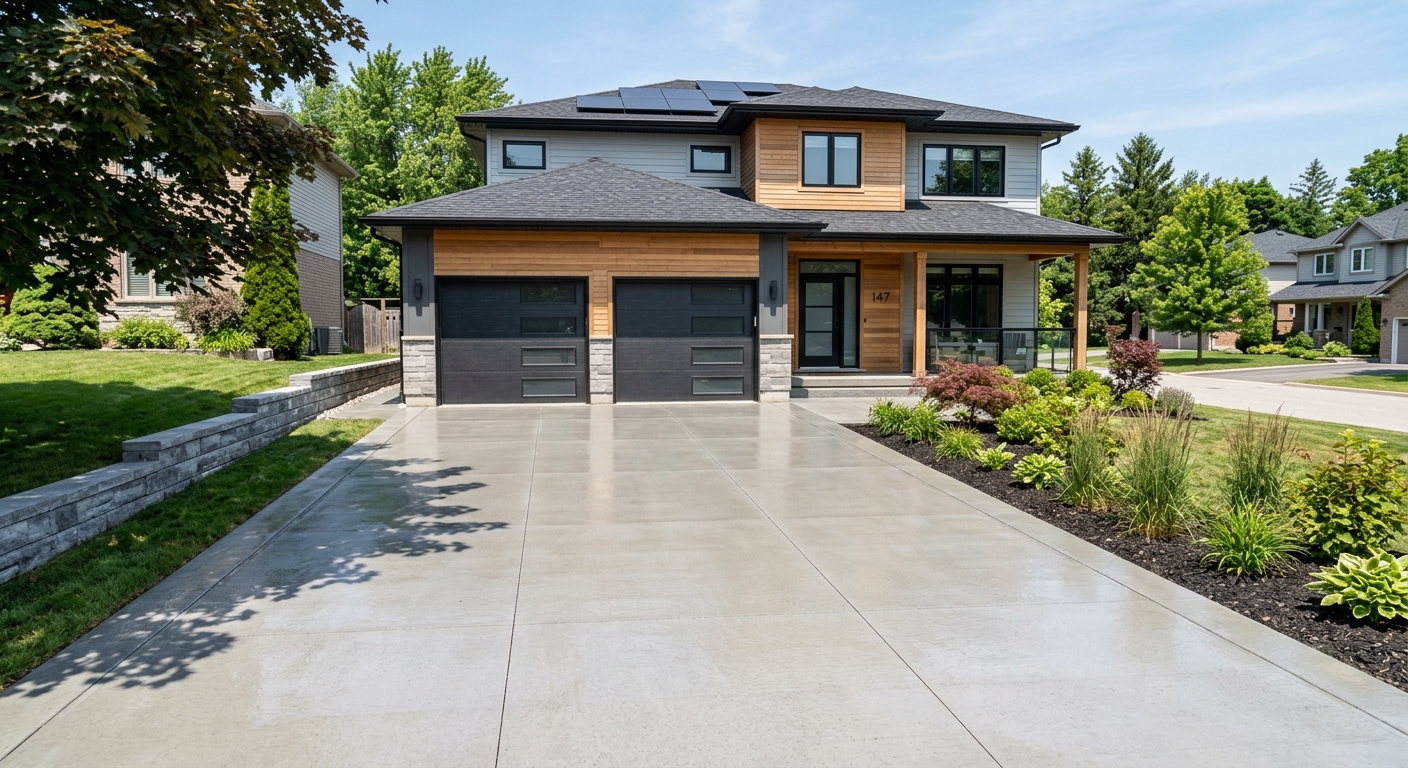
Concrete work options and costs in Batchelor Hills
Concrete work in Batchelor Hills ranges from straightforward flatwork to more detailed mixes and finishes, and the difference shows up quickly on your quote. In a neighbourhood like this, where the local housing stock is dominated by single-detached homes (Statistics Canada, 2021 Census), homeowners typically invest in driveways, patios and walkways that have to perform through Lower Mainland–Southwest freeze–thaw cycles and long, rain-heavy shoulder seasons.
The Lower Mainland–Southwest market also runs on a practical assumption about frost protection: local codes and standard practice typically design around a frost depth near 450 mm / 18", so footings and thickened edges are built below that to help prevent frost heave. Even with a shallower frost line than interior/northern BC, wet subgrade conditions and repeated temperature swings can still lead to scaling or cracking if base prep and drainage aren’t engineered properly. That’s why air-entrained concrete, well-compacted granular base, and correct control joint placement are “non-negotiables” here—not luxury add-ons.
Because the trade is busy around family-focused areas like Tsawwassen Drive and the Ladner-style corridor nearby (where property improvements often stack together), contractor availability can tighten in drier spring and early-summer windows. When rain lingers, curing and scheduling precautions add labour and time, which affects pricing even when the concrete finish looks similar. Use the table below to compare typical options and costs before you ask for site-specific measurements.
| Application |
Typical Size |
Key Spec |
Finish Option |
Price Range |
| Concrete driveway (standard broom finish) |
400–600 sq ft |
Reinforced slab-on-grade, compacted base, air-entrained exterior mix |
Broom finish + control joints |
$9,000 – $16,000 |
| Exposed aggregate driveway |
400–600 sq ft |
Proper mix design + base drainage, curing plan to prevent surface scaling |
Exposed aggregate with sealing |
$13,000 – $20,000 |
| Stamped concrete driveway or patio |
250–500 sq ft |
Air-entrained exterior mix, integral colour (if selected) |
Stamped pattern + release + sealer |
$8,500 – $17,000 |
| Plain concrete patio or walkway |
120–300 sq ft |
Thickness per load needs, compacted granular base, reinforcement where required |
Broom or light broom + control joints |
$2,000 – $6,500 |
| Garage floor (interior slab) |
300–500 sq ft |
Slab reinforcement, vapour control considerations |
Float + hardener (optional) |
$6,500 – $12,000 |
| Foundation footings (structural, below frost) |
Per linear foot with excavation |
Designed footing depth below frost, rebar cage, formwork and inspection readiness |
Structural concrete (not decorative) |
$200 – $350 |
Prices are estimates only and vary by project scope, site access and material selection.
What affects the price of concrete work in Batchelor Hills
In the Lower Mainland–Southwest, it’s common to see quotes for the “same” concrete job differ by 30–50%. The reason usually isn’t the concrete price—it’s the hidden scope that changes with site conditions and climate performance requirements. One contractor may price a job with minimal excavation and basic drainage, while another includes proper compacted granular base, engineered reinforcement placement, and a curing plan built around cool nights and coastal humidity. In British Columbia, these differences matter because freeze–thaw cycles and saturated soils can magnify minor construction shortcuts into early cracking, scaling, or spalling.
Start with frost protection: footings and thickened edges must extend below the design frost depth. In coastal BC that’s often around 0.5–1.2 m, so even though our frost line is shallower than interior provinces, the spec still requires below-frost construction to prevent frost heave. Exterior slabs also need air-entrained concrete mixes to survive freeze–thaw exposure. When temperatures drop near the shoulder seasons, colder regions rely on cold-weather curing precautions (insulation blankets, scheduling changes, and sometimes heating), which can raise cost even if the pour footprint is small. Finally, de-icing salts can accelerate surface deterioration; in practice, sealing is a cost-effective durability step.
Concrete driveway costs may land closer to the $18–$28 band per sq ft when you add proper base prep and reinforcement, and they can stay nearer the low end when the site is level and truck access is straightforward. Stamped and decorative work tends to justify a higher spend—often aligning with the $22–$36 band—because of extra labour time, integral colour, and more careful finishing and sealing.
Local housing age also plays a role: older lots often have service lines, tighter setbacks, or previously disturbed soils. If your existing driveway ties into older concrete, you may need saw cutting, removal, and additional forming, which shifts the quote by hundreds to thousands of dollars even before concrete is poured.
| Price Factor |
Why It Matters |
Cost Impact |
| Frost line depth — determines footing depth and form height |
Below-frost placement helps prevent frost heave and long-term settlement cracks |
Higher excavation/formwork can add several dollars per linear foot |
| Site preparation — excavation, grading, compacted granular base |
Proper drainage and compaction reduce voids that undermine slabs |
Unplanned digging or poor subgrade can raise cost significantly |
| Reinforcement — rebar or wire mesh requirement |
Controls cracking and improves load resistance |
Material and labour for placement and chairs can increase totals |
| Mix design — air-entrainment and compressive strength spec |
Air entrainment improves freeze–thaw durability in exterior exposure |
Higher-spec mix plus quality control can shift the price upward |
| Finish type — broom vs. stamped vs. exposed aggregate |
Decorative finishes require additional steps and careful curing timing |
Stamped/exposed often costs more per sq ft due to labour and materials |
| Pour size and concrete truck access to site |
Long carry distances increase labour and affect logistics |
Access constraints can add labour hours and equipment time |
| Cold-weather curing precautions — heating and blankets |
Protects early strength gain when nights turn cool/humid |
Blankets/heaters and longer scheduling increase project cost |
| Control joint pattern and sealing cost |
Joints reduce random cracking; sealing helps repel salts and moisture |
More joints and a proper sealer system add cost, but improves lifespan |
Permits & regulations in British Columbia
In British Columbia, structural concrete work typically requires a building permit. That includes footings, foundation walls, grade beams, and other foundation structural elements. Many projects also need engineered drawings or have engineering requirements reviewed through the municipal building process. By contrast, concrete flatwork like driveways, patios and walkways often does not require a permit unless your project affects lot grading, impervious surface coverage limits, or the municipal right-of-way. Even when a permit isn’t usually required, it’s still smart to confirm with the local authority before breaking ground—especially if you’re changing drainage patterns or tying into existing services.
For contractor due diligence in Batchelor Hills, verify three things step-by-step: (1) licensing/registration status where applicable for your work type, (2) liability insurance, and (3) WSIB/WCB coverage. Ask for a certificate of insurance showing current coverage limits that match concrete site risk (excavation, formwork, and curing-time protection). Also ask for clearance/coverage confirmation from the relevant workers’ compensation board. You should be able to see these documents before work starts.
Finally, request references from similar-scale projects—ideally exterior flatwork in coastal BC conditions—so you can judge how they manage drainage, curing, and air-entrained mix specifications in wet, cool weather.
Getting concrete right in Batchelor Hills's freeze-thaw climate
Concrete in Batchelor Hills is tested by a classic Lower Mainland–Southwest cycle: saturated ground after coastal rainfall, then cool nights where temperatures hover near freezing, followed by thaw and repeated freeze–thaw movement. Failures usually start from water management issues—poor base prep and drainage let water sit under or at the slab edge, and the freeze–thaw expansion pushes on the surface. If the mix isn’t designed for durability, you can see surface scaling and eventually spalling. The fix is in how the job is specified, not just in how it looks the day it’s poured.
For correct specs, start with base preparation: excavation to the designed depth, then compacted granular sub-base to the required thickness for local soils and frost considerations. Next is mix design: use air-entrainment suitable for exterior exposure (commonly 5–7% air content for exterior flatwork) and specify a minimum 32 MPa compressive strength. Then, use control joints at the proper spacing to limit random cracking. Curing matters in our climate: aim for at least 7 days of curing under proper conditions, and in cool/rainy periods use blankets and seal protection so the slab reaches strength before it’s exposed. Finally, consider penetrating sealer applied after the cure window (often around 28 days post-pour) to help repel de-icing salts and moisture.
Ask technical questions that directly prevent spalling: “What air content are you targeting?”, “How will you control curing temperatures overnight?”, and “What joint spacing are you planning for my slab size?” If your driveway is priced at the low end of the $18–$28 band with thin base and minimal drainage, you may save money upfront—but you’re gambling with premature scaling. A higher-spec driveway with proper base and air-entrained mix can be worth it because the cost of early repairs is typically higher than doing it right once.
| Spec |
Why It Matters in Batchelor Hills |
What to Ask For |
Impact if Skipped |
| Compacted granular base (depth?) |
Prevents water pooling and supports slab through freeze–thaw cycles |
Granular type, target compacted depth, and moisture/compaction method |
Settlement and cracking; edge deterioration during wet/cold cycles |
| Air-entrained concrete mix (target air %?) |
Improves freeze–thaw durability for exterior exposure |
Documented air content target (commonly 5–7%) and exterior exposure spec |
Spalling and scaling accelerate in winter |
| Compressive strength (MPa rating) |
Ensures the slab reaches adequate strength for loads and durability |
Minimum 32 MPa at specified curing/sampling conditions |
Surface wear, crumbling, and reduced long-term performance |
| Control joints (spacing per ACI guidelines) |
Controls where cracks form instead of random fractures |
Planned joint spacing and saw-cut timing |
Random cracking that looks worse and may admit water |
| Minimum 7-day curing period |
Cool/wet conditions can slow strength gain without protection |
How curing will be protected (blankets/sealer curing protection) |
Reduced strength and higher risk of early surface damage |
| Penetrating sealer (when applied after cure) |
Helps repel salts and moisture in freeze–thaw seasons |
Sealer type and application timing (often after 28 days) |
Faster staining, scaling, and salt-related deterioration |
How to choose a concrete work contractor in Batchelor Hills
Choosing the right concrete contractor in Batchelor Hills comes down to proof: proof of coverage, proof of scope, and proof they build for coastal-wet freeze–thaw conditions (not just “good enough” looks). Start by verifying British Columbia coverage: request evidence of liability insurance and WSIB/WCB clearance/coverage for their workers. You can check the contractor’s insurance certificate for expiry dates and coverage limits, and you should be able to see clearance documentation before work begins. If they can’t provide it, that’s a serious issue on a concrete site—especially during excavation and cutting.
Next, demand 2–3 itemised written quotes—not lump sums. You want separate line items for excavation/grading, granular base, reinforcement, concrete supply, finishing, curing protection (blankets/sealer timing), joint cutting, and disposal if included. Confirm whether a permit pull (when required for structural concrete) is included, and whether waste disposal and hauling are in the price or billed separately.
Warranty matters too. Ask for a workmanship warranty length and what it covers (cracking due to shrinkage control, spalling linked to mix/curing, settlement tied to base issues). Also clarify whether there’s a product/manufacturer warranty for any sealers or specialty admixtures, and whether it’s transferable if you sell the home.
For payments, never agree to more than about 10–15% upfront. Hold back payment until the job is complete, joints are cut as planned, edges are finished cleanly, and curing/sealer steps are documented. Finally, get a start date and completion estimate in writing, including schedule adjustments for rain/cool nights.
- Confirm liability insurance certificate is current and matches your job type.
- Verify WSIB/WCB coverage and get clearance documentation.
- Ask how they handle wet subgrade and drainage—what’s included?
- Request concrete mix specs: air content target and minimum MPa rating.
- Get a written rebar/wire mesh plan (where, depth, and support chairs).
- Ensure control joint spacing and cutting timing are in the quote.
- Ask about curing protection in cool nights (blankets/heating if needed).
- Confirm whether sealer is included and when it will be applied.
- Check disposal/hauling is included for concrete removal and excavated soil.
- Require truck access/size assumptions (and what happens if access changes).
- Review exclusions in plain language (e.g., unknown utilities, rock removal, permit fees).
- Confirm warranty terms for workmanship and what proof is required to claim.
Concrete red flags in Batchelor Hills: (1) vague “we’ll reinforce it” language without mesh/rebar placement details, (2) skipping air-entrainment discussion for exterior work, (3) no plan for drainage/base compaction, (4) no curing protection plan for cool/rainy weeks, and (5) trying to take large deposits before forms, base, and scheduling are confirmed.
Frequently asked questions — concrete work in Batchelor Hills
How do I prepare the base for a concrete slab?
Base prep is the foundation of good concrete in Batchelor Hills. A contractor should excavate to the planned depth, remove unsuitable soil/organic matter, and build a compacted granular sub-base with proper grading so water drains away from the slab. In Lower Mainland–Southwest conditions, that granular base needs to be compacted to reduce voids that later turn into settlement and cracking during wet/cool freeze–thaw cycles. Ask what granular material they use, what compacted depth they’re proposing, and whether they’ll proof-compact and document coverage before the pour. If your soil is saturated or poorly draining, you may need additional drainage measures before concrete is placed—this is often why quotes can differ. A properly prepared base can be the difference between staying closer to a driveway budget like the $18–$28 band and facing early repairs.
How do I compare concrete quotes?
When comparing quotes in British Columbia, don’t look only at the total price—compare scope and specs. Ask each contractor for an itemised breakdown: excavation/grading, granular base, reinforcement (mesh/rebar location and quantity), concrete supply mix design (including air entrainment for exterior work), finishing steps, control joints, curing protection, and sealing. If one quote includes penetrating sealer and curing blankets while another doesn’t, you may see a 30–50% difference even for the “same” surface area. Also check exclusions: permit fees (if structural), disposal/hauling, protection of nearby landscaping, and what happens if truck access is limited. Finally, ask for a realistic schedule for rain/cool nights; if they promise a pour without a curing plan, that’s a risk for durability. For reference, a plain patio may align with the $16–$26 band, while decorative work like stamped concrete often lands higher.
Can concrete be poured in cold weather in Batchelor Hills?
Yes, concrete can be poured in cold weather in Batchelor Hills, but it must be protected so it reaches strength properly before exposure. In the Lower Mainland–Southwest, nights can get cool and damp, and freeze–thaw cycles are still active even though winters are milder than interior BC. A good contractor will plan for cold-weather precautions such as curing blankets, controlling the pour schedule, monitoring temperatures, and in some cases using temporary heating to protect the slab until early strength gain. The key is that the concrete mix and curing approach must match the temperature conditions. If a contractor doesn’t discuss curing protection, that’s a concern because early freezing can lead to weaker concrete and higher risk of surface scaling or cracking. Ask how they’ll protect the pour overnight and what minimum curing period they’ll commit to in your specific week.
How do I maintain concrete in Batchelor Hills's freeze-thaw climate?
Maintenance in Batchelor Hills is mostly about keeping water and salts from attacking the surface. Start with sealing: for exterior slabs like driveways and patios, a penetrating sealer applied after curing (often around 28 days post-pour) helps repel moisture and de-icing salts. During winter, use de-icing products carefully—overuse can increase surface deterioration even with air-entrained concrete. Keep gutters and downspouts directed so runoff doesn’t pool at slab edges, and address any low spots that collect water. Visually inspect for early signs of scaling, spalling, or widening joints; small repairs done early are usually cheaper than full resurfacing later. Finally, don’t ignore joint sealant (where specified) and keep joints clean so they can do their job controlling cracking. This kind of maintenance protects the upfront investment you make when pricing is in the $18–$28 driveway band or higher for decorative finishes.
What causes concrete to spall in Batchelor Hills winters?
Spalling typically happens when water gets into the concrete and freeze–thaw expansion disrupts the surface—especially if the concrete mix isn’t properly designed for exterior exposure. In Batchelor Hills and the Lower Mainland–Southwest, saturated conditions from coastal rain plus cool nights create the perfect scenario: water enters through cracks, at edges, or around joints, then expands when temperatures drop near freezing. If the contractor didn’t use air-entrained concrete at the correct target air content (commonly 5–7% for exterior flatwork) and the curing wasn’t protected, the concrete’s ability to resist freeze–thaw damage drops sharply. Spalling can also be worse when base drainage is poor, because the slab edge stays wet longer. Ask directly about air entrainment and the curing plan; those two items prevent most spalling issues. If you’re comparing quotes, a bargain bid that omits mix specs or curing protection is usually where spalling risk starts.
What is rebar and when is it required in British Columbia?
Rebar (reinforcing steel) is steel placed inside concrete to control cracking and improve performance under loads like vehicle traffic and structural movement. In British Columbia, whether rebar or wire mesh is required depends on the design, thickness, soil conditions, and the intended use of the slab or structural element. For example, exterior flatwork such as driveways often includes reinforcement depending on slab thickness and sub-base preparation; foundation footings and other structural components almost always include rebar as part of the engineered system. The contractor should base the reinforcement plan on drawings or engineered specifications and should place steel correctly on chairs/spacing so it sits within the concrete—not sitting on the ground. If structural concrete is involved (like foundation footings below frost), permits and engineered review typically apply more often. Always ask for the reinforcement schedule and thickness assumptions when getting a quote in Batchelor Hills.