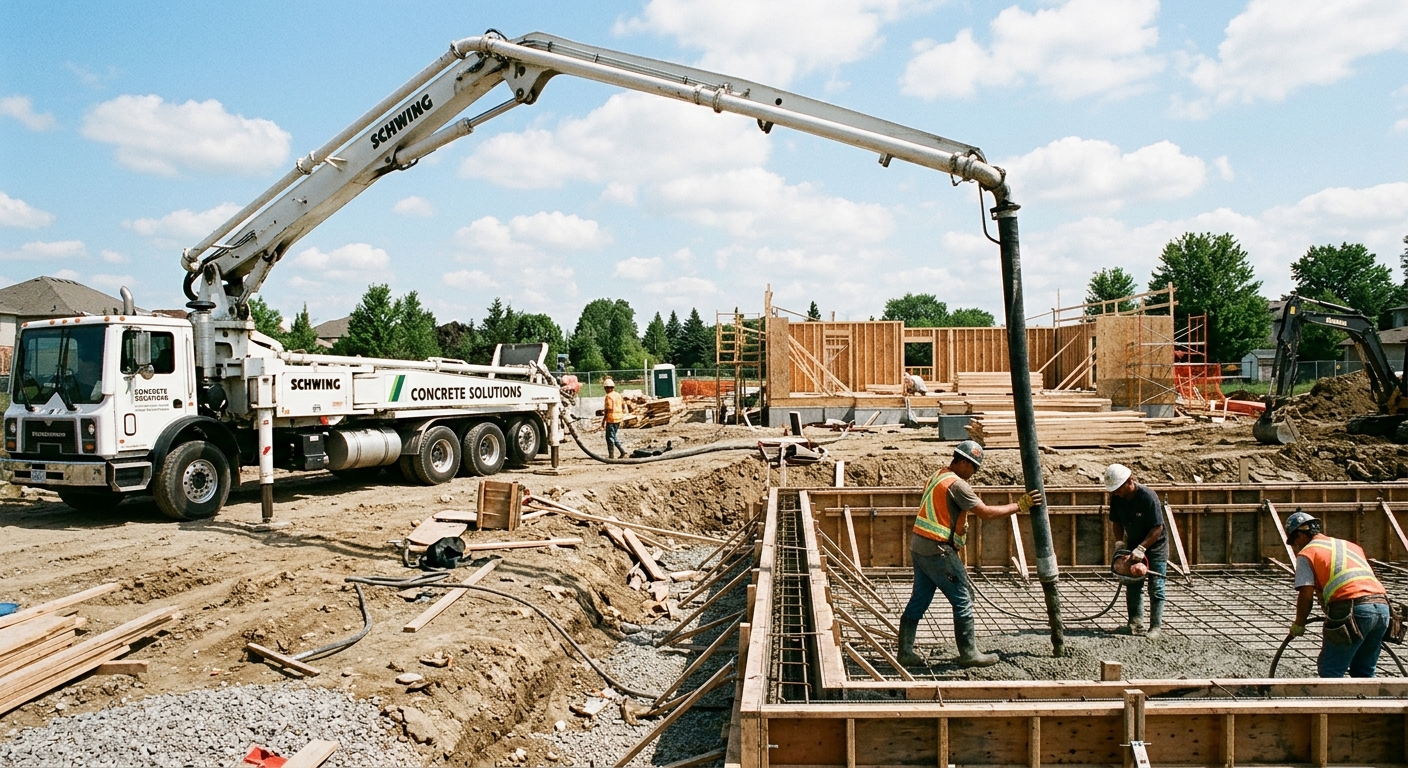
Concrete work options and costs in Stride Hill
Concrete work in Stride Hill, British Columbia, tends to be a balance of durability and season planning. With a population of 6,019 (Statistics Canada, 2021 Census), local contractors often prioritize projects that keep crews moving efficiently across the Lower Mainland–Southwest corridor. Most homeowners here are dealing with family housing stock typical of the region—single-detached homes are a major driver of driveway and patio demand, especially in neighbourhoods around Pacific Drive and the surrounding residential lanes where flatwork is frequently refreshed.
In the Lower Mainland–Southwest, mild winters and a shallow frost line still matter because freeze–thaw cycles and saturated soils can undermine weak base prep. Local practice usually assumes a frost depth around 450 mm / 18", so footings and thickened edges are placed below that to reduce the risk of frost heave. Coastal rainfall also affects curing; prolonged rain, cool nights, and high humidity can slow strength gain, so contractors may use curing blankets and sealers and plan pour dates carefully.
Because of these climate-driven specs—proper drainage, compacted granular base, air-entrained mixes, and controlled joints—prices can move quickly depending on how much work is required before the concrete trucks arrive. As a quick comparison, the cost difference between a broom-finished driveway and stamped or exposed finishes is usually justified by added formwork, prep, and surface finishing time.
Use the table below to benchmark common options for Stride Hill, then match the finish level to how long you want the surface to look sharp.
| Application |
Typical Size |
Key Spec |
Finish Option |
Price Range |
| Concrete driveway (standard broom finish) |
400–500 sq. ft. (approx. 18 ft × 24 ft) |
Air-entrained exterior mix, compacted granular base, control joints |
Broom finish, sealed (optional) |
$18,000–$28,000 |
| Exposed aggregate driveway |
400–500 sq. ft. (approx. 18 ft × 24 ft) |
Air-entrained mix with specified surface retarder, proper curing plan |
Exposed aggregate, sealed |
$22,000–$32,000 |
| Stamped concrete driveway or patio |
300–450 sq. ft. |
Air-entrained mix, base prep for exterior traffic loads |
Stamped pattern + release + sealer |
$22,000–$36,000 |
| Plain concrete patio or walkway |
200–350 sq. ft. |
Vapor-friendly base prep, air-entrained exterior mix |
Broom/float finish |
$16,000–$26,000 |
| Garage floor (interior slab) |
400–500 sq. ft. |
Minimum 32 MPa mix, compacted sub-base, joints as needed |
Float/smooth trowel (finishing varies) |
$14,000–$24,000 |
| Foundation footings (structural, below frost) |
Per linear foot (typical house: several thousand lbs of concrete) |
Excavation + formwork, reinforcing as engineered, below-design frost |
Structural concrete with specified cover |
$200–$350 |
Prices are estimates only and vary by project scope, site access and material selection.
What affects the price of concrete work in Stride Hill
In Stride Hill and across the Lower Mainland–Southwest, two quotes for what looks like the “same” concrete job can differ by 30–50% because the base-build details aren’t the same—especially where freeze–thaw cycles and coastal rainfall force stricter specs. Even when the finish is similar, contractors may use different granular thicknesses, different reinforcement plans, or different curing and sealing approaches to hit durability targets in British Columbia’s wet/cool swings.
Here, the frost-depth design logic still drives every structural detail. Footings must extend below the design frost depth (commonly around 0.5–1.2 m in coastal BC) to prevent frost heave. Exterior slabs and flatwork should use air-entrained mixes to survive repeated wetting and thawing, and proper control joints to manage cracking. Compared with colder regions, the frost line may be shallower, but the Lower Mainland trade-offs come from longer periods of cool, damp weather that can slow curing. Cold-weather precautions—blankets, heaters, or scheduling around rain—can add real labour and equipment cost even when temperatures don’t look extreme.
In Stride Hill, a driveway replacement on saturated or poorly draining subgrade commonly costs more because excavation and base re-build have to be deeper and more carefully graded. Conversely, if your site has good existing drainage and solid granular base, the concrete price can land near the lower end of the regional bands—like a broom-finished driveway around $18,000–$28,000. If you’re stepping up to stamped work, the higher band—like $22,000–$36,000—is often justified by extra labour for patterning, colour integration, and sealing for surface longevity.
| Price Factor |
Why It Matters |
Cost Impact |
| Frost line depth |
Footings and thickened edges must sit below the design frost depth. |
More excavation, form height and rebar cover work can raise structural costs. |
| Site preparation |
Excavation, grading and compacted granular base determine slab stability. |
Wet soils or poor drainage can increase haul/disposal and base quantity. |
| Reinforcement |
Rebar or wire mesh helps control cracking and supports loads. |
Extra labour for placement, chairs/ties, and overlap can add cost. |
| Mix design |
Exterior air-entrainment and specified compressive strength improve freeze–thaw durability. |
Higher-spec concrete and stricter testing can increase materials and truck requirements. |
| Finish type |
Broom vs. exposed aggregate vs. stamped changes labour and surface preparation time. |
Stamped/exposed typically costs more due to colour systems, tools and curing/finishing steps. |
| Pour size and concrete truck access to site |
Smaller pours may require more mobilization; limited access increases labour time. |
More equipment time, wheelbarrowing/hoses, and rework can push the price up. |
| Cold-weather curing precautions |
Cool nights and damp weather slow strength gain and increase finishing risk. |
Blankets/heaters and longer scheduling windows add direct labour and equipment. |
| Control joint pattern and sealing cost |
Joints reduce random cracking; sealing repels moisture and de-icing impact. |
More saw-cuts and a proper sealing step can add modest but important cost. |
Permits & regulations in British Columbia
In British Columbia, most concrete flatwork (patios, walkways, driveways) typically does not require a building permit unless it affects lot grading, drainage plans, impervious surface coverage limits, or involves changes near a municipal right-of-way. However, structural concrete work generally does require a permit—specifically footings, foundation walls, grade beams, retaining foundation elements, and any engineered foundation components tied to the house structure. In many Stride Hill projects, engineered drawings reviewed by the municipality are part of the process for structural elements, especially where reinforcement and bearing are critical.
Before breaking ground, confirm requirements with the local authority (or your contractor can typically coordinate the permit if required). It’s also wise to verify insurance and compliance: ask the contractor for liability insurance and coverage documentation for workers on site. In BC, homeowners should request proof that the contractor is properly registered and carries appropriate worker coverage through the province’s systems.
Here’s a simple step-by-step for Stride Hill homeowners:
- Ask for the contractor’s company name, legal address, and scope (what they’re building and where).
- Request a certificate of liability insurance showing the project details and coverage limits.
- Ask for proof of worker coverage status (documentation may vary, but you should receive written evidence).
- Ask whether a permit is needed for your specific scope (foundation/footings vs flatwork).
- If permits/engineering are required, confirm who pulls them and what inspections are included.
- Collect references from similar-size jobs in the Lower Mainland–Southwest.
This keeps your project moving and avoids expensive surprises once excavation starts.
Getting concrete right in Stride Hill's freeze-thaw climate
Concrete failure in Stride Hill is usually a “systems” problem, not just a bad pour. In the Lower Mainland–Southwest, repeated wetting and freeze–thaw cycles can drive water into tiny voids and cracks. When that water freezes, it expands and pushes the surface apart—leading to scaling and spalling. The right way to avoid this is to spec the base, mix, joints, curing, and sealing as a complete package that matches coastal-wet conditions.
1) Base preparation: Use compacted granular sub-base to the correct depth for local soil and frost logic. A firm base reduces settlement, which otherwise creates stress points where cracking starts. 2) Mix design: Specify air-entrainment (commonly 5–7% air content for exterior flatwork) and a minimum 32 MPa compressive strength. This is the key defence against freeze–thaw damage; inadequate air content is a common root cause of spalling. 3) Control joints: Set a joint spacing plan that limits random cracking and directs where the slab can move. 4) Curing: Plan for at least 7 days of proper curing conditions; in cool, damp weather, longer cure support (blankets or measures to protect from rain/wind) helps reach design strength. 5) Sealing: Apply a penetrating sealer after full cure (often around 28 days post-pour) to help repel de-icing salts and surface water.
When homeowners compare options, the price difference between plain broom finish and stamped can be justified when aesthetics matter and the contractor still hits the durability fundamentals. For example, moving from a plain patio around $16,000–$26,000 to stamped work around $22,000–$36,000 is fair only if you’re also getting the same disciplined base compaction, correct air-entrainment, proper joints, and a curing/sealer plan—not just extra finishing.
| Spec |
Why It Matters in Stride Hill |
What to Ask For |
Impact if Skipped |
| Compacted granular base (depth?) |
Controls settlement and reduces water pumping under freeze–thaw cycles. |
Granular thickness and compaction method; drainage plan if soils are saturated. |
Cracks open, edges lift, and surface deterioration accelerates. |
| Air-entrained concrete mix (target air %?) |
Creates space for freezing water to expand without destroying paste. |
Target air content (commonly 5–7% for exterior flatwork) and documentation/testing. |
High risk of scaling and spalling in wet winters. |
| Compressive strength (MPa rating) |
Improves long-term resistance to abrasion and freeze–thaw stress. |
Minimum 32 MPa and mix design sheet from supplier/truck ticket specs. |
Surface wears quickly; durability drops, especially under tire and foot traffic. |
| Control joints (spacing per ACI guidelines) |
Directs shrinkage and movement to planned locations. |
Joint spacing and timing for saw-cut; include crack control details in quote. |
Random cracking and uneven slab movement become more likely. |
| Minimum 7-day curing period |
In cool, damp weather, curing affects strength gain and surface integrity. |
How they protect concrete from rain/wind and cold nights for the first week. |
Weaker surface, more scaling risk, and finishing defects can remain permanently. |
| Penetrating sealer (when applied after cure) |
Repels moisture and helps reduce salt impact during winter wet cycles. |
Sealer type and schedule (typically after full cure, often around 28 days). |
Water and salts penetrate faster; surface dusting and spalling progress. |
How to choose a concrete work contractor in Stride Hill
Choosing a concrete contractor in Stride Hill is mostly about verifying three things up front: qualifications/licensing (where applicable), insurance, and concrete-process competence. Start with British Columbia documentation—ask for the contractor’s registration details and confirm they are eligible to perform the type of work you need. Then verify insurance: request a certificate of liability insurance naming your property (or project) and showing coverage limits. For worker coverage, ask for proof of worker coverage status and keep it on file; don’t rely on verbal assurances.
Next, get 2–3 itemised written quotes rather than lump sums. Ask for a breakdown of labour and materials: excavation and disposal, base prep and compaction, reinforcement, concrete supply/mix spec, forming, finish materials, joints, curing/blankets (if needed), and sealing timing. Make sure the quote states whether permits are included (structural foundation/footings versus flatwork) and whether traffic control, saw-cutting, and cleanup are covered.
Warranty matters—ask for the workmanship warranty length in writing and whether it covers surface scaling, cracking, or joint issues. Also ask about any manufacturer warranty for sealers or specialty products, and whether it is transferable if you sell the home.
Finally, protect your cash flow. Never pay more than about 10–15% upfront; hold back a portion until the job is complete and cleaned. Ask for a start date and completion estimate in writing, and confirm how they handle rainy stretches common in the Lower Mainland–Southwest.
- Provide proof of liability insurance (certificate) before signing.
- Confirm worker coverage status with written evidence.
- Request project references for similar concrete in the Lower Mainland–Southwest.
- Get quotes with line items (excavation, base, rebar/mesh, concrete mix spec, joints, curing, sealing).
- Ask whether the mix is air-entrained and what target air content is used for exterior flatwork.
- Confirm minimum 32 MPa compressive strength in the quote or supporting documents.
- Ask for the control joint spacing plan and whether joints are saw-cut on schedule.
- Ask how they protect curing in cool or rainy weather (blankets, covers, sequencing).
- Confirm whether sealing is included and the application timeline (after cure, often around 28 days).
- Clarify what’s included/excluded for hauling and disposal of excavated material.
- Verify truck access plan and whether the quote includes pumping/hosing or handwork allowances.
- Review the payment schedule—small deposit, with a completion holdback.
Concrete red flags in Stride Hill include: no mention of air-entrained mix for exterior work, vague “we’ll pour in good weather” promises without curing protection, missing base compaction specs, quotes that omit joint layout/timing, and contractors who ask for large upfront payments or won’t provide insurance documentation.
Frequently asked questions — concrete work in Stride Hill
What is air-entrained concrete and why does it matter here?
Air-entrained concrete is mixed with tiny microscopic air bubbles that give expanding freeze water somewhere to go during cold snaps. In Stride Hill and the broader Lower Mainland–Southwest, even though winters are milder than inland BC, wet concrete surfaces still go through freeze–thaw cycles and repeated saturation from coastal rainfall. That’s why exterior flatwork—driveways, patios and walkways—should use air-entrained mixes to resist scaling and spalling. If a quote doesn’t clearly state air-entrainment and targets (often about 5–7% air for exterior flatwork), you’re taking a durability risk. Cost-wise, air-entrainment is usually a small portion of total pricing, but it can separate a surface that lasts from one that needs early repairs. For planning, remember driveway projects often land in the $18,000–$28,000 band depending on base, finish and site constraints.
How do I prepare the base for a concrete slab?
Base prep is where most durability is won or lost in Stride Hill. Your contractor should excavate to the required depth, remove unsuitable material, and install a compacted granular sub-base designed for your soil and the local frost logic (footings and thickened edges below the design frost depth; exterior slabs still need proper base and drainage). The key steps are grading, placing granular in lifts, compacting to the spec, and addressing drainage so water doesn’t sit under the slab. For saturated sites, expect extra excavation/disposal and potentially improved drainage—this is a common reason quotes can differ by 30–50% in the Lower Mainland–Southwest. A good contractor will also plan for access so the crew can place and consolidate concrete promptly. If base prep is unclear in the quote, ask for granular thickness and compaction methods before you sign.
How do I compare concrete quotes?
Compare quotes item-by-item, not just by the total number. In British Columbia, especially in Stride Hill, the big drivers are excavation/base depth, drainage details, reinforcement requirements, and the concrete mix spec (including air-entrainment). Ask whether the quote includes control joint layout, curing protection for cool nights or rain, and sealing after full cure (often around 28 days). Also check whether disposal and haul-away are included—some contractors quote a low concrete price but charge extra for removing wet soil. For finish level, compare like-for-like: a plain broom-finished patio may land near the $16,000–$26,000 band, while stamped concrete typically runs higher (often $22,000–$36,000) because it’s more labour-intensive and needs a careful curing/sealer plan. If the contractor can’t explain their specs and sequencing, treat that as a warning sign.
Can concrete be poured in cold weather in Stride Hill?
Concrete can often be poured in cold weather in Stride Hill, but the real question is whether the contractor can protect curing to achieve design strength. In the Lower Mainland–Southwest, it’s not uncommon to have cool nights and damp conditions around pour time. Cold-weather procedures may include scheduling around the coldest periods, using insulating blankets, controlling wind/rain exposure, and sometimes adding heating measures so the concrete doesn’t freeze before it reaches safe strength. The mix supplier and the contractor should provide cold-weather guidance and protection steps in writing. A quote should mention curing protection, not just the pour date. If someone offers a “normal” pour with no curing plan when temperatures are low or rain is expected, you’re likely to see weaker surfaces or finishing issues later. For durability, always tie cold-weather curing steps back to the exterior exposure and freeze–thaw performance your driveway or patio needs.
How do I maintain concrete in Stride Hill's freeze-thaw climate?
Maintenance in Stride Hill is mainly about limiting water and salt exposure and keeping surfaces protected through winter cycles. After your slab cures, a penetrating sealer (often applied about 28 days after the pour) helps repel moisture and reduces salt penetration impact from de-icing. For the winter season, use de-icing products carefully—overuse and aggressive products can accelerate surface wear. Keep gutters and downspouts directing water away from edges and joints. If you spot small cracks or joint deterioration, address it early so water doesn’t migrate under the slab and worsen freeze–thaw damage. For patios and walkways, prompt cleaning of algae/mud also matters because trapped moisture can intensify scaling. If you’re choosing between finishes, remember that stamped or exposed surfaces usually benefit even more from proper sealing and routine cleaning because texture can hold grime and water.
What causes concrete to spall in Stride Hill winters?
Spalling in Stride Hill is usually caused by water getting into the concrete and freezing repeatedly, breaking the surface layer. The biggest contributor is often inadequate air-entrainment or poor control of the air content, which reduces the concrete’s freeze–thaw resistance. Other common contributors include weak curing in cool, damp conditions, insufficient base drainage leading to ongoing moisture under the slab, and missing or poorly spaced control joints that allow random cracking. Once cracks form, water channels in and accelerates the freeze–thaw cycle at the surface. Poor sealing or skipping sealing can also make things worse, especially with de-icing salts. If you’re budgeting, don’t confuse higher price with better durability—make sure the quote for your exterior work includes air-entrained concrete, correct joints, proper curing protection, and sealing timing. This is what separates a driveway that stays intact from one that starts spalling after only a couple of winters.