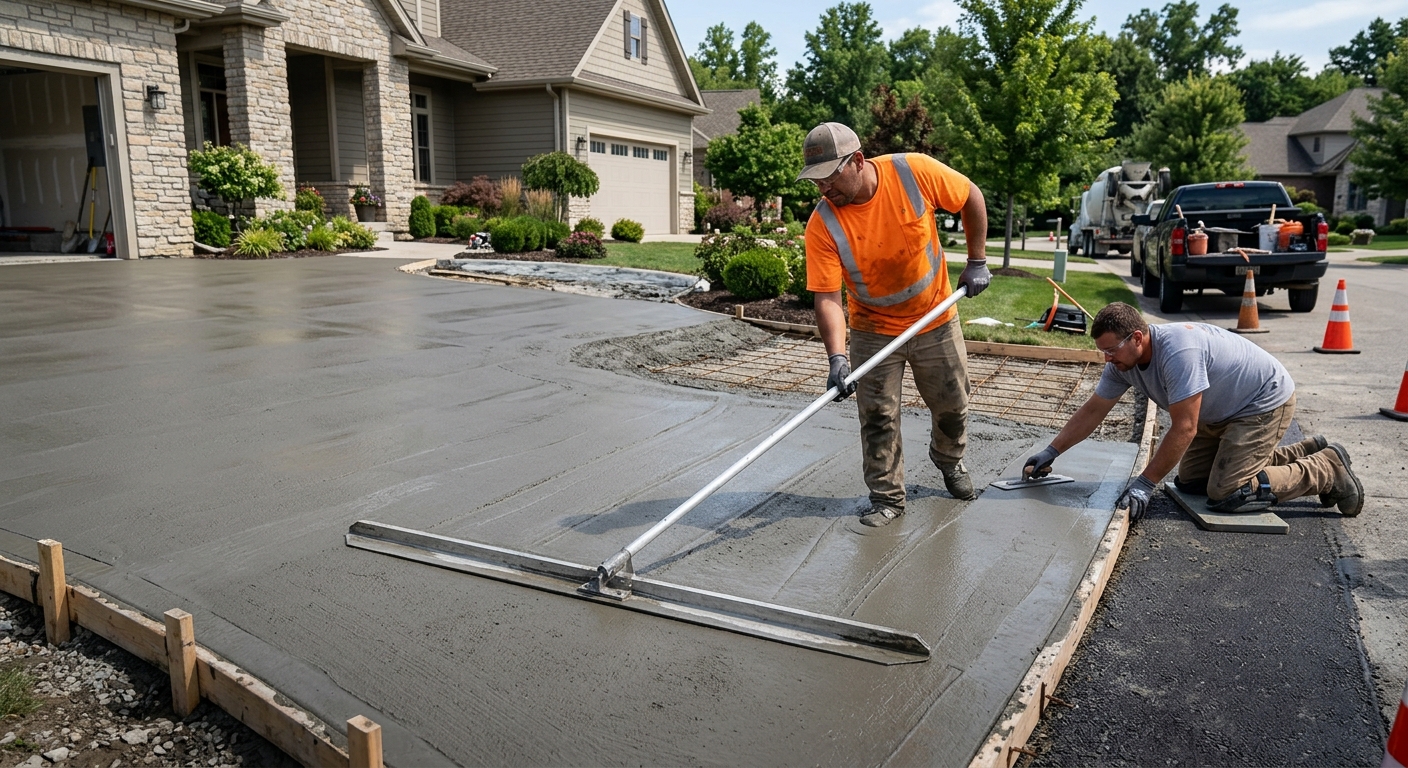
Concrete work options and costs in Mountain Meadows
In Mountain Meadows, concrete is a go-to material for durable driveways and patios, and the local housing mix helps explain the steady demand. With a population of 1,401 (Statistics Canada, 2021 Census), most concrete flatwork is tied to single-family residences, and the work is especially common around established residential pockets in the Mountain Meadows area where homeowners prioritize long-life surfacing. In the Lower Mainland–Southwest, pricing is shaped less by extreme winter cold and more by moisture, shallow frost movement, and frequent freeze–thaw cycles that can punish poorly drained bases and under-specified exterior concrete.
Contractors plan concrete designs around a frost depth assumption of about 450 mm / 18", with footings, thickened edges, and piers placed below that line to reduce the risk of frost heave. That one detail influences excavation volume, rebar and formwork quantity, and how we schedule work during rainy stretches. The coastal-wet climate also affects curing—cool nights and high humidity mean longer cure control, and crews often use curing blankets or sealers to protect fresh concrete.
Because of this, you’ll see healthy competition among local crews for driveway and patio work, but fewer bidders are willing to price “low” if they need to improve drainage, add compacted granular base, or handle cold-weather curing precautions. If you want apples-to-apples comparisons, use this table to align finish type and scope before you call for a quote.
| Application |
Typical Size |
Key Spec |
Finish Option |
Price Range |
| Concrete driveway (standard broom finish) |
400–600 sq. ft. |
Air-entrained mix, control joints, compacted granular base |
Broom finish |
$7,200–$12,000 |
| Exposed aggregate driveway |
400–600 sq. ft. |
Air-entrained mix, seeding/aggregate exposure process, joints |
Exposed aggregate finish |
$9,500–$15,800 |
| Stamped concrete driveway or patio |
300–500 sq. ft. |
Air-entrained mix, integral color, release agent, joints |
Stamped pattern |
$9,000–$17,500 |
| Plain concrete patio or walkway |
200–400 sq. ft. |
Air-entrained mix, proper base, edge forms, joints |
Float/smooth + broom texture or light trowel |
$3,200–$8,000 |
| Garage floor (interior slab) |
300–500 sq. ft. |
Vapour considerations, mesh or rebar as specified, curing |
Plain broom or steel-trowel (scope dependent) |
$5,400–$11,500 |
| Foundation footings (structural, below frost) |
Varies by home |
Excavation to below frost, engineered rebar, formwork, drainage as needed |
Structural concrete only |
$6,000–$14,000 |
Prices are estimates only and vary by project scope, site access and material selection.
What affects the price of concrete work in Mountain Meadows
In Mountain Meadows and across the Lower Mainland–Southwest, the same “driveway size” can come back with a 30–50% spread because concrete pricing isn’t only about the cubic yards—it’s about how the job is built underneath and how it’s protected during curing. Contractors that include proper drainage, compacted granular base, air-entrained concrete, and the right joint layout will price higher than bids that treat those steps as optional. That difference is also why pricing can swing across all of British Columbia: interior and northern projects often face deeper freeze conditions and shorter pour seasons, while Lower Mainland jobs are influenced more by saturation, cool curing windows, and freeze–thaw cycling.
Here, frost depth assumptions (about 450 mm / 18") drive excavation and form height, and exterior slabs and walkways typically require air-entrained concrete to resist freeze–thaw scaling and spalling. When weather stays wet or the nights run cool, we may need curing blankets and longer protection time to reach design strength. De-icing salt later on increases surface stress—so sealing is often recommended for driveways and steps.
Two concrete examples that change the total cost in Mountain Meadows: (1) If your yard drains poorly after rainfall, adding subgrade drainage and thicker base may move a “standard driveway” closer to the higher end of the $18–$28 per square foot concrete driveway band. (2) Choosing stamped concrete can raise the budget toward the $22–$36 per square foot decorative band because of labour time (stamping, curing control, and finishing). For older homes with more settled grades, you’ll often see extra excavation and re-forming costs reflected by hundreds to several thousand dollars depending on how much base rebuild is required.
| Price Factor |
Why It Matters |
Cost Impact |
| Frost line depth |
Determines footing depth and form height to reduce frost heave |
Higher excavation and more rebar/formwork on exterior structural items |
| Site preparation |
Excavation, grading, compacted granular base controls settlement and water |
Extra base, drainage rock, and compaction labour can add several thousand dollars |
| Reinforcement |
Rebar or wire mesh supports cracking resistance and slab strength (as specified) |
Material + labour increases, especially for thickened edges and structural slabs |
| Mix design |
Air-entrainment and compressive strength spec protect against freeze–thaw damage |
Air-entrained mix pricing and quality control can shift costs upward 5–15% |
| Finish type |
Broom vs. stamped vs. exposed aggregate changes materials and labour intensity |
Decorative finishes often push the project from “standard” toward the higher bands |
| Pour size and concrete truck access to site |
Long pours or poor access can require extra labour and smaller pours |
Scheduling changes, additional crew time, and pumping/handwork add cost |
| Cold-weather curing precautions |
Heating/insulating blankets help concrete reach strength reliably |
Blankets, heaters, monitoring time, and slower progress increase total price |
| Control joint pattern and sealing cost |
Joints limit random cracking; sealing helps manage de-icing salt and moisture |
Additional layout labour and sealer material typically add noticeable but worthwhile cost |
Permits & regulations in British Columbia
In British Columbia, structural concrete work generally needs a building permit, especially when the work contributes to a home’s foundation system. This includes footings, foundation walls, grade beams, and other structural components that support loads and protect against frost action. Municipal review may also involve engineered drawings, depending on the structure and site conditions. Concrete flatwork such as patios, walkways, and driveways usually does not require a permit—unless your project affects lot grading, stormwater handling, or municipal requirements around impervious surface coverage, right-of-way, or drainage plans. Always confirm with the local authority before breaking ground.
For safety and compliance, verify the contractor carries liability insurance and has the right coverage under provincial requirements for the work being performed. Step-by-step, here’s how a homeowner in Mountain Meadows can check: (1) ask the contractor for a certificate of insurance and confirm the coverage limits and expiry date; (2) request proof of coverage for workers involved in the job, and keep those documents on file; (3) confirm the contractor’s professional registration/licensing status where applicable using the appropriate provincial registry entry (many firms list their credential number on proposals); (4) ask for recent references on similar-scale concrete flatwork and foundation work, with photos that show drainage and joint detailing.
If the scope includes any structural changes or foundation modifications, expect more documentation. If it’s “just” exterior flatwork, permits may not be required, but drainage and curing decisions still need to be engineered to perform in British Columbia’s freeze–thaw, rain-driven climate.
Getting concrete right in Mountain Meadows's freeze-thaw climate
Concrete failures in Mountain Meadows typically come back to three things: water, temperature cycling, and premature exposure. When saturated base soils freeze and thaw, the slab can heave or lose support, leading to cracking and—worst case—surface scaling and spalling. The best way to protect your investment is to spec the job around Lower Mainland–Southwest realities: build a well-compacted granular base to the right depth and shape for local soil, use air-entrained concrete (commonly 5–7% air content for exterior flatwork), and lay out control joints so cracking happens where it’s intended. Proper curing matters just as much as the mix; in our coastal-wet conditions, cool nights and high humidity mean you need at least 7 days of curing under controlled conditions.
Sealing is another key step. A penetrating sealer applied after cure (commonly around 28 days post-pour) helps repel moisture and reduces how quickly de-icing salts and rainfall degrade the surface. To avoid the most common failure—spalling from inadequate air-entrainment—ask your contractor to specify the air content and to explain how they’ll protect the pour during rain or cool-weather periods.
Price-wise, decorative finishes aren’t automatically “worth it.” For example, if a broom-finished driveway meets your needs, you might stay around the $18–$28 per square foot band. Stamped concrete often moves you toward the $22–$36 per square foot band; that extra cost is justified when you truly want aesthetics and are willing to pay for careful finishing and curing control to lock in durability as well as appearance.
| Spec |
Why It Matters in Mountain Meadows |
What to Ask For |
Impact if Skipped |
| Compacted granular base (depth?) |
Supports the slab and limits water pooling during freeze–thaw |
Confirm base depth to suit soil and frost protection strategy; include drainage rock where needed |
Settlement, rocking, early cracking and potholes |
| Air-entrained concrete mix (target air %?) |
Prevents freeze–thaw scaling and reduces spalling risk in coastal-wet cycles |
Specify air content target (typically 5–7% for exterior flatwork) and document mix design |
Surface scaling and spalling within a few seasons |
| Compressive strength (MPa rating) |
Affects how reliably the slab reaches design durability under local curing conditions |
Minimum 32 MPa (as specified) and confirm test/documentation plan |
Lower durability and higher risk of early surface wear |
| Control joints (spacing per ACI guidelines) |
Controls where shrinkage and movement cracks occur |
Ask for a joint layout plan and spacing consistent with ACI guidance for your slab thickness |
Random cracking that can widen and trap moisture |
| Minimum 7-day curing period |
Critical in British Columbia’s cool, humid windows to develop strength properly |
Confirm curing method (blankets/sealer cure or protection) and protection timeframe |
Reduced strength, higher cracking, and weaker surface |
| Penetrating sealer (when applied after cure) |
Repels moisture and reduces damage from de-icing salts and rainfall exposure |
Apply after full cure (commonly after 28 days) using the right product for exterior concrete |
Faster deterioration and staining; more aggressive surface scaling |
How to choose a concrete work contractor in Mountain Meadows
Choosing the right contractor in Mountain Meadows starts with proof, not promises. In British Columbia, confirm licensing where applicable and request liability insurance documents before scheduling. To verify coverage, ask for the current certificate of insurance (make sure it shows the contractor’s name, policy number, coverage limits, and expiry date). Then ask how provincial work coverage applies to your project and request proof of coverage for workers on-site. If a contractor can’t provide paperwork quickly or won’t show it to you, that’s a major warning sign.
Get 2–3 itemised written quotes. Look for a breakdown that separates labour, concrete supply, base prep and excavation, reinforcement, forms, control joints, and any drainage work—rather than a single lump sum. Also ask what’s excluded: haul-away/disposal, permit pulls (if applicable), protection of landscaping, and whether crack sealer or edging materials are included. Review the scope for curing method and whether sealing is included or an optional add-on (penetrating sealer is typically a separate decision after cure).
For warranty, ask for two parts: a workmanship warranty length (how long they stand behind installation), and a product/manufacturer warranty if they’re installing a specific coating or sealer. Confirm whether the warranty is transferable to a future homeowner. Payment schedule matters—never pay more than 10–15% upfront, and use a holdback until the job is complete and verified. Finally, require a written timeline with a start date and completion estimate, including weather contingencies common in the Lower Mainland–Southwest.
- Ask for proof of liability insurance and review the expiry date.
- Confirm worker coverage documentation before work begins.
- Request 2–3 recent references in similar concrete scopes (driveways/patios/foundations).
- Get an itemised quote with separate line items for excavation, base, reinforcement, and finish.
- Ensure the quote specifies an air-entrained mix for exterior flatwork.
- Confirm joint layout (pattern and spacing) rather than a generic “we’ll add joints.”
- Ask how they handle rain or cool nights during curing.
- Clarify whether disposal/haul-away is included in the price.
- Check whether sealing is included and when it will be applied after cure.
- Review warranty length for workmanship and any sealer/coating product warranty.
- Use a payment schedule with a holdback until completion and site cleanup.
- Get start date and completion target in writing, including weather contingency.
Concrete red flags in Mountain Meadows: vague scopes (“concrete as required” without base/drainage details), quotes that omit air-entrainment or curing protection, no written joint layout plan, weak payment terms asking for large upfront amounts, and contractors who won’t show proof of insurance/coverage or recent local project photos.
Frequently asked questions — concrete work in Mountain Meadows
How do I seal concrete to protect it in Mountain Meadows?
In Mountain Meadows and across British Columbia’s Lower Mainland–Southwest, sealing is mainly about repelling moisture and slowing down surface wear from rainfall and de-icing salts. For exterior flatwork, use a penetrating sealer rather than a film-forming coating, and apply it after the concrete has fully cured—typically around 28 days post-pour—so you’re not sealing in excess moisture. Before sealing, the slab should be clean and dry; rinse off dirt and allow it to dry fully so the sealer can penetrate. If you’re upgrading from broom-finish to a decorative driveway, sealing helps protect the finish pattern as well. If your driveway budget is in the standard range (for example, $18–$28 per square foot), sealing is often a worthwhile add-on because it extends service life and reduces early staining and scaling.
What is the difference between concrete and cement?
This comes up a lot during driveway discussions in Mountain Meadows. Cement is the powdered ingredient (often Portland cement) that acts as the binder. Concrete is the full mixture: cement plus water plus sand/aggregate (and sometimes admixtures like air-entrainment for freeze–thaw resistance). That admixture choice is especially important here because the Lower Mainland–Southwest experiences frequent freeze–thaw cycles and coastal-wet saturation. When contractors talk about “air-entrained concrete,” they’re referring to the finished concrete mix design that improves durability outdoors. So if you see a quote that only mentions “cement” or “basic concrete” without specifying mix design or air-entrainment, you should ask for details before you sign.
How much does concrete work cost in Mountain Meadows?
Concrete costs in Mountain Meadows depend on finish type, excavation/base prep, reinforcement, and weather-related curing measures. As a practical reference, many homeowners land in the $18–$28 per square foot range for standard concrete driveways, while patios and walkways commonly fall around $16–$26 per square foot. Decorative options can move higher: stamped concrete or decorative treatments frequently price in the $22–$36 per square foot range due to extra labour, colour materials, and tighter curing control. Foundation/footing work is priced separately (often quoted on a “per project” basis), and the structural requirement to go below the frost depth can significantly increase excavation and formwork. If your contractor’s pricing seems too low for your desired finish and drainage conditions, ask what they’re excluding—especially base prep, air-entrainment, joints, and curing protection.
How deep must footings be for Mountain Meadows's frost line?
For Mountain Meadows in the Lower Mainland–Southwest, local practice commonly assumes a design frost depth around 450 mm / 18". The intent is that footings and structural elements should extend below the design frost depth to reduce frost heave risk. Exact depth should be confirmed for your specific site and engineered foundation requirements, because soil conditions and drainage can change how frost behaves. That said, you should expect excavation to reach below that frost line before placing structural concrete, with formwork and reinforcement sized for the engineered design. If a quote says “we’ll set footings shallow” without addressing frost depth assumptions, you should treat it as a serious concern—especially since freeze–thaw cycling and saturated soils can amplify movement in poorly prepared sites.
Why does concrete crack in Mountain Meadows and how is it prevented?
Concrete cracking in Mountain Meadows is usually normal shrinkage and movement—it becomes a problem when it’s uncontrolled and allows moisture to enter. The Lower Mainland–Southwest climate adds stress through saturated soils, cool curing windows, and freeze–thaw cycling, which can worsen cracking if the base isn’t compacted correctly or if drainage is poor. Prevention comes from a full system: compacted granular base sized for your site, air-entrained concrete for durability outdoors, and correctly planned control joints that guide cracking to predictable locations. Joint spacing should match slab thickness and ACI-guided expectations. Curing also matters—rushing strength gain or failing to protect the pour in cool/wet conditions increases early cracking. Finally, sealing (often around 28 days after pour) helps limit moisture exposure, especially once de-icing salts start being used.
Stamped vs broom-finish concrete — cost difference?
Stamped concrete usually costs more than broom-finish because it’s labour intensive and requires additional materials like stamping mats, release agents, and integral or surface colour systems—plus careful curing control. In Mountain Meadows, broom-finish driveway projects commonly track the $18–$28 per square foot band depending on base prep and access. Stamped concrete driveways or patios often land in the $22–$36 per square foot range, with the higher end more common when the job includes larger areas, complex patterns, or premium base/drainage work. The “real” difference isn’t just appearance; stamped jobs demand disciplined finishing to protect both durability and the final texture. If you want the decorative look, it’s a good investment—but only if your contractor is also specifying air-entrained concrete, correct joints, and proper curing for our Lower Mainland freeze–thaw conditions.