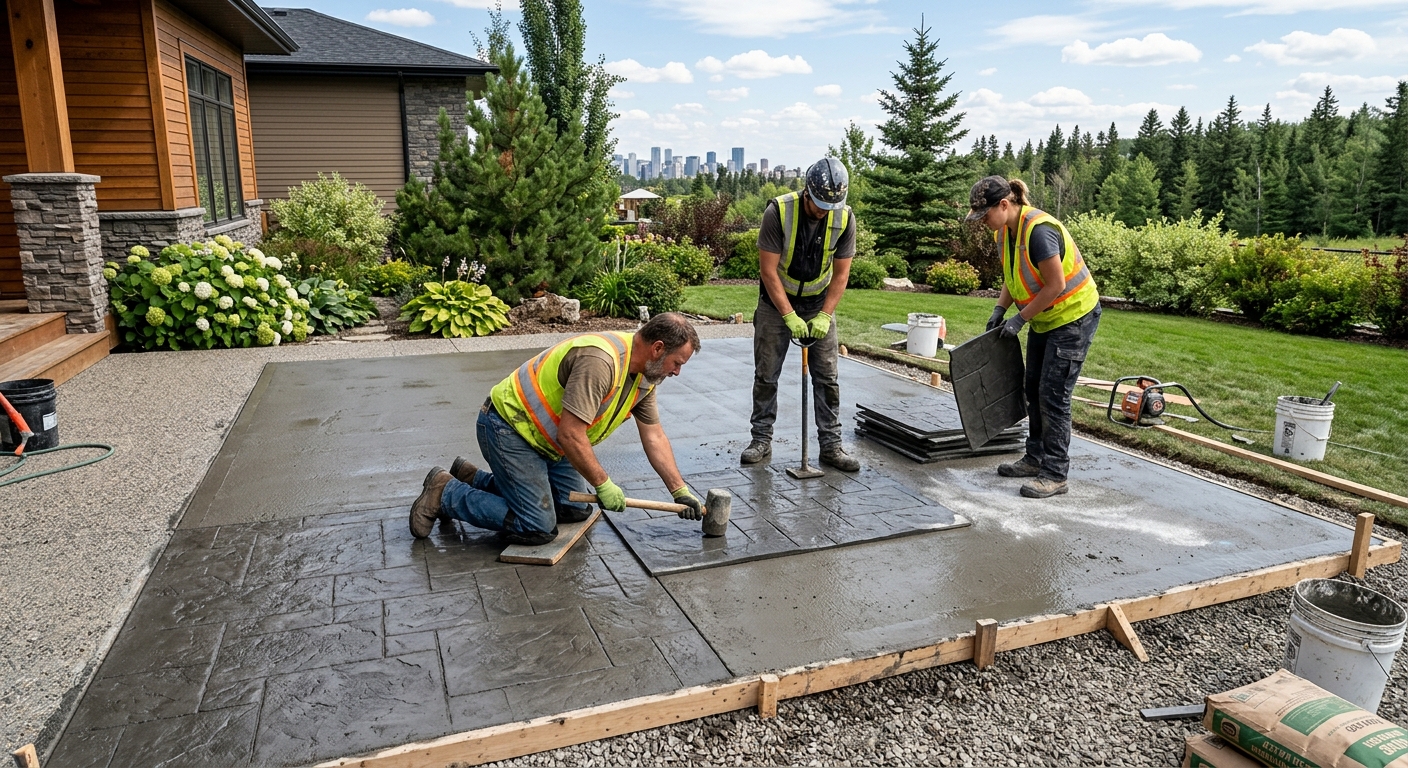
Concrete work options and costs in Princeton
In Princeton, BC, homeowners typically choose concrete for durable flatwork—especially because the town’s housing stock is dominated by single-detached homes (66.2% of dwellings), and many of those properties were built before 1981 (66.2%), meaning driveways, porches, and entrance walks often need replacement sooner than newer builds. With about 74.5% of households owning their homes, there’s steady demand for upgrades that “look good for years,” not just months.
In the Thompson–Okanagan, pricing is shaped by frost depth and freeze–thaw cycles. Local practice assumes frost in the 45–60 cm range for many exterior elements, so concrete flatwork and any below-grade work must be supported on well-compacted granular base and, for structural elements, placed below frost. Frequent temperature swings increase the risk of heaving and surface scaling if the mix, drainage, and jointing aren’t done right—so contractors allocate more labour time for excavation, base prep, and control joints. The colder interior pockets also shorten the practical pour season, which can raise scheduling and labour costs in shoulder months.
Concrete crews are especially busy around the downtown and older residential stretches where accessibility work and driveway replacements are common (for example, properties along Highway 3/near the commercial core). When you’re comparing options, the biggest jump in price usually comes from finish and prep intensity—plain broom-finish work is straightforward, while stamped and exposed aggregate require extra forms, finishing labour, and careful timing to avoid defects. Use the ranges below as a realistic starting point for your scope, then we’ll break down what drives differences between quotes.
| Application |
Typical Size |
Key Spec |
Finish Option |
Price Range |
| Concrete driveway (standard broom finish) |
400–600 sq. ft. |
4" slab, compacted granular base, control joints |
Broom-finish, saw-cut joints |
$6,500–$14,800 |
| Exposed aggregate driveway |
400–600 sq. ft. |
Air-entrained mix, proper curing, base prep |
Washed/exposed aggregate finish |
$9,500–$18,800 |
| Stamped concrete driveway or patio |
300–500 sq. ft. |
Reinforcement as needed, controlled curing timeline |
Stamped patterns (mimic stone/brick) |
$10,000–$21,500 |
| Plain concrete patio or walkway |
200–400 sq. ft. |
4" slab, compacted base, joints at transitions |
Float-and-broom (light texture) |
$2,900–$9,600 |
| Garage floor (interior slab) |
500–700 sq. ft. |
Vapour barrier (when required), reinforcement, proper base |
Broom finish or power trowel (scope dependent) |
$7,800–$18,000 |
| Foundation footings (structural, below frost) |
Varies by plan |
Excavation, forming, reinforcement, concrete below frost |
Structural concrete (not decorative) |
$18,000–$35,000 |
Prices are estimates only and vary by project scope, site access and material selection.
What affects the price of concrete work in Princeton
In the Thompson–Okanagan around Princeton, it’s common to see quotes for the “same” concrete project vary by 30–50% once you account for frost-appropriate specifications, base preparation, and finishing complexity. Compared with warmer parts of BC (or generic online pricing that assumes minimal excavation and minimal cold-weather protection), local crews price for the reality of freeze–thaw cycles: footings must extend below the design frost depth, exterior slabs need air‑entrained concrete, and the timeline needs to respect curing conditions. When shoulder-season temperatures drop, heating or insulating blankets (and added planning to avoid premature freezing) can add real cost—often more than homeowners expect.
Concrete failure is usually tied to two things: water movement and inadequate durability. In Princeton, drainage and granular base compaction are critical because freeze–thaw repeatedly stresses the slab surface and edges. De-icing salt also accelerates spalling on poorly sealed or non-durable mixes, which is why sealing is commonly recommended; it’s a smaller line item than repeating a driveway.
Local examples that change your price: (1) replacing an older driveway that has poor subgrade often forces deeper excavation to reach a stable granular layer, which can move a basic broom-finish job toward the higher end of the $18–$28 per sq. ft. driveway band; (2) upgrading from plain patio work into stamped concrete typically pushes you into the stamped/decorative band (around $24–$38 per sq. ft. for decorative work), because labour is higher and the pour must be timed precisely for consistent texture; and (3) adding reinforcement or thicker slabs for heavy use can add materials and labour even if the surface area is unchanged.
Because many homes are older (66.2% built before 1981), existing drainage paths and settlement issues are more common—those site corrections can be the difference between a straightforward replacement and a “must-do” prep scope. The result is that your final cost is strongly tied to how your contractor accounts for frost depth, air-entrainment, curing, and jointing—not just the volume of concrete.
| Price Factor |
Why It Matters |
Cost Impact |
| Frost line depth — determines footing depth and form height |
Exterior elements must sit below frost to prevent heaving/cracking |
Higher excavation and forming; can significantly raise structural work costs |
| Site preparation — excavation, grading, compacted granular base |
Wrong subgrade leads to settlement and early surface failure |
More labour and granular supply; pushes pricing toward higher driveway ranges |
| Reinforcement — rebar or wire mesh requirement |
Controls cracking and improves slab performance for heavier loading |
Extra materials and tying/batching time |
| Mix design — air-entrainment and compressive strength spec |
Freeze–thaw durability depends on correct air content and strength |
Often modest per-yard cost but critical; protects long-term value |
| Finish type — broom vs. stamped vs. exposed aggregate |
Decorative finishes require more steps and skilled labour |
Can move a project from plain ($14–$24 patio band) into stamped ($24–$38) tier |
| Pour size and concrete truck access to site |
Access limits can require line pumping/extra handling |
Delays and labour additions; increases cost variability between contractors |
| Cold-weather curing precautions — heating and blankets |
Ensures strength gain and prevents early freezing damage |
Heating time, blankets, and added supervision during critical days |
| Control joint pattern and sealing cost |
Joints manage shrinkage; sealing reduces salt-driven surface breakdown |
Added labour and sealant materials; improves durability |
Permits & regulations in British Columbia
In British Columbia, structural concrete work usually requires a building permit, especially where it forms part of the foundation system—think footings, foundation walls, and grade beams. Many of these projects also involve engineered drawings reviewed through the municipal process before the first excavation. For concrete flatwork (patios, walkways, and driveways), permits are often not required unless your project affects lot grading, drainage, or impervious surface limits, or it involves work near municipal right-of-way areas.
Because rules can vary based on how your property is serviced and how much grading is being altered, the safest approach for a homeowner in Princeton is to confirm with the local authority before breaking ground. Regardless of permit needs, insist on documentation: ask your contractor for current liability insurance and proof they have WSIB/WCB coverage where applicable for their workers. For larger residential projects, also request references on similar-scale work in the Thompson–Okanagan.
To verify compliance step-by-step:
- Start with the BC online registry (search the contractor name) to confirm the company is properly registered/licensed for the work type.
- Ask for a Certificate of Insurance and confirm coverage is active, with the correct company listed.
- Ask for proof of WSIB/WCB coverage (or applicable coverage documentation) for their personnel.
- Request their reference list and photos for foundation/flatwork similar to your scope (age of home and freeze–thaw region matters).
- Match the paperwork to the quote scope—if the quote is missing items like disposal or base prep, you’ll often see compliance gaps later.
Getting concrete right in Princeton's freeze-thaw climate
Concrete can fail in Princeton’s Thompson–Okanagan climate when water gets into the slab system and repeatedly freezes and thaws. The most common issues we see are scaling (surface deterioration), spalling near edges, and random cracking from shrinkage and movement that wasn’t properly planned. To spec the job correctly, you need to control the slab “system,” not just the concrete.
First, base preparation: excavate to the correct depth for a stable, well-compacted granular sub-base suitable for local soils and frost conditions. Second, mix design: for exterior flatwork, require air-entrainment (typically 5–7% air content) and a minimum 32 MPa compressive strength so the concrete survives freeze–thaw cycles. Third, control joints: plan saw-cut joints to limit random cracking, especially for driveways and wider patios. Fourth, curing: plan for a minimum 7-day curing period under proper conditions; in cool weather you may need insulating blankets or other cold-weather measures so strength gain isn’t interrupted. Fifth, sealing: apply a penetrating sealer after the concrete is fully cured (commonly around 28 days post-pour) to reduce moisture and help protect against de-icing salt damage.
If you’re deciding between options, the extra cost is often justified. For example, moving from broom-finish to stamped concrete can add roughly $24–$38 per sq. ft. for decorative work in this tier; that premium is worth it when the contractor also budgets the time for correct curing and consistent workmanship—otherwise you pay for the look without getting the performance. For plain patios and walkways, the $14–$24 band works well when base prep and joints are done properly.
Ask technical questions early—especially about air-entrainment and curing—because inadequate air-entrainment is a direct route to spalling in our interior freeze–thaw swings.
| Spec |
Why It Matters in Princeton |
What to Ask For |
Impact if Skipped |
| Compacted granular base (depth?) |
Prevents settlement and reduces water retention beneath the slab during freeze–thaw |
Granular depth and compaction method for your site |
Uneven settlement, cracking, premature surface failure |
| Air-entrained concrete mix (target air %?) |
Air voids allow freeze–thaw expansion without damaging the paste |
Confirm 5–7% air content for exterior flatwork |
Scaling and spalling, especially where de-icing salt hits |
| Compressive strength (MPa rating) |
Supports long-term durability in cold interior conditions |
Minimum 32 MPa specified for the pour |
Slower strength gain and weaker long-term performance |
| Control joints (spacing per ACI guidelines) |
Controls where shrinkage cracks will occur |
Joint spacing plan and sealant-ready joint detailing |
Random cracking across visible surfaces |
| Minimum 7-day curing period |
Ensures strength development before exposure to freeze cycles |
Curing plan for your pour date and temperature forecast |
Reduced strength, surface damage, durability issues |
| Penetrating sealer (when applied after cure) |
Repels moisture and helps protect against salt-driven deterioration |
Application schedule (commonly about 28 days post-pour) and product type |
Faster water ingress and accelerated scaling/spalling |
How to choose a concrete work contractor in Princeton
Choosing a contractor in Princeton comes down to proof and process. Start by verifying British Columbia licensing/registration for the scope they’re proposing, then confirm they carry liability insurance. Ask directly for their Certificate of Insurance and ensure it’s current and lists the correct legal company name. For workers on the job, request proof of WSIB/WCB coverage (or applicable coverage documentation) so you’re not taking on liability for labour-related incidents.
Next, get 2–3 itemised written quotes—not a single “lump sum” without breakdowns. A proper quote should separate labour, concrete volume, forms, excavation, granular base, reinforcement, finishing (broom vs stamped), and curing/protection measures if temperatures are expected to drop. Confirm what’s excluded: disposal of old concrete, removal of existing landscaping, whether saw-cut joints and sealing are included, and whether a permit pull is part of the scope for any structural portion.
Warranty matters. Look for a clear workmanship warranty period (and what it covers), plus any product/manufacturer warranty for sealers or admixtures where applicable. Ask whether warranties are transferable if you sell the home. For payment, don’t accept large upfront cheques—aim for no more than 10–15% upfront, then hold back until the job is complete and deficiencies are corrected. Finally, insist on a start date and a completion estimate in writing, including weather contingencies. In the Thompson–Okanagan, a contractor’s ability to plan cold-weather curing often distinguishes a durable slab from a “looks good today” pour.
- Valid BC registration/license for the type of concrete work proposed
- Certificate of liability insurance (active coverage, correct company name)
- Proof of WSIB/WCB coverage for workers
- 2–3 itemised quotes with line-by-line breakdowns (labour/materials)
- Written scope includes excavation, base preparation, and disposal (or explicitly excludes)
- Spec includes air-entrainment and minimum strength for exterior work
- Control joint plan and whether joints are sealed (and what product)
- Finishing method is clearly stated (broom finish vs stamped vs exposed aggregate)
- Cold-weather curing plan if temps could drop during the pour window
- Clear reinforcement details (where mesh/rebar is included)
- Workmanship warranty length and what qualifies as a deficiency
- Realistic schedule with weather contingencies and curing/protection steps
Concrete contractor red flags in Princeton: vague quotes with no spec for air-entrainment or curing, refusal to provide insurance/coverage documents, missing base-prep and excavation details, pressure for large upfront payments, and “we’ll seal it later” statements with no written schedule or product specified.
Frequently asked questions — concrete work in Princeton
Why does concrete crack in Princeton and how is it prevented?
Concrete commonly cracks because it shrinks as it cures and because it must handle movement from frost and thaw. In Princeton and the Thompson–Okanagan, freeze–thaw cycles add extra stress at edges and joints, especially if water sits beneath the slab or if the mix isn’t built for durability. Prevention starts with correct base preparation (well-compacted granular), planning for joints, and using air‑entrained concrete for exterior work. Control joints help “direct” shrinkage cracking to predictable lines. Also confirm a minimum 7-day curing period before the slab is fully exposed to cold swings. If de-icing salt is used, sealing after cure (around 28 days) helps reduce moisture ingress and surface breakdown, which indirectly lowers the chance of wider deterioration.
Stamped vs broom-finish concrete — cost difference?
In Princeton, the difference usually comes from labour and process, not just the look. A broom-finish driveway is typically the lowest-cost option and aligns with the local concrete driveway band (about $18–$28 per sq. ft.). Stamped concrete requires additional steps—pattern work, careful finishing timing, and often more attention to curing consistency—so it generally falls into the stamped/decorative pricing tier (roughly $24–$38 per sq. ft.). The upgrade can be worth it when the contractor also specs the same performance essentials: air‑entrainment, correct base depth, and a control joint pattern designed for freeze–thaw. If the contractor cuts corners on those, stamped concrete can fail just like broom-finish does, only with a higher replacement cost.
When is the best time to pour concrete in Princeton?
For Princeton and interior BC, the best timing is when temperatures will stay within a workable range for at least several days and when you can protect curing concrete from freezing and rapid drying. Practically, many homeowners get the smoothest results in spring through early fall, but shoulder-season pours can still work if the contractor has a cold-weather curing plan (insulating blankets and/or heating where needed). The reason is simple: in freeze–thaw climates, early freezing can disrupt strength gain, and rapid drying can cause surface issues. Ask your contractor to base the schedule on the forecast and to describe the exact curing/protection measures they’ll use if nighttime temperatures drop.
How long does concrete take to cure?
Concrete curing is often misunderstood. For most structural and flatwork projects, contractors use a minimum curing period of about 7 days before you consider the slab “hardened enough” for many typical uses, but full durability development takes longer. That’s why we still recommend waiting about 28 days before applying penetrating sealer for exterior slabs—this timing helps ensure the concrete is properly cured and ready to accept and benefit from the sealant. In British Columbia’s Thompson–Okanagan winter swings, curing conditions matter as much as the calendar. If there’s risk of freezing early on, additional curing protection is crucial. A reputable Princeton contractor should describe both the minimum 7-day curing plan and how they’ll protect the slab through cold nights.
Do I need a permit for concrete work in British Columbia?
Often, simple concrete flatwork like patios, walkways, and driveways does not require a building permit in British Columbia unless it affects grading/drainage, impervious surface limits, or work within municipal right-of-way areas. Structural concrete work—such as footings, foundation walls, and grade beams—usually requires a building permit and often engineered drawings reviewed by the municipality. Because your exact scope (especially removal/replacement and any regrading) changes the answer, confirm with the local authority before excavation. No matter the permit outcome, make sure your contractor provides liability insurance and coverage documentation for their workers, and ask for references on similar work in Princeton or the surrounding interior region.
Concrete vs pavers for a patio in Princeton?
Both options can work in Princeton, but the decision should consider maintenance and freeze–thaw performance. Pavers can look excellent and may be easier to replace in small sections, but they rely on a well-drained base and good edge restraint to prevent shifting. Concrete patios—when built with air‑entrained mix (as needed), correct base preparation, and a planned joint pattern—typically perform well through freeze–thaw when sealed. Cost-wise, plain concrete patio/work often sits around the $14–$24 per sq. ft. band for this tier, while stamped concrete usually lands higher (about $24–$38 per sq. ft.). If you use de-icing salts, a sealed concrete surface generally holds up better against salt-driven deterioration than unsealed joints and edges.