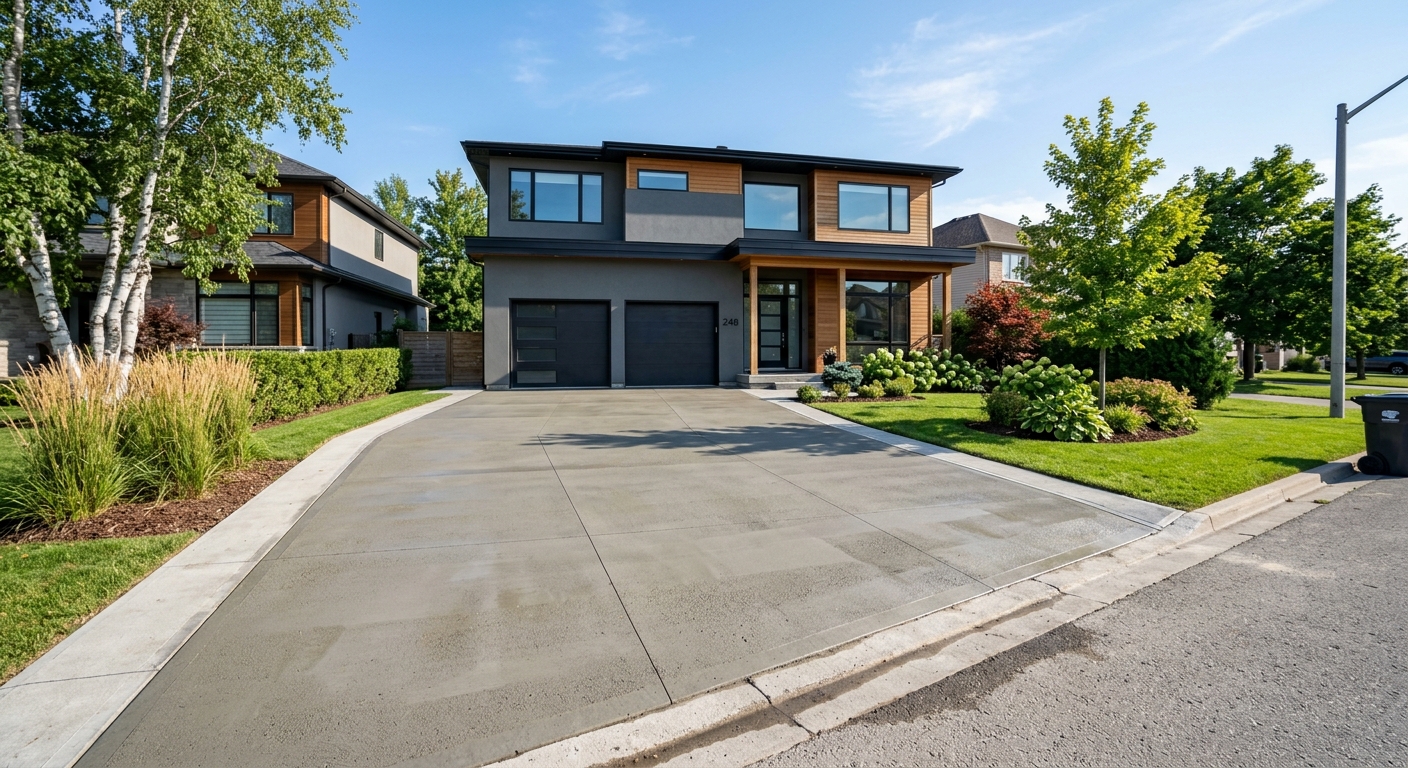
Concrete work options and costs in Nelson
In Nelson, British Columbia, concrete flatwork is one of the most practical upgrades homeowners make—especially in neighbourhoods like South Nelson where older housing stock and sloped lots mean we’re often dealing with drainage, grading, and freeze–thaw movement. With the Kootenays profile showing 3,125 homeowner households (63.1% of households own) and 50.6% of dwellings are single-detached, driveways, patios, walkways, and garage slabs are the bread-and-butter projects that keep local crews busy.
What you pay in Nelson isn’t just about “concrete.” In the Kootenay region, cold continental winters and frequent micro-climate differences (valley moisture near the lake versus higher, drier areas) drive up the technical requirements. Frost pushes footing bottoms below grade, and the freeze–thaw cycle demands air-entrained mixes and tighter control-joint planning to reduce random cracking. Also, the pour season is shorter than in milder parts of BC—so contractors often schedule earlier, add winter protection (curing blankets/heated enclosures), and coordinate truck access to avoid delays.
As a result, two quotes for the same driveway can legitimately differ depending on base excavation depth, rebar layout, and whether the finish plan accounts for de-icing salt. If your home is in an area with a lot of pre-1981 construction (68.4% of homes built before 1981), you may also see higher costs for regrading, tie-ins, and repairing legacy drainage before we pour. With that in mind, below is a practical price comparison to help you budget before you request itemised quotes.
| Application |
Typical Size |
Key Spec |
Finish Option |
Price Range |
| Concrete driveway (standard broom finish) |
16 ft × 24 ft (384 sq. ft.) |
4 in slab, air-entrained, compacted base |
Broom finish + standard jointing |
$6,900 – $10,700 |
| Exposed aggregate driveway |
16 ft × 24 ft (384 sq. ft.) |
4 in slab, air-entrained, controlled wash |
Exposed aggregate texture + joints |
$8,400 – $13,200 |
| Stamped concrete driveway or patio |
12 ft × 20 ft (240 sq. ft.) |
4 in slab, air-entrained, release + colour |
Stamped pattern + integral colour |
$6,000 – $9,600 |
| Plain concrete patio or walkway |
10 ft × 14 ft (140 sq. ft.) |
4 in slab, compacted base, air-entrained |
Float + light broom + joints |
$2,400 – $4,100 |
| Garage floor (interior slab) |
20 ft × 22 ft (440 sq. ft.) |
4–5 in slab, interior curing control |
Broom finish |
$7,400 – $12,500 |
| Foundation footings (structural, below frost) |
Per linear foot (project-dependent) |
Below frost depth, formwork + rebar |
Structural concrete |
$70 – $120 |
Prices are estimates only and vary by project scope, site access and material selection.
What affects the price of concrete work in Nelson
In Nelson, two contractors can price the “same” concrete project differently—often by 30–50%—because the real work is in the build-up: excavation, compacted base, reinforcement, mix design, jointing, and curing. In Kootenay communities like Nelson, Trail, and Castlegar, the winter climate forces stricter specs and more job management than you’d see in milder parts of BC, so small changes in scope can move the total cost fast.
First, frost line depth and freeze–thaw cycles dictate every decision. Footings must extend below design frost depth to prevent frost heave and helical movement. For exterior slabs (driveways, patios, walks), we typically use air-entrained concrete so the freeze–thaw cycle doesn’t crack and scale the surface over time. Second, Nelson’s colder winter schedule means a shorter practical pour season. When temperatures drop, contractors may add winter protection—curing blankets, insulation boards, or heated enclosures—so the mix reaches strength reliably, which can increase labour and fuel costs. Third, de-icing salt accelerates surface spalling when concrete isn’t properly air-entrained or sealed; that’s why sealing and correct finishing are part of a durable spec.
In practice, these factors show up in line items. For example, a broom-finished driveway might align with the $18–$28 per sq. ft. band, while upgrading to stamped concrete can move toward the $25–$40 per sq. ft. range because of colour materials, labour intensity, and careful finishing. Also, if your home has pre-1981 elements (68.4% of homes built before 1981), expect additional grading and drainage work—often the difference between a straightforward pour and a more expensive prep scope.
| Price Factor |
Why It Matters |
Cost Impact |
| Frost line depth — determines footing depth and form height |
Footings below frost reduce heave and long-term cracking risk |
Higher excavation and formwork can add material + labour |
| Site preparation — excavation, grading, compacted granular base |
Correct base thickness and drainage prevent settlement and pumping |
Extra digging/hauling and compacted granular supply increase cost |
| Reinforcement — rebar or wire mesh requirement |
Controls crack width and improves slab performance |
Rebar grid, chairs, and tie-in labour add to the quote |
| Mix design — air-entrainment and compressive strength spec |
Protects against freeze–thaw damage and scaling |
Air-entrained material and tested batching can raise per-cubic-yard cost |
| Finish type — broom vs. stamped vs. exposed aggregate |
Finish complexity affects labour time and curing/processing steps |
Stamped and exposed work typically costs more than plain broom finish |
| Pour size and concrete truck access to site |
Access limits can change crew size, placement method, and time |
Long wheelbarrow runs or crane/rigging increases labour and equipment |
| Cold-weather curing precautions — heating and blankets |
Ensures strength gain and reduces cold-joint issues |
Heating time, blankets, and protection supplies add cost |
| Control joint pattern and sealing cost |
Joints manage shrinkage cracking; sealing helps resist salt scaling |
More joints, saw-cut timing, and sealer add line-item expense |
Permits & regulations in British Columbia
In British Columbia, structural concrete work is typically handled as part of a permitted structural scope. That means projects like foundation footings, foundation walls, and grade beams require a building permit, and often require engineered drawings that the municipality reviews. For concrete flatwork—driveways, patios, and walkways—a permit usually is not required by default, but it can become necessary if the work changes lot grading, impacts stormwater drainage, or affects impervious surface coverage or right-of-way boundaries. Before you break ground in Nelson, confirm with the local authority so you don’t get hit with redesign or rework.
For contractor verification in BC, do it step-by-step. Start by asking the contractor for their certificate of insurance (liability coverage) and proof they have coverage for their workers through the provincial system. Then verify the contractor’s status/credentials using the appropriate online contractor registry information (you can usually locate this through the BC government lookup tools or contractor association listings). Request a clearance letter or current proof of coverage where applicable, and keep copies. Finally, ask for references on similar Nelson-area scopes—especially projects involving freeze–thaw exposure—so you know they’ve planned for air-entrainment, curing, and jointing.
Getting concrete right in Nelson's freeze-thaw climate
Concrete fails in Nelson mainly because of water movement and freeze–thaw expansion. When bases are under-compacted, drainage is poor, or the mix isn’t designed for cold exposure, you can see settlement, “random” cracking, and surface scaling—especially along edges where meltwater and de-icing salt concentrate. The fix is to spec the job correctly from the ground up, not just “pour and hope.”
(1) Base preparation: Nelson soils and frost conditions require a compacted granular sub-base to the proper depth and grade line. We over-excavate as needed, install granular base, and compact in lifts to reduce voids that later collect water. (2) Mix design: for exterior flatwork, use air-entrainment (typically 5–7% air content) and meet minimum strength targets (commonly 32 MPa for many exterior flatwork specs). (3) Control joints: plan joint spacing to minimize random cracking; joints give shrinkage a place to go. (4) Curing: in cold weather, “setting” isn’t enough—concrete needs time under protection. A minimum 7-day curing under proper conditions is critical, and colder pours often require blankets or heated enclosures. (5) Sealing: apply penetrating sealer after full cure—often at 28 days—to help repel de-icing salts.
If you’re choosing between finishes, compare price to durability and maintenance. For instance, a broom-finished driveway might land near the $18–$28 per sq. ft. band, while stamped concrete can move toward $25–$40 per sq. ft. The extra cost is justified when the contractor matches it with the right air-entrained mix, joint pattern, and curing plan—otherwise the appearance won’t last through Nelson winters.
| Spec |
Why It Matters in Nelson |
What to Ask For |
Impact if Skipped |
| Compacted granular base (depth?) |
Limits settlement and water retention before freeze–thaw cycles |
Confirm excavation depth, granular thickness, and compaction method |
Settlement, rocking edges, and accelerated cracking |
| Air-entrained concrete mix (target air %?) |
Protects surface from scaling and freeze–thaw damage |
Ask for air content target typically 5–7% for exterior flatwork |
Spalling and surface breakdown in winter |
| Compressive strength (MPa rating) |
Ensures strength gain so it can resist loading and weathering |
Confirm minimum 32 MPa (or project-engineered rating) |
Premature wear and cracking under traffic |
| Control joints (spacing per ACI guidelines) |
Controls shrinkage cracking under cold contraction |
Ask for joint spacing plan and whether saw-cut timing is specified |
Random cracks that can open and admit water |
| Minimum 7-day curing period |
Cold weather slows strength gain and increases risk if unprotected |
Ask how they protect concrete during cold snaps (blankets/heating) |
Weak surface, cold joints, and reduced durability |
| Penetrating sealer (when applied after cure) |
Reduces salt penetration and surface scaling risk |
Confirm sealer type and that it’s applied after full cure (often 28 days) |
More aggressive surface wear from de-icing salts |
How to choose a concrete work contractor in Nelson
When you’re hiring a concrete contractor in Nelson, your first job is to confirm they can legally and reliably work in British Columbia. Ask for their liability insurance certificate and proof they carry the required worker coverage (WSBC/WCB coverage). In practice, you’ll want to see a current COI (certificate of insurance) with your project listed as an additional insured where applicable, or at minimum the coverage active for the contract term. For contractor credentials, verify through BC’s online registry lookup (and any applicable professional/industry listings) and request a current clearance letter or coverage proof. Don’t accept “we’re good” answers—request documents.
Next, get 2–3 itemised written quotes that break labour and materials into clear line items (excavation, formwork, base material, rebar, concrete supply, finishing, joints, sealing, waste/disposal, and protection for cold weather). Avoid lump-sum quotes that don’t state what’s included. Carefully check: is permit pulling included if needed for the scope? Is disposal included for excavated material? Who handles saw-cutting for joints? What’s the timeline for curing protection in cold conditions?
Good contractors provide a sensible payment schedule: typically no more than 10–15% upfront, then progress payments tied to milestones, with a holdback until completion and cleanup. Get a start date and completion estimate in writing, and ask about warranty length for workmanship and whether any product warranty is transferable.
- Request insurance and worker coverage proof before signing.
- Confirm they’ve worked on Nelson-area freeze–thaw projects (references).
- Ask for a written spec: air-entrainment, strength target, joint plan, curing method.
- Insist on itemised quotes (no vague “concrete supply included” lines).
- Verify what’s included for excavation, granular base, and compaction.
- Confirm reinforcement details (rebar grid size, spacing, chairs for correct cover).
- Ask how they handle cold weather: blankets/heating and minimum curing time.
- Clarify access: where the truck can park and how they’ll place concrete.
- Confirm joint pattern and whether joints are saw-cut at the right time.
- Ask about sealing: product type and exact timing after cure.
- Review warranty terms in writing (workmanship duration and conditions).
- Keep a holdback until sealing, joint cleanup, and final grade acceptance.
Concrete red flags I see in Nelson include: quotes that skip the base thickness/compaction details, contractors who can’t explain air-entrainment and joint spacing, “lowest bid” proposals that exclude disposal or winter protection, and timelines that ignore curing—especially when pours happen near freezing or during wet valley conditions.
Frequently asked questions — concrete work in Nelson
How long does a concrete project take in Nelson?
Typical concrete flatwork in Nelson (driveways, patios, and walkways) is often a fast “build day,” but it’s not a fast “completion” timeline. The pour itself is usually one day, however the job sequence includes layout, excavation, compacted granular base, forming, rebar/wire setup (if required), finishing, and then protecting the slab. After the pour, curing and protection matter—especially in cold snaps common to the Kootenays—so contractors usually plan for at least a week of proper curing before heavy use. Full durability improvements continue beyond that, and sealer (if included) is usually applied after full cure, commonly around 28 days. In short, plan for several days to a couple of weeks depending on weather, curing approach, and whether sealing or stamped finishing is part of the scope. (Statistics Canada, 2021 Census)
What is a concrete overlay and is it suited to Nelson?
A concrete overlay is a new layer of material installed over an existing slab to refresh appearance and level uneven areas. In Nelson, overlays can work when the original concrete is well-bonded, structurally sound, and properly prepared—because freeze–thaw exposure will quickly reveal weak adhesion or trapped moisture. The big risks are water movement through cracks, poor surface profiling, and lack of drainage. If the existing slab has extensive cracking, spalling, or ongoing settlement, an overlay may not last as long as replacing the slab or repairing the base. When overlays are appropriate, they can be a cost-effective option versus full replacement, but your contractor should do concrete condition testing (surface integrity and moisture considerations) and explain the prep method. For budgeting, many homeowners who want a “refresh” still end up pricing near the standard driveway band when full prep and joint work are required—so ask for itemised prep and bonding steps.
How do I seal concrete to protect it in Nelson?
Sealing concrete in Nelson is mainly about protecting against water and contaminants—particularly de-icing salt in winter. The key is timing: sealing should be done after the concrete has fully cured (often around 28 days for many sealers) so the surface is ready to accept the product. Ask your contractor for a penetrating sealer (commonly preferred for exterior slabs) rather than a film-forming coating, and confirm the expected coverage and application conditions (temperature and dryness). Before sealing, the slab should be cleaned of dust and any curing residues, and joints/edges should be maintained so water doesn’t channel into cracks. Sealer helps slow salt and moisture penetration, which reduces the chance of scaling and surface spalling during repeated freeze–thaw cycles. If your quote is only for concrete and doesn’t include sealing, clarify whether it’s optional or excluded—then align it with the durability goal.
What is the difference between concrete and cement?
Concrete is the full building material: a mixture of cement (the binding component), water, sand/aggregate, and air (for air-entrained concrete used outdoors). Cement is only one ingredient—the “glue” that hydrates and helps the mix harden. In Nelson’s exterior work, the cement alone doesn’t determine freeze–thaw durability; the overall mix design does. That’s why reputable Kootenay contractors specify air-entrainment and strength targets, not just “cement quality.” You’ll also see differences in aggregate gradation, water-cement ratio, and finishing timing—all of which impact cracking risk and surface durability. When you’re comparing quotes, ask for the mix design details: target air content (often 5–7% for exterior flatwork), minimum compressive strength (commonly 32 MPa for many specs), and whether the mix is engineered for cold exposure.
How much does concrete work cost in Nelson?
Concrete costs in Nelson depend heavily on base preparation, reinforcement, finish type, and cold-weather protection. For budgeting, local price bands for the Kootenays commonly run about $18–$28 per sq. ft. for a concrete driveway/slab and $14–$24 per sq. ft. for patios and walkways. Stamped & decorative options typically land higher, around $25–$40 per sq. ft., because of extra labour and finishing steps. For foundations/footings, structural pricing is often quoted per linear foot in the $70–$120 range due to excavation and rebar/formwork below frost. As a practical reference point, a broom-finished 16 ft × 24 ft driveway (384 sq. ft.) can often land roughly in the mid-to-upper driveway band once you include proper compaction, jointing, and site conditions typical of the Nelson area. (Statistics Canada, 2021 Census)
How deep must footings be for Nelson's frost line?
Footing depth in Nelson must be below the local design frost depth to prevent frost heave and cracking. The exact required depth depends on your soil conditions and the specific engineering/design for the foundation, but the principle is consistent: exterior structural concrete (footings, grade beams, and foundation elements) should extend below frost to keep the base from cycling with freezing temperatures. In colder Canadian climates, frost can push footing bottoms well below grade, so excavation and form height become major cost drivers—often a significant part of the $70–$120 per linear foot footing budget. For your project, the safest approach is to follow the engineer’s specification for Nelson, and ensure the contractor verifies excavation depth and documents base conditions before the concrete is placed. If you’re doing flatwork only (driveway/patio), you still need the correct granular base build-up, but the frost-depth requirement specifically drives structural foundation work.