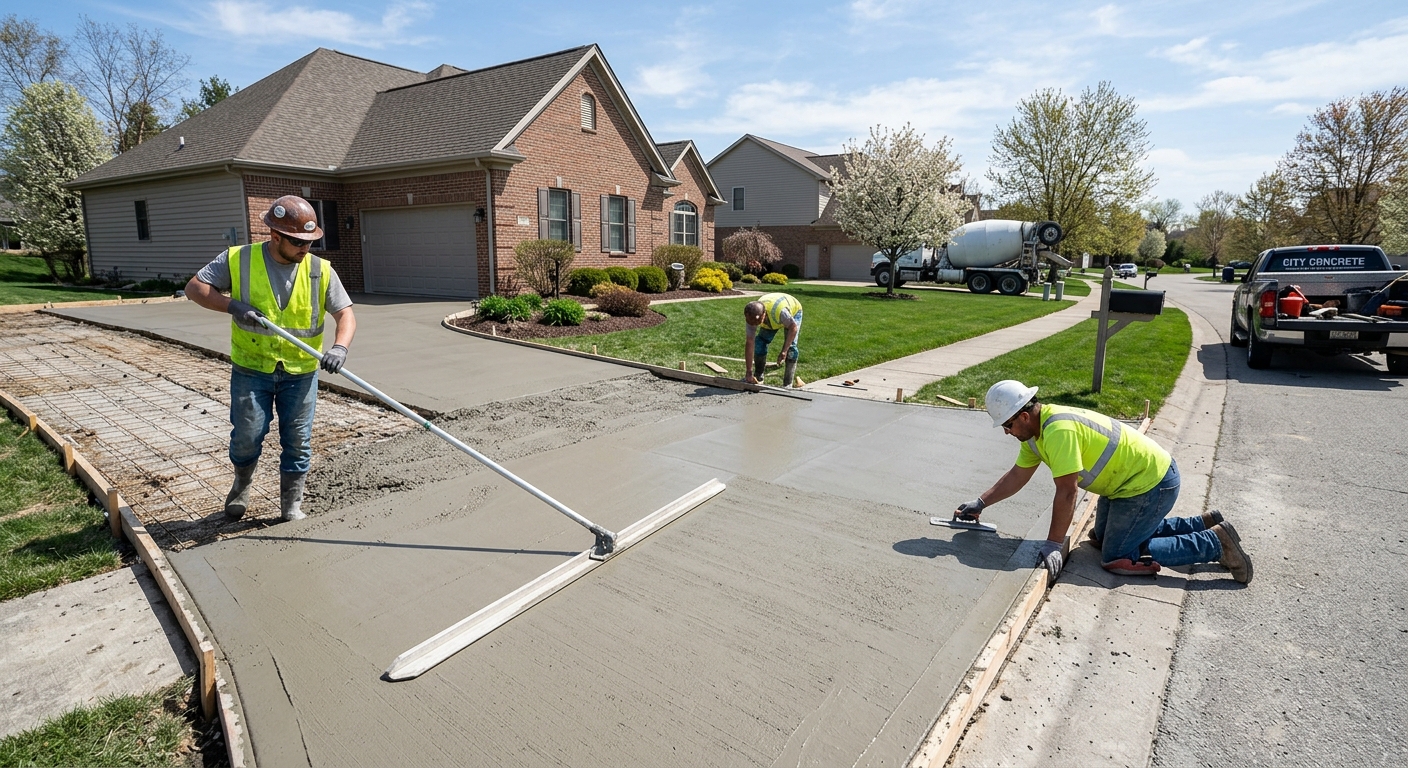
Concrete work options and costs in Harbour Chines
In Harbour Chines, British Columbia, homeowners typically start with three concrete priorities: durable driveways, low-maintenance patios, and solid foundations. With a population of 4,577 (Statistics Canada, 2021 Census), this is a tight-market community where scheduling can matter as much as the mix design. Concrete flatwork is especially common for the neighbourhood’s established housing stock—most owners in the Lower Mainland–Southwest are maintaining existing lots rather than rebuilding from scratch, which keeps demand steady for replacement slabs, re-grades, and fresh approaches.
Pricing here is shaped by our coastal-wet weather and a frost depth that practice commonly assumes around 450 mm / 18" for exterior work. Even though coastal BC is milder than interior regions, freeze–thaw cycles plus heavy rainfall can still drive scaling and cracking when the base prep, drainage, and air-entrainment aren’t right. Contractors in the Vancouver–Surrey–Abbotsford corridor often plan pours around cool nights and prolonged rain, using blankets and extended curing to protect surface strength and long-term durability.
Demand is particularly strong in the Harbour Chines / Three Harbour Connector area, where driveways and pathways see frequent vehicle and foot traffic and where drainage issues can show up fast after storms. If you’re comparing options, the good news is that the difference between a standard broom finish and a premium finish (like stamped or exposed aggregate) usually comes down to labour time, surface prep, and material cost. Next, use the table below to compare typical scopes and realistic price ranges for common concrete jobs.
| Application |
Typical Size |
Key Spec |
Finish Option |
Price Range |
| Concrete driveway (standard broom finish) |
400 sq. ft. (approx. 12' x 33') |
Air-entrained exterior mix, compacted granular base |
Broomed, control joints, sealer optional |
$7,200 – $11,200 |
| Exposed aggregate driveway |
400 sq. ft. (approx. 12' x 33') |
Air-entrained mix, wash exposure step |
Exposed stone finish, broom edges |
$9,500 – $14,200 |
| Stamped concrete driveway or patio |
300 sq. ft. (approx. 15' x 20') |
Air-entrained mix, base prep and curing control |
Stamp pattern + color release |
$9,000 – $13,500 |
| Plain concrete patio or walkway |
250 sq. ft. (approx. 10' x 25') |
Exterior slab, compacted base, control joints |
Float trowel + light broom |
$4,000 – $6,500 |
| Garage floor (interior slab) |
500 sq. ft. (approx. 20' x 25') |
Vapour barrier/insulation as needed, proper compaction |
Standard float and trowel |
$9,500 – $14,500 |
| Foundation footings (structural, below frost) |
Typical small foundation: 80–120 linear ft. |
Excavate below design frost, rebar per engineer |
Formed footings, concrete placement |
$16,000 – $33,000 |
Prices are estimates only and vary by project scope, site access and material selection.
What affects the price of concrete work in Harbour Chines
In the Lower Mainland–Southwest, two quotes for the “same” concrete job can easily diverge by 30–50% because the scope is rarely identical. One contractor may be assuming a simple slab over existing grade, while another properly includes drainage, removal of unsuitable soil, compacted granular base at the right thickness, and the correct exterior air-entrained mix. In other parts of BC or for more difficult sites, excavation depth and seasonal work limits can also change labour hours and equipment costs, which then flows through to your per-square-foot pricing for slabs and the “below frost” portions of foundations.
Here’s the technical reason that drives variation: frost depth and freeze–thaw cycles dictate every key spec. In coastal BC, practice often places exterior footings and thickened elements below a shallow design frost range (commonly about 0.5–1.2 m in many coastal settings), but the coastal-wet environment still produces saturated soils and frequent freeze–thaw cycles. That’s why exterior slabs require air-entrained concrete to manage scaling and cracking, plus proper control jointing and sealing plans. When conditions are cool and damp, curing becomes harder; cold-weather precautions—like curing blankets or scheduling for daytime temperature—add direct cost. And because de-icing salt can accelerate surface spalling, sealing and surface protection are more than “nice-to-have” in Harbour Chines.
Concrete examples from Harbour Chines: (1) a driveway replacing compacted fill typically costs more after proper excavation, because the base must be rebuilt before the pour; (2) a stamped job may run higher than a plain patio, but if you’re paying roughly $16–$26 per square foot for a plain patio alternative, the jump to stamped is usually justified by extra formwork labour, stamp placement time, and careful finishing and curing. (3) Foundations that require deeper, narrower excavation below frost can spike cost even if the footprint is small.
| Price Factor |
Why It Matters |
Cost Impact |
| Frost line depth — determines footing depth and form height |
Footings must extend below local design frost to resist frost heave and movement |
Higher excavation and forming cost; can add thousands |
| Site preparation — excavation, grading, compacted granular base |
Base compaction and drainage control determine slab settlement and longevity |
Major swing factor on uneven, soft, or poorly drained sites |
| Reinforcement — rebar or wire mesh requirement |
Controls cracking and improves performance under loads |
Labour + steel cost; increases with thicker slabs and rebar cages |
| Mix design — air-entrainment and compressive strength spec |
Exterior air content and strength protect against freeze–thaw and scaling |
Premium materials and quality control; prevents costly failures |
| Finish type — broom vs. stamped vs. exposed aggregate |
Finish requirements change labour time and workmanship |
Stamped/exposed typically add cost for materials and skilled finishing |
| Pour size and concrete truck access to site |
Access affects pumping, labour, and time-on-site for the crew |
Hard access can raise labour and equipment rental fees |
| Cold-weather curing precautions — heating and blankets |
Protects early strength gain in cool, damp periods |
Blankets/heat plans can add meaningful line-item costs |
| Control joint pattern and sealing cost |
Joint spacing limits random cracking; sealing improves surface durability |
Often small cost compared to repairing scaled or spalled surfaces |
Permits & regulations in British Columbia
In British Columbia, the need for permits depends on what concrete work you’re doing and whether it’s structural. Structural concrete work—such as footings, foundation walls, grade beams, and other engineered elements—requires a building permit, and in many cases engineered drawings reviewed by the municipality before construction. Concrete flatwork (driveways, patios, and walkways) often doesn’t require a permit unless it changes lot grading, impacts impervious surface coverage limits, or involves municipal right-of-way/roadside connections. Because Harbour Chines is a coastal, rain-sensitive area where drainage and grades are closely managed, I strongly recommend you confirm the requirement with the local authority before any digging starts.
To verify your contractor in BC, do three checks in order. First, confirm the contractor’s licence status using the online registry available through the province’s contractor licensing tools (look for the correct business category/coverage). Second, ask for a certificate of insurance: you want liability coverage that’s valid for the project dates and includes construction activities. Third, request proof of Workers’ Compensation coverage (WSBC/WCB). You should also ask for a clearance letter or account verification if your contractor uses subcontract crews.
Step-by-step for Harbour Chines homeowners: get the quote in writing, ask whether a permit is required for your specific footing or drainage tie-in, request insurance and coverage documents before you sign, and verify they match the scope and estimated start date. This protects you when weather delays push curing and scheduling windows.
Getting concrete right in Harbour Chines's freeze-thaw climate
Concrete doesn’t fail because of “one bad pour” in Harbour Chines—it fails when the base, mix, joints, and curing aren’t aligned with our wet coastal conditions and freeze–thaw cycles. The two biggest risks are (1) inadequate base preparation and drainage, which leads to settlement and cracking, and (2) spalling from freeze–thaw when the concrete isn’t properly air-entrained. If water gets in and the surface lacks the right pore structure, repeated freezing creates pressure that flakes the surface.
To spec the job correctly, focus on five areas. (1) Base preparation: use compacted granular sub-base to the required depth for your site conditions (especially where soils are saturated after storms). (2) Mix design: for exterior flatwork, request air-entrainment typically in the 5–7% range and a minimum 32 MPa compressive strength. (3) Control joints: place them to control where cracking happens—spacing matters, and the contractor should use a consistent plan rather than “eyeballing” panels. (4) Curing: plan for at least 7 days of curing under proper conditions, which is critical in cool nights and high humidity. (5) Sealing: apply a penetrating sealer after the concrete has cured (often at 28 days) to repel de-icing salts and reduce water ingress.
One practical price example: if your choice is between a plain patio at about $16–$26 per square foot and a stamped patio at about $22–$36 per square foot, the higher cost can be justified when the contractor also upgrades base prep and curing discipline. If they’re skipping base drainage or using the wrong mix, you’ll pay twice—first for the finish, then for remedial work.
| Spec |
Why It Matters in Harbour Chines |
What to Ask For |
Impact if Skipped |
| Compacted granular base (depth?) |
Provides stable support and controls moisture movement under the slab during rain and freeze–thaw |
Granular type and target depth for your soil; compaction testing method |
Settlement, uneven cracking, faster failure around edges and joints |
| Air-entrained concrete mix (target air %?) |
Air void structure reduces damage from repeated freezing and thawing in exterior exposure |
Confirm target air content (commonly 5–7% for exterior flatwork) |
Higher risk of surface scaling and spalling within a few winters |
| Compressive strength (MPa rating) |
Ensures durability and adequate early/long-term strength for loading |
Minimum 32 MPa and curing schedule that supports strength gain |
Surface wear, chipping, and premature deterioration |
| Control joints (spacing per ACI guidelines) |
Limits random cracking and keeps cracks tight so water doesn’t infiltrate |
Joint layout drawings and spacing plan |
Random cracking patterns, wider cracks, and moisture pathways |
| Minimum 7-day curing period |
Cold damp conditions slow strength development; curing protects early performance |
Plan for temperature/blanket measures if pouring in cool weather |
Reduced strength, increased cracking, weaker surface resistance |
| Penetrating sealer (when applied after cure) |
Helps repel de-icing salts and reduces water absorption in our coastal-wet environment |
Penetrating sealer and timing after cure (commonly around 28 days) |
More scaling/spalling risk and faster surface deterioration |
How to choose a concrete work contractor in Harbour Chines
Choosing the right concrete contractor in Harbour Chines is mostly about verification and clarity. In British Columbia, you should confirm licensing status (use the provincial online registry to check the business and registration category), then request proof of liability insurance for the project. Finally, verify WSBC/WCB coverage: ask for documentation that shows the contractor (and any key subcontractors) are covered for workers. This matters because concrete work often involves excavation, forming, and concrete delivery schedules that can’t be safely rushed.
Next, get 2–3 itemised written quotes—don’t accept a single lump sum without line items. You want a breakdown that separates concrete supply, excavation, compacted granular base, reinforcement, formwork, finishing, joints, curing provisions, and sealing. Make sure the scope includes what’s excluded: permit pull (if required), disposal of unsuitable soil, and whether old slab removal is included or priced separately.
Warranty should be in writing with both workmanship coverage and any product/manufacturer warranty terms. Ask whether the warranty is transferable if you sell your home. For payment, a safe approach is to keep upfront payment to 10–15% and use holdback until completion and final cleanup/finishing checks are done. Timelines should include a start date and completion estimate, plus how delays from rain or cool night temperatures are handled.
- Provide licence number and project-appropriate contractor category
- Include current liability insurance certificate with coverage limits
- Confirm WSBC/WCB coverage for workers and list any subcontractors
- Submit 2–3 itemised quotes (not lump-sum only)
- Show excavation and base prep depth as a line item
- Specify concrete mix design: air-entrainment target and 32 MPa minimum
- Include reinforcement details (rebar size/spacing or mesh specification)
- Provide control joint spacing plan and finish method
- State curing plan (blankets/curing time) for cool damp periods
- Clarify sealing scope and timing (often around 28 days)
- Confirm disposal, hauling, and site protection (silt fencing/mats) are included
- Use a payment schedule with no more than 10–15% upfront and a completion holdback
Concrete red flags in Harbour Chines: refusing to disclose mix design or air content, “skipping” proper base drainage under the slab, offering a price that ignores excavation depth and reinforcement, starting work without clear joint layout or curing plans for cool, rainy weather, and asking for large deposits before any protective site prep or engineered/structural requirements are confirmed.
Frequently asked questions — concrete work in Harbour Chines
How do I maintain concrete in Harbour Chines's freeze-thaw climate?
In Harbour Chines and across coastal BC, maintenance is about keeping water out and limiting salt damage. Start with a good drainage approach: redirect downspouts away from slabs and keep weeping areas and edges clear of debris so meltwater and storm water don’t pool. For winter, use sand rather than heavy chloride salt if possible; de-icing salts can accelerate surface spalling. Inspect control joints after major storms—if you see gaps, have them cleaned and resealed if your contractor recommends joint sealing. If your concrete is exterior and hasn’t been sealed, schedule penetrating sealer after the concrete cures (often around 28 days). Budget-wise, routine sealing is usually far cheaper than resurfacing; for example, a stamped patio can run from about $22–$36 per square foot, so protecting the surface from scaling helps preserve your finish life.
What causes concrete to spall in Harbour Chines winters?
Spalling typically comes from freeze–thaw damage plus water access. In Harbour Chines’ wet coastal conditions, rain saturates exposed surfaces and edges; when nighttime temperatures drop, water in pores and microcracks expands and breaks the surface. The most common technical root cause is inadequate air-entrainment: without the correct air void structure, the concrete can’t safely accommodate freezing stress. Poor base prep and drainage can worsen it by keeping the slab edge saturated longer. Another contributor is weak surface strength from rushing early curing during cool, damp weather. Even if the colour/finish looks good, spalling can show up after a few winters. The remedy is prevention: specify exterior air content (often 5–7%) and minimum 32 MPa strength, plus proper curing and—crucially—penetrating sealer after cure (around 28 days), especially if you use de-icers.
What is rebar and when is it required in British Columbia?
Rebar is reinforcing steel placed inside concrete to help it resist tensile forces that concrete alone isn’t designed to handle. In British Columbia, rebar requirements depend on the structural design—foundation footings, foundation walls, and grade beams are typically engineered and will specify reinforcement size, spacing, cover, and placement. For exterior flatwork like driveways and patios, reinforcement may be used based on thickness, soil conditions, and loading: heavy vehicle traffic, larger slabs, or poor subgrade conditions often lead contractors to add rebar or wire mesh. The key point is that reinforcement isn’t decided by “tradition”; it should follow the engineer’s drawings for structural work or the site and slab design for flatwork. For a practical comparison, structural foundation footings are often priced differently than exterior slabs (foundation work often totals well above standard flatwork), so always confirm the reinforcement spec before signing.
How long does a concrete project take in Harbour Chines?
Timelines in Harbour Chines depend on weather, access, and the curing requirements for your concrete mix and exposure. Most flatwork jobs can be scheduled quickly in good conditions: excavation and base prep may take 1–3 days, with forming and reinforcing on top for larger slabs. The pour itself is usually a single day, but finishing and protection follow immediately. Curing is what governs usable time: while you can walk on many slabs after a short period, crews typically require at least 7 days of curing under proper conditions before heavy loading, and sealing plans often target a 28-day mark for best performance. Cool nights and prolonged rain can extend the schedule because contractors must protect the slab to reach design strength. If you’re deciding between options, stamped concrete and exposed aggregate typically take longer on finishing steps than a plain broom-finished slab, so allow extra time in the booking window.
What is a concrete overlay and is it suited to Harbour Chines?
A concrete overlay is a new concrete layer poured or bonded over an existing slab—often used to resurface worn, stained, or lightly damaged concrete without fully removing it. In Harbour Chines, overlays can be suited in some cases, but they must be assessed carefully because freeze–thaw can keep pushing moisture and cracks through the old slab. If the existing slab has structural movement, wide spalling, or active cracking, an overlay may fail prematurely by reflecting cracks or letting water undermine the bond. A proper assessment should include checking for delamination, voids, and whether drainage issues are resolved. If the existing surface is stable and properly prepared (cleaned, profiled, and bonded with the right system), overlays can be a cost-effective alternative to full replacement. Compare pricing: a plain patio or walkway is commonly around $16–$26 per square foot, while replacements for driveways often start higher; an overlay can reduce excavation costs, but only if the substrate is truly sound.
How do I seal concrete to protect it in Harbour Chines?
Sealing helps protect concrete in Harbour Chines by reducing water absorption and limiting the penetration of de-icing salts that can contribute to scaling and spalling during freeze–thaw cycles. The main rule is timing: most penetrating sealers are applied after the concrete has cured—commonly around 28 days—when the slab has reached appropriate dryness and strength. Before sealing, the surface should be clean and dry; any dust, curing compounds, or oils can prevent good penetration. Choose a penetrating sealer designed for exterior concrete and verify it’s compatible with the finish type (broom, stamped, or exposed aggregate). Apply according to manufacturer instructions (typically multiple coats where specified) and avoid sealing if rain is expected during the curing window. If you’re comparing options, spending on sealing is usually far less than the price gap between a plain exterior slab and premium finishes like stamped concrete (often $22–$36 per square foot), and it supports the service life of whatever finish you choose.