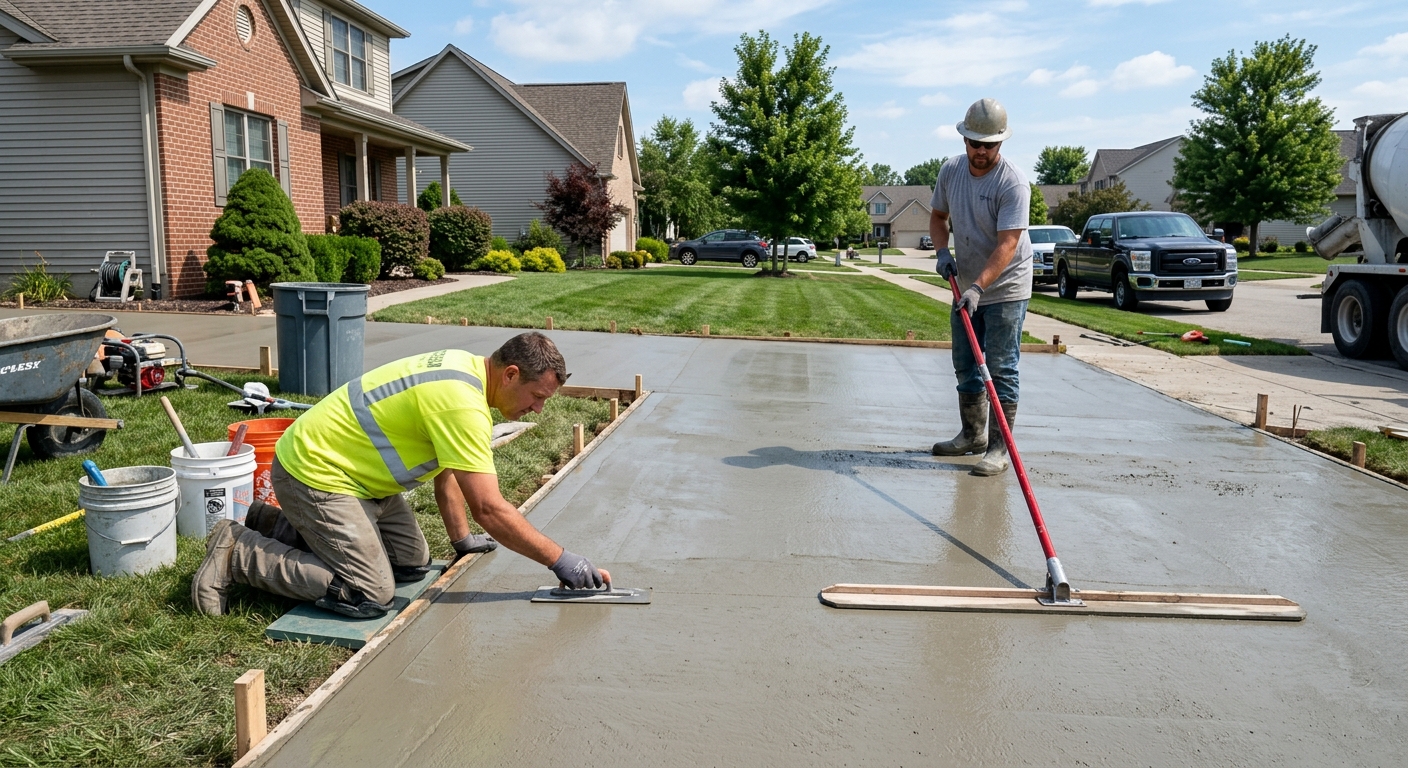
Concrete work options and costs in Sidney
Concrete work in Sidney, British Columbia is mostly about durability—building driveways, patios and walkways that can handle wet winters, coastal moisture, and the freeze–thaw cycles that create surface scaling and cracking if the base and mix aren’t right. In a town where 34.8% of homes are single-detached houses (Statistics Canada, 2021 Census), there’s steady demand for new flatwork and replacement of older slabs as homeowners renovate bathrooms, garages and front entrances in neighbourhoods like North Saanich Road/Beacon Avenue area and the older housing pockets closer to the waterfront. It’s also common to see foundations and site drainage issues corrected during re-slabs and driveway rebuilds because many homes were built before 1981, when modern air-entrainment and tighter control-joint detailing wasn’t always the norm (Statistics Canada, 2021 Census).
On Vancouver Island and the Coast, our pricing is shaped by a relatively shallow frost line and frequent freeze–thaw conditions. Local designs generally assume frost depths in the coastal band (commonly around 18 inches in this climate band), so footings are still set below frost for heave control, and exterior slabs must use air-entrained concrete. Even though our winters are milder than interior BC, contractors still build in weather contingencies for rain windows and cold snaps, plus proper curing protection—because slow strength gain on cool, saturated subgrade can lead to weak, dusty surfaces.
Below are realistic starting points for common Sidney projects, so you can compare like-for-like specs when you request quotes.
| Application |
Typical Size |
Key Spec |
Finish Option |
Price Range |
| Concrete driveway (standard broom finish) |
12 m x 3 m (about 36 m²) with simple borders |
Reinforcement to spec, air-entrained exterior mix, compacted base |
Broom finish with control joints |
$6,000–$9,000 |
| Exposed aggregate driveway |
12 m x 3 m (about 36 m²) |
Air-entrained mix, proper timing for wash/expose, strong base |
Exposed aggregate with seal-ready surface |
$8,000–$11,500 |
| Stamped concrete driveway or patio |
9 m x 4 m (about 36 m²) |
Air-entrained mix, integral colours as specified |
Stamp pattern + release + sealer |
$9,000–$14,000 |
| Plain concrete patio or walkway |
4 m x 5 m (about 20 m²) |
Air-entrained exterior mix, compacted granular base, joints |
Smooth trowel or light broom finish |
$2,800–$4,400 |
| Garage floor (interior slab) |
6 m x 6 m (about 36 m²) |
Vapour barrier (as required), proper base/compaction |
Broom finish (often slip-resistant) |
$4,500–$8,000 |
| Foundation footings (structural, below frost) |
Per typical home footprint; pricing varies with perimeter length |
Excavation + forming, rebar per engineer, below-frost elevation |
Structural concrete placement, engineering drawings |
$10,000–$18,000 |
Prices are estimates only and vary by project scope, site access and material selection.
What affects the price of concrete work in Sidney
In Sidney, two homeowners can receive quotes that look “the same” on paper yet differ by 30–50% because the details that control freeze–thaw durability are either included or excluded. On Vancouver Island and the Coast, contractors also price around schedule risk: rain can delay stripping and finishing, and cold snaps can slow curing on saturated soils. Where labour availability is tight (busy spring/summer windows), mobilisation, crew planning and concrete truck scheduling can add cost too.
The frost line and freeze–thaw cycles dictate nearly every spec. Footings need to sit below the design frost depth to prevent frost heave and differential movement. In coastal BC, that’s often in the 0.5–1.2 m band, but even a small footing elevation change increases excavation and forming. For exterior slabs and flatwork, we use air-entrained concrete so the freeze–thaw cycle doesn’t strip paste and cause spalling. Cold-weather precautions also add cost: when it’s too cool at night to cure properly, crews may need insulating blankets and sometimes temporary heating to protect the pour and hit strength targets. Finally, de-icing salts accelerate surface wear—so sealing becomes a practical “durability cost,” not a cosmetic add-on.
Local conditions that commonly raise costs include poor subgrade drainage, soft spots that need subgrade remediation, and longer truck distances or tight access. Costs can be lower where the site is flat, excavation is straightforward, and the slab is a simple rectangle with easy forms. As a quick example, upgrading a broom-finished driveway into stamped concrete is typically where you see a move from a “basic” $16–$25 per square foot equivalent style range into the decorative $22–$35 style range for stamped and coloured finishes—if the base and joints are already being done correctly, that extra cost is usually justified. For older homes built before 1981, we often spend more on base prep and drainage because settlement is more likely than on newer builds.
| Price Factor |
Why It Matters |
Cost Impact |
| Frost line depth — determines footing depth and form height |
Controls heave risk and structural stability in freeze–thaw cycles |
Deeper placement increases excavation, forming labour and disposal |
| Site preparation — excavation, grading, compacted granular base |
Good base stops voids and differential settlement |
Soft subgrade or poor drainage can add significant remediation cost |
| Reinforcement — rebar or wire mesh requirement |
Improves crack resistance and load transfer |
Engineered rebar designs or thick slabs raise material and labour |
| Mix design — air-entrainment and compressive strength spec |
Air void system is critical for exterior freeze–thaw durability |
Higher-spec mixes can cost more and may require more strict placement |
| Finish type — broom vs. stamped vs. exposed aggregate |
Surface performance depends on finish technique and timing |
Decorative work adds crews, tools and process time (curing and finishing) |
| Pour size and concrete truck access to site |
Determines batching, pumping needs and efficiency |
Tight access or pump requirements increase mobilisation and equipment |
| Cold-weather curing precautions — heating and blankets |
Protects strength gain and surface integrity |
Can add daily materials/labour and adjust scheduling |
| Control joint pattern and sealing cost |
Controls where cracks happen and limits moisture-driven damage |
Better joint detailing and sealing add cost, but reduce future repairs |
Permits & regulations in British Columbia
In British Columbia, the key difference is whether the concrete work is considered structural and whether it affects lot servicing or grading. Concrete work such as footings, foundation walls and grade beams is typically treated as part of the building’s structural system—so it generally requires a building permit and, for many projects, engineered drawings reviewed by the municipality.
Concrete flatwork like patios, walkways and driveways often does not require a permit by itself. However, if your driveway or patio changes lot grading, affects stormwater drainage, or increases impervious surface coverage in a way that triggers municipal requirements, you may need approvals. Also, if your work touches a municipal right-of-way (for example, tying into curb/sidewalk areas), you should confirm requirements with the local authority before you break ground.
For Sidney, when you verify a contractor, do it step-by-step: (1) ask for their certificate of liability insurance and confirm it covers your project; (2) ask for proof of applicable workers’ compensation coverage (WCB) for their workers; (3) request a clear, current workers’ comp clearance letter if applicable to the job setup; (4) check whether they list themselves with a provincial/regulatory registry for the type of work they’re performing; and (5) verify references from similar-scale local flatwork or footing projects. If they can’t provide documents quickly and clearly, that’s a red flag.
Getting concrete right in Sidney's freeze-thaw climate
Concrete failures in Sidney usually trace back to one of five issues: weak base prep, poor mix design, missing or incorrect reinforcement, inadequate jointing, and curing or sealing shortcuts. In our Vancouver Island and Coast climate, the freeze–thaw cycle plus coastal moisture means the surface is repeatedly wetted and cooled—so the job must be designed to tolerate expansion and contraction. If you don’t spec air-entrained concrete correctly, the freeze–thaw process can strip paste and you’ll see spalling or scaling over time.
To spec the job correctly, start with base preparation: we excavate to the design depth and install a compacted granular sub-base sized for local soil and frost protection. Next, mix design: for exterior flatwork, specify air-entrainment at about 5–7% and a minimum 32 MPa compressive strength unless engineering calls for more. Then control joints: spacing must be planned so cracks form in the joints rather than randomly. Curing matters as much as the pour—plan for minimum 7-day curing, with added protection when temperatures are cool or nights are near-freezing. Finally, sealing: apply a penetrating sealer after the cure period (often around 28 days post-pour) so water and de-icing salts don’t get inside the surface pores.
When questions come up, ask technical ones: “What air content are you using for this exterior slab?” “What’s the planned base depth and compaction method?” “How are you laying out joint spacing to control cracking?” “How will you protect curing if rain or a cold snap arrives?” A concrete example: if a homeowner chooses stamped concrete for a patio, the finish premium might move the project into the $22–$35 style decorative range, but the biggest durability cost driver is still base + air entrainment + jointing—paying to get those right is what prevents expensive future replacements.
| Spec |
Why It Matters in Sidney |
What to Ask For |
Impact if Skipped |
| Compacted granular base (depth?) |
Supports slab, reduces voids, and helps frost protection in freeze–thaw |
Confirm excavation depth, granular type, and compaction method to grade |
Settlement and cracking; water pumping under slab accelerates damage |
| Air-entrained concrete mix (target air %?) |
Protects against freeze–thaw scaling and spalling |
Specify exterior target air content (typically 5–7%) and confirm mix ticket |
Higher risk of surface deterioration within a few winters |
| Compressive strength (MPa rating) |
Strength gain controls long-term wear and reduced dusting |
Request minimum 32 MPa rating for exterior flatwork (or engineering spec) |
Weaker surface, faster abrasion and joint failure |
| Control joints (spacing per ACI guidelines) |
Creates predetermined crack lines in a wet-freeze environment |
Ask for joint layout plan and spacing appropriate to slab thickness |
Random cracking, water intrusion and wider cracks over time |
| Minimum 7-day curing period |
Prevents early damage in cool, moist coastal conditions |
Confirm curing plan and protection if temperatures drop or rain occurs |
Surface defects, reduced strength and increased scaling risk |
| Penetrating sealer (when applied after cure) |
Helps repel water and de-icing salt-driven deterioration |
Ask for penetrating sealer and timing (often after cure, ~28 days) |
Faster staining, moisture absorption and surface breakdown |
How to choose a concrete work contractor in Sidney
Choosing the right concrete contractor in Sidney starts with proof, not promises. For British Columbia, ask for documentation you can verify: (1) liability insurance with project coverage—request the certificate; (2) workers’ compensation coverage (WCB) for their crews, plus a clearance letter if their process requires it; and (3) any applicable professional registration or permit scope for the specific structural work they’re doing. If they’re pricing footings or foundation elements, they should also be comfortable coordinating engineering/municipal review where required.
Next, get 2–3 itemised written quotes. Prefer quotes that separate labour and materials (excavation, granular base, rebar/wire mesh, concrete supply, forming, finish materials, curing protection and sealing). Avoid lump sums that don’t explain what’s included in removal, disposal, and base build-up. Ask whether a permit is included (when applicable), whether drainage adjustments are part of the scope, and what happens if subgrade remediation is required.
Warranty should be in writing: confirm the workmanship warranty length, what it covers (cracking due to workmanship vs. structural movement issues), and whether it’s transferable to future owners. Payment schedule matters too—never pay more than 10–15% upfront. Hold back a portion until the job is complete and surfaces are cured/protected as specified. Finally, get a start date and completion estimate in writing, especially because rain windows and curing protection can affect schedule on Vancouver Island and the Coast.
- Confirm liability insurance certificate (current policy and project coverage).
- Confirm WCB coverage and request a clearance letter if needed for your job setup.
- Ask for at least two local references for similar Sidney projects.
- Request itemised pricing: excavation, base prep, reinforcement, concrete supply, forming, finish, cure protection, sealing.
- Confirm whether demolition/removal and disposal are included.
- Ask for subgrade evaluation steps and what triggers additional charges.
- Verify mix design specs: air entrainment and minimum compressive strength for exterior work.
- Ask for reinforcement details (wire mesh vs. rebar) and slab thickness plan.
- Confirm joint layout and whether control joints are saw-cut or formed.
- Ask how they protect curing during cool, wet weather.
- Clarify sealing: penetrating vs. topical, and exact timing after pour.
- Agree on schedule and weather contingencies in writing.
Concrete red flags in Sidney include: vague “all-in” pricing with no base prep or mix specs, refusal to provide insurance/WCB documentation, skipping control joints or offering one-size-fits-all spacing, promising “no cracking” warranties, and telling you sealing isn’t needed when your area gets frequent wetting, freeze–thaw and de-icing salt exposure.
Frequently asked questions — concrete work in Sidney
What is rebar and when is it required in British Columbia?
Rebar (reinforcing steel) is embedded in concrete to help control cracking and improve structural performance, especially for slabs exposed to bending loads. In British Columbia, rebar requirements depend on the structural design and slab thickness, not just the homeowner’s preference. For example, exterior flatwork like driveways and patios often uses either rebar, wire mesh, or a combination depending on thickness and load assumptions; engineered foundation work typically includes rebar per the structural drawings. When you’re doing footings and foundation walls (structural concrete), engineered requirements and a municipal building permit process are commonly involved. In a freeze–thaw climate like Sidney, correct reinforcement plus proper base prep and air-entrainment are what you want to see in writing—because spalling starts when the mix isn’t right, and cracking accelerates when the slab can’t handle movement.
How long does a concrete project take in Sidney?
Timelines in Sidney vary by weather, site access and whether you’re doing flatwork or structural concrete. A typical small concrete walkway or patio can be poured and finished within a day, with curing taking time before full use—your contractor should plan at least the minimum 7-day curing period to protect the surface in our coastal conditions. A driveway is usually longer due to base preparation, forms, reinforcement placement, and finishing steps. Structural foundation work (footings) takes additional time for excavation, forming, inspections (where required) and concrete placement in sequence. Also, on Vancouver Island and the Coast, rain and cold snaps can shift schedule, so reputable contractors plan weather contingencies. If you’re comparing quotes, ask how the contractor protects curing if temperatures drop overnight, because that can add time and cost—but it’s part of doing the job correctly.
What is a concrete overlay and is it suited to Sidney?
A concrete overlay is an additional concrete layer placed over an existing slab to improve appearance and restore a flatter surface, often after grinding/prep and repair. It can be suited to Sidney when the existing driveway is structurally sound (not badly heaving, severely separated or extensively broken), and when moisture issues are controlled. However, overlays can fail faster in freeze–thaw conditions if water gets trapped between layers or if the original slab has movement. That’s why preparation matters more than marketing: surface profiling, crack repair, bonding methods (as specified) and proper drainage all determine success. In many cases, homeowners compare overlay costs to replacement—replacement flatwork often aligns with the local concrete patio/driveway pricing bands (for example, basic concrete driveway/flatwork can commonly land around the $16–$25 style range per square foot equivalent), while decorative overlays or stamped systems can climb into the higher finish ranges. A proper site assessment is the only way to know what’s best.
How do I seal concrete to protect it in Sidney?
Sealing in Sidney is about protecting against moisture and de-icing salt exposure, which can accelerate surface wear during wet winters and freeze–thaw cycles. For exterior slabs, we typically recommend a penetrating sealer applied after the concrete has cured—often around 28 days post-pour depending on conditions—so the concrete has time to develop strength and release moisture. The concrete needs to be clean and dry enough for the sealer to penetrate properly; sealing too early can trap moisture. Ask your contractor what product type they’ll use (penetrating vs. topical film-forming), how they’ll prep the surface, and what coverage rate to expect. If your area uses salt during winter, sealing is especially important for driveways and walkways. Also, ask about maintenance intervals and whether the sealer comes with a product warranty. A good seal plan pairs with correct air-entrained concrete and control joints.
What is the difference between concrete and cement?
Cement is the binding ingredient inside concrete. Concrete is the finished construction material made from cement, water, aggregates (sand and gravel), and admixtures. In everyday conversation, people often say “concrete” when they mean cement, but the performance differences come from the concrete mix design—like air-entrainment for exterior freeze–thaw durability, water-cement ratio, and specified strength (often a minimum like 32 MPa for exterior flatwork in many practical scopes). In Sidney and across Vancouver Island and the Coast, the freeze–thaw cycle is why contractors focus on mix details: air-entrainment isn’t just a technical preference; it directly reduces scaling and spalling risk. When you get a quote, ask for the mix specs (including air content for exterior work) rather than focusing only on the word “concrete.”
How much does concrete work cost in Sidney?
Concrete pricing in Sidney depends heavily on scope (size, removal, base prep, reinforcement), finish level, and site access. For budgeting, local price bands for this market are a useful baseline: concrete patio or walkway commonly falls around $14–$22, and stamped & decorative concrete commonly runs about $22–$35 depending on complexity and finish. Driveways usually sit higher than simple patios because of excavation, base and reinforcement needs; many homeowners see driveway projects align with the $16–$25 style range for standard flatwork, then more for exposed aggregate or stamping. Foundation footings are a different category and are priced based on excavation, perimeter length, and below-frost elevations. If two contractors quote very different totals, compare the included specs: air-entrained mix, granular base depth and compaction, reinforcement type, control joints, curing protection, and whether sealing is planned.