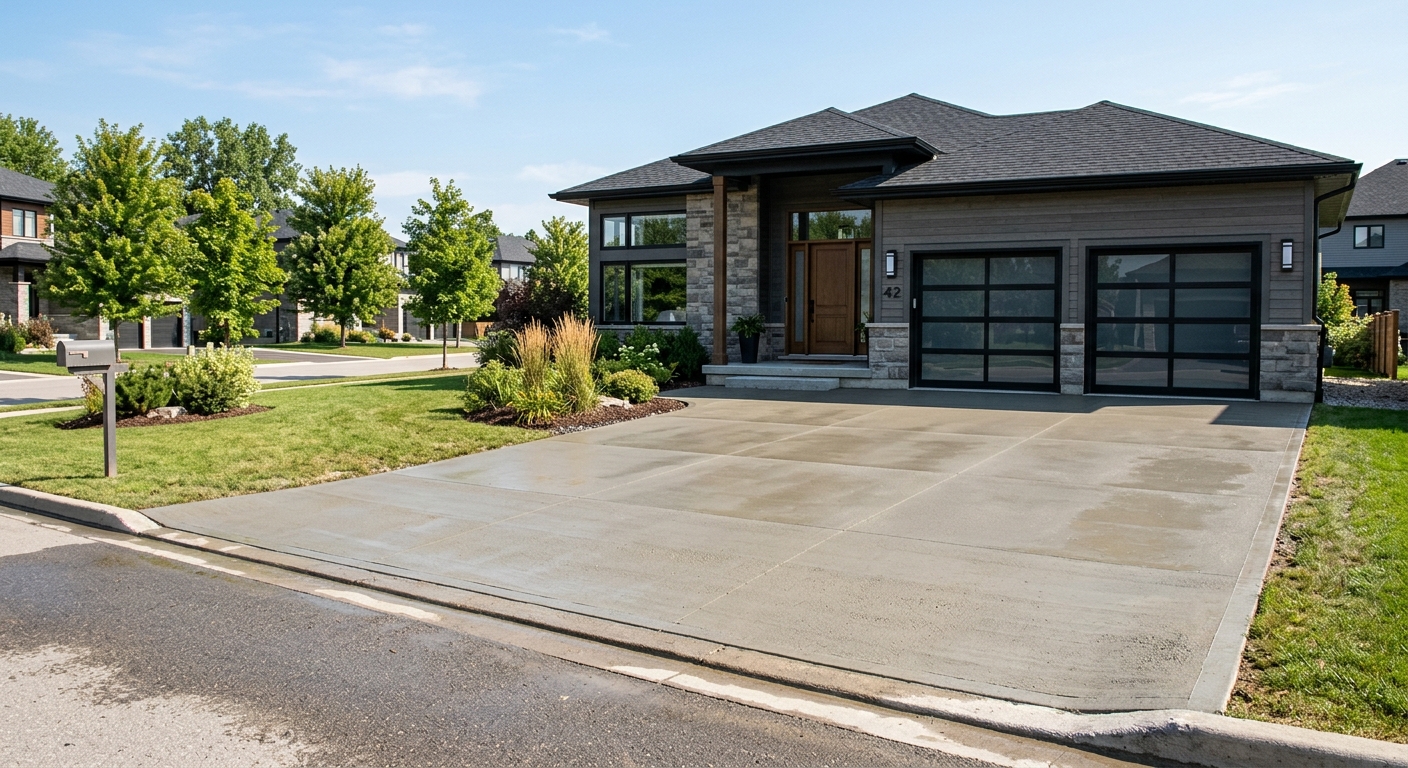
Concrete work options and costs in Clinton-Glenwood
In Clinton-Glenwood, choosing the right concrete option comes down to how long you need it to last, how it will be used, and how much the Lower Mainland–Southwest climate will challenge it. With a 2021 population of 8,422 (Statistics Canada, 2021 Census), the area’s owner-occupied housing stock is a steady base for driveway and patio work—especially around family homes where flatwork is part of daily life. The Lower Mainland–Southwest market also means lots of competition for schedules, but prices still reflect real field costs: crews plan around frequent rain, cool nights and the freeze–thaw pattern that can scale or spall surfaces if the mix, joints and curing aren’t right. Even though coastal BC typically has a shallower frost line than colder parts of the province, practice still targets footings placed below the design frost depth (often assumed around 450 mm / 18" for scheduling and thickness decisions) to reduce frost heave risk. That pushes excavation depth and base prep for foundations and thickened edges.
If you’re in the Clinton and Glenwood service radius, you’ll often see demand spike for driveways and walkways due to older home lots being renovated and regraded for better drainage—work that directly affects excavation quantity and compacted granular requirements. For homeowners comparing choices, the simplest way is to look at typical sizes and the finishes that survive our wet-cool conditions. Below is a practical comparison table to help you translate quotes into apples-to-apples scopes.
| Application |
Typical Size |
Key Spec |
Finish Option |
Price Range |
| Concrete driveway (standard broom finish) |
16 ft x 22 ft (352 sq ft) |
Air-entrained exterior mix, compacted granular base, control joints |
Broom finish |
$7,500–$11,000 |
| Exposed aggregate driveway |
16 ft x 22 ft (352 sq ft) |
Air-entrained exterior mix, proper curing to hold texture |
Exposed aggregate |
$10,000–$15,000 |
| Stamped concrete driveway or patio |
12 ft x 18 ft (216 sq ft) |
Air-entrained mix, release agent, added finishing time |
Stamped pattern |
$5,000–$8,000 |
| Plain concrete patio or walkway |
10 ft x 14 ft (140 sq ft) |
Minimum 32 MPa, reinforced as required, joints |
Float & broom/plain |
$2,500–$4,000 |
| Garage floor (interior slab) |
20 ft x 22 ft (440 sq ft) |
Vapor barrier (where needed), 32 MPa mix, joints |
Steel trowel or broom/skim |
$8,000–$14,000 |
| Foundation footings (structural, below frost) |
Typical detached structure: 80–140 linear ft |
Below frost depth, reinforced concrete, excavation and forming included |
Structural finish |
$16,000–$35,000 |
Prices are estimates only and vary by project scope, site access and material selection.
What affects the price of concrete work in Clinton-Glenwood
In the Lower Mainland–Southwest, concrete quotes for the “same” driveway or patio can differ by 30–50% because the critical cost drivers aren’t just the square footage. They’re the work you can’t easily see: how deep we excavate, how much engineered base we place and compact, the rebar or wire mesh schedule, and how we cure and protect the surface during our cool, damp stretches. In British Columbia overall, scheduling flexibility can also matter—when multiple crews compete for limited concrete pour windows around rain or persistent cold snaps, labour and pump/access costs can rise quickly.
In our climate, frost line depth and freeze–thaw cycles dictate every spec. That’s why exterior work uses air-entrained concrete mixes and why footings must extend below the design frost depth to prevent frost heave. Even though coastal BC frost depth is typically 0.5–1.2 m, the key is not the number on a map—it’s matching excavation depth to soil conditions and drainage. Exterior slabs also require air-entrained concrete and control joints to manage cracking and scaling risk during repeated wetting and drying. Cold-weather curing precautions—like insulated blankets or slab heating—can add real cost during shoulder-season pours, and de-icing salts used on driveways can accelerate spalling if the mix and curing aren’t correct.
In Clinton-Glenwood specifically, two common examples explain why one bid can be higher: (1) sites with poor drainage or saturated soils often require more granular base and attention to subgrade separation, while (2) jobs involving thickened edges or deeper excavation below grade for proper bedding raise forming and concrete volume. Finish choices can move the price too: a standard broom driveway generally falls near the $18–$28 per sq ft band, while stamped or exposed work often climbs toward the $22–$36 per sq ft range because finishing time and material handling are more intensive.
| Price Factor |
Why It Matters |
Cost Impact |
| Frost line depth — determines footing depth and form height |
Footings must sit below design frost to limit frost heave and settlement |
Higher excavation and forming can add significant labour and concrete volume |
| Site preparation — excavation, grading, compacted granular base |
Proper base controls settlement and prevents pumping/voids under slabs |
More haul-off, regrading, and granular supply increases cost |
| Reinforcement — rebar or wire mesh requirement |
Reinforcement supports cracking control and load distribution |
Material plus installation labour (often higher for garage floors and foundations) |
| Mix design — air-entrainment and compressive strength spec |
Air entrainment protects against freeze–thaw scaling; strength supports long-term durability |
Specific mix requirements can add per-yard material costs |
| Finish type — broom vs. stamped vs. exposed aggregate |
Complex finishes need extra labour, tools, and curing control |
Stamped/exposed typically increase labour and material handling time |
| Pour size and concrete truck access to site |
Long pours may require scheduling changes and pumping or extra labour |
Access constraints raise pump/line-set and crew time |
| Cold-weather curing precautions — heating and blankets |
Protects strength gain when nights are cool or rain delays curing |
Blankets, heaters, and longer protection days add direct costs |
| Control joint pattern and sealing cost |
Joints guide cracking; sealing reduces chloride intrusion and surface damage |
Correct spacing and sealing are added line-items but prevent premature deterioration |
Permits & regulations in British Columbia
In British Columbia, structural concrete work generally needs permitting, and that’s where many homeowners get tripped up. Work such as foundation footings, foundation walls, and grade beams typically requires a building permit and often engineered drawings that the municipality can review. Concrete flatwork—think driveways, patios, and walkways—usually does not require a permit by itself unless it affects lot grading, surface drainage, impervious surface limits, or work near the municipal right-of-way. The safe move in Clinton-Glenwood is to confirm the scope with the local authority before the first excavation.
For contractor compliance, verify three things before you sign: (1) the contractor’s provincial standing/licensing information where applicable, (2) liability insurance, and (3) WSIB/WCB coverage (or the applicable workers’ protection coverage for your trade/service arrangements). Step-by-step, ask for an updated certificate of insurance showing the coverage period and limits. Next, request proof of workers’ coverage and keep it in your file. Then, check the contractor’s public registry details online for licence/registration status if listed, and ask them for a clearance letter or documentation matching the project start date.
Also, insist on references for similar-scale pours—especially cold-season scheduling—because a technically correct mix and curing plan is as important as the paperwork.
Getting concrete right in Clinton-Glenwood's freeze-thaw climate
Concrete problems in Clinton-Glenwood usually start with one of five breakdown points: inadequate base, weak or wrong-mix concrete, poor jointing, rushed curing, or skipping protection after the pour. Our Lower Mainland–Southwest climate brings a wet-cool rhythm—rain, saturated soils, and repeated temperature swings—so the job must be specified to resist freeze–thaw damage and scaling. The key is getting the build-up right from the ground up. First, base preparation: place and compact a granular sub-base to the required depth for your soil and frost considerations, with drainage handled so water doesn’t sit under the slab.
Second, mix design: specify an air-entrained exterior mix targeting 5–7% air and a minimum 32 MPa compressive strength. Third, control joints: plan spacing so cracks occur where you want them, not randomly. Fourth, curing: plan for minimum 7 days of proper curing conditions; in cool weather this often means blankets or other protection so the slab can reach strength reliably. Fifth, sealing: apply a penetrating sealer after cure (commonly around 28 days) to repel de-icing salts and reduce surface deterioration.
Here’s a practical dollar example: a sealed standard driveway may cost roughly an extra $500–$1,200 depending on area and access, but that added protection can be worth it compared with replacing a failing top surface later—particularly when de-icing salts are used. The most important technical question to ask is simple: “Will you use an air-entrained mix and properly sized joints for freeze–thaw durability?” That one spec is often the difference between a driveway that lasts and one that scales and spalls.
| Spec |
Why It Matters in Clinton-Glenwood |
What to Ask For |
Impact if Skipped |
| Compacted granular base (depth?) |
Prevents settlement and reduces water/voids under the slab in wet seasons |
Granular type and compaction method; confirm total base depth |
Cracking, uneven surface, and early joint failure |
| Air-entrained concrete mix (target air %?) |
Air voids help concrete resist freeze–thaw scaling and moisture expansion |
Target air content for exterior flatwork (typically 5–7%); mix design sheet |
Spalling/scaling risk rises sharply during freeze–thaw cycles |
| Compressive strength (MPa rating) |
Strength supports long-term durability and wear resistance |
Minimum 32 MPa and pour documentation |
Surface wear, dusting, and reduced structural reliability |
| Control joints (spacing per ACI guidelines) |
Controls where cracks occur and improves longevity of exterior slabs |
Joint spacing, saw-cut timing, and routing depth targets |
Random cracking and more water intrusion into cracks |
| Minimum 7-day curing period |
Strength gain depends on temperature and moisture during early days |
How curing will be maintained; blankets/sealer protection if cool or rainy |
Lower strength and increased scaling risk |
| Penetrating sealer (when applied after cure) |
Helps repel salts and moisture in a freeze–thaw/road-treatment environment |
Type of penetrating sealer and schedule (commonly around 28 days) |
Faster surface deterioration and staining |
How to choose a concrete work contractor in Clinton-Glenwood
Choosing the right contractor in Clinton-Glenwood is mostly about proof and process—not just price. For British Columbia work, verify (1) they carry liability insurance and the coverage limits are reasonable for your scope, and (2) they have WSIB/WCB coverage (or the applicable workers’ coverage for their workforce). Ask for a certificate of insurance before any work begins, confirm the dates cover your project timeline, and ensure you’re named appropriately if required by your agreement. Then ask for proof of clearance/coverage if they can provide it. If they’re vague, that’s a red flag.
Get 2–3 itemised written quotes rather than lump sums. You want a line-by-line breakdown that shows excavation/grading, granular base, reinforcement, concrete mix specification, forming, labour, finishing, joints, and any curing/sealing allowances. Carefully read what’s excluded: permit pull, disposal/haul-off, site regrading beyond a set threshold, and concrete truck accessibility. If there’s no mention of control joints, air-entrainment, or curing blankets in cold/rainy periods, ask questions—those details are where durability is won or lost.
Warranty matters too. Look for a clear workmanship warranty length and understand if it’s transfer-able to future owners. Confirm whether they include any product/manufacturer warranty on concrete-related admixtures/sealers. For payment scheduling, never accept terms that require more than 10–15% upfront; hold back a portion until completion and cleanup. Finally, ensure your timeline includes a start date and a completion estimate in writing, accounting for rain and cure time.
- Ask for the exact concrete mix specification (air entrainment and strength) in writing.
- Request confirmation of base depth and compaction method.
- Confirm rebar or mesh placement details (cover, chairs/spacers, and tie-in).
- Require a joint plan: spacing, saw-cut timing, and sealant/sealer scope if offered.
- Check whether curing blankets/heaters are included for shoulder-season pours.
- Get an itemised quote with labour and materials separately.
- Clarify exclusions: permit fees, disposal/haul-off, and extra excavation due to unstable soils.
- Verify site access: truck routes, pumping needs, and any crane/formwork constraints.
- Ask who handles traffic/safety measures for the pour day.
- Confirm product and workmanship warranty details in plain language.
- Review payment terms; avoid large deposits.
- Schedule a pre-pour walk-through to match elevations, forms, and drainage assumptions.
Concrete contractor red flags in Clinton-Glenwood: (1) quotes that don’t mention air-entrainment or control joints, (2) blanket statements like “we do it the same way every time” without base-depth and curing details, (3) missing or expired insurance/coverage paperwork, (4) refusing to provide itemised scopes, and (5) rushing curing or discouraging sealing where salts are used.
Frequently asked questions — concrete work in Clinton-Glenwood
How long does a concrete project take in Clinton-Glenwood?
In Clinton-Glenwood, the schedule depends on weather windows and how thick and reinforced the slab is. A typical exterior flatwork job often runs as: one to three days for base prep and forming, one day for the pour and finishing, and then curing time before you can load or open it to regular traffic. While concrete strength continues to build beyond day 7, surface protection rules matter—especially in British Columbia’s wet-cool freeze–thaw conditions. If your pour is during a rainy stretch, crews may add curing blankets or protective tarps, which can shift timelines by a few days. As a rough planning guide, simple patios can be ready for light use sooner, while driveways with thicker edges and joints generally require more attention to curing and joint timing. If your quote is based on a standard driveway band like $18–$28 per sq ft, it usually assumes normal access and standard curing procedures; ask your contractor what the plan is for cool nights and damp conditions.
What is a concrete overlay and is it suited to Clinton-Glenwood?
A concrete overlay is a new concrete layer placed over an existing concrete slab (after surface preparation), typically to improve appearance and extend service life without full removal. In Clinton-Glenwood and across coastal BC climates, overlays can be suited for slabs that are structurally sound—meaning the original slab isn’t badly settled, heavily cracked, or actively pumping water from below. The big risk in our freeze–thaw environment is bonding failure: if moisture gets trapped or if the existing surface is deteriorating underneath, the overlay may crack or spall early. Overlays also still need air-entrained mix design, proper joint planning, and correct curing to avoid premature scaling. Cost-wise, overlays often compete with replacement when the existing slab has good elevation and minimal voids, but if demolition is required, you may lose savings. If your driveway quote is closer to $18–$28 per sq ft for full new work, compare it to the overlay scope item-by-item (prep, bonding agent, thickness, and joint strategy).
How do I seal concrete to protect it in Clinton-Glenwood?
Sealing in Clinton-Glenwood is about protecting against moisture, staining, and de-icing salts, which can worsen surface scaling during freeze–thaw cycles. The most common approach for exterior flatwork is a penetrating sealer applied after the concrete has cured—often around 28 days post-pour—so the slab is dry enough for good penetration. Before sealing, the surface should be clean and dry; remove dirt, oil, or algae growth. Ask your contractor what sealer product they use and whether they recommend a specific prep method (light wash, degreaser, or pressure washing). In British Columbia’s cool, humid conditions, rushing the seal can trap moisture and reduce performance. If your driveway or patio is planned near the standard price band (for example, broom-finished work often sits around $18–$28 per sq ft), sealing is frequently an add-on—but it’s usually cheaper than surface repairs later. Ensure your scope includes the sealer coverage rate and whether application is excluded if it rains or temperatures are too low.
What is the difference between concrete and cement?
In everyday language, many people use “cement” and “concrete” interchangeably, but they aren’t the same. Cement is the binder powder (the key ingredient that reacts with water to create strength). Concrete is the full mixture: cement plus water, sand, gravel (or crushed stone), and sometimes admixtures like air-entrainment agents. In British Columbia, the difference matters because exterior concrete must be designed correctly for our freeze–thaw cycles. For example, driveway and patio specifications commonly call for an air-entrained mix so the concrete can tolerate repeated wetting and cooling without scaling or spalling. If a contractor tells you “it’s just concrete,” ask for the mix design details: targeted air content and the minimum compressive strength rating. When you compare quotes in Clinton-Glenwood, price bands like $18–$28 per sq ft for driveways assume the right mix design and base prep, not just basic material.
How much does concrete work cost in Clinton-Glenwood?
Concrete pricing in Clinton-Glenwood generally tracks regional labour and material realities in Lower Mainland–Southwest: mild winters help some work, but frequent rain, drainage requirements, and freeze–thaw protection still increase costs. For quick budgeting, driveway or slab projects commonly land in the $18–$28 per sq ft band, while patio and walkway pricing often sits in the $16–$26 per sq ft range. Decorative options like stamped or exposed work commonly run higher—often aligned with the $22–$36 per sq ft band—because the finishing process takes more time and skill. Foundation footings are quoted differently (often by linear footage and excavation conditions) and can swing widely based on depth below frost and reinforcement needs. For a homeowner, the most accurate numbers come from itemised quotes that show base prep, reinforcement, mix spec, and access/pour logistics. As you compare bids, don’t just compare total dollars—confirm that both include air-entrainment, joints, and curing measures for our BC climate.
How deep must footings be for Clinton-Glenwood's frost line?
Footing depth in Clinton-Glenwood is driven by local frost protection requirements and soil conditions—not just a single “magic number.” In practice, codes and typical design assumptions in Lower Mainland–Southwest often target a frost depth around 450 mm / 18", with structural footings placed below that design depth to reduce frost heave risk. However, coastal BC can involve frost depths that vary (often referenced around 0.5–1.2 m depending on site and assumptions), and drainage or soil type can require deeper or more engineered solutions. That’s why engineered drawings for structural foundations are important for accuracy. When reviewing a quote, ask the contractor to specify the footing depth (from finished grade), confirm it matches the design below frost, and explain how they handled excavation and base preparation. If a bid doesn’t state footing depth or reinforcement details, it’s difficult to compare fairly—and it can lead to premature movement or cracking in our freeze–thaw conditions.