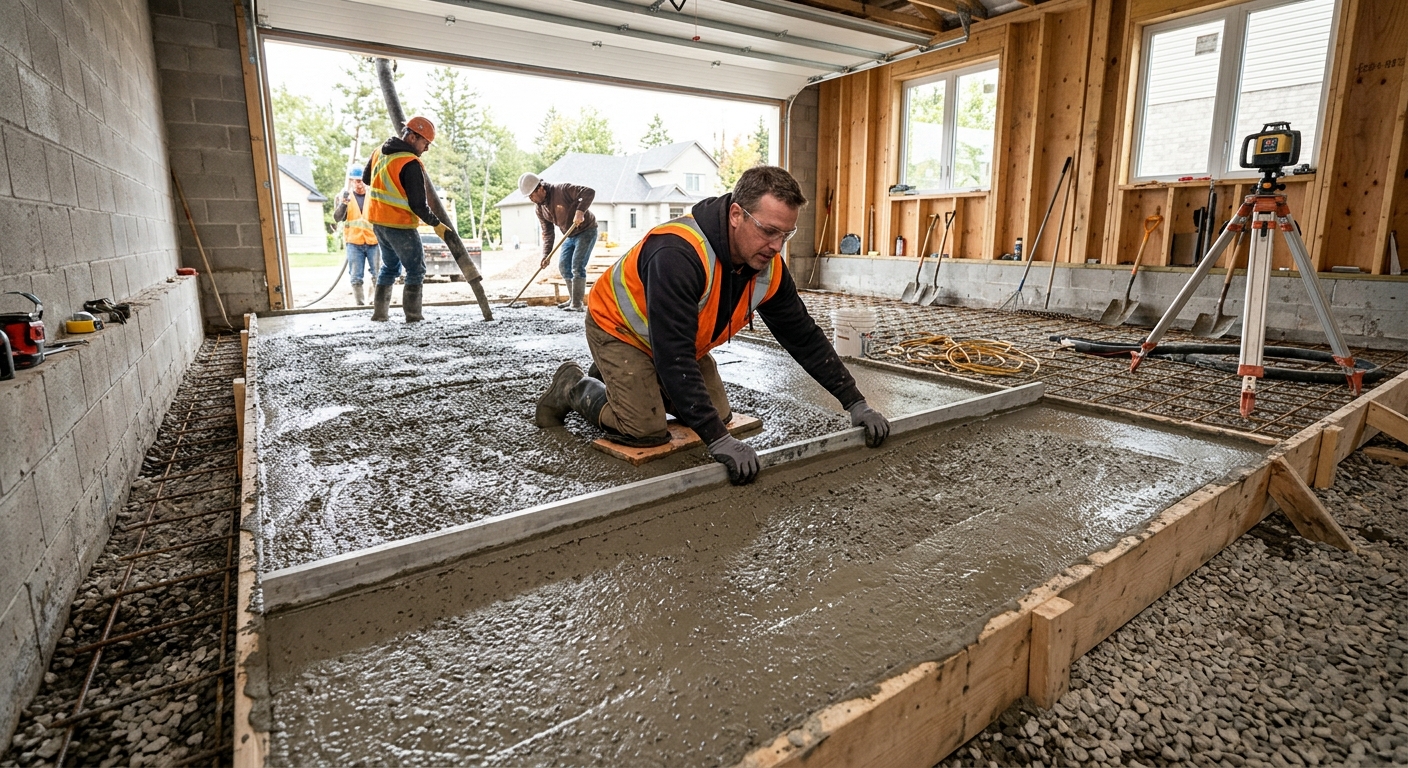
Concrete work options and costs in Shellmont
Concrete is a common exterior upgrade in Shellmont, especially where homeowners want durable, low-maintenance flatwork. With Shellmont sitting in the Lower Mainland–Southwest region—home to 11,420 people (Statistics Canada, 2021 Census)—there’s steady demand for the kind of driveway and patio work that keeps curb appeal strong. The local housing mix is dominated by single-detached neighbourhood development, which typically drives repeat projects like new driveways, garage slabs, and rear-yard patios. If you’ve walked around places like the Sandhill Park area (Shellmont), you’ll notice many driveways and walkways that are due for repairs or replacement.
Pricing here is shaped by our coastal-wet conditions and freeze–thaw cycles. Even with a shallow design frost depth of about 450 mm / 18", footings and thickened edges are still placed below that depth to reduce frost heave risk. Contractors also plan around rainfall and high humidity—cool nights slow curing, so we often extend curing time and use curing blankets or sealers to protect surfaces. That’s a big reason quotes for “the same slab size” can still differ: access, drainage details, mix design (air-entrained), and finishing complexity (broom versus exposed aggregate or stamped) all change labour hours and material use. Decorative finishes also require additional formwork care, colour selection, and weather-timed application.
Below is a practical cost comparison for common options in Shellmont, so you can line up scope and finishes before you call for a site visit and quote.
| Application |
Typical Size |
Key Spec |
Finish Option |
Price Range |
| Concrete driveway (standard broom finish) |
320–420 sq ft (typical) |
Air-entrained exterior mix; compacted granular base; control joints |
Broom finish |
$18,000–$28,000 |
| Exposed aggregate driveway |
320–420 sq ft (typical) |
Air-entrained mix; colour/stone selection; curing + wash exposure |
Exposed aggregate |
$22,000–$36,000 |
| Stamped concrete driveway or patio |
240–400 sq ft |
Air-entrained mix; base prep for exterior durability |
Stamped patterns with release + seal |
$24,000–$44,000 |
| Plain concrete patio or walkway |
160–320 sq ft |
Air-entrained exterior mix; compacted granular base; edge forms |
Float + light broom (or smooth trowel where suitable) |
$16,000–$26,000 |
| Garage floor (interior slab) |
480–650 sq ft |
Vapour barrier (as required); proper thickness; joints as needed |
Plain broom or hard-trowel (spec dependent) |
$20,000–$34,000 |
| Foundation footings (structural, below frost) |
Per project; typical typical perimeter + piers |
Excavate below design frost; reinforcement as per engineer; concrete placed to spec |
Structural concrete (not decorative) |
$200,000–$350,000 |
Prices are estimates only and vary by project scope, site access and material selection.
What affects the price of concrete work in Shellmont
In Shellmont and across the Lower Mainland–Southwest, it’s normal to see concrete quotes swing by 30–50% for what looks like “the same job” on paper. The gap usually comes from the specs that protect the concrete in our coastal-wet, freeze–thaw conditions: footing depth and base prep, air-entrained mix design, reinforcement, and the finishing/curing plan. In colder parts of British Columbia, the season can be shorter and cold-weather precautions can add cost, while local contractors in the Lower Mainland often remain busy year-round—yet rain and humidity still impact scheduling and curing time.
Here’s the core technical reason: the design frost depth matters. Lower Mainland projects often plan around about 450 mm / 18" so footings extend below that frost line to prevent freeze–thaw heave. Exterior slabs typically use air-entrained concrete so the surface can resist scaling and micro-damage. Colder regions require more time and sometimes heating/blankets to protect curing concrete; that’s where extra labour and equipment costs show up. Also, de-icing salt accelerates surface breakdown on improperly sealed slabs—so sealing is not a “nice-to-have” in our winters.
Two practical Shellmont examples: upgrading from a broom-finished driveway to exposed aggregate can add work around stone exposure and more careful curing, often moving you closer to the stamped & decorative band (for example, creeping toward the $22–$36 per sq ft range). Conversely, a plain patio can stay closer to the $16–$26 per sq ft band when base prep, drainage, and jointing are standard and the pour schedule is straightforward.
Finally, older housing stock means you may inherit drainage issues, settlement, or cracked edges around existing slabs. Fixing that—sometimes with additional excavation, regrading, or thicker edges—can add thousands, but it’s often cheaper than repeated patchwork.
| Price Factor |
Why It Matters |
Cost Impact |
| Frost line depth — determines footing depth and form height |
Footings must extend below the design frost depth to limit frost heave. |
Higher excavation and forming time; can add significant labour and material cost. |
| Site preparation — excavation, grading, compacted granular base |
Weak subgrade leads to settlement and cracking; drainage failures increase freeze–thaw damage. |
More hauling/compaction and possible drainage improvements increase cost. |
| Reinforcement — rebar or wire mesh requirement |
Controls crack widths and improves structural capacity for driveways and some slabs. |
Material + tying/lift supports; often labour-intensive on larger pours. |
| Mix design — air-entrainment and compressive strength spec |
Air-entrainment helps resist scaling in freeze–thaw cycles. |
Costs more per cubic metre but reduces failure and early repairs. |
| Finish type — broom vs. stamped vs. exposed aggregate |
Decorative finishes require extra steps, timing, and careful curing/colour work. |
Usually shifts pricing upward toward the $22–$36 band for decorative work. |
| Pour size and concrete truck access to site |
Access affects whether concrete can be placed efficiently or needs extra labour. |
Hard access can increase labour for handling, pumping, or multiple truck trips. |
| Cold-weather curing precautions — heating and blankets |
Cold nights and humidity slow strength gain; early freeze can damage the surface. |
Blankets, heaters and monitoring can add equipment and labour hours. |
| Control joint pattern and sealing cost |
Joints manage cracking; sealing helps protect against de-icing salt damage. |
More layout time and sealer material; typically worth it for exterior durability. |
Permits & regulations in British Columbia
In British Columbia, structural concrete work is generally treated as building work that requires a permit. That includes footings, foundation walls, grade beams, and other load-bearing foundation elements. For new foundations or significant structural alterations, municipalities may also request engineered drawings for review before work begins. Concrete flatwork like patios, walkways, and typical driveways often does not require a permit by default—however, permits can become necessary if the project impacts lot grading, drainage, impervious surface coverage limits, or the municipal right-of-way. Because rules can be triggered by site conditions, always confirm with the local authority before you start excavation.
For your Shellmont project, verify your contractor’s credentials step-by-step. First, confirm the contractor is properly registered/licensed for the type of work they’re doing and carries liability insurance. Next, ask for a current certificate of insurance (COI) showing coverage limits and effective dates. Then confirm workers’ compensation coverage (WSIB/WCB) so you’re not exposed to subcontractor gaps—request proof directly and keep it with your job file.
Finally, request references for similar-scale Shellmont projects (exterior slabs, drainage details, and winter curing). When you’re comparing quotes, ask who pulls any required permit, whether drainage ties-in are included, and how they’ll protect fresh concrete from rain and cool nights during curing.
Getting concrete right in Shellmont's freeze-thaw climate
Concrete fails in Shellmont mainly when the slab is exposed to repeated freeze–thaw cycles without enough protection at the base, in the mix, and at the surface. The most common problem homeowners see is spalling—surface scaling and flaking—often caused by inadequate air-entrainment or poor curing. In our Lower Mainland–Southwest climate, you also have frequent rain and saturated soils, so drainage and a properly compacted granular base are just as important as the finish you can see.
p>To spec the job correctly, start with (1) base preparation: excavate and place compacted granular sub-base to the depth required for local soil conditions and frost protection. Exterior work should include proper drainage detailing so water doesn’t sit under the slab. Next (2) mix design: order air-entrained concrete with target air content typically around 5–7% for exterior flatwork, and specify minimum 32 MPa compressive strength. Then (3) control joints: plan a joint layout that limits random cracking and matches your slab size and shape. For (4) curing: aim for at least 7 days of curing under suitable conditions, and in cooler periods use curing blankets or other cold-weather precautions. Finally (5) sealing: apply a penetrating sealer after the slab cures—commonly 28 days post-pour—so de-icing salts and moisture don’t accelerate surface breakdown.
Where does cost make sense? For instance, choosing a correctly air-entrained exterior mix and doing proper joints/sealing can cost more than a “basic pour,” but it’s usually cheaper than repeating patch repairs. If a plain patio is priced near the $16–$26 per sq ft band, the incremental cost to bring the spec up to long-term freeze–thaw durability is often justified when you account for reduced maintenance and fewer early failures.
| Spec |
Why It Matters in Shellmont |
What to Ask For |
Impact if Skipped |
| Compacted granular base (depth?) |
Limits settlement and helps manage moisture under the slab during wet-cool cycles. |
Base depth plan for your soil; compaction testing/standards used; drainage details. |
Uneven slab, cracking, and faster freeze–thaw deterioration. |
| Air-entrained concrete mix (target air %?) |
Air bubbles give space for freezing water expansion, reducing surface scaling. |
Target 5–7% air for exterior flatwork; batch ticket proof. |
Higher risk of spalling and scaling in winter. |
| Compressive strength (MPa rating) |
Strength gain supports durable performance and faster safe handling. |
Minimum 32 MPa (or higher if required by design/spec). |
Surface wear and reduced long-term durability. |
| Control joints (spacing per ACI guidelines) |
Controls where cracks form as the slab contracts and expands. |
Planned joint spacing and layout; saw-cut timing. |
Random cracking and more water infiltration at edges. |
| Minimum 7-day curing period |
Ensures strength development before exposure to rain/cool nights. |
Curing method used; protection plan for weather. |
Weak surface, higher cracking, and compromised finishing quality. |
| Penetrating sealer (when applied after cure) |
Reduces moisture and salt penetration into the concrete surface. |
Apply after curing—commonly 28 days post-pour; product type for salt resistance. |
Faster surface degradation and more maintenance. |
How to choose a concrete work contractor in Shellmont
Choosing the right contractor in Shellmont is mostly about verifying credentials and getting scope clarity—because exterior concrete performance depends on details. In British Columbia, confirm the contractor’s licence/registration for the work type they’re performing, then verify liability insurance by requesting a current certificate of insurance (COI) with appropriate coverage limits. Next, ensure workers’ compensation coverage (WCB/WSIB) is in place; ask subcontractors to be covered too, not just the primary contractor. If they can’t provide documentation quickly, that’s a serious red flag.
Get 2–3 itemised written quotes that separate labour and materials. Look for line items like excavation and disposal, granular base supply/placement, reinforcement (mesh/rebar and chairs/ties), concrete supply, finishing steps, joint cutting, curing protection, and sealer (when included). A lump sum might hide major differences in drainage details or finishing scope.
Read exclusions carefully: is disposal included? Are permit-related tasks included if required for grade/drainage changes? Who supplies/installs edge forms and how are they protecting neighbouring landscaping during the pour? Ask about warranty—workmanship length (and what it covers), whether product/manufacturer warranties apply to admixtures/sealers, and if anything is transferable. For payment, plan for minimal upfront deposit: never more than about 10–15%, and use a holdback until the job is complete and cured enough for acceptance. Finally, request a written timeline with the start date, pour window (weather dependent), and completion estimate.
- Provide proof of liability insurance (COI) and confirm effective dates.
- Confirm WCB/WSIB coverage for the contractor and their subs.
- Ask for references on Shellmont exterior slabs (driveways/patios) with similar sizes.
- Get itemised quotes: excavation/disposal, base, reinforcement, concrete, finishing, joints, curing, sealer.
- Verify air-entrained mix and minimum strength are explicitly included.
- Ask who manages weather protection during curing (blankets/cover plans for cool nights/rain).
- Confirm control joint spacing and when saw cutting occurs.
- Clarify whether sealing is included and when it’s scheduled (commonly after 28 days).
- Check whether drainage improvements are part of the scope if water is currently pooling.
- Ensure truck access and placement method are explained (and included in the quote).
- Review payment schedule: 10–15% max upfront; holdback until acceptance.
- Get start date and completion estimate in writing, including a realistic rain-weather buffer.
Red flags in Shellmont include: quotes that don’t mention air-entrainment for exterior work, no discussion of base depth/compaction or drainage, vague jointing/curing timelines, large upfront payments without holdback, and refusing to provide COI/WCB proof or itemised scope details.
Frequently asked questions — concrete work in Shellmont
How do I prepare the base for a concrete slab?
Base preparation in Shellmont is where durability is won or lost. Start with correct excavation to reach stable subgrade, then place a compacted granular base to the depth required for your soil and slab type. Because we’re in a coastal-wet, freeze–thaw environment, water management matters: you want granular that drains and compaction that prevents settlement. A contractor should explain how they compact in lifts, what standards they follow, and whether they’re addressing existing drainage issues (like pooling near the foundation). For exterior slabs, ensure the specification includes an air-entrained mix and proper edge thickness/grade. If you’re comparing costs, a driveway near the $18–$28 band may still vary a lot depending on how much attention is paid to base prep and drainage.
How do I compare concrete quotes?
Compare quotes the way you’d compare vehicle maintenance plans: line by line. Ask for itemised pricing that separates excavation/disposal, granular base, reinforcement (if included), concrete supply, finishing, curing protection, and whether control joints and sealing are included. Pay attention to what’s specified: exterior work should use air-entrained concrete and meet a minimum compressive strength (often 32 MPa). In Shellmont, don’t ignore curing conditions—cool nights and rain can affect strength gain, so look for a written plan for protection. Quotes can differ by 30–50% across the Lower Mainland–Southwest because some proposals cut corners on base prep, jointing, or sealing. If one option is near the plain patio $16–$26 band and another is closer to decorative pricing, make sure the scope reflects the extra steps.
Can concrete be poured in cold weather in Shellmont?
Yes, concrete can be poured in cold weather in Shellmont, but it has to be done with the right cold-weather curing precautions. The key risk isn’t just “cold” in general—it’s freezing conditions early in the pour before the concrete gains enough strength. A good contractor will plan around the schedule, use curing blankets or protective coverings, and sometimes use heating methods where needed to keep the slab protected. They should also manage rain and high humidity so the surface isn’t damaged during finishing. Always ask how they determine whether conditions are suitable on a given day, and what they do to protect form edges and joints. Weather-driven precautions can add cost, but they prevent early failure that’s far more expensive than the pour-day labour.
How do I maintain concrete in Shellmont's freeze-thaw climate?
Maintenance in British Columbia’s coastal-wet winters is about reducing moisture and protecting the surface. First, seal properly: for exterior slabs, a penetrating sealer is typically applied after full curing—often around 28 days post-pour—so de-icing salts and water don’t penetrate the surface. Second, keep water from sitting on the slab by maintaining grading and clear drainage points (downspouts, slopes, and weeping areas). Third, clean carefully: avoid harsh scraping that damages the surface layer, and consider using de-icing methods that are less aggressive when possible. If you notice early scaling, repair promptly rather than letting water reach deeper layers. Well-specified concrete (air-entrained, correct joints, and sealing) generally holds up better, and it’s one reason driveway and patio scopes typically price based on finishing and long-term protection, not just pour labour.
What causes concrete to spall in Shellmont winters?
Spalling in Shellmont is most commonly tied to freeze–thaw damage at the surface. The #1 culprit is inadequate air-entrainment—if the concrete doesn’t have enough properly distributed air voids, water that enters pores can freeze, expand, and break the surface layer. Drainage problems also contribute: saturated base or poor edge drainage allows moisture to stay near the slab, accelerating deterioration. Poor curing and cold weather without protection can weaken the surface before it reaches strength, making it more vulnerable. Salt exposure makes it worse; de-icing salt can accelerate surface breakdown when the slab isn’t protected by an appropriate sealer. If your contractor is quoting a plain patio near the $16–$26 band but doesn’t discuss air content, curing protection, joints, and sealing, that’s a gap you should address before signing.
What is rebar and when is it required in British Columbia?
Rebar (reinforcing steel) is used to improve concrete’s performance where tensile stresses and cracking control matter. In British Columbia, the “when” is typically determined by the engineer’s design for structural elements or by the slab design requirements for your specific project. For example, structural foundation components such as footings and foundation walls are commonly reinforced and engineered—these are the kinds of jobs that often require permits and engineered drawings review. For exterior flatwork like driveways, some specs call for reinforcement (rebar or wire mesh), especially for larger spans, heavier loading, or thicker sections designed for reduced cracking. The contractor should identify the reinforcement type, placement height (on chairs/spacers), and cover. If you’re doing something structural in Shellmont, ask whether an engineer has specified reinforcement and whether the contractor can show how it matches the drawings.