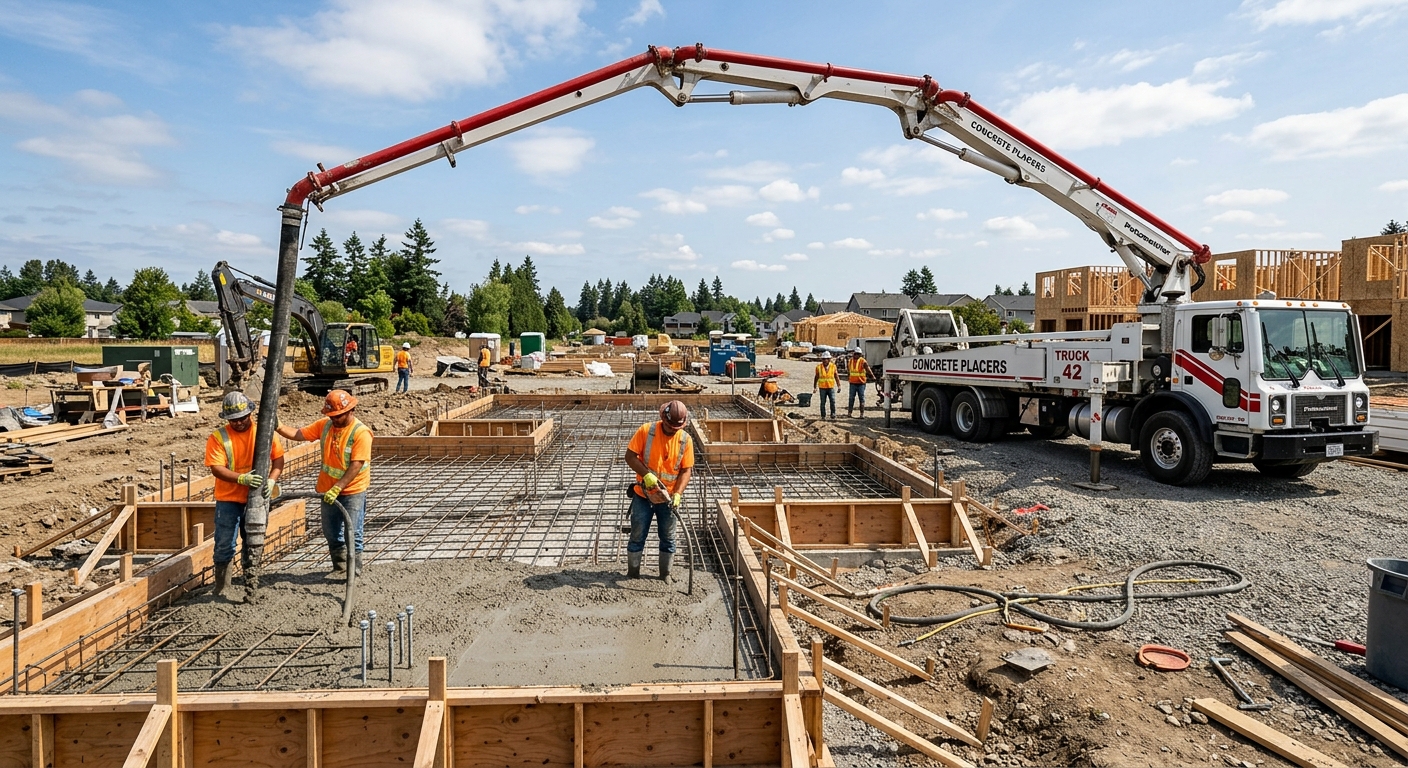
Concrete work options and costs in Sparwood
Sparwood is a great town for durable concrete flatwork, but every driveway and patio has to earn its way through Kootenay winters. With 55.4% of local dwellings being single-detached homes and about 1,300 homeowner households (Statistics Canada, 2021 Census), most concrete demand in Sparwood is driven by driveways, patios, walkways and garage slabs. Another big local reality: 55.1% of homes were built before 1981 (Statistics Canada, 2021 Census), so many projects are retrofits—raising, replacing, and sometimes reworking drainage and old sub-bases rather than “like-for-like.”
In the Kootenays, cold continental winters and freeze–thaw cycles mean concrete needs tighter specifications. Footings typically must be installed below design frost depth, exterior slabs need air-entrained mixes, and control joints have to be planned so cracks don’t become pathways for water. The shorter pour season also affects scheduling—contractors often build in winter protection (blankets/heating enclosures) and that can push unit costs up compared with milder parts of BC. Neighbourhood demand is especially steady around Sparwood’s residential areas off Highway 3 where access for trucks, re-grading needs, and snow-management logistics are common.
Below is a practical pricing snapshot for common options in Sparwood, followed by the specs that drive those numbers in real quotes.
| Application |
Typical Size |
Key Spec |
Finish Option |
Price Range |
| Concrete driveway (standard broom finish) |
400 sq. ft. (about 20' x 20') |
Air-entrained mix, compacted base, control joints |
Broom finish + saw-cut joints |
$7,200 – $11,200 |
| Exposed aggregate driveway |
400 sq. ft. (about 20' x 20') |
Air-entrained mix, proper aggregate placement |
Exposed aggregate (washed surface) |
$10,000 – $14,800 |
| Stamped concrete driveway or patio |
300 sq. ft. (about 20' x 15') |
Air-entrained mix, release agent + proper curing |
Stamped pattern + sealed finish |
$7,500 – $12,000 |
| Plain concrete patio or walkway |
200 sq. ft. (about 20' x 10') |
Compacted base + control joints |
Float/trowel + light broom or broom |
$2,900 – $4,800 |
| Garage floor (interior slab) |
400 sq. ft. (about 20' x 20') |
Vapour barrier (if required), mesh or rebar as specified |
Plain finish + optional hardener |
$7,200 – $11,500 |
| Foundation footings (structural, below frost) |
Per linear metre equivalent |
Below frost, engineered specs, formwork + rebar |
Structural concrete (no decorative finish) |
$4,200 – $7,200 |
Prices are estimates only and vary by project scope, site access and material selection.
What affects the price of concrete work in Sparwood
In Kootenay communities, quotes for the “same” concrete job can swing by 30–50% because cold-weather detailing changes how much work and labour goes into the project. Two projects that both look like a 400 sq. ft. slab may not share the same base thickness, rebar plan, or curing method—and in Sparwood those differences are what protect your concrete from early cracking and spalling. Contractors also price risk differently when the frost line is deep and when freeze–thaw cycles are frequent.
Specifically, frost depth and freeze–thaw cycles dictate nearly every decision. Footings must extend below design frost depth to prevent frost heave, and exterior slabs typically require air-entrained concrete to survive repeated expansion and contraction. In cold areas the pour season is shorter, so crews often need heating, insulated curing blankets, and tighter scheduling windows; that labour and equipment time adds cost. Also, de-icing salts accelerate surface scaling when concrete is not properly air-entrained and when sealing is delayed or skipped—sealing is a small line item compared to the cost of replacement.
In Sparwood, a typical cost driver is site preparation: if excavation hits poor soil or saturated pockets, you’ll see higher granular base and drainage work. Another cost lever is finish—plain flatwork can land near the $18–$28 per sq. ft. driveway backbone, while stamped or exposed aggregate options can move toward the $25–$40 decorative band once pattern work and extra labour are included. Finally, older housing stock built before 1981 often means more uneven grades to correct, which can add truckloads of granular base and forming time; for many homeowners on these retrofits, the “cheaper” option is only cheaper if the drainage and sub-base are truly addressed.
| Price Factor |
Why It Matters |
Cost Impact |
| Frost line depth — determines footing depth and form height |
Heave risk increases if concrete isn’t below frost |
Higher excavation + more concrete + taller forms |
| Site preparation — excavation, grading, compacted granular base |
Bad sub-base leads to settlement and cracking |
More truckloads, compaction time, possible drain work |
| Reinforcement — rebar or wire mesh requirement |
Controls crack widths and improves slab durability |
Material + labour to place correctly on chairs |
| Mix design — air-entrainment and compressive strength spec |
Protects from freeze–thaw scaling/spalling |
Higher material cost and stricter batching |
| Finish type — broom vs. stamped vs. exposed aggregate |
Finish methods change labour and curing/handling |
Stamped/exposed typically require more steps and tools |
| Pour size and concrete truck access to site |
Moreсё time and extra assistance for limited access |
Short-load fees, hoses/placement labour, site traffic control |
| Cold-weather curing precautions — heating and blankets |
Prevents early freezing and weak surface development |
Equipment rental + added labour on pour days |
| Control joint pattern and sealing cost |
Manages cracking and reduces water/salt damage |
Saw-cut labour + sealer material and application time |
Permits & regulations in British Columbia
In British Columbia, whether you need a permit depends on what you’re building and how it affects structural elements or site services. Structural concrete work—such as footings, foundation walls, grade beams, and other load-bearing foundation components—typically requires a building permit, and engineered drawings are often reviewed by the municipality before work starts. Concrete flatwork (patios, walkways, and driveways) often does not require a permit, unless it changes lot grading/drainage, touches municipal right-of-way requirements, or triggers impervious surface coverage and drainage constraints tied to the site’s stormwater plan.
For a Sparwood homeowner, the safest step-by-step approach is:
- Confirm with the local authority whether your specific scope (e.g., driveway replacement with re-grading, footing work, or any drainage changes) triggers a permit.
- Request the contractor’s certificate of insurance (liability) before work begins; ensure coverage includes concrete operations.
- Verify worker coverage under the applicable provincial work coverage requirements (commonly referred to as WCB in BC discussions). Ask for the clearance letter/confirmation.
- Use the contractor’s business details to check their licensing status through the relevant online registries and verify the trade aligns with the work being quoted.
- Ask for references on similar-scale projects completed in cold-weather conditions, not just summer-only pours.
When you confirm these items up front, you reduce the risk of schedule delays and costly rework—especially important in Sparwood’s short pour season.
Getting concrete right in Sparwood's freeze-thaw climate
Concrete failures in Sparwood usually come from three places: poor base preparation, weak or improperly specified mix, and inadequate curing or joint/finish planning. In a freeze–thaw climate, water gets into tiny gaps and pores; when it freezes, it expands and can push the surface apart. The most common symptom homeowners see is spalling—flaking and scaling—often where de-icing salts and vehicle traffic concentrate. The fix starts with asking for the right specs, not just “a good price.”
For base preparation, ensure the sub-base is excavated to the correct depth for local frost conditions and compacted properly with the right granular material and drainage strategy. For the mix design, exterior flatwork should use air-entrained concrete with a target air content typically in the 5–7% range and a minimum compressive strength often specified around 32 MPa for exterior work. For control joints, plan saw-cut joints to manage shrinkage and temperature movement; in practice, spacing is based on slab thickness and geometry so you get predictable cracking lines instead of random cracks.
Curing is non-negotiable. Even in a great weather window, cold snaps can slow hydration; spec for minimum 7 days of curing under proper conditions and, if pouring late in the season, include insulation/curing blankets or heated enclosures. Finally, sealing matters in town where salt use is common: a penetrating sealer is typically applied after the cure window—around 28 days post-pour—to help repel moisture and salt ions.
A practical example: if a plain broom-finish driveway quote is close to the $18–$28 per sq. ft. backbone but the proposal doesn’t include air-entrainment and proper curing protection, you may save short-term yet pay later for patching or replacement. Paying for the correct mix and curing can be the difference between a driveway that looks good after the first winter and one that sheds surface material within a couple of seasons.
| Spec |
Why It Matters in Sparwood |
What to Ask For |
Impact if Skipped |
| Compacted granular base (depth?) |
Prevents settlement and reduces water retention under the slab |
Base thickness and granular type; compaction requirements |
Uneven support → cracking, rocking, shortened lifespan |
| Air-entrained concrete mix (target air %?) |
Improves freeze–thaw durability and reduces spalling risk |
Target air content (typically 5–7% for exterior flatwork) |
Surface scaling/spalling in winter cycles |
| Compressive strength (MPa rating) |
Controls strength development under cold curing conditions |
Minimum 32 MPa (confirm project-specific spec) |
Higher chance of early surface failure under loads |
| Control joints (spacing per ACI guidelines) |
Manages movement and limits random cracking pathways |
Joint layout plan tied to slab thickness and dimensions |
Random cracks → water ingress → freeze–thaw damage |
| Minimum 7-day curing period |
Ensures hydration before exposure to cold or moisture |
Curing method and protection plan if temperatures drop |
Weak surfaces, scaling, and reduced long-term durability |
| Penetrating sealer (when applied after cure) |
Helps repel de-icing salt and moisture |
Sealer type and timing (commonly after full cure window) |
Faster salt-driven deterioration and surface loss |
How to choose a concrete work contractor in Sparwood
Choosing the right contractor in Sparwood is mostly about verifying four things: capability, insurance, coverage, and clarity in the quote. Start by confirming British Columbia licensing/trade authorization for the work being proposed. Next, request proof of liability insurance and review the certificate for current dates and coverage amounts (it should specifically cover the nature of concrete construction activities). For worker coverage, ask for documentation/clearance demonstrating the contractor’s provincial work coverage compliance (commonly referenced as WCB in BC). If a contractor can’t produce these items quickly, it’s a red flag.
Then get 2–3 itemised written quotes, not lump sums. You want the labour and materials breakdown so you can see whether one quote includes air-entrainment spec, base prep, reinforcement placement, control joint cutting, and curing protection. Pay attention to what’s excluded: is disposal and haul-away included? Are forms and excavation included, or treated as extras? If they mention permits, ask whether permit pull (and any related fees) is included or excluded—especially if the scope touches drainage/grading.
Warranty also matters in freeze–thaw regions. Ask for a clear workmanship warranty length and what’s covered (e.g., cracking within first-year movement plan versus full replacement). Confirm product/manufacturer warranties for sealers or specialty materials and whether they’re transferable. For payment, never pay more than 10–15% upfront; use a holdback until the slab passes final finishing, curing steps, and any promised sealing.
Finally, ask for a start date and completion estimate in writing. In Sparwood’s shorter pour season, the timeline is often where quality is won or lost.
- Check BC business details and licence/trade authorization before signing.
- Request liability insurance certificate and verify coverage is current.
- Ask for provincial work coverage confirmation/clearance before work begins.
- Confirm they spec air-entrained concrete for any exterior flatwork.
- Require itemised scope: excavation, base prep, reinforcement, concrete supply, finishing, joints, curing protection.
- Get the joint plan (layout, spacing) and sealer timing included if exterior.
- Ask about cold-weather protection: blankets, heaters, and curing method.
- Clarify disposal and haul-away costs if demolition is required.
- Verify truck access assumptions (hose/finishing crew time) in the quote.
- Confirm warranty terms in writing and what “failure” means for claims.
- Set payment schedule with a holdback until curing/cleanup/sealer steps are done.
- Ask for references from similar projects in cold-weather conditions.
Concrete contractor red flags in Sparwood: no documentation of insurance/coverage, vague specs like “concrete mix standard” without air-entrainment, skipping or bundling curing protection as an “extra,” refusing to provide an itemised quote (especially base depth and reinforcement), and promising work “this week” without a realistic cold-weather plan.
Frequently asked questions — concrete work in Sparwood
What is air-entrained concrete and why does it matter here?
Air-entrained concrete is mixed with tiny, intentionally trapped air bubbles that give freezing water places to expand without damaging the paste. In Sparwood and the broader Kootenay area, freeze–thaw cycles are frequent, and surface scaling/spalling tends to show up first on exterior slabs and driveways—especially where de-icing salt is used. That’s why reputable contractors in British Columbia specify an air-entrained mix for any exterior flatwork and pair it with correct curing. When comparing quotes, don’t accept “standard mix” language—ask for the air content target and whether the mix is explicitly designed for exterior exposure and cold weather.
If one contractor is only slightly cheaper but doesn’t clearly include air entrainment, the risk is higher. On a driveway priced around the $18–$28 per sq. ft. backbone, the “savings” can be wiped out by early patching or resurfacing.
How do I prepare the base for a concrete slab?
Base preparation in Sparwood is about getting the right depth and compaction so the slab never loses support. Typically, the contractor excavates to the designed elevation, removes unsuitable material, and builds a compacted granular sub-base (often with a drainage-minded approach). The key is uniform thickness and proper compaction—your slab can be perfectly mixed, but if the base is uneven or too wet, you’ll see settlement cracks later. For exterior slabs, also make sure drainage paths are addressed so water doesn’t sit at the slab edge during spring melt.
In your quote request, ask for the base thickness, granular material type, and compaction method. For foundation footings (below frost), the base prep is structural and must follow engineered requirements, not “rule-of-thumb.”
How do I compare concrete quotes?
When you compare quotes in Sparwood, the biggest mistake is choosing based only on total price. Instead, compare the details that protect against winter damage: base excavation depth and granular base specification, reinforcement plan (mesh vs. rebar and placement height on chairs), concrete mix design (including air-entrainment for exterior), and the joint layout. Also check whether curing protection is included for cold snaps (blankets/heating) and whether sealing is included for exterior surfaces—sealing timing is commonly around 28 days post-pour.
Ask for an itemised breakdown and confirm what’s included/excluded: disposal/haul-away, forms, site access allowances, and whether saw-cut control joints are included. If one driveway option lands near the $18–$28 per sq. ft. range but another is closer to a stamped/decorative band (often $25–$40 per sq. ft. for decorative work), make sure you’re truly comparing finishes and not comparing different spec levels.
Can concrete be poured in cold weather in Sparwood?
Yes, concrete can be poured in cold weather in Sparwood, but it requires planning and protection. The contractor may need to heat water/aggregates, use curing blankets or an insulated enclosure, and ensure proper temperature control so the concrete reaches strength before it freezes. The bigger risk in Kootenay winters is not only air temperature—it’s wind chill, ground temperatures, and how fast the surface cools during the curing window.
Ask your contractor: What minimum temperatures trigger protection? What heating/blanketing method will you use? Who monitors temperatures during curing, and for how long? A well-prepped cold-weather pour can still be durable, but rushing without protection often leads to weak surfaces and early scaling. Because Sparwood’s pour season can be shorter, cold-weather precautions may increase the quote even for the “same” driveway size.
How do I maintain concrete in Sparwood's freeze-thaw climate?
Maintenance is mostly about limiting water and salt contact at the surface. Keep the surface clean—especially after winter sanding and snow-melt residues—so salts aren’t sitting in pores and joints. If you have a driveway or walkway, consider sealing once the concrete has fully cured (often around 28 days post-pour), using a penetrating sealer designed for freeze–thaw durability. Reseal timing depends on product and exposure, but the goal is to reduce moisture and salt migration.
Inspect joints and edges during spring. If you notice joint material separating or small cracks growing, address them early with appropriate crack/joint repair materials before water gets deeper. Also, plow carefully to avoid gouging—surface damage can become a starting point for scaling.
What causes concrete to spall in Sparwood winters?
Spalling is flaking or scaling of the concrete surface and is commonly tied to freeze–thaw damage. In Sparwood’s conditions, water gets into the concrete’s pores or along micro-cracks; when it freezes, expansion creates pressure that can break down the surface. The biggest preventable causes are inadequate air-entrainment, poor mix consistency, and insufficient curing—especially when cold snaps freeze the surface before strength develops. De-icing salt can worsen the problem by increasing deterioration and making the surface more aggressive to scaling.
That’s why a quote should clearly include air-entrained mix design and cold-weather curing protection for exterior work. If you’re comparing driveway options around the $18–$28 per sq. ft. range, make sure the cheaper proposal isn’t cutting out the very specs that prevent spalling.