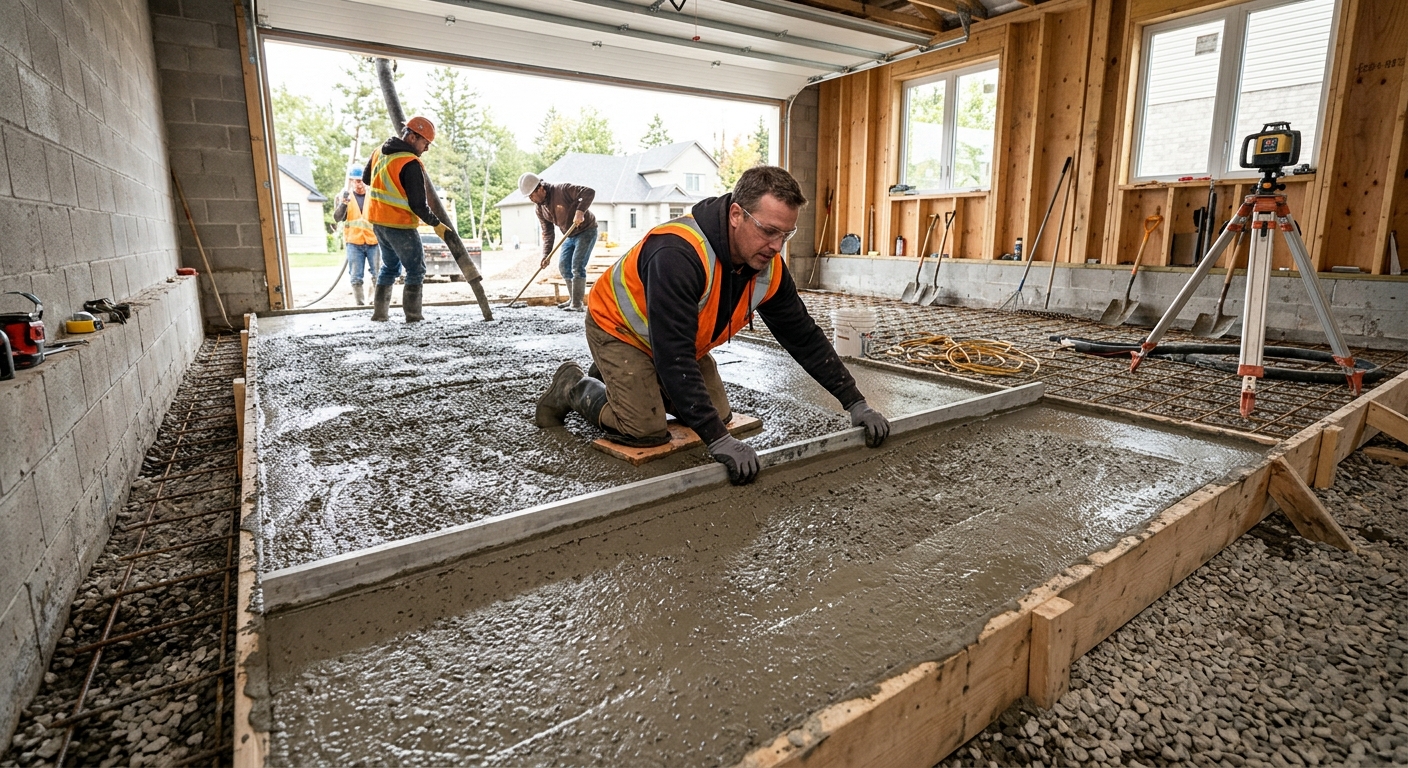
Concrete work options and costs in Fruitvale
Concrete work in Fruitvale is a practical, long-term choice for homeowners, especially because local housing stock is older—about 69.0% of homes were built before 1981 (Statistics Canada, 2021 Census). In this community, single-detached houses make up 72.7% of dwellings, so driveways, patios, walkways and garage floors are constant upgrade targets. You’ll also see many homeowners actively maintaining their properties: there are 690 homeowner households, and 80.7% of households own (Statistics Canada, 2021 Census).
In the Kootenays, pricing and availability are shaped by cold continental winters and micro-climates across the region. Fruitvale’s freeze–thaw cycles mean contractors must protect against heave and random cracking: footings typically need to sit below frost depth, and exterior slabs require air-entrained concrete plus a careful joint layout. Because the pour season is shorter, scheduling matters—cold-weather curing (blankets, insulated enclosures, or added heat) often pushes costs up versus milder parts of BC. Labour and fuel costs across British Columbia have also influenced what you’ll see on bids, particularly for jobs that require extra excavation and drainage.
In Fruitvale proper, we tend to get the most driveway and walkway demand from the residential areas near the downtown core (around Victoria Avenue and connections toward the highway corridor), where vehicle access and sidewalk tie-ins are frequent. Use the table below to compare common options and typical price ranges before you book site measurements.
| Application |
Typical Size |
Key Spec |
Finish Option |
Price Range |
| Concrete driveway (standard broom finish) |
12 m x 3 m (36 m²) |
Air-entrained exterior mix, compacted granular base, control joints |
Broomed surface |
$18,000–$28,000 |
| Exposed aggregate driveway |
12 m x 3 m (36 m²) |
Air-entrained exterior mix, retarder/clean exposure plan, sealed finish |
Exposed aggregate |
$24,000–$36,000 |
| Stamped concrete driveway or patio |
25 m² (driveway apron/patio section) |
Air-entrained mix, proper base drainage, non-slip stamping approach |
Stamped + integral or hardener colour |
$6,500–$10,000 |
| Plain concrete patio or walkway |
20 m² patio or 1.2 m x 6 m walk |
Exterior air-entrained mix, edges formed, jointing |
Float and light broom/medium texture |
$3,000–$5,000 |
| Garage floor (interior slab) |
6 m x 6 m (36 m²) |
32 MPa mix, vapour barrier (if required), jointing plan |
Steel trowel finish or broom finish |
$10,000–$16,000 |
| Foundation footings (structural, below frost) |
Per linear metre (typical 40–60 m total) |
Engineered layout, below-frost depth excavation, reinforcing |
Formed concrete with proper curing |
$70–$120 |
Prices are estimates only and vary by project scope, site access and material selection.
What affects the price of concrete work in Fruitvale
In the Kootenays, it’s common to see the same concrete scope come back 30–50% apart on quotes—especially when one contractor includes the “winter survival” items (base drainage, below-frost preparation, air-entrained mix, curing protection) and another assumes standard conditions. In British Columbia, micro-climates matter: Fruitvale’s freeze–thaw cycles require specifications that reduce heaving, spalling and random cracking. That means footings and structural concrete must be set below design frost depth—locally, the practical result is deeper excavation and more form height than homeowners expect. Exterior slabs and driveways should use air-entrained concrete (to withstand repeated freeze–thaw), while colder scheduling often shortens the pour window and increases the need for heated curing, curing blankets, and stricter timing.
De-icing salt is another cost driver: it can accelerate surface scaling/spalling if the mix and finishing/sealer aren’t right. In Fruitvale, where many driveways belong to older homes (and sometimes have older fill soils around the foundation perimeter), we often find areas that need extra over-excavation and re-compaction to correct drainage. On the flip side, costs can come down when your base is already stable, drainage is clear, and truck access is straightforward.
For example, a standard broom driveway might land in the $18,000–$28,000 zone, while a stamped driveway typically costs more because of additional labour for stamping/colour, plus thicker attention to finishing control. An exposed aggregate surface can also require extra crew time and material handling, but it can be justified if you’re prioritizing non-slip texture for winter traction.
| Price Factor |
Why It Matters |
Cost Impact |
| Frost line depth |
Determines footing depth and form height |
Higher excavation and concrete volume; major driver of total cost on foundations |
| Site preparation |
Excavation, grading, compacted granular base |
Unstable soils, soft spots, or poor drainage can add labour and materials |
| Reinforcement |
Rebar or wire mesh requirement |
Increases material and placement time; essential where loads or engineer specs demand it |
| Mix design |
Air-entrainment and compressive strength spec |
Air-entrained exterior mixes and higher strength add cost but reduce failure risk in freeze–thaw |
| Finish type |
Broom vs. stamped vs. exposed aggregate |
Decorative work increases labour and materials; can add a noticeable premium |
| Pour size and concrete truck access to site |
Crews need efficient placement and minimal re-handling |
Hard access can mean smaller batch logistics or pump/extra equipment |
| Cold-weather curing precautions |
Heating and blankets |
Shortened season and winter protection add overhead and labour |
| Control joint pattern and sealing cost |
Controls cracking and protects from salts/abrasion |
Correct joint spacing is labour; sealing is an added material step (but helps longevity) |
Permits & regulations in British Columbia
In British Columbia, concrete can fall into two different buckets: structural work that typically requires permitting, and flatwork that often does not. Structural concrete work such as foundation footings, foundation walls, and grade beams generally requires a building permit and, in many cases, engineered drawings reviewed by the municipality. Concrete flatwork—like patios, walkways and driveways—usually doesn’t require a permit unless it affects lot grading, drainage, impervious surface coverage limits, or ties into a municipal right-of-way.
Always confirm with your local authority before breaking ground, even for “just a driveway,” because the municipality may have rules about slope/grading, runoff direction, or access points.
When hiring in Fruitvale, verify your contractor’s coverage and standing in B.C. Step-by-step: (1) ask for their B.C. business information and check their online listing through the provincial contractor/building trades resources (the goal is to confirm they are active and properly listed for the work they’re advertising); (2) request a current Certificate of Insurance showing liability coverage—your contractor should list your project address (or be willing to confirm coverage details); and (3) confirm their workers’ compensation clearance, commonly handled through WCB accounts. Ask for the clearance proof in writing before work starts. Finally, request references from similar-scale flatwork and slab projects so you can compare finishing quality, jointing, and how they handled the winter conditions.
Getting concrete right in Fruitvale's freeze-thaw climate
Concrete fails in Fruitvale’s freeze–thaw climate when water finds weak spots, the base isn’t compacted to the right depth, or the mix and finishing don’t resist repeated expansion and salt exposure. The fix is in the spec. Start with (1) base preparation: excavate to the proper depth for local soils and frost considerations, then install a compacted granular sub-base with correct grading and drainage so water doesn’t sit under the slab. Next (2) mix design: for exterior flatwork, you want air-entrainment (typically in the 5–7% air range for durability in freeze–thaw) and a minimum 32 MPa compressive strength. (3) control joints: plan joint spacing to reduce random cracking—this is where many DIY or “value” bids fall short. (4) curing: ensure a minimum 7-day cure under proper conditions; in cold weather, curing blankets or enclosures protect strength development and surface quality. (5) sealing: apply a penetrating sealer after cure (commonly around 28 days) to repel de-icing salts and reduce surface scaling.
If a contractor skips air-entrainment or uses the wrong exposure/finishing plan, you risk spalling—small surface flakes that expand into rough edges over winters. It’s not unusual to see long-term repairs cost more than choosing the right driveway finish initially.
For a dollar example: if you’re choosing between a broom-finished driveway in the $18,000–$28,000 band and a stamped option in the $6,500–$10,000 band for a smaller patio-sized section, the decorative premium is justified when it includes correct base prep, air-entrained mix, jointing, and adequate curing. If the scope details are vague, pay attention—saving upfront often shows up later as cracking, patched areas, or premature surface breakdown.
| Spec |
Why It Matters in Fruitvale |
What to Ask For |
Impact if Skipped |
| Compacted granular base (depth?) |
Prevents settlement and water-related heave during freeze–thaw |
Confirm excavation depth, granular thickness, and compaction test/approval method |
Settlement, cracking, and voids that can trap water under the slab |
| Air-entrained concrete mix (target air %?) |
Durability against repeated freezing and thawing |
Ask for air-entrainment specification (typically 5–7% for exterior flatwork) |
Higher risk of surface scaling/spalling in winter |
| Compressive strength (MPa rating) |
Ensures strength development through cold conditions |
Confirm minimum 32 MPa rating for the exterior slab application |
Weaker surface that degrades faster under snowplough abrasion and salt |
| Control joints (spacing per ACI guidelines) |
Controls where cracking happens, reducing random fractures |
Ask for joint layout drawing and spacing plan |
Random cracking and difficult-to-fix slab damage |
| Minimum 7-day curing period |
Strength gain and surface quality in cold weather |
Confirm curing method and whether blankets/heating are planned |
Surface weakness, cracking, and poorer long-term durability |
| Penetrating sealer (when applied after cure) |
Helps repel de-icing salts and reduces scaling |
Ask for timing (commonly after cure, around 28 days) and sealer type |
Faster surface deterioration and stain/spotting |
How to choose a concrete work contractor in Fruitvale
Choosing the right concrete contractor in Fruitvale comes down to verification, clarity, and how they protect the slab in winter conditions. In British Columbia, first confirm licensing/registration for the type of work they’re quoting and ask for their business information. Next, request liability insurance—get a Certificate of Insurance and confirm it’s current. For workers’ compensation, ask how they provide WCB/WCB clearance documentation and obtain proof before work starts (your contractor should be able to provide it). If they can’t produce these items quickly, that’s a major red flag for a trade where winter durability spec matters.
Then, get 2–3 quotes that are itemised—not just a lump sum. You want labour and materials broken down (excavation, forms, granular base, steel/rebar if required, concrete supply, finishing, joints, and sealing). Make sure you understand what’s excluded: permit pull (if applicable), disposal/haul-away, traffic control, saw cutting, coring, and any changes to drainage. Clarify whether they include cold-weather protection for your expected pour dates.
Finally, protect yourself with warranty and scheduling. Ask for workmanship warranty length in writing and whether it’s transferable if you sell the home. Agree on a payment schedule: never pay more than about 10–15% upfront; use progress payments and holdback until completion and clean-up. Get a start date and completion estimate in writing, plus what happens if weather delays the pour or curing.
- Ask what air-entrainment and strength spec they will use for exterior work (and where it’s written in the quote).
- Confirm footing/below-frost requirements are included where the scope includes foundations.
- Get confirmation of granular base depth and compaction method (not just “we’ll prepare the base”).
- Request a joint layout (spacing and location) and whether joints are saw-cut or formed.
- Clarify curing plan for cold weather: blankets, enclosures, or heating—when needed.
- Confirm finishing method (broom profile, trowel timing, curing compound or not) for traction.
- Ask if a penetrating sealer is included and when it will be applied after cure.
- Make sure disposal/haul-away and any soil/rock removal are included if excavation is required.
- Check for truck access and placement method; confirm if pump/chute is required.
- Verify insurance and workers’ compensation clearance before any concrete is delivered.
- Require an itemised written scope with unit prices where possible, so changes are easy to track.
- Agree on warranty terms in writing, including what “defect” means and what maintenance is expected.
Concrete contractor red flags in Fruitvale include: vague specs (no mention of air-entrainment or jointing), refusing to document insurance/WCB clearance, promising winter pours without curing protection, quoting too low without including excavation/compaction and proper base, and using a “one-size” mix or finish plan that doesn’t account for freeze–thaw and salt exposure.
Frequently asked questions — concrete work in Fruitvale
How long does a concrete driveway last?
In Fruitvale and across the Kootenays, a well-built driveway typically lasts decades, but longevity depends on how the base and winter durability are handled. Driveways experience freeze–thaw expansion, de-icing salt exposure, and tire/snowplough abrasion. If the contractor used air-entrained concrete, installed a properly compacted granular base, and controlled cracking with the right joint spacing, your driveway is far more likely to stay smooth without early scaling or spalling. If you’re comparing options, the durability spec is often more important than surface aesthetics. For example, a standard broom driveway is commonly quoted in the $18,000–$28,000 band depending on thickness, excavation, and access, while decorative finishes cost more but still rely on the same underlying freeze–thaw precautions.
What is air-entrained concrete and why does it matter here?
Air-entrained concrete is designed to include tiny, evenly distributed air bubbles in the mix. In British Columbia’s Kootenay region, those bubbles give expanding ice somewhere to go during freeze–thaw cycles, reducing internal pressure that leads to scaling and spalling. In Fruitvale, where winters are cold and the freeze–thaw rhythm is frequent, air-entrainment is one of the most important durability requirements for exterior slabs, patios, and driveways. A driveway that looks fine initially can still fail prematurely if the air content was too low or the mix didn’t meet an exterior exposure spec. When you request quotes, ask for the air-entrainment target (commonly 5–7% for exterior flatwork) and the compressive strength (often minimum 32 MPa) so you can compare “apples to apples.”
How do I prepare the base for a concrete slab?
Base preparation in Fruitvale starts with excavation to the correct depth, then installing and compacting granular material to support the slab and control water movement. Cold climates punish weak bases: if the granular base is too thin, poorly compacted, or water can collect underneath, the slab can heave and crack over multiple winters. A good contractor will also address drainage and grading so runoff isn’t directed under the slab. For exterior work, you want a stable, well-compacted sub-base before any steel or vapour barrier components are placed (where needed). When comparing quotes, insist the scope names excavation/grading, granular base thickness, and compaction expectations. Skipping or downgrading base preparation is one reason some driveways crack early even if the finishing looks good at pour day.
How do I compare concrete quotes?
Start by comparing scope details line-by-line, not just the total number. Ask each contractor to itemise labour and materials: excavation, forms, granular base, reinforcement (if required), concrete supply, finishing, jointing, curing protection, sealing (if included), and disposal/haul-away. In Fruitvale, ensure the quote confirms exterior freeze–thaw durability: air-entrained mix, a minimum 32 MPa compressive strength, and a control joint plan. Also clarify cold-weather measures—blankets or enclosures—because in the Kootenays the pour season is shorter and curing may be more complex. If you’re looking at pricing bands, compare realistic ranges such as $18,000–$28,000 for a standard driveway versus higher-decorative options, and make sure the “cheaper” bid isn’t missing excavation depth, joints, or curing/air specs. A clear written scope is usually a better indicator than marketing claims.
Can concrete be poured in cold weather in Fruitvale?
Yes, concrete can be poured in cold weather in Fruitvale, but it must be handled correctly. The risk isn’t just the temperature—it’s preventing freezing during the early curing period, because strength gain needs time. In the Kootenay climate, contractors often use curing blankets, insulated enclosures, and sometimes heating around the pour area to keep concrete within acceptable curing conditions. You should ask the contractor what the plan is for your proposed pour date: how they’ll manage night temperatures, whether they’ll insulate formwork and slabs edges, and how long they’ll protect the concrete. Quotes that don’t mention cold-weather curing precautions are incomplete for exterior work. If the weather is too severe or conditions can’t be controlled, delays can be the safest and ultimately cheaper choice versus paying for remedial patches later.
How do I maintain concrete in Fruitvale's freeze-thaw climate?
Maintenance in Fruitvale is mostly about water and salt management. Keep an eye on drainage: if runoff is channelled toward the driveway edges or foundation, fix grading or add drainage solutions. For de-icing, use salt carefully and avoid over-salting because it can accelerate surface deterioration. Sealing helps—many exterior flatwork projects benefit from a penetrating sealer applied after the concrete has cured (often around 28 days). Inspect yearly for early signs like surface scaling, popped aggregates, or widening cracks around joints. Small crack or joint damage is easier to address early than after water infiltrates and expands during freezes. If you had a broom finish, keep it reasonably clean to avoid embedded grit grinding down the surface. When you choose a contractor, confirm whether sealing is included; that detail can affect long-term performance in British Columbia’s winters.