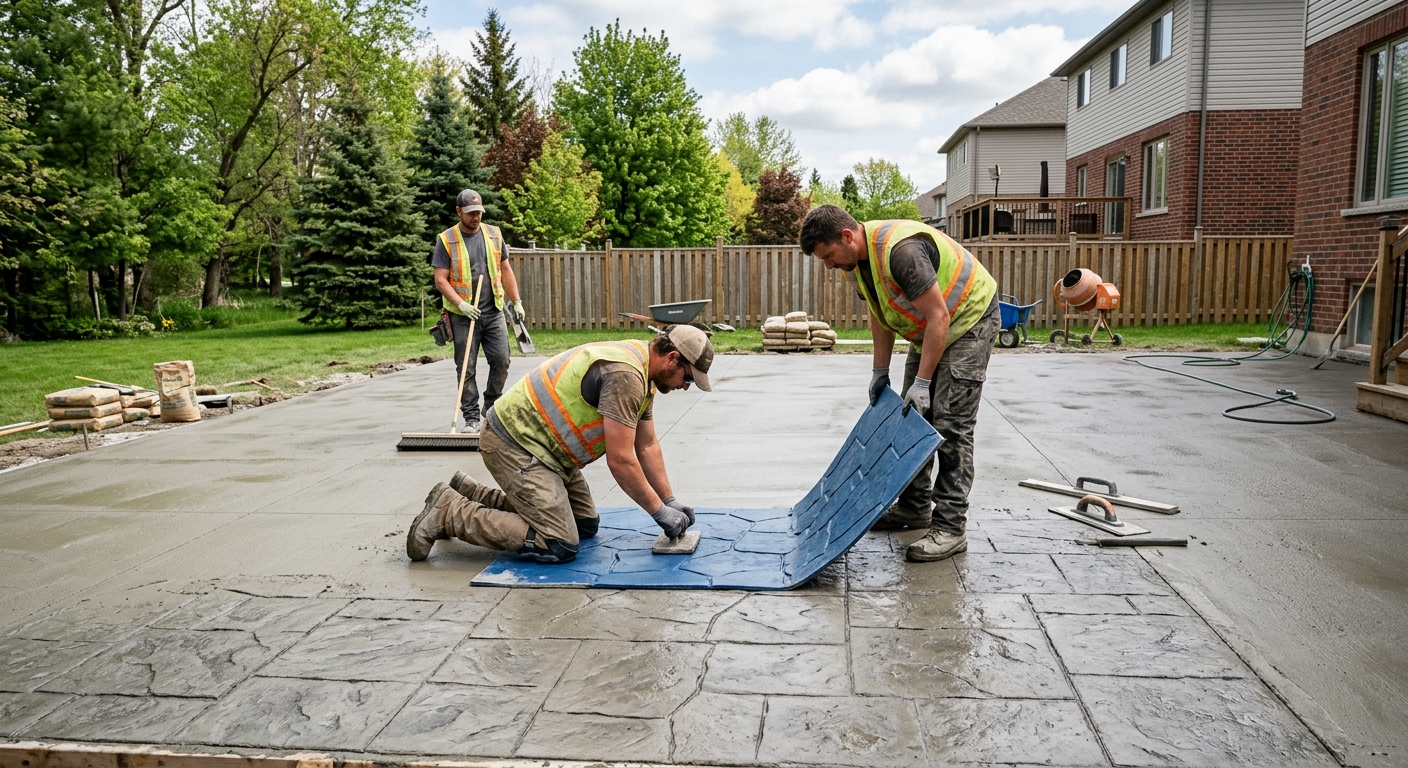
Concrete work options and costs in Caulfeild
In Caulfeild, homeowners typically book concrete work because it’s durable in a coastal-wet climate and holds up well through the frequent freeze–thaw cycles that hit the Lower Mainland–Southwest. With a local population of 3,757 people (Statistics Canada, 2021 Census), Caulfeild is a small market—so availability can be tighter than in larger centres, and schedule windows often book up around dry-weather stretches. Most concrete flatwork goes on single-detached homes and similar lots, where driveways, patios and walkways are treated as year-round exterior “infrastructure,” not just a cosmetic upgrade.
In this region, costs are shaped by the shallow-but-critical frost depth (local practice commonly assumes about 450 mm / 18"). That means footings and thickened edges must sit below frost to reduce the risk of freeze heave, even when winters feel mild compared with inland BC. Coastal rainfall also affects sequencing: sub-base prep, drainage, and curing plans need to account for cool nights and high humidity. Contractors often include curing blankets, sealers, and longer cure times to protect surfaces from scaling and salt-related wear.
Concrete demand is especially strong around Caulfeild’s commercial-and-neighbourhood pocket along Cross Creek Road, where property upkeep and upgrades are frequent. If you’re comparing options, start with typical pricing for common jobs, then tighten specs based on your soil conditions, access, and finish choice—see the table below.
| Application |
Typical Size |
Key Spec |
Finish Option |
Price Range |
| Concrete driveway (standard broom finish) |
400–600 sq ft |
Air-entrained exterior mix, control joints, compacted granular base |
Broom finish, optional sealer |
$7,200–$13,500 |
| Exposed aggregate driveway |
400–600 sq ft |
Air-entrained mix, proper base, sawcut joints |
Exposed aggregate (surface retarder/wash) |
$9,500–$16,800 |
| Stamped concrete driveway or patio |
300–500 sq ft |
Air-entrained mix, engineered base where required |
Stamp + color hardener (or integral color) |
$10,000–$19,000 |
| Plain concrete patio or walkway |
200–400 sq ft |
Air-entrained exterior mix, drainage allowance |
Smooth or broom finish |
$3,200–$8,000 |
| Garage floor (interior slab) |
300–500 sq ft |
Plain concrete, minimum thickness per design, vapour considerations if needed |
Broom finish |
$4,800–$10,500 |
| Foundation footings (structural, below frost) |
Varies by design |
Concrete below local frost depth, rebar per engineer, excavation/forming |
Structural concrete |
$200–$350 |
Prices are estimates only and vary by project scope, site access and material selection.
What affects the price of concrete work in Caulfeild
In the Lower Mainland–Southwest, you can see quote differences of 30–50% for “the same” concrete job, especially when comparing work done on different lots across British Columbia. The biggest swings are driven by what’s happening under the surface: excavation depth, base build-up, frost protection, reinforcement scope, and how difficult it is to get materials and crews on site. Even your finish choice matters, but it’s the groundwork and climate controls that usually account for most of the variance.
First, frost depth and freeze–thaw cycles dictate the design. Local practice commonly assumes a frost depth around 450 mm / 18" for typical detailing, but footings and thickened edges are placed below that to prevent frost heave. That leads to extra excavation and forming compared with an “above-grade” approach. Second, all exterior slabs need an air-entrained mix to survive repeated freeze–thaw and saturated coastal conditions; without the right air content, you’re more likely to see scaling and surface spalling. Third, when temperatures drop or nights run cool, contractors may need cold-weather curing precautions—curing blankets, insulated covers, and sometimes temporary heating—so concrete actually reaches strength. Finally, de-icing salt accelerates surface wear, which is why sealing is commonly included for driveways and patios.
In Caulfeild, I often price higher where drainage is poor and subgrade is soft—base prep can move from “standard” compacted granular to a deeper rebuild. Conversely, if you have straightforward truck access and firm, well-draining soils, a broom-finished driveway that falls in the $18–$28/sq ft band can land closer to the low end. For higher visual specs, stamped & decorative work sits more like $22–$36/sq ft, but the price is justified when the base, joints, and curing plan are done right—not just when the colour is added.
| Price Factor |
Why It Matters |
Cost Impact |
| Frost line depth — determines footing depth and form height |
Footings must sit below design frost depth to prevent freeze heave |
Higher excavation/form time can add substantial cost on sloped or engineered sites |
| Site preparation — excavation, grading, compacted granular base |
Correct base thickness and compaction protect slabs from settlement and cracking |
Soft subgrade or poor drainage increases granular supply, grading, and labour |
| Reinforcement — rebar or wire mesh requirement |
Reinforcement is selected based on load and slab design |
More rebar layers and tie-wire time increase labour; fibre alone may not be acceptable |
| Mix design — air-entrainment and compressive strength spec |
Exterior durability depends on proper air content and target strength |
Upgrading to the right exterior mix can raise material cost, but reduces failure risk |
| Finish type — broom vs. stamped vs. exposed aggregate |
Labour intensity and material handling differ by finish system |
Stamped/exposed generally costs more per square foot than broom finish |
| Pour size and concrete truck access to site |
Long ramps, narrow gates, or steep slopes increase labour and time |
Extra pumps/hoses, waiting time, and equipment can add to total price |
| Cold-weather curing precautions — heating and blankets |
Cool nights slow strength gain; curing protection helps reach design strength |
Blankets, temporary heat, and scheduling add cost and limit pour windows |
| Control joint pattern and sealing cost |
Joints manage cracking locations; sealing helps repel salt and moisture ingress |
Quality joint layout and proper sealer application add line-item cost but improve longevity |
Permits & regulations in British Columbia
In British Columbia, structural concrete work typically requires a building permit, often with engineered drawings reviewed through the local municipal process. That includes concrete elements like footings, foundation walls, and grade beams—essentially, any structural work that supports the building or is part of the engineered foundation system. Concrete flatwork (patios, walkways and driveways) usually does not require a permit on its own unless it impacts lot grading, drainage, impervious surface coverage limits, or work occurs near a municipal right-of-way. Because rules can be specific to your lot conditions, confirm with the local authority before breaking ground.
To protect yourself on a Caulfeild project, verify the contractor carries appropriate liability insurance and coverage for workers. Step-by-step, here’s how homeowners can check:
- Contractor licence/registration: search the applicable BC registry for the legal business name and confirm it matches the quote and invoicing.
- Certificate of Insurance (COI): ask for a current COI showing general liability limits; ensure your address is listed if they offer it as an additional insured arrangement.
- Clearance/coverage letter: confirm workers’ compensation coverage status (commonly referred to as WCB clearance in BC) for anyone working on site.
- References: request photos and references for similar-scale projects in the Lower Mainland–Southwest, especially exterior flatwork built for coastal-wet conditions.
- Scope confirmation: ensure the quote specifies base prep, air-entrained mix, curing method, and sealing timing.
Doing this upfront reduces the risk of change orders caused by missing engineering details, insurance gaps, or scope items like disposal and drainage.
Getting concrete right in Caulfeild's freeze-thaw climate
Concrete fails in Caulfeild mainly when water gets into the system and then expands during freeze–thaw cycles. The culprits are usually poor base prep, weak or improperly mixed concrete, inadequate air-entrainment, and control-joint mistakes that create random cracking paths. In the Lower Mainland–Southwest, prolonged rain and cool evenings can also slow curing, which means concrete may look “set” but still not reach the strength and surface durability needed for the season.
To spec the job correctly, start with (1) base preparation: the sub-base must be compacted granular to the right depth for your soil and frost protection needs, with drainage attention so water can’t pond under the slab. (2) mix design: ask for air-entrained exterior concrete, typically targeting 5–7% air content for exterior flatwork, and a minimum 32 MPa compressive strength at the specified curing period. (3) control joints: joints should be planned to limit cracking to intentional lines rather than letting cracks wander. (4) curing: plan for at least 7 days of curing under proper conditions; in cool, damp stretches, curing blankets or other temperature protection are often necessary. (5) sealing: for driveways and patios, penetrating sealer applied after the cure period helps repel de-icing salt and reduces moisture-related deterioration.
If you want an example of where the price difference makes sense: upgrading from plain broom-finish to stamped concrete can add roughly the $22–$36/sq ft decorative band compared with the standard driveway band of $18–$28/sq ft. It’s worth it when the contractor also budgets for the correct base, the right air-entrained mix, and a curing plan that protects the surface—otherwise, decorative work can still scale if the mix and curing are off.
Use this as your checklist when requesting quotes: “What’s your air-entrainment plan? How thick is your base and what compaction standard do you use? Where are the control joints and how will you protect the slab during the first week?” These questions target the common failure—spalling from inadequate air-entrainment and poor curing.
| Spec |
Why It Matters in Caulfeild |
What to Ask For |
Impact if Skipped |
| Compacted granular base (depth?) |
Stable support reduces settlement and keeps the slab flat through wet seasons |
Granular type, target compacted depth, and drainage details |
Uneven settling, cracking, and faster surface deterioration |
| Air-entrained concrete mix (target air %?) |
Air voids help concrete resist freeze–thaw scaling and spalling |
Target exterior air content (typically 5–7%) and mix design sheet |
Higher risk of spalling and scaling in coastal freeze–thaw cycles |
| Compressive strength (MPa rating) |
Strength gain supports durability and load capacity over time |
Minimum 32 MPa (or as engineered) and curing timeframe |
Surface can wear prematurely and crack under normal use |
| Control joints (spacing per ACI guidelines) |
Joints manage where cracks occur during shrinkage |
Joint layout, sawcut timing, and recommended spacing method |
Random cracking patterns and cosmetic/structural concerns |
| Minimum 7-day curing period |
Cold nights and coastal humidity can slow early strength development |
How they maintain curing conditions during rain/cool weather |
Reduced strength and increased long-term shrinkage cracking |
| Penetrating sealer (when applied after cure) |
Helps repel salts and moisture that drive freeze–thaw damage |
Confirm product type and application timing (often after 28 days) |
Faster surface wear and higher maintenance costs |
How to choose a concrete work contractor in Caulfeild
Choosing the right concrete contractor in Caulfeild is mostly about proof: proof they’ve built similar exterior flatwork for Lower Mainland–Southwest conditions, proof they carry proper coverage, and proof their quotes include the spec details that prevent freeze–thaw damage. In British Columbia, verify three things. First, licensing/registration: check the contractor’s legal business name against the BC registry for active status. Second, liability insurance: ask for a Certificate of Insurance showing general liability limits (and request the COI to be dated recently). Third, workers’ coverage: confirm they have current WCB/WCB clearance for the workers doing the work; you want this before any demolition, excavation, or forming starts.
Next, get 2–3 itemised written quotes. Ask for a line-by-line breakdown including labour and materials, not just one lump sum. Make sure the quote spells out: excavation and disposal, granular base type and depth, reinforcement (rebar/wire mesh), the air-entrained mix spec, finishing steps, curing method, and whether sealing is included (and when it’s applied). Clarify exclusions: is the contractor including permit pull (if required), driveway tie-ins, forms for thickened edges, and any engineering requirements?
Warranty and payment should be conservative. Look for a workmanship warranty length that’s clearly stated, understand whether any product/manufacturer warranty applies to you directly, and confirm whether it’s transferable if you sell. On payment schedule, never pay more than 10–15% upfront; hold back a final portion until the job is complete and cleaned up.
Finally, demand a timeline: get the proposed start date and estimated completion date in writing, with weather contingencies. In Caulfeild’s wet, cool shoulder seasons, schedule certainty depends on curing protection—good contractors build that into their plan.
- Confirm BC registry status matches the company name on the quote.
- Request current COI for liability insurance before signing.
- Verify workers’ coverage (WCB/WCB clearance) for the team on site.
- Get 2–3 itemised quotes with labour + material breakdowns.
- Require air-entrained exterior mix for any driveway/patio exposed outdoors.
- Ask for base depth, granular type, and compaction approach.
- Ensure reinforcement details are written (rebar size, spacing, or mesh requirement).
- Check whether disposal, haul-away, and topsoil removal are included.
- Confirm control joint pattern, sawcut timing, and sealing plan.
- Ask how they handle rain and cool nights during curing.
- Review warranty terms in writing; separate workmanship vs product warranty.
- Set payment milestones so the final holdback is tied to completion and cleanup.
Concrete red flags to watch for in Caulfeild: contractors who won’t specify air-entrainment/mix, quotes that omit base prep depth and drainage, vague “we’ll do joints” language without spacing, promises to pour/finish regardless of rain without curing protection, and pricing that’s far below typical bands (for example, a driveway priced like the $18–$28/sq ft range when decorative work is requested, or when excavation and rebar clearly should be included).
Frequently asked questions — concrete work in Caulfeild
Why does concrete crack in Caulfeild and how is it prevented?
Concrete in Caulfeild usually cracks for predictable reasons: normal shrinkage, temperature movement, and weak support. The coastal-wet climate and freeze–thaw cycles don’t just affect durability—they also magnify the consequences of small issues like trapped moisture or an underbuilt base. Prevention is mostly about detailing: proper compacted granular support, an exterior air-entrained mix, and a control joint plan that limits cracking to intentional lines. For driveways in this area, many projects land around the standard driveway band of $18–$28 (per sq ft), but the “real” cost is tied to base prep and joint layout. If a quote skips those specs, cracking becomes more likely within the first seasons.
Stamped vs broom-finish concrete — cost difference?
Stamped concrete costs more than broom-finish because it’s labour-intensive and uses additional materials (release agents, stamp mats, and often colour systems). In the Lower Mainland–Southwest, broom-finish driveway work commonly falls in the $18–$28/sq ft band, while stamped and decorative concrete typically runs $22–$36/sq ft. In Caulfeild, the decision isn’t only about appearance—stamped work must still include the same freeze–thaw durability specs (air-entrainment, correct base prep, and proper curing). If the contractor promises a decorative surface but doesn’t budget for drainage and curing protection, you can pay more and still get scaling or premature wear.
When is the best time to pour concrete in Caulfeild?
The “best” time in Caulfeild is when you can manage curing: ideally a stretch with minimal rain, workable temperatures, and predictable drying conditions for finishing and protection. While winters are milder than interior BC, cool nights and persistent coastal moisture still slow strength gain. Contractors often plan pours around short weather windows and may use curing blankets when temperatures dip, especially for exterior flatwork. If cold weather handling isn’t built into the schedule, you can see slower strength development and increased surface wear later. Practically, homeowners get the best outcomes when they schedule early enough for the contractor to prep drainage and base correctly—before the pouring day—rather than rushing on a day with high rainfall.
How long does concrete take to cure?
Concrete curing has two timeframes homeowners should understand: initial set and design strength. For typical exterior flatwork in British Columbia, you should plan for at least a 7-day curing period before treating the slab as “usable,” especially in cool, wet conditions typical of Caulfeild. Full strength development generally continues beyond that, and durability improvements—like sealing—are typically scheduled after the slab has had time to cure properly (often around 28 days for many sealers). If rain or cold nights occur, a good contractor protects the surface and maintains curing conditions so the mix can reach the intended strength. That’s also why solid quotes include curing blankets or other cold-weather precautions when needed.
Do I need a permit for concrete work in British Columbia?
In British Columbia, structural concrete work—such as footings, foundation walls, and grade beams—typically requires a building permit and often engineered documentation reviewed in the municipal process. Concrete flatwork (driveways, patios, and walkways) usually doesn’t require a permit by itself unless it affects lot grading, drainage planning, impervious surface coverage limits, or work occurs near a municipal right-of-way. For a Caulfeild homeowner, the safest approach is to ask the contractor to confirm whether your scope changes drainage or grading and then verify with the local authority before starting. Also confirm the contractor has liability insurance and current workers’ coverage for the crews on site.
Concrete vs pavers for a patio in Caulfeild?
Both concrete and pavers can work well in Caulfeild, but they fail differently. Concrete patio slabs are monolithic and—when built on a proper compacted granular base with correct drainage—can be very durable and cost-predictable. Pavers can be easier to local-repair if a section shifts, but they still depend on base preparation and proper edging. Concrete typically fits a wide range of budgets: plain patios and walkways often land around the $16–$26 band, while stamped/decorative options can push higher within the $22–$36 range. If you value a smoother, continuous look and want less surface joint maintenance, concrete is usually the practical choice—just ensure the mix is air-entrained and the control joints are done to manage cracking in freeze–thaw cycles.