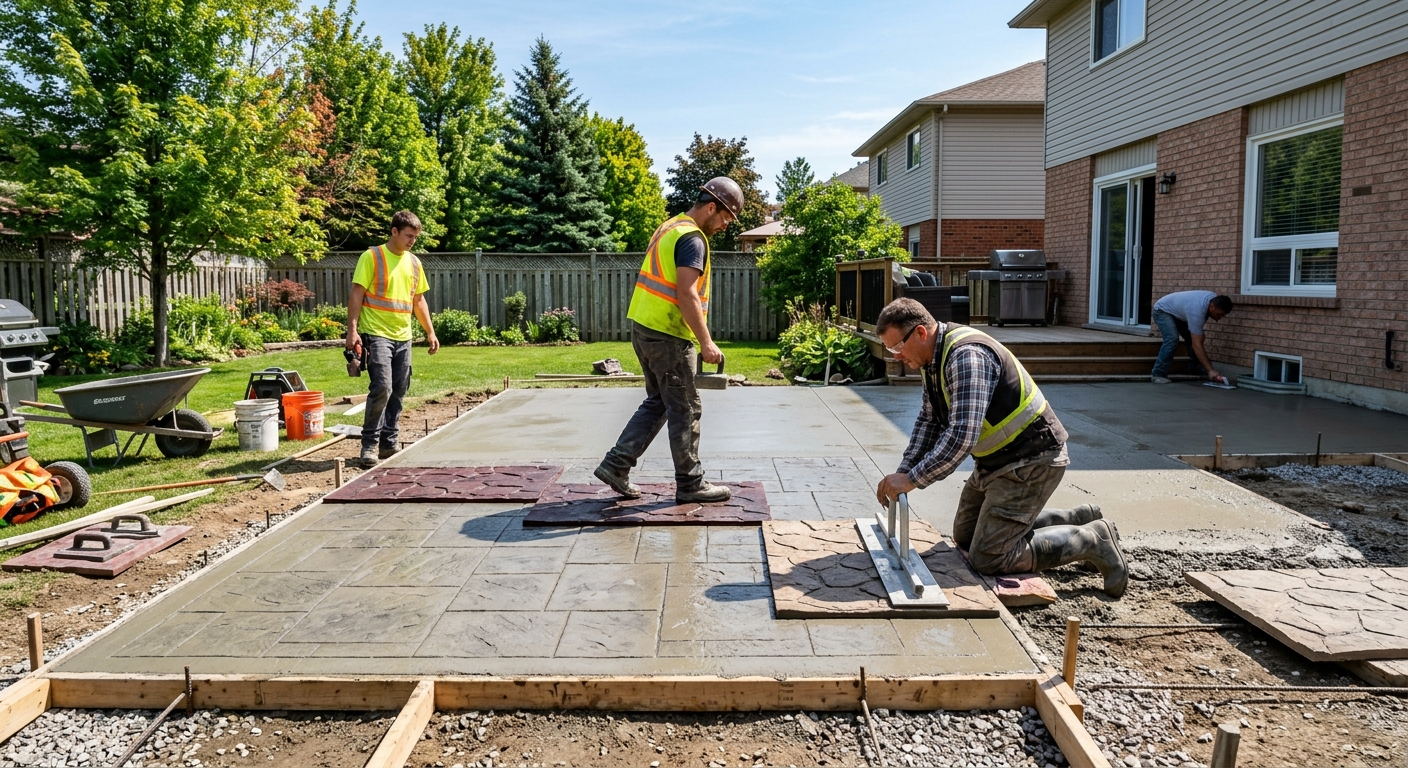
Concrete work options and costs in Glenrosa
Concrete work in Glenrosa is a practical upgrade for driveways, patios and foundations, and costs here reflect the Lower Mainland–Southwest climate as much as the size of the job. Glenrosa has a population of 6,039 (Statistics Canada, 2021 Census), and most homeowners are dealing with established residential lots where drainage, grading and access can make a big difference once excavation begins. In this area, concrete flatwork is especially common in neighbourhoods like the Glenrosa residential core, where older drive approaches and walk paths often need replacement rather than patching. Across British Columbia, concrete contractors also see steady demand from homeowners who want durable surfaces that can handle the region’s wet winters and repeated freeze–thaw cycles.
In the Lower Mainland–Southwest, the frost line is typically planned around 450 mm / 18" in design. Even with milder winters than interior BC, we still place footings and thickened edges below that design depth to reduce frost heave, and we specify air-entrained mixes for exterior slabs. Coastal rainfall and frequent cool nights can also slow curing, so contractors often schedule around prolonged wet weather and use curing blankets or sealers to protect the surface. That’s why you may see quote differences on the same “standard” driveway: one contractor priced a full engineered base with proper drainage and air-entrainment; another priced minimal prep and shorter curing assumptions.
Use the table below to compare realistic options and the typical price band you’ll see in Glenrosa, then match the finish to your site conditions and expectations for longevity.
| Application |
Typical Size |
Key Spec |
Finish Option |
Price Range |
| Concrete driveway (standard broom finish) |
400 sq. ft. (about 20' x 20') |
Air-entrained exterior mix, compacted base, control joints |
Light broom texture |
$7,200–$11,200 |
| Exposed aggregate driveway |
400 sq. ft. (about 20' x 20') |
Air-entrained exterior mix, drainage-ready base, proper edging |
Exposed stone aggregate finish |
$8,800–$14,000 |
| Stamped concrete driveway or patio |
300 sq. ft. (about 15' x 20') |
Air-entrained exterior mix, base prep, release agents & curing plan |
Stamp mats, colour hardener or integrally coloured options |
$9,000–$13,800 |
| Plain concrete patio or walkway |
200 sq. ft. (about 10' x 20') |
Air-entrained exterior mix, compacted granular base, joints |
Float/smooth or broom texture (light) |
$3,200–$5,200 |
| Garage floor (interior slab) |
400 sq. ft. (about 20' x 20') |
Vapour barrier (as required), fibres or wire mesh, well-prepped sub-base |
Trowel finish |
$6,000–$10,000 |
| Foundation footings (structural, below frost) |
Assorted linear footage (typical entry: short run + piers) |
Excavation to below design frost, rebar, engineered formwork |
Structural concrete only (no decorative finish) |
$6,000–$14,000 |
Prices are estimates only and vary by project scope, site access and material selection.
What affects the price of concrete work in Glenrosa
In the Lower Mainland–Southwest, it’s common to see the same concrete job priced 30–50% differently across British Columbia. That gap usually comes from how thoroughly the contractor handles the items that prevent failure: excavation depth below frost, base preparation and drainage, mix design (especially air-entrainment), reinforcement, and curing/finishing time. Two contractors might both quote a “400 sq. ft. driveway,” but one includes full compacted granular base and proper joint layout; the other may under-spec excavation or assume faster curing in wet weather. In Glenrosa, where exterior slabs face saturated soil and repeated freeze–thaw cycles, those differences show up in both durability and labour time.
Frost depth planning drives a major portion of structural scope. Exterior footings and thickened edges must extend below the design frost depth to reduce frost heave, and the region’s practice commonly plans around 450 mm / 18". Exterior slabs also require air-entrained concrete so the freeze–thaw cycle doesn’t scale and spall the surface. Cold snaps can shorten pour windows, and cool nights plus high humidity mean curing may need blankets or longer protection—both add cost. De-icing salts (when used on sidewalks and drive edges) can accelerate surface wear if the concrete isn’t properly sealed after cure.
In Glenrosa specifically, costs often rise when there’s soft/low-bearing soil that needs thicker granular base and careful drainage, or when access limits truck placement—adding shoring, additional labour, and longer pump/handling times. Costs can be lower when a site is flat, already serviced, and drainage is straightforward, keeping excavation and disposal minimal. As a budgeting anchor: a standard driveway often lands in the $18–$28 per sq. ft. band, while stamped work commonly sits higher (often compared as $22–$36 per sq. ft.) because it needs more labour for forming, stamping and finishing.
| Price Factor |
Why It Matters |
Cost Impact |
| Frost line depth |
Determines footing depth and form height to prevent frost heave |
Higher excavation and formwork can add significant labour and disposal |
| Site preparation |
Excavation, grading, and compacted granular base control settlement and cracking |
More base depth and compaction time increases material and labour costs |
| Reinforcement |
Rebar or wire mesh helps control cracking and supports load transfer |
Added steel, tying, and placement can raise the quote |
| Mix design |
Air-entrainment and strength spec improve freeze–thaw durability |
Specialty mix can cost more per yard; it’s a major durability driver |
| Finish type |
Broom vs. stamped vs. exposed aggregate affects labour time and materials |
Stamped/exposed typically add cost versus plain broom finishes |
| Pour size and concrete truck access to site |
Smaller pours and tight access increase handling time and equipment needs |
Longer labour and possible pump/extra crew hours |
| Cold-weather curing precautions |
Heating, blankets and cure protection help reach design strength |
Additional materials and time; can extend scheduling |
| Control joint pattern and sealing cost |
Joints reduce random cracking; sealing helps resist de-icing salt scaling |
More layout time plus sealer cost, often quoted separately |
Permits & regulations in British Columbia
In British Columbia, structural concrete work such as footings, foundation walls, and grade beams generally requires a building permit, and you’ll often see engineered drawings reviewed as part of the permitting process. Concrete flatwork—driveways, patios and walkways—typically does not require a permit by default, unless it affects lot grading, drainage, or triggers municipal requirements related to impervious surface coverage or the municipal right-of-way. Before work starts in Glenrosa, confirm the scope with the local authority to avoid rework.
Regardless of permit requirements, homeowners should treat contractor qualification as non-negotiable. Before excavation, verify the contractor carries liability insurance and WCB/WSIB coverage (as applicable to the company’s payroll structure and compliance obligations). Ask for a list of recent projects that match your scope size (for example, a driveway with similar slope and drainage issues), not only decorative work.
To verify compliance step-by-step in British Columbia:
- Check the contractor’s registration/licence status using the provincial online registry where contractors are listed.
- Request a certificate of insurance showing liability coverage; verify the policy is active and includes the correct named insured.
- Ask for proof of WCB/WSIB coverage and confirm it covers the crews who will be on site.
- Request references for similar Glenrosa-style exterior work (drainage and freeze–thaw durability).
If a contractor can’t provide documents or wants to start first and “paperwork later,” that’s a risk—especially for foundation-level concrete that needs proper approvals.
Getting concrete right in Glenrosa's freeze-thaw climate
Concrete failures in Glenrosa are usually climate-driven. The biggest enemy is freeze–thaw damage when water penetrates the slab surface or sits under a poorly drained base. In the Lower Mainland–Southwest, the frost line is often planned around 450 mm / 18", but you can still get trouble from saturated soils, cool nights, and repeated temperature swings. If the mix isn’t air-entrained or if curing is interrupted during the first days, the concrete can scale and spall—especially near edges, joints, and areas exposed to de-icing salts. Cracking also accelerates if the base isn’t compacted to a stable, properly graded profile.
To spec the job correctly, focus on five areas: (1) base preparation with compacted granular sub-base to the right depth and grade for drainage and frost protection; (2) mix design using air-entrainment and a minimum compressive strength (commonly 32 MPa for exterior flatwork); (3) control joints set early enough and spaced to limit random cracking; (4) curing with adequate protection—minimum 7 days, with extra measures if conditions are cool and wet; and (5) sealing after cure to repel moisture and reduce salt-related wear.
For example, the price gap between a plain broom-finish driveway and a more durable “full-spec” exterior approach is often justified. If your options are roughly in the $18–$28 per sq. ft. driveway band, choosing the higher end can make sense when the contractor includes a thicker compacted base with better drainage, uses properly air-entrained mix, and plans curing blankets for cool nights. That’s how you buy fewer surface repairs and avoid repeat tear-outs.
When you’re asking questions, push on air-entrainment and curing first—spalling from inadequate air entrainment is one of the most common avoidable problems in wet coastal climates.
| Spec |
Why It Matters in Glenrosa |
What to Ask For |
Impact if Skipped |
| Compacted granular base (depth?) |
Stable support reduces settlement and pumping during freeze–thaw |
Granular depth and compaction method matched to your subgrade and frost strategy |
More cracking, edge failure, and uneven slab movement |
| Air-entrained concrete mix (target air %?) |
Protects against scaling/spalling from water freezing inside paste |
Target air content (commonly 5–7% for exterior flatwork) and mix documentation |
Surface scaling, pop-outs, and faster deterioration |
| Compressive strength (MPa rating) |
Ensures the concrete reaches design performance for durability |
Minimum 32 MPa rating (or project-specific requirement) |
Lower strength increases cracking and abrasion wear |
| Control joints (spacing per ACI guidelines) |
Controls where cracks form during shrinkage and temperature change |
Joint spacing plan and timing for cutting/finishing workflow |
Random cracking and wider joints that admit water |
| Minimum 7-day curing period |
Cold nights and wet humidity slow strength gain |
Minimum 7 days curing under proper conditions; curing blankets/sealer plan if needed |
Surface weakness, reduced durability, increased early cracking |
| Penetrating sealer (when applied after cure) |
Repels moisture and helps limit de-icing salt-related surface damage |
Apply penetrating sealer at least 28 days post-pour (after cure), per product spec |
Faster moisture ingress and salt-driven scaling at edges and joints |
How to choose a concrete work contractor in Glenrosa
Choosing the right concrete contractor in Glenrosa starts with proof, not promises. For British Columbia, ask for the contractor’s licence/registration details (through the provincial online registry), then verify active liability insurance. Request proof of WCB/WSIB coverage for their working crews. If they can’t provide clear documents or they provide outdated certificates, that’s a major red flag—especially when your project touches foundations, where errors are expensive.
Next, get 2–3 itemised written quotes instead of one lump sum. A good quote breaks down labour and materials (excavation, forms, base, reinforcement, concrete supply, finishing, joints, and sealing if included). Also look for what’s excluded: demolition haul-away, sawcutting for existing slabs, disposal fees, permit pull (where required), and whether traffic control or protection measures are included.
Warranty matters too. Ask for a workmanship warranty (how many months/years), and whether any product/manufacturer warranties apply to sealers, admixtures, or decorative systems. Confirm whether warranties are transferable if you sell the home. Finally, agree on payment schedule—avoid large deposits. A common safe approach is 10–15% upfront, then schedule remaining payments tied to milestones (form/base completion, pour day completion, then final finishing/curing requirements).
Make sure you get start date and completion estimate in writing, since rain and cool nights can delay curing in Glenrosa and affect when the surface becomes eligible for sealing or traffic.
- Provide licence/registration details from the provincial online registry.
- Show a current certificate of liability insurance.
- Provide proof of WCB/WSIB coverage for the crews.
- Use itemised quotes: excavation, granular base, rebar/wire mesh, concrete volume, finish, joints, sealing.
- Specify air-entrained exterior mix and confirm target air content.
- Include curing plan (blankets/heating if cool nights are expected).
- Confirm joint layout: spacing and timing for cutting.
- Ask whether demolition and disposal are included (and how they’ll protect landscaping).
- Clarify truck access and whether pump/extra handling is required.
- Confirm whether sealing is included and the required wait time after pour (often 28 days).
- Request photos of similar Glenrosa jobs, not just marketing shots.
- Review payment milestones; limit upfront to 10–15% and hold back until close-out.
Concrete red flags in Glenrosa: (1) no clear plan for air-entrainment on exterior slabs, (2) skipping or minimizing base compaction and drainage, (3) cutting joints too late or not cutting at all, (4) “we’ll pour and you’ll be fine” curing promises despite cool/wet forecasts, and (5) quotes that don’t list disposal, jointing, or sealing scope—leaving you to pay change orders after the pour.
Frequently asked questions — concrete work in Glenrosa
How long does a concrete driveway last?
In Glenrosa and the wider Lower Mainland–Southwest, a well-built driveway commonly lasts decades. The lifespan depends less on the “concrete brand” and more on freeze–thaw durability choices: air-entrained concrete for exterior slabs, a well-compacted granular base with drainage, properly spaced control joints, and curing under the right conditions. Sealing after cure can also help protect against moisture and de-icing salt effects at edges and joints. If your contractor is quoting the driveway near the lower end (for example, budgets around the $18–$28 per sq. ft. band), ask what’s included—because durability comes from specs, not just the pour. Poor joints or inadequate air entrainment can lead to surface scaling and early deterioration even in milder coastal climates.
What is air-entrained concrete and why does it matter here?
Air-entrained concrete is mixed with tiny, evenly distributed air bubbles that act like pressure relief valves when water inside the paste freezes and thaws. In British Columbia’s Lower Mainland–Southwest, you may not get deep ground freezing like northern regions, but you still get moisture saturation and temperature swings that drive freeze–thaw cycles. That’s why exterior flatwork—driveways, patios and walkways—should use air-entrained mixes. Without it, you can see scaling, flaking, and spalling, especially at the surface and along joints where water collects. When comparing quotes in Glenrosa, ask the contractor to confirm air-entrainment and provide their target air content. This is one of the most cost-effective specs to get right, even if the finish is broom or stamped.
How do I prepare the base for a concrete slab?
Base preparation is where durability is won or lost. For a slab or driveway in Glenrosa, your contractor should excavate to a stable subgrade and then place compacted granular material to the depth needed for your soil and frost-protection strategy. Even with a typical frost depth planning around 450 mm / 18", the base must be engineered for settlement resistance and drainage under wet coastal conditions. Ask about grading so water drains away rather than pooling, and ensure compaction is done in lifts with appropriate equipment. A quote near the low end of the driveway range might be missing granular depth, compaction time, or drainage details. When you receive itemised quotes, look for the base section and ask the contractor to describe granular type, compacted depth, and how they handle soft spots or organics.
How do I compare concrete quotes?
Start by comparing like-for-like scopes. Ask for itemised pricing showing labour and materials: excavation, base prep, rebar or wire mesh, concrete volume, finishing, jointing, curing provisions, disposal/haul-away, and sealing (if included). Pay attention to whether the quote specifies air-entrained exterior mix and the curing approach for cool/wet weather. Check concrete truck access and whether additional handling (or pumping) is included, since tight Glenrosa sites can add labour. Decorative work like stamped concrete can sit higher than plain finishes; for instance, stamped concrete often lands in the $22–$36 per sq. ft. range depending on size and complexity. A “cheaper” quote may only be cheaper because it omitted base thickness, joint work, or sealing—items that matter most for freeze–thaw durability.
Can concrete be poured in cold weather in Glenrosa?
Yes—concrete can be poured in cold weather in Glenrosa, but it must be protected so it reaches design strength. Cold nights slow hydration, and high humidity with rain can complicate curing. Contractors typically plan around temperature forecasts and use curing blankets, insulation, and sometimes controlled heating to maintain proper curing conditions during the first days. The key is whether the contractor has a cold-weather curing plan in writing, not just a “we’ll do our best” statement. Ask what minimum temperatures they maintain at the slab surface, how long blankets remain in place, and what they do if rain arrives shortly after finishing. If a quote doesn’t mention curing protection and timing, it’s a risk—especially for exterior slabs where freeze–thaw exposure can arrive quickly after early strength gain.
How do I maintain concrete in Glenrosa's freeze-thaw climate?
Maintenance in Glenrosa focuses on keeping water out and protecting surfaces where ice and salts collect. First, avoid frequent heavy de-icing salt use; if you must de-ice, use it sparingly and with follow-up cleaning to reduce salt residue on edges and joints. Second, seal the concrete after it has cured—often around 28 days post-pour for penetrating sealers—so moisture doesn’t saturate the surface pores. Third, keep joints clean and monitor for joint sealant failure (if your system includes joint sealing). Finally, address minor spalls early rather than letting water penetrate. If you had decorative finishes (like stamped or exposed aggregate), maintenance is still about moisture control and surface cleaning, not just appearance. These steps help manage the freeze–thaw cycle that’s typical in the Lower Mainland–Southwest.