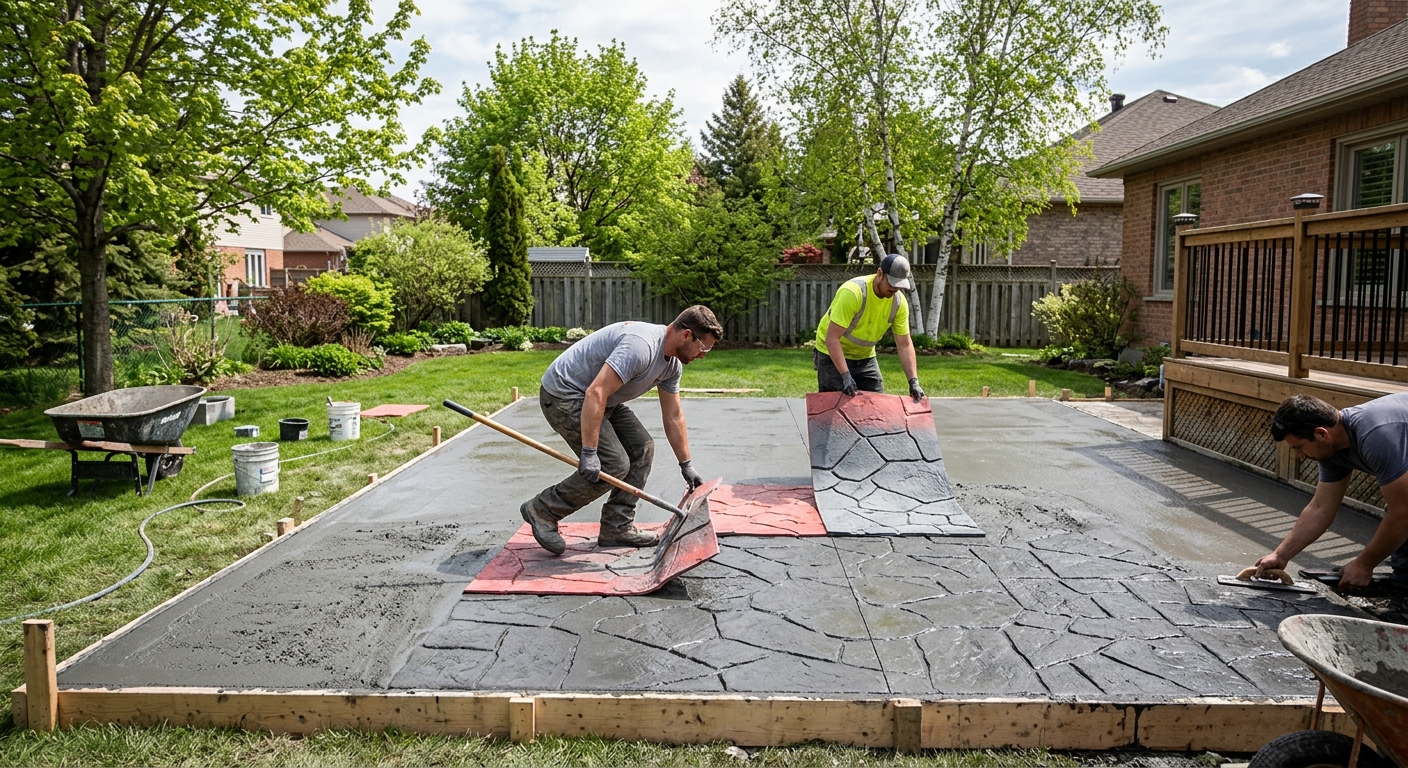
Concrete work options and costs in Yarrow
Concrete work is a common need in Yarrow, British Columbia, especially as homeowners keep improving older driveways and patios in established neighbourhoods like Abbotsford–Yarrow (municipal area of Yarrow). With a total population of 3,326 (Statistics Canada, 2021 Census), demand is steady but not “big-city” busy, so scheduling can swing based on weather and crew availability in the Lower Mainland–Southwest. The local housing mix—much of it single-detached and family-oriented—means flatwork (driveways, patios, walkways) is where many projects start, and that’s also where small specification changes affect cost and longevity.
In this region, mild winters and a shallow frost line shape the design, but we still protect against freeze–thaw and frequent coastal rainfall. Local practice typically assumes a frost depth around 450 mm / 18", so footings, piers, and thickened edges are placed below that to avoid frost heave. Costs in Yarrow are also influenced by drainage and base preparation for saturated soils—most quotes include compacted granular, attention to subgrade drainage, and air-entrained mixes with proper control joints to manage cracking and scaling. When rain is persistent or nights turn cool, curing and scheduling steps (curing blankets, sealers, longer cure times) add labour and materials, even for “simple” slabs.
Below is a practical cost comparison for common concrete options in Yarrow. Use it to sanity-check quotes before you ask about base depth, reinforcement, mix design, and finish details.
| Application |
Typical Size |
Key Spec |
Finish Option |
Price Range |
| Concrete driveway (standard broom finish) |
400–600 sq. ft. |
Air-entrained exterior slab; compacted granular base; control joints |
Broom finish |
$18,000–$28,000 |
| Exposed aggregate driveway |
400–600 sq. ft. |
Proper base drainage; air-entrained mix; surface retard/cleaning |
Exposed aggregate |
$22,000–$34,000 |
| Stamped concrete driveway or patio |
300–600 sq. ft. |
Air-entrained mix; integral colour; thicker finishing workflow |
Stamped pattern |
$26,000–$40,000 |
| Plain concrete patio or walkway |
200–400 sq. ft. |
Air-entrained exterior mix; compacted base; joints |
Float/smooth then light broom or broom edges |
$14,000–$22,000 |
| Garage floor (interior slab) |
400–600 sq. ft. |
Vapour control as needed; fibre or mesh depending on use; proper base |
Light broom or smooth trowel + densifier |
$18,000–$30,000 |
| Foundation footings (structural, below frost) |
Varies (per perimeter length) |
Excavation below design frost; reinforced concrete; engineered specs |
Formed/formed finish (structural) |
$8,000–$18,000 |
Prices are estimates only and vary by project scope, site access and material selection.
What affects the price of concrete work in Yarrow
In Yarrow (and across the Lower Mainland–Southwest), two homeowners can receive quotes for “the same” concrete job that differ by 30–50% because the cheapest scope usually assumes lighter base prep, less specified drainage, or a lower-cost mix/finish system. In British Columbia, the combination of shallow frost design, frequent coastal-wet conditions, and labour availability in the Vancouver–Surrey–Abbotsford corridor means your contractor’s assumptions about frost protection, compacted granular, reinforcement, and curing can swing the final price. Even when the slab thickness looks similar, the base depth, jointing plan, and mix air content are where performance (and cost) are built.
Here’s the key: frost line depth and freeze–thaw cycles dictate every spec. Exterior footings must extend below the design frost depth (commonly around 450 mm / 18" locally, with thickened edges and structural elements placed deeper where required) to prevent frost heave. All exterior slabs are typically air-entrained so the mix survives freeze–thaw and scaling risk. Colder periods also shorten pour seasons and increase cold-weather curing precautions—heating, insulated blankets, and longer curing management—raising labour and equipment costs. If homeowners plan to use de-icing salt, surface sealing becomes even more important because chloride exposure can speed up surface deterioration and spalling.
In Yarrow, costs rise when the site has poor drainage or high groundwater, because we may need deeper excavation and stronger base/sub-drain detailing before we pour. Costs can also drop when access is easy and the pour can be done in one working window. For budget comparisons, a standard driveway often lands around $18–$28 per sq. ft. (concrete driveway/slab band), while decorative systems like stamped concrete usually move closer to the $22–$36 per sq. ft. range because they require more colour/finishing steps and labour time.
| Price Factor |
Why It Matters |
Cost Impact |
| Frost line depth — determines footing depth and form height |
Below-frost placement prevents frost heave and movement |
Higher excavation and forming; can materially change foundation/edge work |
| Site preparation — excavation, grading, compacted granular base |
Saturated soils need proper drainage and compaction to reduce settlement |
More haul/disposal and base material if soils are unsuitable |
| Reinforcement — rebar or wire mesh requirement |
Controls cracking under loads and improves slab integrity |
Material cost + extra labour for placement and chairs/tie-wire |
| Mix design — air-entrainment and compressive strength spec |
Air-entrainment helps resist freeze–thaw scaling/spalling |
Premium mix and testing/quality control; usually required for exterior |
| Finish type — broom vs. stamped vs. exposed aggregate |
Finishes change labour time and curing/cleaning workflow |
Stamped/exposed typically higher; plain broom is fastest |
| Pour size and concrete truck access to site |
Long carries, steep grades, and limited access slow placing |
Extra crew time, chutes/telebelts, and sometimes re-sequencing |
| Cold-weather curing precautions — heating and blankets |
Cool nights and humidity can delay strength gain |
Heaters, insulated blankets, and longer wait times |
| Control joint pattern and sealing cost |
Joints limit random cracking; sealing protects against chloride and water |
Higher material/labour for sawcut timing and later sealer application |
Permits & regulations in British Columbia
In British Columbia, the line between “structural” and “flatwork” matters. Structural concrete work—such as footings, foundation walls, grade beams, and other load-bearing foundation elements—requires a building permit and is often tied to engineered drawings that the municipality reviews. Concrete flatwork like driveways, patios, and walkways usually does not require a building permit by itself, but it can still trigger review if it affects lot grading, drainage, or impervious surface coverage or if it impacts the municipal right-of-way.
Regardless of the project type, confirm requirements with the local authority before breaking ground. Also verify your contractor is properly covered: ask for evidence of liability insurance and worker coverage through the applicable provincial system (WCB) for workers on site. For homeowner comfort, request references for similar-scale work in the Fraser Valley area.
How to verify a contractor in Yarrow step-by-step:
- Check the contractor’s credentials using the provincial online business/contractor listings where applicable for your trade category.
- Ask for a certificate of insurance (COI): ensure it names you correctly as additional insured where offered, and confirm it’s current.
- Confirm worker coverage: request documentation showing WCB coverage for workers who will be on your project.
- Request a written scope and proof of similar projects nearby (photos and addresses where possible).
- Before start, verify they will protect landscaping and handle disposal/transport for concrete waste.
Getting concrete right in Yarrow's freeze-thaw climate
Concrete failure in Yarrow usually isn’t about “bad concrete”—it’s about the details. In the Lower Mainland–Southwest, rain, saturated soils, and frequent freeze–thaw cycles can drive water into the slab. When water freezes and expands, surface and near-surface deterioration can start as scaling and then spalling, especially if the mix isn’t properly air-entrained or if control joints and curing are mishandled.
To spec the job correctly, focus on five areas. (1) Base preparation: use compacted granular sub-base to the depth required for local soils and frost protection; drainage matters as much as depth. (2) Mix design: specify air-entrainment for exterior flatwork (targeted around 5–7% air content depending on mix design) and minimum 32 MPa compressive strength for durability. (3) Control joints: plan spacing so cracks form where you want them, not randomly. (4) Curing: require at least 7 days of curing under suitable conditions; in cool, damp weather, blankets or other cold-weather precautions help achieve strength and reduce early cracking. (5) Sealing: apply a penetrating sealer after the slab has cured (commonly around 28 days post-pour) so water and de-icing salt sit less easily in the surface pores.
If you want a clear “value” example: moving from a basic broom-finish driveway to stamped concrete typically costs more (often aligned with the decorative band of $22–$36 per sq. ft.). That premium is justified when the contractor also maintains correct base drainage and uses an appropriate air-entrained mix—because the decorative look won’t survive freeze–thaw if the slab is compromised.
Use this as your checklist when you meet contractors: if they can’t explain base, air, joints, and curing in plain language, that’s usually the biggest risk in Yarrow.
| Spec |
Why It Matters in Yarrow |
What to Ask For |
Impact if Skipped |
| Compacted granular base (depth?) |
Prevents settlement and limits water pumping under the slab |
Minimum base depth for your soil + drainage plan for your site |
Uneven slab, cracks, and faster deterioration |
| Air-entrained concrete mix (target air %?) |
Protects against scaling and spalling during freeze–thaw |
Documented air content (commonly 5–7% for exterior flatwork) |
Surface scaling/spalling in a few seasons |
| Compressive strength (MPa rating) |
Ensures durability and adequate strength gain in cool months |
Minimum 32 MPa (or engineered requirement for the application) |
Reduced lifespan and cracking under loads |
| Control joints (spacing per ACI guidelines) |
Directs cracking and reduces random cracking paths |
Joint spacing plan and sawcut timing schedule |
Random cracking, water intrusion, and joint-edge spalling |
| Minimum 7-day curing period |
Strength and surface durability development in damp/cool weather |
How they protect curing at night and during rain (blankets/sealer timing) |
Weak surface, higher cracking risk, poor long-term durability |
| Penetrating sealer (when applied after cure) |
Repels water and reduces chloride penetration from de-icing |
Penetrating sealer applied after full cure (commonly around 28 days) |
Faster staining, freeze–thaw damage, and surface scaling |
How to choose a concrete work contractor in Yarrow
Choosing the right concrete contractor in Yarrow is mostly about verification and clarity. In British Columbia, confirm licensing/credential requirements for the trade and business. Also verify liability insurance (ask for a current certificate of insurance and make sure coverage limits are appropriate for the scope) and worker coverage through WCB (request proof that workers on your site are covered). If a contractor can’t provide documentation promptly, consider that a red flag—concrete work involves heavy materials, truck traffic, excavation, and risk on site.
Next, get 2–3 itemised written quotes, not just lump sums. Ideally the quote separates labour and materials, and lists base preparation, reinforcement, concrete mix/cement content, finish type, curing/blankets (if needed), sawcut timing, disposal, and any permit-related tasks. Read exclusions carefully: ask what is not included (for example, tree root removal, minor grading, or snow/temporary access). If the job affects drainage or lot grading, ask whether they will address it to meet municipal expectations.
Warranty matters: ask for a clear workmanship warranty length, whether it covers cracking/spalling under normal use, and the relationship between workmanship coverage and any manufacturer/product warranty. For payment, never pay more than about 10–15% upfront; hold back a reasonable portion until the work is complete and you’ve received all close-out items. Finally, insist on a written start date and an estimated completion window, including allowances for rain delays and curing time.
- Provide COI for liability insurance before work begins.
- Provide proof of WCB coverage for workers.
- Use an itemised quote (materials + labour) with line-by-line quantities.
- Confirm base depth and compaction method in writing.
- Confirm mix is air-entrained for exterior work.
- Ask about reinforcement type (wire mesh vs rebar) and where it’s required.
- Confirm control joint layout and sawcut timing.
- Ask how they handle rain, cool nights, and curing protection.
- Confirm whether disposal/haul-away is included.
- Get details on sealing (product type and when applied after cure).
- Ask how they manage forms/edges, slopes, and drainage away from structures.
- Request a written warranty and what conditions void it (salt use, access, etc.).
Red flags in Yarrow include: quotes that don’t mention air-entrainment for exterior slabs, skipping compacted granular base depth details, refusing to list reinforcement and joint spacing, starting pours late in the day without a curing plan for cool nights, or asking for large upfront payments (beyond roughly 10–15%) with no written schedule.
Frequently asked questions — concrete work in Yarrow
What causes concrete to spall in Yarrow winters?
Spalling in Yarrow (British Columbia) is usually tied to freeze–thaw cycling combined with water getting into the slab surface. When the mix isn’t properly air-entrained for exterior exposure, water expansion during freezing can break down the surface paste and create scaling that progresses to spalls. Another common contributor is poor base prep or drainage—if water sits under or around the slab, it increases saturation and accelerates damage. De-icing salt can also worsen the issue by increasing chloride exposure at the surface. To reduce risk, ask for air-entrained concrete (typical exterior targets are about 5–7% air) plus an appropriate control joint plan and adequate curing. Sealing after cure (often around 28 days) helps repel water and salt, protecting the surface durability.
What is rebar and when is it required in British Columbia?
Rebar (reinforcing steel) is steel bars embedded in concrete to improve tensile strength and limit cracking under load. In British Columbia, whether rebar is required depends on the structural design, slab thickness, soil conditions, and the application—your engineer’s drawings or the applicable design standard typically dictate reinforcement for foundations, footings, and certain exterior slabs. For driveways and patios, some projects use wire mesh, fibre reinforcement, or rebar depending on thickness, reinforcing strategy, and expected loads. In cold, wet Lower Mainland–Southwest conditions, reinforcement won’t replace good base drainage, air-entrainment, and jointing, but it does help the slab perform under movement and thermal cycles. Ask your contractor to specify the reinforcement type and placement, not just “rebar or mesh included.”
How long does a concrete project take in Yarrow?
In Yarrow, the total duration depends on site access, formwork, and especially weather because cool nights and rain can slow curing management. For most flatwork like a driveway or patio, the actual pour day is only part of the timeline; compaction, forms, and finishing steps usually take 1–2 days, and curing protection may extend the calendar even if you can walk on it sooner. A typical driveway project often runs about 3–7 working days including prep, pour, finishing, and demobilization, with additional time to reach full durability targets. Foundation/footings work takes longer because excavation, inspection points, and structural sequencing are involved. If you’re comparing contractor schedules, be wary of quotes that promise “fast” curing with no mention of blankets or extended cure in cold/humid conditions, which can undermine durability.
What is a concrete overlay and is it suited to Yarrow?
A concrete overlay is an additional layer placed over an existing slab surface to improve appearance or restore a level, usually after surface prep like grinding. In Yarrow’s freeze–thaw climate, overlays can be suitable when the existing base is sound and drainage issues are corrected—because if water is already trapped under the slab, the overlay won’t fix the underlying movement and deterioration. The key is substrate condition: if the original slab is actively moving or badly cracked, a full replacement or deeper corrective drainage may be necessary. Overlays also have their own finishing and curing requirements, and they should still be made with an exterior-appropriate mix design and control strategy. If your current slab is failing from spalling, salt exposure, or pumping water, ask for a site assessment before paying for an overlay that may have a shorter lifespan. Compare this approach against pricing such as driveway concrete bands around $18–$28 per sq. ft. to understand value.
How do I seal concrete to protect it in Yarrow?
Sealing in Yarrow (British Columbia) is about keeping water and de-icing salt from penetrating the surface. For best results, wait until the concrete has cured—commonly around 28 days post-pour for proper application—then use a penetrating sealer designed for exterior use. Before sealing, make sure the surface is clean, dry, and free of dust or paint overspray; sealing on dirty concrete reduces coverage and performance. Apply according to the product label and ensure consistent coverage, especially along joints and edges where water collects. In freeze–thaw conditions, sealing won’t eliminate cracking entirely, but it helps slow deterioration from saturation. If you plan to use salt on driveways during winter, sealing becomes more important; ask your contractor what sealer they use, whether it’s breathable/penetrating, and whether it’s included in the quote or an add-on.
What is the difference between concrete and cement?
In everyday language, people say “cement” when they mean the full concrete product, but the terms aren’t the same. Cement is the binding ingredient (the powder) that reacts with water to form paste. Concrete is cement plus water plus aggregates (sand and gravel/crushed stone). When you’re planning a driveway or patio in Yarrow, the performance you feel—durability, freeze–thaw resistance, and strength development—depends on the full concrete mix design, not just the brand or amount of cement. In our Lower Mainland–Southwest climate, air-entrainment for exterior flatwork and correct curing practices are especially important to reduce spalling risk during freeze–thaw cycles. If you’re comparing quotes for standard broom-finish driveways (often around $18–$28 per sq. ft.), ask what the contractor specifies for mix design, air content, and strength (often aiming for minimum 32 MPa for durability) so you’re comparing apples to apples.