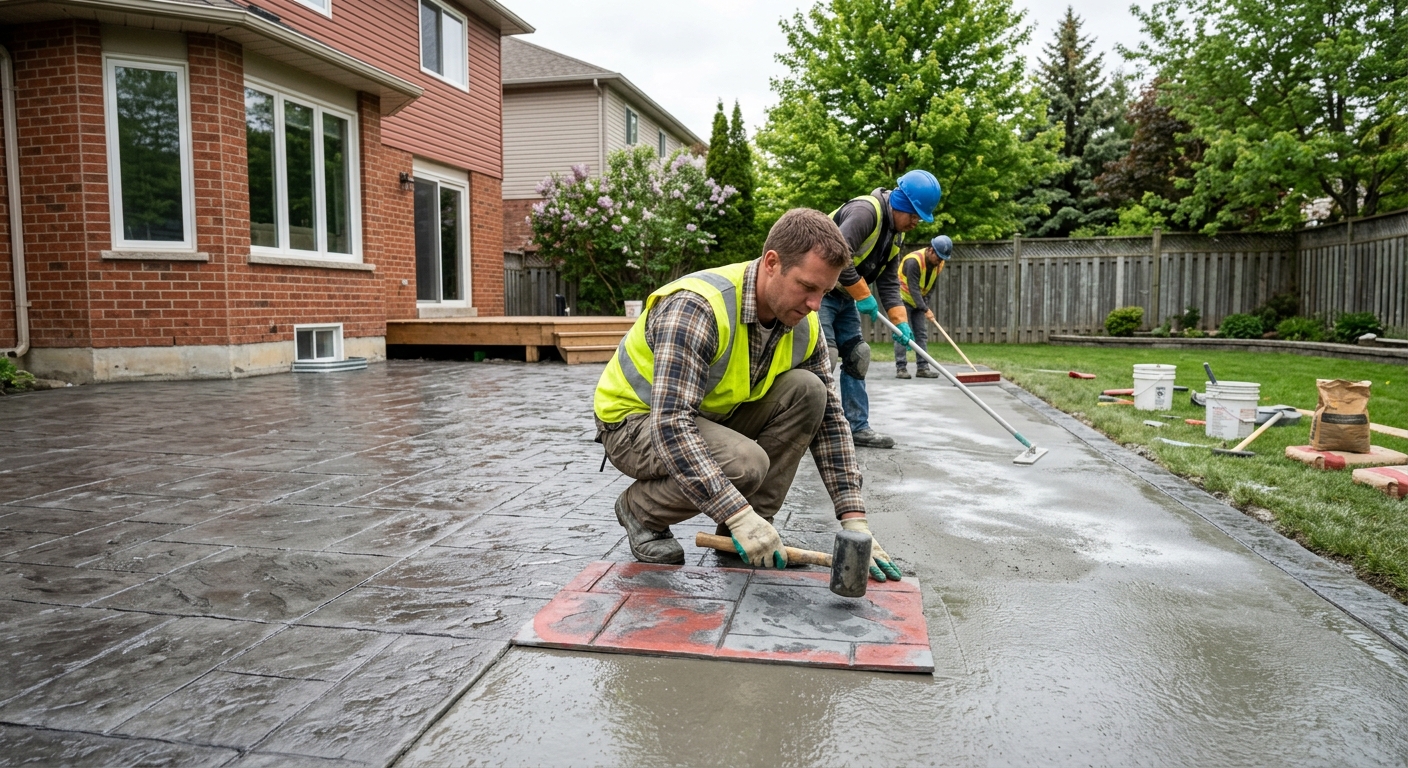
Concrete work options and costs in Marpole
In Marpole, concrete flatwork is a regular part of homeowners’ projects—especially for driveways, patios and walkway upgrades. With a population of 27,843 (Statistics Canada, 2021 Census), the neighbourhood’s mix of housing types creates steady demand for both practical maintenance work and higher-end finishes. Much of this market is tied to single-detached and infill-style lots where families expand living space with new or re-poured slabs, and where drainage around exterior surfaces matters as much as the concrete itself.
In the Lower Mainland–Southwest, mild winters can be deceptive: we still design for a shallow but significant frost depth—commonly around 450 mm / 18"—and we plan for frequent freeze–thaw cycles and heavy coastal rainfall. That combination affects everything from how deep footings sit below frost to how contractors build compacted granular base and specify air-entrained mixes. It also shapes scheduling: prolonged rain, cool nights and high humidity can slow curing, so crews often rely on curing blankets, sealers and longer cure windows to achieve durable driveways and patios.
In Marpole, this trade is especially in demand around the Cambie Corridor and the Broadview–Marpole edges where lots are actively renovated. If you’re comparing options, the right finish choice can cost more upfront but save repair headaches later. Use the table below as a practical starting point for budgeting, then match the spec details to your site conditions and access.
| Application |
Typical Size |
Key Spec |
Finish Option |
Price Range |
| Concrete driveway (standard broom finish) |
400–600 sq. ft. |
Engineered base, rebar reinforcement; air-entrained exterior mix |
Broom finish with control joints |
$3,500–$7,000 |
| Exposed aggregate driveway |
400–600 sq. ft. |
Exposed-aggregate prep; proper curing to prevent scaling |
Exposed aggregate with sealed surface |
$5,500–$9,500 |
| Stamped concrete driveway or patio |
300–500 sq. ft. |
Reinforced slab; air-entrained mix |
Stamped pattern with release, color hardener and sealer |
$6,500–$12,500 |
| Plain concrete patio or walkway |
200–350 sq. ft. |
Reinforced where needed; slope to drain; air-entrained exterior mix |
Broom or light broom; simple control joints |
$2,500–$6,500 |
| Garage floor (interior slab) |
300–600 sq. ft. |
Vapour barrier (as required), reinforced slab; proper curing |
Power trowel and sealed finish |
$4,500–$10,500 |
| Foundation footings (structural, below frost) |
Per lin. ft. / project-dependent |
Below-design frost depth; formwork, reinforcement, inspection-ready |
Structural finish (typically not decorative) |
$200–$350 |
Prices are estimates only and vary by project scope, site access and material selection.
What affects the price of concrete work in Marpole
In Marpole and across the Lower Mainland–Southwest, two quotes for what looks like the “same” concrete job can differ by 30–50% because the price drivers are mostly invisible until you get into the spec: excavation depth, base thickness and compaction, reinforcement type, mix design, and curing measures for a wet/coastal climate. In practice, a contractor who designs for freeze–thaw durability costs differently than one who treats exterior slab prep as a generic step. Labour availability can also tighten during peak pour windows, pushing crews to book around weather and truck schedules.
Frost depth and freeze–thaw cycles dictate every spec. Exterior footings and foundation elements must extend below the design frost depth—locally, that’s commonly planned around 450 mm / 18"—to prevent frost heave. For exterior flatwork, the concrete mix needs air-entrainment to resist freeze–thaw damage and scaling. When temperatures are cool or there’s a higher risk of rain, contractors may need cold-weather precautions (insulating blankets, curing protection and sometimes heating), which adds labour and equipment cost. Also, de-icing salts (even used sparingly) can accelerate surface deterioration on unsealed or poorly cured concrete, so sealing becomes a practical durability step.
A few local examples show why price swings happen. If your driveway subgrade is soft or drainage is poor, excavation and granular replacement add cost quickly—often more than upgrading from a broom finish to exposed aggregate. On the other hand, if you already have good grade and access, a plain patio can land close to the $16–$26 per sq. ft. band, while stamped work usually climbs toward the $22–$36 range because pattern materials, additional labour and sealing are built into the workflow. In Marpole’s older housing stock, where we sometimes see dated drainage and settled edges, correcting slope and base thickness can be the difference between a long-lasting slab and early cracking that leads to costly rework—sometimes within a few seasons.
| Price Factor |
Why It Matters |
Cost Impact |
| Frost line depth |
Determines footing depth and form height below the local design frost level. |
Higher excavation and labour; typically pushes structural work toward the $200–$350 per lin. ft. band for footings. |
| Site preparation |
Excavation, grading and compacted granular base protect the slab from settlement and pooling. |
Can add large variability; soft or saturated subgrade may require deeper, wider base replacement. |
| Reinforcement |
Rebar or wire mesh improves crack control and load capacity for driveways and garage slabs. |
Material and placement labour; complexity increases where there are steps, edges or dowels. |
| Mix design |
Air-entrainment and the specified compressive strength help exterior concrete survive freeze–thaw cycles. |
Upcharges for air-entrained mix and QA; usually worth it for exterior durability. |
| Finish type |
Broom, exposed aggregate and stamped work require different labour sequencing and materials. |
Stamped and exposed finishes commonly price above plain work (often aligning with the $22–$36 band for decorative). |
| Pour size and concrete truck access to site |
Line of travel, driveway access and staging affect pump/spot charges and labour time. |
Poor access can force smaller pours, more labour and additional equipment. |
| Cold-weather curing precautions |
Cool nights and high humidity slow strength gain; curing protection helps reach design strength. |
Heating/blankets can raise costs—especially for late-season pours. |
| Control joint pattern and sealing cost |
Joint spacing limits random cracking; sealing improves resistance to moisture and de-icing salt impact. |
Not the biggest line item, but essential for long-term surface performance. |
Permits & regulations in British Columbia
In British Columbia, structural concrete work typically requires a building permit and may also require engineered drawings reviewed by the municipality. This includes foundation elements such as concrete footings, foundation walls, grade beams and other load-bearing components. For concrete flatwork—patios, walkways and driveways—permits are often not required unless your project changes lot grading, impacts impervious surface coverage limits, affects drainage servicing, or touches municipal right-of-way conditions. Because site rules can vary by how your driveway connects, how runoff is managed, and what’s being replaced, you should confirm with the local authority before breaking ground.
Before hiring in Marpole, verify the basics every homeowner should check: contractor liability insurance, and coverage consistent with construction work in the province (WSBC/WCB). Step-by-step, start by asking the contractor for a certificate of insurance (COI) and proof of clearance/coverage. Then confirm their business licence status through public listings where available, and request references for similar-scale concrete jobs (driveways, patio slabs or foundation work). For concrete flatwork projects, keep a clear paper trail: photos of existing conditions, a written scope, and confirmation of whether a permit is needed for grading or foundation tie-ins. If engineered foundation work is in scope, insist on the permit path being handled before pour scheduling so you don’t lose time to inspection delays.
When in doubt, treat permit verification as part of your quote—good contractors will ask the right questions early rather than pricing around an unknown.
Getting concrete right in Marpole's freeze-thaw climate
In Marpole, concrete failure usually isn’t about “bad luck”—it’s about water movement, inadequate base prep, and freeze–thaw stress concentrated at edges and surfaces. When base is too shallow or not properly compacted, the slab can settle and open hairline cracks. If the concrete isn’t air-entrained, freeze–thaw cycles can damage the cement paste, leading to scaling and spalling. Heavy coastal rainfall also means curing conditions vary day to day, especially when cool nights extend the time to reach early strength.
To spec the job correctly for the Lower Mainland–Southwest, focus on five items. First, base preparation: use compacted granular sub-base to the right depth for your local soil and drainage so the slab doesn’t “float” and crack. Second, mix design: exterior flatwork should use air-entrained concrete with a typical target of 5–7% air content and a minimum 32 MPa compressive strength. Third, control joints: plan joint spacing to encourage cracking in the right locations, not randomly across the slab. Fourth, curing: plan for at least 7 days of proper curing conditions; when the forecast is cool or wet, curing blankets and protection matter more than most people think. Fifth, sealing: apply a penetrating sealer after the slab has cured—often at 28 days—to improve resistance to moisture and reduce how quickly de-icing salts can contribute to surface breakdown.
Ask yourself whether decorative upgrades are worth it for your site. For example, moving from a plain broom-finish patio to stamped concrete can increase your budget toward the $22–$36 per sq. ft. decorative band because of extra labour and materials. That premium is justified when your base, joints and drainage are already correct—otherwise, spending more on finish won’t stop premature cracking.
| Spec |
Why It Matters in Marpole |
What to Ask For |
Impact if Skipped |
| Compacted granular base (depth?) |
Stabilizes the slab against settlement and helps drainage during heavy coastal rains. |
Documented base depth and compaction method suited to your subgrade. |
Uneven settling, early cracking and edge breakdown. |
| Air-entrained concrete mix (target air %?) |
Protects against freeze–thaw damage and surface scaling in exterior exposure. |
Air content target of 5–7% for exterior flatwork and confirmation of mix design. |
Spalling and scaling that show up over 1–3 winters. |
| Compressive strength (MPa rating) |
Ensures the slab achieves design durability under Marpole’s variable curing conditions. |
Minimum 32 MPa compressive strength and curing plan. |
Slower strength gain, weaker surface and higher wear risk. |
| Control joints (spacing per ACI guidelines) |
Controls where shrinkage cracking occurs—critical for driveways and patios. |
Joint layout tied to slab dimensions, with saw-cut timing and plan for sealant. |
Random cracks that can channel water into the base. |
| Minimum 7-day curing period |
Cool nights and humidity in the Lower Mainland can slow strength development. |
Specified curing approach; confirmation curing protection if nights are cool. |
Surface deterioration and durability problems. |
| Penetrating sealer (when applied after cure) |
Helps repel moisture and limits de-icing salt impact on exterior slabs. |
Sealer type and application timing—commonly around 28 days after pour. |
Faster staining, higher moisture uptake and reduced surface lifespan. |
How to choose a concrete work contractor in Marpole
Start by confirming contractor legitimacy in British Columbia. Ask for proof of liability insurance (COI) that matches the work’s scope and ask for their WCB/WSBC coverage documentation. If the contractor can’t provide certificates or clearance evidence, that’s a major warning sign—especially on jobs with excavation, rebar installation and concrete truck traffic. You can also verify the company name and business details through provincial online resources where businesses are listed, then cross-check the COI against that legal entity name.
Next, get 2–3 itemised quotes. Ideally, the quote breaks labour and materials out by line item (excavation, formwork, granular base, reinforcement, concrete supply, pumping if needed, finishing, control joints and sealing) rather than one lump sum. Make sure “exclusions” are clear: disposal of concrete, sidewalk/curb protection, any saw-cut depth, and whether a permit (if needed) or inspections are included. For foundation or grade-related changes, confirm who pulls the permit and who schedules inspections.
Be disciplined about warranty and payment. Ask for a workmanship warranty length and whether it covers joints, spalling and settlement-related issues (not just “cracks”). For payment, never pay more than 10–15% upfront; use a holdback until the job is complete and cleanup is done. Then lock your timeline in writing with a start date, curing/sealing schedule and completion estimate—Marpole pours can be impacted by rain, so a realistic schedule protects you from rushed finishing.
- Ask whether they design base thickness and compaction for your subgrade, not “standard blanket thickness”.
- Request the exact mix specification: air-entrainment and minimum 32 MPa for exterior work.
- Confirm reinforcement plan: rebar/wire mesh where needed and how it’s supported (chairs/spacers).
- Get joint layout details and saw-cut timing for control joints.
- Ask how they handle prolonged rain and cool nights (blankets, curing plan).
- Verify liability insurance COI is current and the insured entity matches the contractor’s legal name.
- Request WCB/WSBC coverage proof/clearance documentation before signing.
- Ensure disposal and site restoration are included (hauling, backfill, topsoil, grading touch-ups).
- Check whether sealing is included and when it will be applied (commonly after cure).
- Confirm truck access and whether pump/spotting charges are included in the quote.
- Use an itemised quote comparing total quantities and unit rates for concrete and base materials.
- Set a payment schedule with a holdback until final finishing, joint sealing (if included) and cleanup.
In Marpole, red flags include: quotes that avoid mentioning air-entrainment or joint spacing, contractors who don’t discuss curing/blankets for cool wet forecasts, “cheap” decorative work with no sealer plan, vague scopes that omit excavation depth and granular base, and schedules that promise a pour without a weather-correction plan for rain and early finishing.
Frequently asked questions — concrete work in Marpole
How much does concrete work cost in Marpole?
Concrete pricing in Marpole depends heavily on prep and finish, not just the concrete itself. For budgeting, many driveways and slabs in the Marpole area land in the practical range of about $18–$28 per sq. ft. for standard concrete driveway work, while decorative options like stamped concrete commonly price higher—often aligning with the $22–$36 per sq. ft. band depending on pattern complexity and sealing requirements. Plain patios and walkways tend to fall closer to $16–$26 per sq. ft. Your final number can swing based on excavation depth, granular base replacement, reinforcement, and access for concrete trucks. If your site needs drainage corrections or deeper base due to saturated soils, expect an upward shift compared with a straightforward replacement.
How deep must footings be for Marpole's frost line?
For Marpole and the Lower Mainland–Southwest, concrete foundation footings are typically planned below the design frost depth, with local practice often assuming around 450 mm / 18" for frost depth. In other words, footings and thickened edges need to extend below that level to reduce the risk of frost heave. The exact depth can vary based on the building design, soil conditions, and engineering requirements, especially if there are drainage issues or soil variability. Also note that frost protection is only part of the durability story: you still need proper base support and concrete specifications for freeze–thaw resilience. If your project involves foundation work, expect engineered drawings and a permit path before excavation and formwork.
Why does concrete crack in Marpole and how is it prevented?
Cracking in Marpole is usually caused by shrinkage, settlement, and water movement—not “bad concrete.” The Lower Mainland’s freeze–thaw cycles and frequent moisture from coastal rainfall can widen cracks once water finds a path into edges or joints. Prevention starts before the pour: compacted granular base, correct slab thickness and reinforcement placement, and proper drainage grading. Then you need control joints planned and executed correctly to encourage cracking in intended locations rather than random spots. A well-detailed joint pattern, correct saw-cut timing, and sealing after cure help keep water out. Specifying an air-entrained mix also matters for exterior durability because freeze–thaw scaling can worsen surface cracking over time.
Stamped vs broom-finish concrete — cost difference?
Stamped concrete costs more than broom-finish because it requires additional labour steps, pattern materials and careful finishing sequencing. In Marpole, broom-finished driveway work often trends toward the $18–$28 per sq. ft. band, while stamped finishes are commonly in the $22–$36 per sq. ft. range depending on size, complexity, and how much handwork is needed around steps, edges and transitions. That premium can be justified when the base prep, reinforcement and joint layout are solid—because the finish won’t compensate for poor drainage or inadequate curing. If budget is tight, a practical compromise is broom-finish with a good sealer and a tighter joint plan, then upgrade later if you want decorative patterning.
When is the best time to pour concrete in Marpole?
The best time to pour concrete in Marpole is when temperatures are stable enough to support curing and when rain can be managed. While our winters are milder than interior BC or other regions, Lower Mainland–Southwest schedules still need protection against cool nights and prolonged wet conditions. Contractors plan around the pour day and the curing window, using curing blankets and protection if the forecast threatens early strength development. In practice, late spring through early fall often offers the smoothest scheduling for exterior flatwork, while foundations may be planned earlier or with additional curing protection depending on weather. The key is not just the day of the pour—it’s the ability to cure properly for at least 7 days under suitable conditions.
How long does concrete take to cure?
Concrete curing happens in stages. For most exterior flatwork in Marpole, you should plan for at least a 7-day curing period to support early strength development, with curing conditions managed for humidity, rain exposure and cool nights. Even after the initial cure, concrete continues gaining strength over time, which is why sealing is typically scheduled after the slab has fully cured—commonly around 28 days for penetrating sealers. That matters because proper sealing helps repel moisture and reduces how quickly de-icing salts can contribute to surface breakdown during freeze–thaw cycles. If you need to use the driveway or patio soon after a pour, ask your contractor for a practical staging plan so you don’t damage corners, joints or the surface before strength is adequate.