Concrete work options and costs in Chemainus
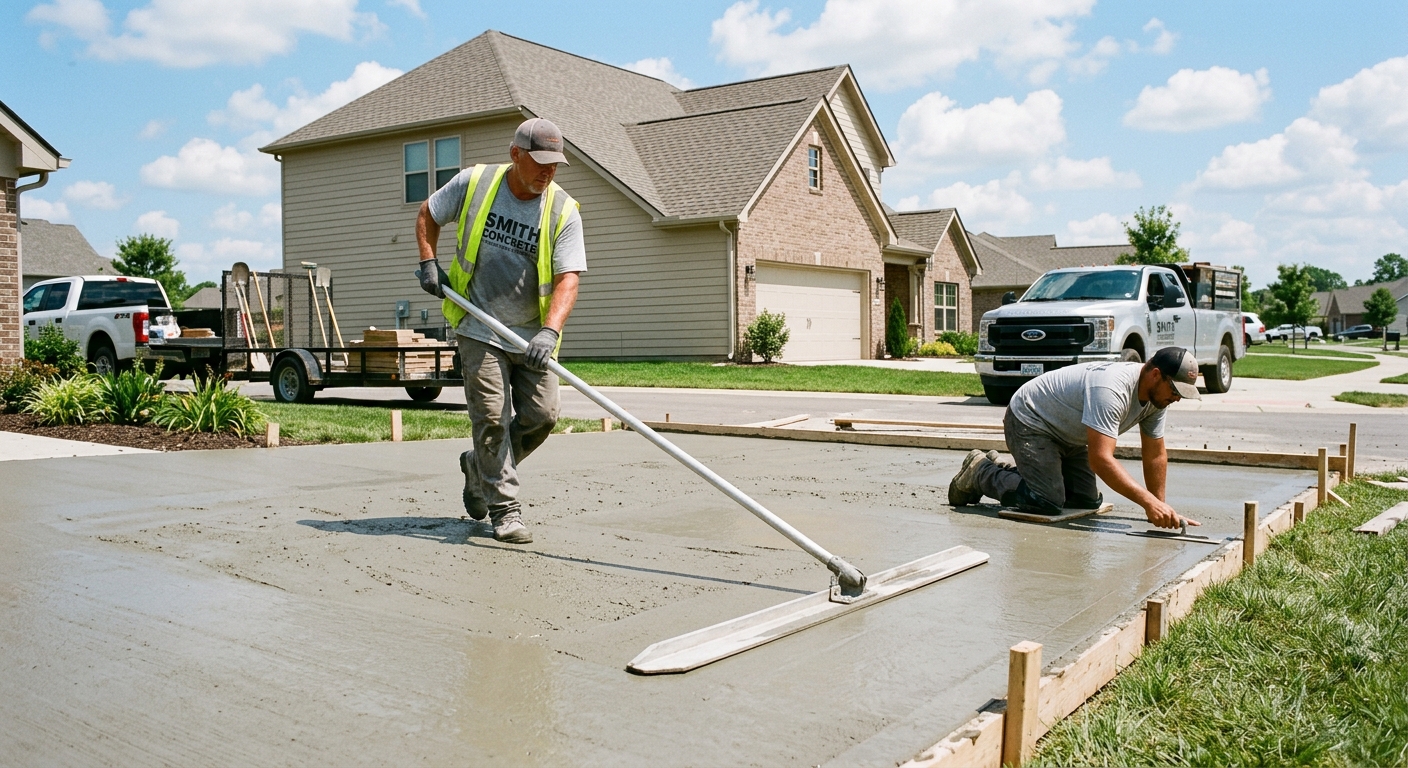
Chemainus is a small Vancouver Island community (population 3,021, Statistics Canada, 2021 Census), but it still has active concrete demand—especially around older homes that need driveway and patio upgrades for better curb appeal and safer access. Most concrete flatwork goes into residential properties, and in this area that typically means replacing or expanding driveways, patios, steps, and entry walkways for the way families actually use their homes. In the Lower Mainland–Southwest, contractors plan around the local climate—mild winters with a shallow frost line, yet frequent freeze–thaw cycles and coastal-wet rainfall that can damage surfaces when drainage and mix design aren’t right. Even in Chemainus, our job specs generally assume exterior frost protection (often near 450 mm / 18") so footings and thickened edges are built below that to help prevent frost heave. Pricing also reflects the real availability of crews and material logistics across the Lower Mainland–Southwest corridor, where scheduling around rain and cool nights can lengthen curing timelines. That’s why you’ll see quotes that separate “looks nice” finishes from the concrete systems underneath—compacted base, air-entrained mix, reinforcement where required, and proper control joints.
Below is a practical price comparison for common Chemainus projects, then we can fine-tune your estimate once we know your site access, soil conditions, and whether you want standard broom, exposed aggregate, or stamped work.
| Application |
Typical Size |
Key Spec |
Finish Option |
Price Range |
| Concrete driveway (standard broom finish) |
400–600 sq. ft. |
4" slab, compacted granular base, air-entrained mix |
Broom finish + control joints |
$18,000–$28,000 |
| Exposed aggregate driveway |
400–600 sq. ft. |
Air-entrained mix, proper curing for clean exposure |
Exposed aggregate (medium/large stone) |
$22,000–$34,000 |
| Stamped concrete driveway or patio |
300–500 sq. ft. |
Air-entrained mix, release agent + coloured hardener |
Stamp pattern (random ashlar/flagstone style) |
$22,000–$36,000 |
| Plain concrete patio or walkway |
200–400 sq. ft. |
4" slab, compacted base, control joints |
Float & broom/wood float texture |
$16,000–$26,000 |
| Garage floor (interior slab) |
300–500 sq. ft. |
4" slab, vapour control as needed, finishing to specs |
Smooth trowel or light broom |
$18,000–$30,000 |
| Foundation footings (structural, below frost) |
~40–80 linear ft. |
Engineered footing dimensions below frost depth |
Structural concrete placement |
$8,000–$14,000 |
Prices are estimates only and vary by project scope, site access and material selection.
What affects the price of concrete work in Chemainus
In the Lower Mainland–Southwest, the same concrete job can come in significantly different—often 30–50%—because contractors price the “system” (excavation, drainage, base, mix design, placement, curing) rather than just the finish you see. In BC, frost depth and freeze–thaw cycles drive the spec: exterior work must be designed around protecting slabs and foundations from frost heave and scaling. While coastal BC can have a shallow frost range (commonly 0.5–1.2 m in coastal BC practice), it still isn’t “ignore frost.” Footings and thickened edges must extend below the design frost depth, and exterior slabs typically use air-entrained concrete so the freeze–thaw cycle doesn’t break the surface over time. Colder or wetter periods also tighten the pour window and increase curing precautions—curing blankets, longer cure management, and sometimes heating—so costs rise compared with projects done in stable summer weather.
Concrete in Chemainus also carries site realities: if your subgrade is saturated or fine-grained, base prep costs go up because we need proper drainage and compaction. If you have slope, tight access, or a need to sawcut existing concrete and haul disposal, truck time and labour increase. Conversely, straightforward replacement on firm, well-draining soil can land closer to the lower end of the $18,000–$28,000 driveway band or the $16,000–$26,000 patio/walkway band. A good example is stamped concrete: the extra cost (often closer to the upper end) is justified because colour hardener, stamping operations, and careful finishing/curing control the final look—whereas a broom-finish slab can be more sensitive to how well the base and joints are executed.
| Price Factor |
Why It Matters |
Cost Impact |
| Frost line depth |
Determines footing depth and form height for frost protection |
Can add excavation and rebar/formwork labour on exterior structural work |
| Site preparation |
Excavation, grading, compacted granular base, drainage corrections |
Unsuitable soil often increases base depth and hauling/disposal |
| Reinforcement |
Rebar or wire mesh helps control cracking and supports heavier loads |
Materials + placement time; required for garage slabs and many driveways |
| Mix design |
Air-entrainment and compressive strength spec for freeze–thaw durability |
Higher-spec mix and careful batching can raise material costs |
| Finish type |
Broom vs. stamped vs. exposed aggregate affects labour complexity |
Stamped and exposed finishes usually cost more than plain broom |
| Pour size and concrete truck access to site |
Placement efficiency and pump/short access requirements |
Tight sites can add pump time or extra labour for smaller loads |
| Cold-weather curing precautions |
Heating/insulation blankets protect strength gain during cool nights |
Extends production costs and can delay scheduling |
| Control joint pattern and sealing cost |
Controls cracking locations and reduces water/ice intrusion |
Proper jointing and later sealing adds measurable line-item cost |
Permits & regulations in British Columbia
In British Columbia, structural concrete work—such as footings, foundation walls, grade beams, and other load-bearing elements—typically needs a building permit, and engineered drawings are often required for review by the municipality. For concrete flatwork like patios, walkways, and driveways, a permit is usually not required unless your project changes lot grading, affects impervious surface coverage limits, or involves work near a municipal right-of-way. Regardless, confirm with the local authority before breaking ground; even “just a driveway” can trigger drainage or drainage-works review when it alters how water runs off your property.
As a homeowner in Chemainus, you can also verify the contractor’s credentials step-by-step:
- Check the contractor is currently eligible to work in BC for their trade scope (use the provincial business/licensing registry or the contractor’s official standing listing, then confirm it matches the company name on the contract).
- Request a Certificate of Insurance (CGL) showing liability coverage and ensure it names your address or is written for job site coverage.
- Confirm Workers’ Compensation coverage (WCB) for the individuals who will be on site. If they use subcontractors, ask for each subcontractor’s coverage.
- Ask for references on similar-scale Chemainus or Vancouver Island/Lower Mainland projects, not just “completed jobs” photos.
- Get everything in writing: scope, exclusions (e.g., removal/disposal), schedule, and cure/finish requirements.
This is also how you avoid delays and surprise scope gaps—especially important in a freeze–thaw climate where correcting base and drainage later becomes expensive.
Getting concrete right in Chemainus's freeze-thaw climate
Concrete fails in Chemainus mainly when water gets into the slab and then expands during freeze–thaw cycles, leading to surface scaling or spalling. The solution is not just “stronger concrete”—it’s the full build-up: base prep, correct mix, joints, curing, and later sealing. First, start with base preparation: excavate to the right depth for your soil and frost protection, then place compacted granular sub-base in lifts and verify compaction. Next, specify the mix: exterior flatwork in our coastal-wet environment is typically air-entrained, targeting about 5–7% air content, with a minimum 32 MPa compressive strength to achieve durable performance. Then control cracking: plan control joints at appropriate spacing so cracks form where you designed them, not randomly. Curing matters a lot here—plan a minimum 7-day curing period under good conditions, and when cool nights and rain interrupt the window, curing blankets and careful scheduling protect strength gain. Finally, sealing: apply a penetrating sealer after the slab has cured (commonly around 28 days post-pour) to help repel water and de-icing salts.
When homeowners skip air-entrainment or rush jointing, you can see the difference quickly during winter seasons that cycle between damp thaw and cold freeze. For a cost example: moving from a basic broom finish to an exposed aggregate driveway can add roughly $4,000–$8,000 depending on size, but it’s justified when the contractor also nails the base drainage, air content, and curing—those are what keep the surface from scaling. If those fundamentals aren’t right, even the best-looking finish won’t last.
| Spec |
Why It Matters in Chemainus |
What to Ask For |
Impact if Skipped |
| Compacted granular base (depth?) |
Controls drainage and reduces movement under freeze–thaw |
Confirm excavation depth, base material type, and compaction method |
Settlement, cracks, and accelerated deterioration |
| Air-entrained concrete mix (target air %?) |
Improves freeze–thaw scaling resistance in exterior exposure |
Ask for target air content (typically 5–7% for exterior) |
Higher risk of spalling and surface scaling |
| Compressive strength (MPa rating) |
Ensures the slab achieves durability under wet/cold conditions |
Confirm minimum 32 MPa (or higher if required by design) |
Lower strength gain and reduced service life |
| Control joints (spacing per ACI guidelines) |
Directs cracking to planned locations and reduces water paths |
Ask for joint spacing and whether joints are sawcut or formed |
Random cracking, curling, and more freeze–thaw damage |
| Minimum 7-day curing period |
Strength gain and surface durability depend on curing conditions |
Confirm cure plan, weather monitoring, and protection in rain/cold |
Weak surface, dusting, and premature wear |
| Penetrating sealer (when applied after cure) |
Helps repel water and de-icing salts entering micro-pores |
Confirm sealer type and timing (commonly after ~28 days cure) |
Faster staining, scaling, and salt-related spalling |
How to choose a concrete work contractor in Chemainus
Start by verifying contractor coverage and credibility in British Columbia. Ask for a current Certificate of Insurance (liability/CGL) and ensure the policy is active for the job date range and coverage level makes sense for your project. Then request confirmation of WCB coverage for workers (or proof of coverage for subcontractors). For licensing, you’re looking for the contractor’s ability to lawfully perform the trade scope they’re quoting—match the name on the estimate to the name on insurance documents and registration listings.
Next, get 2–3 itemised written quotes that break out labour and materials rather than a single lump sum. A detailed quote should show: excavation and disposal, base prep and compaction, reinforcement (if included), concrete mix spec (air-entrained exterior mix), thickness, finish type, control joints, and curing/sealing timing. Confirm what’s excluded: for example, removal of existing concrete, protection of landscaping, site dewatering, sawcutting, and whether permit pulling is included when required for foundation/structural work. Warranty should be clear: workmanship warranty length, whether it covers cracking/spalling, and whether product/manufacturer warranty is included for sealers/admix (and if it’s transferable to you). Payment scheduling should be conservative—never pay more than 10–15% upfront, and use a holdback until the job is complete and properly cured. Ask for a written timeline: start date, pour day plan, and a completion estimate.
- Ask how they verify subgrade and base compaction (and what they do if soil is soft/saturated).
- Confirm they specify air-entrainment for exterior slabs in Chemainus conditions.
- Check that control joints are included (quantity and spacing), not “as required later.”
- Verify slab thickness and footing depth are stated, not vague.
- Confirm who supplies the concrete mix design and whether test records are available.
- Ask whether the quote includes sawcutting joints and cleaning/surface prep for sealing.
- Clarify disposal and haul-off for demo concrete and unsuitable soil.
- Ask about drainage and how runoff is handled around driveway edges and patios.
- Request an explicit finish description (broom, exposed aggregate, stamped pattern/sealer compatibility).
- Confirm crew size and how they manage placement timing to avoid cold joints.
- Ask what happens if it rains during the pour or if temperatures drop at night.
- Make sure warranty terms are in writing and cover the finish—not just “materials only.”
Concrete red flags in Chemainus: contractors who won’t discuss air-entrainment targets, quotes that ignore base drainage/compaction, vague jointing (“we’ll see”), refusal to provide insurance/WCB proof, and crews starting without a written cure plan for cool, wet periods.
Frequently asked questions — concrete work in Chemainus
Can concrete be poured in cold weather in Chemainus?
Yes, concrete can be poured in cold weather in Chemainus and across British Columbia, but it must be done with the right cold-weather controls. The issue is not the pour temperature alone—it’s how quickly concrete can reach early strength before it cools too much. A good crew will monitor forecast conditions and plan protection (curing blankets, insulation, and sometimes controlled heating) so the slab develops strength properly. If it’s raining heavily, you also need a plan to protect fresh concrete from surface damage and to manage curing in high humidity. For exterior work, skipping cold-weather curing precautions can lead to weaker surfaces and earlier scaling, which shows up during winter freeze–thaw cycles.
How do I maintain concrete in Chemainus's freeze-thaw climate?
Maintenance in Chemainus is mostly about keeping water and de-icing salts from sitting in the slab. Start with good drainage: ensure downspouts and yard runoff aren’t directed onto your driveway or patio. Use a penetrating sealer applied after full cure (commonly about 28 days post-pour) to reduce how easily water migrates into pores. During winter, avoid aggressive, high-salt “piling” at the same spots; that can accelerate spalling when moisture freezes in the surface. For routine care, sweep debris, remove sand/rocks promptly, and wash with a mild cleaner when stains build up. If you’re estimating your budget, remember a plain broom-finish patio can land around the $16,000–$26,000 band, but the durability you get depends heavily on sealing and jointing maintenance.
What causes concrete to spall in Chemainus winters?
Spalling is usually caused by water getting into the concrete and freezing, then repeating that cycle through multiple winter nights. In Chemainus’s wet coastal conditions, the biggest contributors are inadequate air-entrainment, poor base drainage, and cracks that let water travel into the slab. When air-entrainment is missing or too low for the exposure class, freeze–thaw pressure damages the surface paste and you’ll see scaling and spalling over time. Joints that are too widely spaced—or not sealed—also allow water to enter along hairline cracks. Finally, cold-weather curing that’s rushed can produce a weaker surface that can’t tolerate salt and repeated freeze–thaw stresses. A properly air-entrained exterior mix is one of the most important spec items for long-term durability.
What is rebar and when is it required in British Columbia?
Rebar is steel reinforcement bars embedded in concrete to improve strength and crack control, especially for slabs exposed to heavier loads, thicker sections, and areas needing structural performance. In British Columbia, when reinforcement is required depends on the design and the engineer’s requirements (and on local building code/permit plans). For structural concrete—like foundation footings, grade beams, and walls—reinforcement is commonly specified in engineered drawings and is part of the permit scope. For residential flatwork, reinforcement may be included for garage floors and many driveways depending on thickness, subgrade conditions, and expected loads. The key is that “it depends” is normal in BC: a good contractor should explain what reinforcement is included in your quote and why, rather than defaulting blindly.
How long does a concrete project take in Chemainus?
The overall timeline in Chemainus depends on prep work, access, weather, and curing management. Site preparation and base prep can take 1–3 days for many residential slabs, longer if there’s demo and drainage correction. The pour day itself is usually fast—often just hours—but finishing and jointing require tight workmanship, and curing protection may add time if temperatures drop. Even when the concrete looks “done” in a day, full strength and durability come from proper curing; many crews plan at least a 7-day curing period before normal heavy use, and sealing is typically scheduled after full cure (commonly around 28 days). That’s one reason stamped concrete projects (often around the $22,000–$36,000 band for driveways/patios) can take longer than a basic broom finish—the process is more sensitive to timing and weather control.
What is a concrete overlay and is it suited to Chemainus?
A concrete overlay is a new concrete layer installed over an existing slab (or a thin repair system over distressed areas). It can be a cost-effective choice when the existing concrete is mostly sound—no major structural failures, and the base isn’t moving. In Chemainus’s freeze–thaw climate, overlays can perform well if prep is done correctly: grinding/profiling, proper bonding, patching spalls and cracks first, and matching the overlay thickness and reinforcement strategy to the existing conditions. If the original slab has significant cracking, movement, or drainage problems, overlays tend to fail sooner because the new layer inherits the same water pathways and stresses. If you’re considering an overlay to avoid full replacement, ask for a condition assessment and a clear plan for drainage, joint treatment, and how they’ll prevent moisture intrusion.