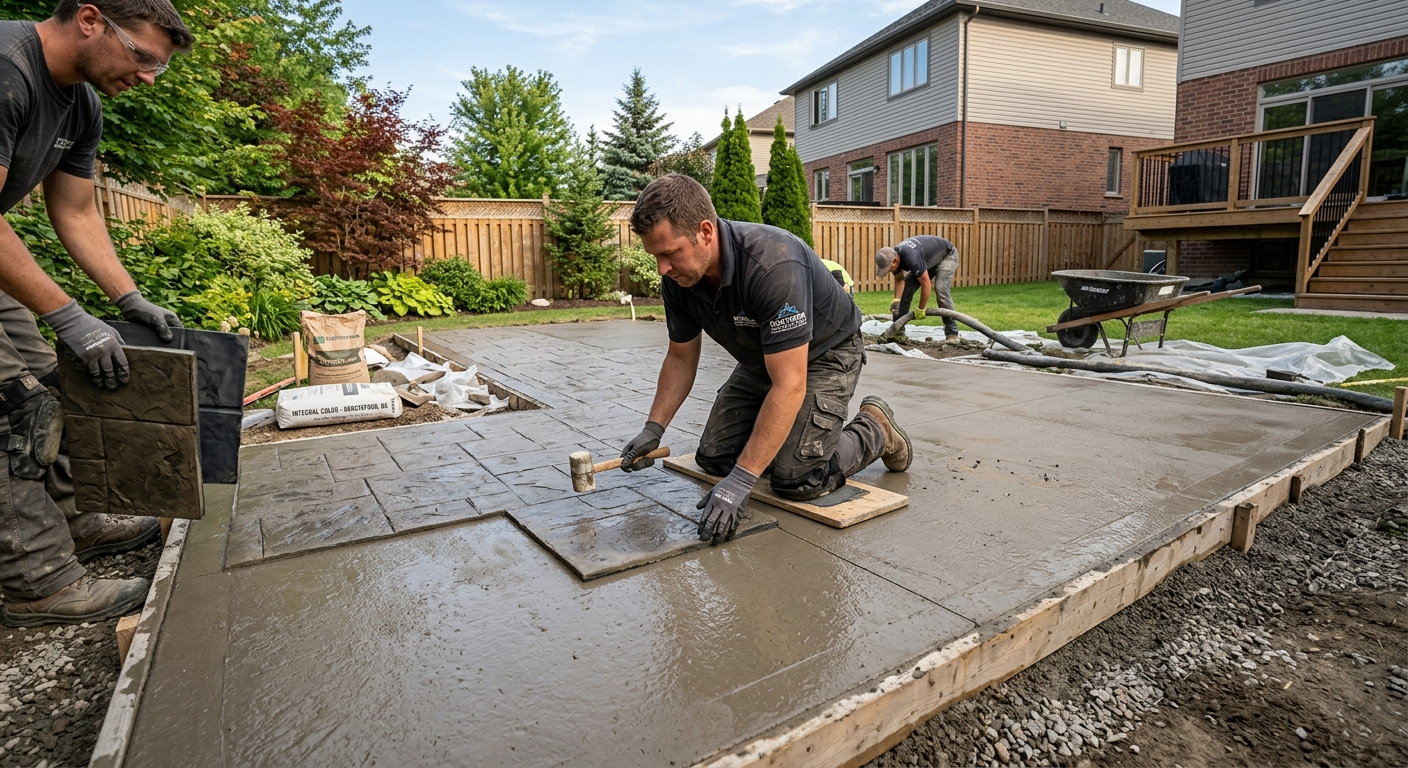
Concrete work options and costs in Quilchena
In Quilchena, homeowners usually choose concrete for driveways, patios, walkways and structural foundations because it’s durable and predictable—especially in a neighbourhood that’s home to 5,692 residents (Statistics Canada, 2021 Census). In Lower Mainland–Southwest communities, many properties are single-detached homes, so flatwork demand is steady year-round and crews are often most booked around spring and early fall. Quilchena’s climate also pushes the specifications: even with a relatively shallow frost depth of about 450 mm / 18" (common planning assumption), we still design footings and thickened edges below frost to manage freeze–thaw cycles and saturated coastal-wet soil. That same wet/cool pattern affects curing and scheduling—rain, high humidity and cool nights can delay finishing and require curing blankets, sealers, and longer protection times to reach design strength and surface durability.
Because frost protection, drainage, and air-entrained concrete are “baked into” exterior work here, pricing tends to cluster around the regional backbone rates. It’s also why two contractors can quote different totals for the same driveway: one may include the right granular base and proper control joints, while another may under-spec the mix or skip details that prevent scaling. In Quilchena—particularly around the older housing pockets closer to shopping and transit corridors—there’s frequent work on replacement driveways and patio expansions as owners renovate kitchens and backyards. Use the table below to compare realistic options and finish choices before you ask for an itemised quote.
| Application |
Typical Size |
Key Spec |
Finish Option |
Price Range |
| Concrete driveway (standard broom finish) |
300–400 sq. ft. |
Reinforced slab; air-entrained exterior mix |
Broom finish + control joints |
$18,000 – $28,000 |
| Exposed aggregate driveway |
300–400 sq. ft. |
Air-entrained mix; proper curing to reduce scaling |
Exposed aggregate (wash/burn-off) + sealer |
$22,000 – $34,000 |
| Stamped concrete driveway or patio |
250–350 sq. ft. |
Air-entrained mix; colour hardener where specified |
Stamped pattern + release + sealing |
$22,000 – $36,000 |
| Plain concrete patio or walkway |
120–250 sq. ft. |
Proper base compaction; drainage consideration |
Float & broom finish; light sealer (optional) |
$4,800 – $6,500 |
| Garage floor (interior slab) |
300–500 sq. ft. |
Vapour control where required; thickened edges as applicable |
Steel trowel / broom depending on use |
$10,000 – $16,000 |
| Foundation footings (structural, below frost) |
Varies by house |
Excavate to below design frost; rebar cage as required |
Reinforced concrete footings |
$3,000 – $5,500 |
Prices are estimates only and vary by project scope, site access and material selection.
What affects the price of concrete work in Quilchena
In the Lower Mainland–Southwest, two quotes for the “same” concrete job can differ by 30–50% because the price depends on what’s actually under the slab: how deep we dig, how we prepare and drain the base, the mix design, and how long we protect and cure concrete to reach target strength and durability. Across British Columbia, frost and weather patterns change the work. Even when footings in our region are typically planned around a shallow frost depth (about 450 mm / 18"), crews must still prevent freeze–thaw damage and manage moisture. That’s why exterior concrete uses air-entrained mixes and why drainage and compacted granular base are part of “good” scope—not add-ons.
Cold-weather precautions also matter. While Quilchena winters are milder than inland or northern BC, we still get cool nights and freeze–thaw cycles. When temps drop, concrete may need heating, insulated blankets and extended curing protection. That can shift a simple broom-finished driveway toward the upper end of the $18–$28 band, especially if the schedule is tight due to rain. Meanwhile, stamped or exposed finishes add cost for labour, forms and finishing time—pushing many projects into the $22–$36 decorative band when colour and pattern detail are specified.
Here are a few Quilchena-specific examples that move the needle:
- If your soil is saturated or the site has poor drainage, base prep and granular underdrain work can increase costs for both standard and decorative slabs.
- If you’re replacing older flatwork near established landscaping, demolition and disposal can add significant labour.
- If access is tight (narrow driveway, retaining walls, or overhead lines), pump/placement and forming costs rise.
Local housing stock also plays a role: many neighbourhood homes were renovated over the years, so tie-ins to existing slabs can require saw-cutting, dowels and careful jointing to avoid reflective cracking—often adding a few hundred to a few thousand dollars depending on the interface.
| Price Factor |
Why It Matters |
Cost Impact |
| Frost line depth — determines footing depth and form height |
Footings must extend below local design frost to prevent frost heave |
Can add excavation and forming time; common regional assumption ~450 mm / 18" |
| Site preparation — excavation, grading, compacted granular base |
Unsuitable subgrade leads to settlement, cracking and premature scaling |
Higher in saturated soils or when drainage/granular thickness increases |
| Reinforcement — rebar or wire mesh requirement |
Controls cracking; supports slab where loads and freeze–thaw cycles act |
Material and labour; more steel for driveways/garage floors |
| Mix design — air-entrainment and compressive strength spec |
Air-entrainment improves freeze–thaw durability and surface scaling resistance |
Air-entrained exterior mix adds material cost; protects performance |
| Finish type — broom vs. stamped vs. exposed aggregate |
Finish determines labour hours and curing/sealing steps |
Stamped/exposed usually pushes the project into upper price bands |
| Pour size and concrete truck access to site |
Placement logistics affect staffing and equipment needs |
Tight access can raise costs via additional pump/crew time |
| Cold-weather curing precautions — heating and blankets |
Ensures strength gain when temperatures drop during placement/curing |
Can add daily labour and material rental costs during shoulder seasons |
| Control joint pattern and sealing cost |
Jointing limits random cracking; sealing helps repel de-icing salts and moisture |
Sealer and labour for saw-cut/joint finishing add but reduce long-term failure |
Permits & regulations in British Columbia
In British Columbia, structural concrete work—such as footings, foundation walls, and grade beams—typically requires a building permit and often engineered drawings that the municipality reviews. For concrete flatwork like driveways, patios and walkways, permits usually are not required by default, but there are common exceptions: if the work changes lot grading, increases impervious surface beyond local thresholds, affects stormwater management, or impacts the municipal right-of-way/sidewalk area, you’ll want to confirm with the local authority before breaking ground.
For homeowners in Quilchena, the safest approach is to verify three things before scheduling: the contractor’s licensing/registration where applicable, their liability insurance, and their coverage for workers. Step-by-step:
- Licence/registration: check the appropriate online registry for the concrete contractor’s eligibility (often through the provincial/industry registry listed in their quote).
- Certificate of Insurance (COI): request a current COI showing liability coverage that matches the scope (footings, forming, excavation risks).
- WSIB/WCB coverage: ask for proof of coverage; your contract and COI should show active coverage for the relevant work.
- Clearance letter (if requested): some project types or homeowners’ due diligence may require a clearance letter confirming coverage status.
- References: ask for recent similar-scale jobs in the Lower Mainland–Southwest so you know they can handle drainage, rain scheduling and air-entrainment specs.
Those checks protect you on the biggest risks: structural performance, jobsite safety, and weather-driven schedule changes.
Getting concrete right in Quilchena's freeze-thaw climate
Concrete fails in Quilchena when moisture gets into the slab or base and then expands during freeze–thaw cycles—leading to scaling, cracking, and in worst cases, spalling. The fix starts before the pour. (1) Base preparation: we build a compacted granular sub-base to the correct thickness and grade so water doesn’t pond under the slab. In the Lower Mainland–Southwest, saturated soils and coastal rainfall are common, so drainage and base compaction are non-negotiable. (2) Mix design: for exterior flatwork, specify air-entrained concrete (commonly 5–7% air content) and minimum 32 MPa compressive strength so the surface can resist freeze–thaw damage. (3) Control joints: proper joint spacing helps the concrete crack where you want, rather than randomly. (4) Curing: plan for a minimum 7-day curing period under suitable conditions; in cool, wet weather, protecting the slab with curing blankets can be the difference between “looks okay” and “performs okay.” (5) Sealing: apply a penetrating sealer after cure (often around 28 days post-pour) to help repel moisture and reduce the impact of de-icing salts.
Ask the right technical questions to avoid the most common failure: spalling from inadequate air-entrainment. If a contractor is vague about the mix or joints, that’s a red flag. As a dollar example, moving from a “lowest bid” broom driveway that cuts corners to a properly air-entrained spec can add roughly $2,000–$5,000 on a 300–400 sq. ft. driveway—money that’s justified when you consider the cost and disruption of early replacement.
| Spec |
Why It Matters in Quilchena |
What to Ask For |
Impact if Skipped |
| Compacted granular base (depth?) |
Helps prevent settlement and limits moisture movement under the slab |
Granular thickness and compaction plan based on your subgrade |
Cracking, uneven surfaces, and early scaling in wet winters |
| Air-entrained concrete mix (target air %?) |
Improves freeze–thaw durability and reduces scaling/spalling |
Confirmed air content (typically 5–7% for exterior flatwork) |
Spalling and surface deterioration after winter cycles |
| Compressive strength (MPa rating) |
Ensures the concrete reaches sufficient strength for durability |
Minimum 32 MPa target (and test documentation if applicable) |
Surface damage, dusting and reduced service life |
| Control joints (spacing per ACI guidelines) |
Directs cracking to controlled locations and limits random cracks |
Joint layout plan, timing for saw-cut or formed joints |
Random cracking and cosmetic failures that are hard to hide |
| Minimum 7-day curing period |
Strength gain and durability depend on proper cure—especially in cool weather |
Protection plan if temperatures drop or rain is expected |
Lower strength, rough surfaces, and durability losses |
| Penetrating sealer (when applied after cure) |
Helps repel moisture and supports performance against de-icing salts |
Sealer type and application timing after cure (often ~28 days) |
More moisture ingress and faster surface wear |
How to choose a concrete work contractor in Quilchena
Choosing a concrete contractor in Quilchena isn’t just about the lowest price—on concrete, the details are the product. Start with verification. In British Columbia, ask for (1) proof of licensing/registration appropriate to their work, (2) a current liability insurance certificate, and (3) proof of WSIB/WCB coverage for workers. You can check these by reviewing the contractor’s COI (look for policy dates, coverage limits, and the scope noted), and by using any online registry information they provide in their quote or on their website. If they can’t produce documentation quickly, don’t treat that as “normal”—it’s avoidable.
Next, get 2–3 itemised written quotes that show labour and materials separately (not just a lump sum). Confirm what’s included: permit pull (if structural work triggers it), excavation and disposal, base prep thickness, reinforcement type, concrete mix spec, curing blankets/curing plan, and sealing. A clear scope matters because rain scheduling and curing protection are real cost drivers in the Lower Mainland–Southwest.
For warranty, ask how long the contractor stands behind workmanship, whether there’s a manufacturer warranty for materials, and if any coverage is transferable to future owners. For payment schedule, keep it controlled: never pay more than 10–15% upfront, and agree on a holdback until completion and cleanup are done. Finally, get the start date and estimated completion timeline in writing, including weather contingency language.
- They quote the concrete mix spec (air-entrainment and strength), not just “concrete.”
- They list base prep (granular type, thickness and compaction expectations).
- They include drainage considerations for exterior slabs.
- They explain reinforcement (where rebar or mesh is used and why).
- They provide a joint layout plan to control cracking.
- They detail curing protection for cool/wet days (blankets, seal timing).
- They specify sealing (penetrating sealer, when applied after cure).
- They state how they handle rain delays and rescheduling.
- They include disposal and site cleanup in the scope (or clearly exclude it).
- They confirm access for trucks/pump and placement method.
- They show an itemised labour/material breakdown.
- They share recent references from the Lower Mainland–Southwest.
Concrete red flags in Quilchena include: quotes that don’t mention air-entrainment, no written curing plan for cool/wet periods, missing proof of insurance/WCB, vague joint spacing (“we’ll figure it out on site”), and “rock-bottom” pricing that skips proper base prep—often the difference between a driveway in the $18–$28 band and one that fails early.
Frequently asked questions — concrete work in Quilchena
How do I maintain concrete in Quilchena's freeze-thaw climate?
In Quilchena, maintenance is about keeping water from sitting on the slab. Start with regular washing to remove dirt and fine debris that holds moisture. If you use de-icing products, avoid over-salting—frequent salt exposure can accelerate surface wear and lead to more scaling if the mix wasn’t specified correctly. After your slab has cured (often around 28 days), consider a penetrating sealer to repel moisture and help protect against wet-season exposure. Inspect control joints each spring and fill small joint gaps with an appropriate joint filler when needed. If you notice minor scaling early, address it promptly rather than waiting for deeper spalling. Good drainage around your driveway or patio is equally important; pooling water is the quickest path to freeze–thaw damage.
What causes concrete to spall in Quilchena winters?
Spalling is usually moisture-related damage, amplified by freeze–thaw cycling. In the Lower Mainland–Southwest, exterior concrete can repeatedly get wet from rainfall and saturated soils, then experience cold nights that freeze water in the paste and near the surface. If the concrete mix doesn’t have proper air-entrainment, freeze–thaw pressure can break down the surface, leading to scaling and then spalling. Sometimes the root cause is also a base/prep issue—if water can migrate under the slab or pond at the surface, the slab stays saturated longer and deterioration accelerates. A properly designed job typically includes air-entrained concrete, correct joint spacing, and a curing/sealing plan. If you’re budgeting, don’t automatically choose the lowest bid when prices are near the $18–$28 driveway range—skimping on mix or curing is what often triggers early failures.
What is rebar and when is it required in British Columbia?
Rebar (reinforcing steel) is used to strengthen concrete and control cracking by improving how the slab handles tension. Whether it’s required depends on the design, the structural loads, and the type of work. In British Columbia, structural concrete such as footings and foundation elements typically includes engineered reinforcement and often requires permits and engineered drawings. For exterior flatwork like driveways and garage slabs, reinforcement (rebar or wire mesh) is commonly used based on thickness, soil conditions and intended loads (like vehicles). It’s also a quality indicator: a contractor should explain where reinforcement goes and how it’s supported at the correct cover, not just “we’ll add mesh.” In Quilchena, reinforcement decisions also tie back to durability—freeze–thaw doesn’t create the structural need by itself, but it increases the consequences of cracking and moisture ingress if the slab isn’t built to resist it.
How long does a concrete project take in Quilchena?
Timelines vary by scope, weather and access, but you can plan around the reality that concrete needs placement and then curing/protection. A typical driveway replacement or large patio project often takes about 2–5 days of active work on site (demo, excavation, base prep, forming, pour, finishing), with additional time needed for curing and weather protection. Even after the pour, you usually can’t treat the slab as fully ready until strength gain progresses—your contractor should specify what “ready for use” means for your project. In Quilchena’s wet, cool shoulder-season conditions, rain can affect finishing and may shift curing logistics (curing blankets, seal timing, scheduling around cool nights). If you’re budgeting, a standard broom-finished driveway may land in the $18–$28 band, but decorative work (like stamped concrete) often takes longer to finish and can extend calendar time because of colour/hardener and pattern steps.
What is a concrete overlay and is it suited to Quilchena?
A concrete overlay is a new concrete layer placed over an existing concrete surface, usually after surface preparation like grinding and patching. It can be suited to Quilchena if the existing slab is structurally sound—no major base failure, severe settlement, or widespread heaving. If the old slab is already moving or the base is failing, an overlay may only postpone the problem. Overlays also need excellent surface preparation and proper bonding; otherwise, moisture can get trapped between layers and freeze–thaw can worsen deterioration. In practice, overlays are most successful when the existing concrete is mostly intact and you want a cosmetic upgrade (crack repair and a fresh surface) without full demolition. If you’re considering it, ask for a condition assessment and a written plan for prep, bonding method, mix design, curing and sealing—especially since Quilchena’s rainy periods and seasonal temperature swings can make moisture management critical.
How do I seal concrete to protect it in Quilchena?
Sealing helps by reducing moisture penetration and improving surface resistance to winter exposure and de-icing salt effects. For best results in Quilchena, wait until the slab has cured enough for sealer adhesion—commonly around 28 days post-pour for many products, but your contractor should match the schedule to the mix and curing conditions. Use a penetrating sealer designed for exterior concrete (not a simple paint-like coating unless specified for that purpose). Before sealing, ensure the surface is clean, dry and free of curing compounds, oils or residue from finishing. Then apply according to label directions for coverage rate and reapplication schedule. If you plan a driveway or walkway in the $18–$28 range, sealing is often the difference between “it looks good” and “it lasts,” provided the mix was correctly air-entrained and the joints were done to control cracking.