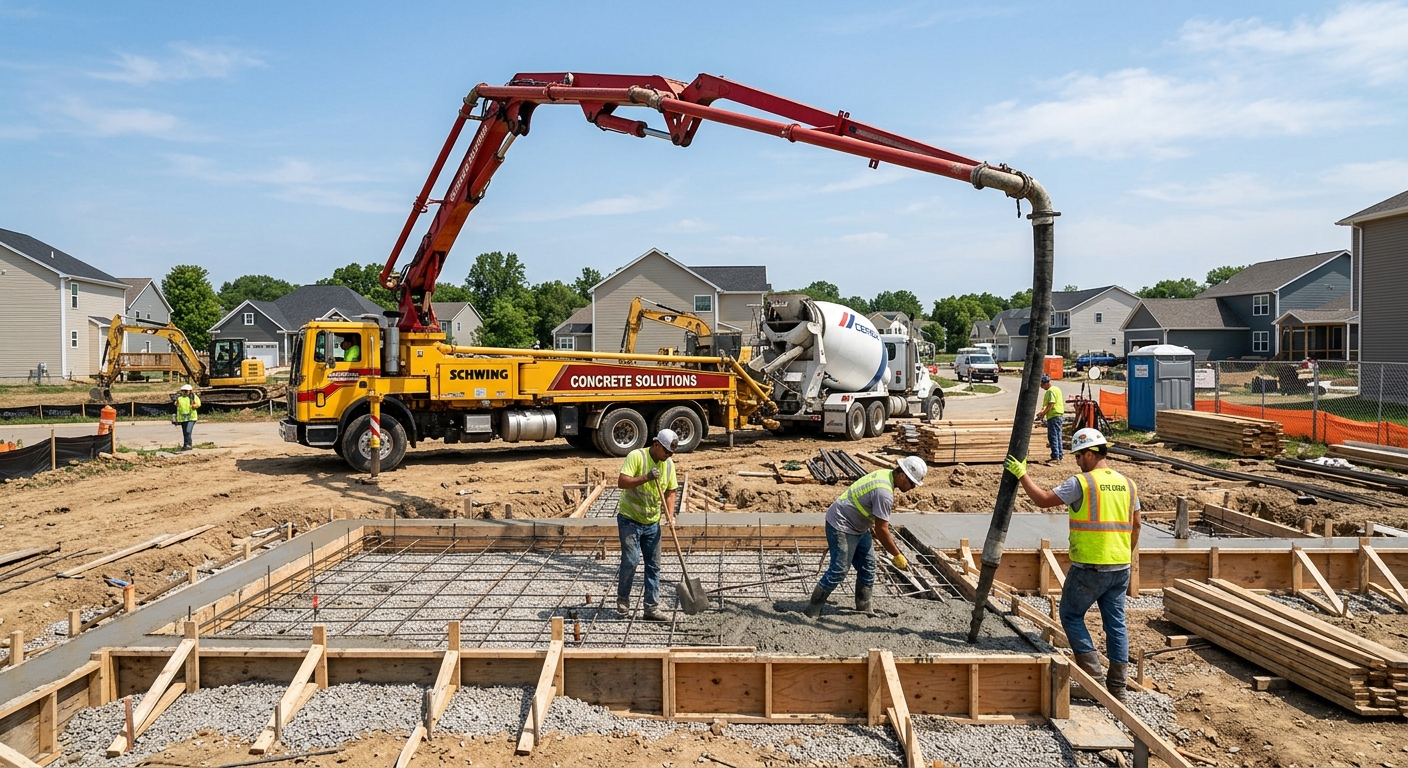
Concrete work options and costs in Coronation Park
Concrete work in Coronation Park is shaped by the realities of a small, growing community—population is 1,468 (Statistics Canada, 2021 Census)—and by the type of housing that brings repeat demand for flatwork. In this part of the Lower Mainland–Southwest, homeowners most often need driveways, patios and walkways that can handle wet conditions, cool nights, and the freeze–thaw cycling that stresses concrete surfaces. Even though our coastal-wet climate keeps winters milder than interior BC, local practice still assumes a shallow frost depth of about 450 mm / 18", so footings, thickened edges and structural bases must be placed below frost to avoid heave.
That frost-and-rain balance is why quotes can differ even for “the same” slab: excavation and base prep are driven by saturated soils and drainage needs, and exterior concrete typically uses air-entrained mixes plus careful jointing. Scheduling also matters—when prolonged rain or low overnight temperatures slow curing, contractors need extra protection (blankets, sealers, and longer cure times) to reach design strength and surface durability. In Coronation Park, trade demand is especially steady around the residential areas where lots are graded for access and drainage—such as near local connector roads where driveways and front steps see year-round wear.
Below are typical options and price bands you’ll see in the Lower Mainland–Southwest market. Use this table to compare finishes and scopes before you request itemized quotes.
| Application |
Typical Size |
Key Spec |
Finish Option |
Price Range |
| Concrete driveway (standard broom finish) |
400–600 sq. ft. |
Air-entrained exterior mix, compacted granular base, control joints |
Broom finish |
$18,000–$28,000 |
| Exposed aggregate driveway |
400–600 sq. ft. |
Air-entrained mix, proper curing to protect surface texture |
Exposed aggregate |
$22,000–$34,000 |
| Stamped concrete driveway or patio |
250–500 sq. ft. |
Air-entrained mix, release agent and stamping timing, sealer |
Stamped pattern |
$22,000–$36,000 |
| Plain concrete patio or walkway |
200–400 sq. ft. |
Compacted base, air-entrained mix, jointing for shrinkage control |
Float/trowel then light broom |
$16,000–$26,000 |
| Garage floor (interior slab) |
500–700 sq. ft. |
Interior mix, vapour barrier (if required), hardened surface plan |
Plain/steel trowel |
$16,000–$25,000 |
| Foundation footings (structural, below frost) |
Per project (typ. 2–3 days forming/pouring) |
Engineered sizing, rebar cage, pour below design frost depth |
Structural concrete (not decorative) |
$200–$350 |
Prices are estimates only and vary by project scope, site access and material selection.
What affects the price of concrete work in Coronation Park
In Coronation Park and across the Lower Mainland–Southwest, the biggest reason two homeowners see prices that are 30–50% apart for similar “concrete” is scope: excavation depth, base design, reinforcement, mix specification, and curing protection. A “cheap” driveway bid can look close on paper, but if the contractor doesn’t include proper drainage, a compacted granular base to the right elevation, and air-entrained concrete for freeze–thaw durability, you often pay later for scaling repairs and replacements. In colder parts of BC, the same type of work can be even higher because winter scheduling is tighter and cold-weather curing often requires heating and longer protection; that cost jump is smaller here than in northern climates, but it’s still real when nights drop and the ground stays saturated.
Local frost design influences nearly every exterior spec. While frost depth is shallow in coastal BC (commonly around 0.5–1.2 m for footing design ranges depending on soil and local conditions), footings and thickened edges still must extend below the design frost depth to prevent frost heave. Exterior slabs should also be air-entrained (typically 5–7% air) to survive freeze–thaw cycles and reduce spalling risk. De-icing salts and wet surface scaling then push many homeowners toward sealing, which is extra labour but helps protect the surface durability.
Cost differences you’ll commonly see in Coronation Park include: (1) whether the base prep includes granular drainage and compacted lifts, which can swing driveway pricing across the $18–$28 range; (2) whether reinforcement is required by engineered design or site conditions; and (3) whether you choose an upgrade like stamped concrete (often aligned with the $22–$36 range). For older properties with mature landscaping, excavation and disposal can add dollars quickly due to obstructions—sometimes turning a straightforward patio into a more involved, machine-time-heavy job.
| Price Factor |
Why It Matters |
Cost Impact |
| Frost line depth — determines footing depth and form height |
Footings and thickened edges must sit below design frost to prevent heave |
Higher excavation/formation costs on deeper runs and more soil removal |
| Site preparation — excavation, grading, compacted granular base |
Wet soils need drainage planning and properly compacted granular support |
Can add significant labour and equipment time if the site is saturated |
| Reinforcement — rebar or wire mesh requirement |
Controls cracking from shrinkage and movement; structural designs may require cages |
Materials and install labour increase, especially for larger slabs |
| Mix design — air-entrainment and compressive strength spec |
Air-entrainment helps manage freeze–thaw; strength supports long-term performance |
Exterior-duty mix can raise material costs vs interior mix designs |
| Finish type — broom vs. stamped vs. exposed aggregate |
Finish upgrades require more skilled labour and timing control |
Stamped/exposed typically costs more per square foot than broom |
| Pour size and concrete truck access to site |
Access affects pump placement, hose lengths, and pour efficiency |
Poor access can mean extra labour and potential equipment rental |
| Cold-weather curing precautions — heating and blankets |
Cold nights slow hydration and can jeopardize surface durability |
Extra materials and crew time to protect and maintain temperature |
| Control joint pattern and sealing cost |
Jointing controls cracking; sealing helps repel salts and water ingress |
Improves longevity but adds labour/materials for joint tooling and application |
Permits & regulations in British Columbia
In British Columbia, the rule of thumb is that structural concrete work needs municipal buy-in, while most decorative flatwork does not—unless it impacts drainage, lot grading, or municipal requirements. Footings, foundation walls, and grade beams are typically part of the structural system, so they generally require a building permit and often engineered drawings reviewed by the municipality. Concrete flatwork like patios, walkways, and driveways usually does not require a permit, but you should still confirm with the municipality if your work changes lot grading, increases impervious surface coverage beyond what’s allowed, or affects drainage patterns toward adjacent properties or a municipal right-of-way.
For your Coronation Park project, verify the contractor before work starts. First, ask for a valid contractor licence number (and confirm it through the appropriate online licensing registry for BC). Next, request a certificate of liability insurance showing coverage that matches the job value and site conditions. For workers, confirm WSIB/WCB coverage (or the contractor’s applicable worker protection coverage documentation). Then, ask for references from similar-scale projects in your region—especially jobs that include exterior slabs with air-entrained mix and drainage prep.
Step-by-step homeowner check: (1) request licence + insurance + coverage documents in writing; (2) check the licence details on the BC online registry; (3) review the COI dates and project endorsements; (4) ensure coverage is active for the project period; and (5) keep copies for your records in case of warranty or dispute.
Getting concrete right in Coronation Park's freeze-thaw climate
Concrete failures in Coronation Park are usually about water movement and freeze–thaw stress, not about “bad concrete” in a generic sense. The biggest risks are inadequate base prep (leading to settlement or pumping), poor drainage (water trapped under slabs), and concrete mixes that don’t have the required air-entrainment for durability. When water gets into the slab surface and pores freeze and expand, inadequate air void systems can lead to scaling and spalling—especially on driveways and steps where de-icing salts and tire abrasion accelerate surface damage.
To spec the job correctly for the Lower Mainland–Southwest, start with base preparation: use a compacted granular sub-base to the right depth and elevation for local soil support and frost considerations. Next, require an air-entrained mix with appropriate exterior exposure performance (commonly 5–7% air content for exterior flatwork) and minimum 32 MPa compressive strength for typical residential durability targets. Then, include control joints at a spacing that limits random cracking; finally, protect the pour with proper curing. Even though we don’t face Alberta-style deep freeze, cold nights and high humidity can slow hydration—so plan for a minimum 7-day curing period under suitable conditions, using blankets or seal protection when needed. After cure, apply a penetrating sealer (often around 28 days post-pour) to repel de-icing salts and wetting.
Where pricing is justified: if a standard broom-finish driveway is within the $18–$28 band, paying for stamped or decorative concrete (often aligned with $22–$36) can be worth it if the contractor also keeps the same correct base, mix and jointing specs. The finish upgrade should not “trade off” durability—if it does, you’re not saving money long-term.
| Spec |
Why It Matters in Coronation Park |
What to Ask For |
Impact if Skipped |
| Compacted granular base (depth?) |
Stable support reduces settlement and water pumping under slabs |
Granular sub-base to engineered thickness for your soil and drainage plan |
Uneven settling, cracking, and faster deterioration of the slab edges |
| Air-entrained concrete mix (target air %?) |
Air void system reduces damage from freeze–thaw cycles |
Exterior-duty air-entrained mix with target air content of about 5–7% |
Surface scaling and spalling, especially where salts and water collect |
| Compressive strength (MPa rating) |
Strength supports long-term wear and weather durability |
Minimum 32 MPa (or higher if specified by your design) |
Reduced durability and increased risk of surface wear and cracking |
| Control joints (spacing per ACI guidelines) |
Controls where cracks open as concrete shrinks |
Joint spacing and layout plan that matches slab size and shape |
Random cracking and difficult-to-repair edges and corners |
| Minimum 7-day curing period |
Proper hydration supports strength development in coastal humidity/cool nights |
Schedule that allows at least 7 days of suitable curing conditions |
Lower early strength, higher risk of surface defects and scaling |
| Penetrating sealer (when applied after cure) |
Repels water and salts to slow surface deterioration |
Penetrating sealer applied around 28 days post-pour after adequate cure |
Faster salt and water absorption; more frequent maintenance and repairs |
How to choose a concrete work contractor in Coronation Park
Choosing the right contractor in British Columbia starts with proof, not promises. First, confirm licensing: ask for the contractor’s licence details and check them through the appropriate online licensing registry for BC. Next, verify liability insurance—review the certificate of insurance dates and confirm coverage is active for your project period. For worker protection, ask for WSIB/WCB coverage documentation (or the applicable coverage proof the contractor is required to carry). If a contractor can’t provide these documents quickly, pause the process.
Then get 2–3 itemised written quotes—not lump-sum only. You want separate lines for labour, materials (including whether the mix is air-entrained), excavation and disposal, base preparation, reinforcement, finishing, curing protection, and sealing. The scope should clearly state what’s excluded: for example, removal of existing concrete, regrading beyond the slab footprint, drainage corrections, or permit support (if applicable for footings/foundation work). Ask whether the contractor pulls any required building permits for structural work, and whether the quote includes construction debris disposal.
Warranty matters too: confirm workmanship warranty length and what it covers (usually cracking that results from installation errors, not normal shrinkage cracks controlled by joints). Ask whether any product/manufacturer warranty applies and whether it’s transferable if you sell your home. For payment, a good rule is never pay more than 10–15% upfront; hold back a portion until the job is complete and cleaned. Finally, insist on a timeline in writing: start date, pour date, cure/protection period, and estimated completion.
- Ask for licence number and confirm it in the BC online registry before signing.
- Request a current certificate of liability insurance (COI) and verify project dates.
- Confirm WSIB/WCB coverage with documentation, not just verbal confirmation.
- Get at least two quotes with itemised labour + materials (not just a number).
- Insist the exterior mix is air-entrained and state target air content in the quote.
- Require a base prep plan: compacted granular thickness, grading, and drainage notes.
- Confirm reinforcement (mesh/rebar) matches your design and site conditions.
- Ask about control joints: spacing and layout, including sealing plan if required.
- Clarify curing protection: blankets/heating if temperatures require it.
- Ask if penetrating sealer is included and the timing (around 28 days post-pour).
- Confirm disposal and haul-away are included, or priced separately.
- Review payment schedule: limit upfront, and hold back until final inspection.
Concrete red flags I see in Coronation Park: quotes that omit air-entrainment and jointing details, “too-good-to-be-true” pricing that skips granular base prep, vague curing language (no mention of blankets/heating when needed), no written warranty terms, and contractors who ask for large upfront payments before any base prep or inspection.
Frequently asked questions — concrete work in Coronation Park
How much does concrete work cost in Coronation Park?
In Coronation Park, typical pricing follows the Lower Mainland–Southwest market bands for residential scopes. For a concrete driveway with a standard broom finish, many homeowners budget about $18,000–$28,000 depending on size, access, and how much excavation and drainage work is needed. A plain concrete patio or walkway is often around $16,000–$26,000 for typical residential footprints. If you want decorative work like stamped concrete, budgets often align with $22,000–$36,000. Foundation footing work is usually quoted per project or per linear measurement based on engineered specs, and the foundation/footings band commonly sits around $200–$350. Ask for an itemised quote because differences in base prep, reinforcement, and curing protection are the main drivers of price variation in British Columbia.
How deep must footings be for Coronation Park's frost line?
For Coronation Park and the coastal-wet Lower Mainland–Southwest climate, typical design assumptions use a shallow frost depth around 450 mm / 18" for many exterior foundation details. In practice, that means footings and structural supports are placed below the design frost depth to prevent frost heave, with exact depths depending on engineered drawings and local soil conditions. It’s not just a “one number fits all” situation: saturated soils, drainage quality, and building design influence how deep and how thick the footing and thickened edges must be. For homeowners, the key point is that the footing depth should come from your engineered foundation plan (for structural work), not from guesswork. Always confirm the contractor is placing concrete below the frost depth stated in the design and that they’re accounting for excavation conditions encountered on-site.
Why does concrete crack in Coronation Park and how is it prevented?
Concrete cracking is common in Coronation Park because slabs shrink as they cure and expand/contract as moisture and temperature change through wet periods and freeze–thaw cycling. Cracks aren’t always a “defect,” but uncontrolled cracking is what causes water to enter and can speed up surface scaling. Prevention starts with the right base: a properly compacted granular base reduces movement. Next is the correct mix design—exterior air-entrainment helps manage freeze–thaw stress. Third, control joints are used to create planned weak points so cracks occur where they can be managed. Finish quality and curing protection also matter: a minimum 7-day curing period under appropriate conditions helps the concrete gain strength and reduces early surface problems. For de-icing areas, sealing after cure helps repel salts. In British Columbia, skipping any of these steps often turns minor shrinkage cracking into larger repairs over time.
Stamped vs broom-finish concrete — cost difference?
Stamped concrete costs more than broom-finish primarily because it requires more skilled labour and tighter timing during placement and finishing, plus typically a higher-end sealing approach for the decorative surface. In the Lower Mainland–Southwest, broom-finished driveways usually fall around $18,000–$28,000 depending on size and site prep. Stamped concrete driveways or patios commonly land in the decorative band of $22,000–$36,000. The important part for homeowners in Coronation Park is that the cost difference should not come from cutting durability specs. A proper stamped job should still include air-entrained exterior mix, correct base prep and drainage, and proper control joints. If the contractor can’t clearly explain mix and joint specs, the cheaper bid may only look attractive at the start.
When is the best time to pour concrete in Coronation Park?
The best time to pour in Coronation Park is when temperatures and weather allow consistent curing. In the Lower Mainland–Southwest, winters are milder than interior BC, but freeze–thaw cycles and cool, damp nights still affect hydration and surface durability. Contractors typically plan around rain windows and schedule pours when the forecast supports proper curing and protection. If overnight temperatures are low, cold-weather curing precautions may be needed—this can mean insulating blankets and sometimes heating measures to maintain temperature for strength gain. Even for exterior flatwork, prolonged rain and high humidity can increase scheduling complexity. For homeowners, ask the contractor how they protect the slab during curing and whether they adjust mix placement or protection plans based on temperature. Clear weather planning is one reason reputable contractors are booked in advance during better pour windows.
How long does concrete take to cure?
Concrete curing isn’t just “drying”—it’s hydration. For typical residential exterior flatwork in British Columbia, a minimum 7-day curing period under suitable conditions is often used to support early strength development and reduce surface issues. Full design strength continues to develop beyond that, and protective performance keeps improving with time. For homeowners, the practical schedule is: protect the slab during the first days after the pour, avoid heavy loads too soon, and keep curing consistent (especially when cold nights or high humidity slow hydration). If you’re applying a penetrating sealer, many contractors target about 28 days after the pour so the concrete has cured enough to accept and benefit from sealing. If the work is rushed or curing protection is inadequate, you’re more likely to see premature scaling or spalling in Coronation Park’s wet-freeze conditions.