Concrete work options and costs in Quesnel
In Quesnel, British Columbia, concrete flatwork is a year-round need, but it’s priced and scheduled around the realities of a Cariboo freeze-thaw climate. With 59.6% of local dwellings being single-detached houses and 2,795 homeowner households in the city’s area (Statistics Canada, 2021 Census), most driveway and patio work is residential and typically built to last through deep winter freeze cycles. About 62.3% of homes were built before 1981 (Statistics Canada, 2021 Census), so it’s common to see repairs, re-sloping, and replacement of older slabs that have lifted or scaled at the surface.
In the Cariboo, frost can reach several feet and the frost line can sit deep enough that permanent footings must be designed to bear below frost to avoid frost heave and cracking. Exterior slabs also need air-entrained mixes to resist scaling and spalling, and bases must be well-drained and compacted to reduce freeze-thaw pumping. Costs can be higher than warmer parts of B.C. because the pour season can be shorter, mobilization is less flexible, and curing may require insulated blankets or heating to maintain temperature for strength gain. Neighbourhoods around central Quesnel and the newer edges near the highway corridor tend to see steady demand for driveway replacements and garage pads due to regular housing turnover and landscaping updates.
Below are practical starting price ranges you’ll see for typical jobs in Quesnel, so you can compare quotes before you ask contractors for line-by-line details.
| Application |
Typical Size |
Key Spec |
Finish Option |
Price Range |
| Concrete driveway (standard broom finish) |
16 ft x 20 ft (320 sq ft) |
Air-entrained exterior mix; compacted granular base |
Broom finish + control joints |
$6,000–$8,000 |
| Exposed aggregate driveway |
16 ft x 20 ft (320 sq ft) |
Scrub/ wash reveal + air-entrained mix |
Exposed aggregate surface |
$7,500–$10,500 |
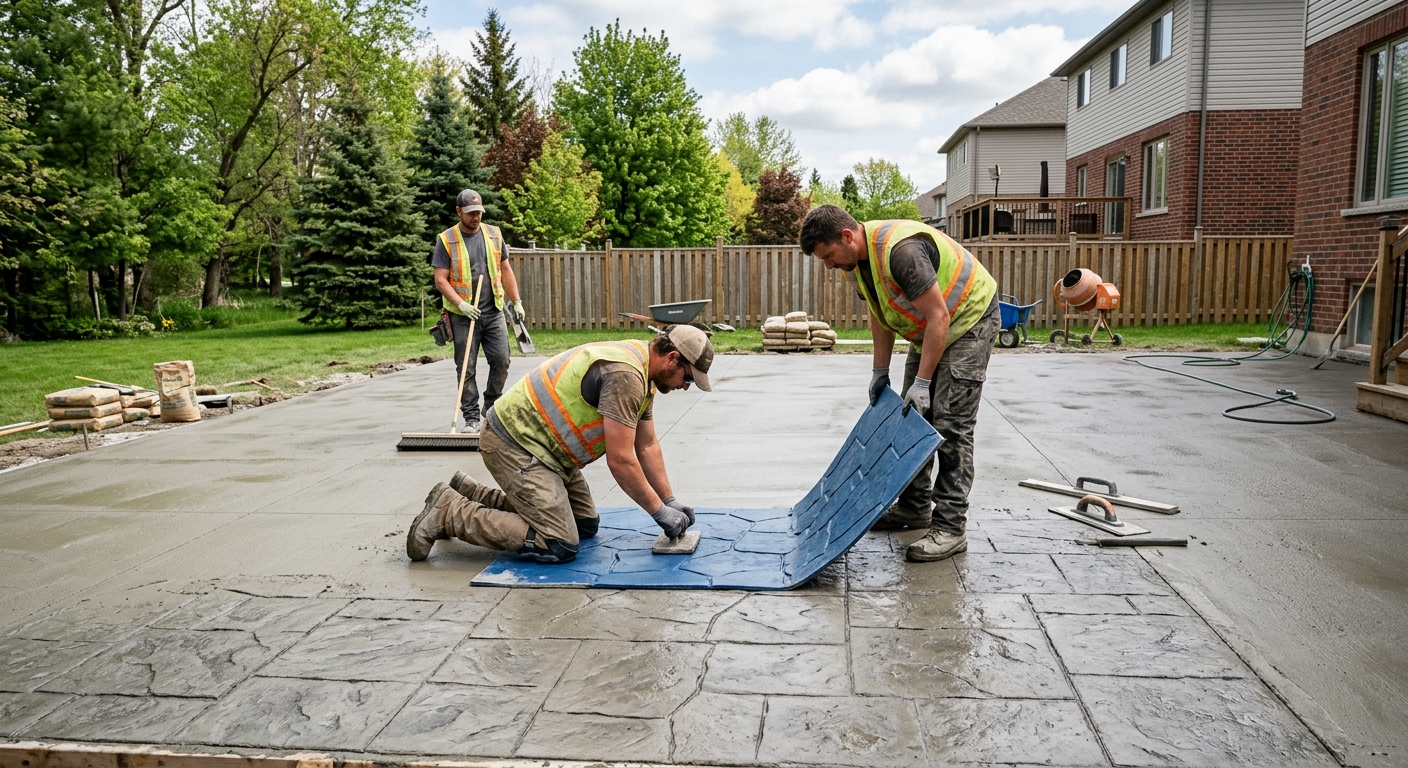
| Stamped concrete driveway or patio |
12 ft x 24 ft (288 sq ft) |
Air-entrained exterior mix; release agent; colour hardener |
Stamped pattern + sealer |
$9,500–$13,500 |
| Plain concrete patio or walkway |
10 ft x 16 ft (160 sq ft) |
Air-entrained mix for exterior exposure |
Float/ trowel + light broom texture |
$2,200–$3,500 |
| Garage floor (interior slab) |
24 ft x 24 ft (576 sq ft) |
Vapour barrier; wire mesh or rebar as required |
Light broom or smooth trowel |
$7,500–$11,500 |
| Foundation footings (structural, below frost) |
Typical detached build: 40–60 lin ft |
Excavation to frost depth; rebar; concrete designed for loads |
Structural concrete, no decorative finish |
$4,000–$9,600 |
Prices are estimates only and vary by project scope, site access and material selection.
What affects the price of concrete work in Quesnel
In the Cariboo region, it’s normal to see quotes for the “same” concrete job vary by 30–50% because the specs that prevent failure cost money—and those specs change with soil, frost depth, finish complexity, and how long crews must protect curing. Quesnel is in a true cold-weather concrete market where labour and equipment time can stretch due to shorter pour seasons and the need to keep concrete warm enough to reach strength reliably. That’s why an exterior slab that’s simply “poured and finished” can cost less upfront than one that’s air-entrained, properly bedded, and cured with blankets—yet the cheaper option often shows scaling and cracking sooner.
Frost line depth and freeze-thaw cycles drive nearly every line item. Footings must extend below the local design frost depth to prevent frost heave, and exterior slabs typically require air-entrained mixes to survive repeated temperature cycling. Cold regions also need cold-weather curing precautions (insulated blankets and sometimes heaters), which add direct labour and equipment rental. Plus, de-icing salt accelerates surface deterioration; sealing becomes a practical part of protecting your finish.
Two quick Quesnel examples show how specs move cost. First, moving from a plain broom driveway to stamped concrete can shift you into a higher decorative band—think roughly $16,000–$25,000 for typical driveway-sized flatwork in the higher end when colour and stamping are included, versus the more basic driveway pricing closer to the $16–$25 per sq ft market range. Second, a foundation/footing scope can land in the structural band around $90–$160 per linear foot when excavation depth, reinforcement, and frost-bearing design are fully accounted for; shallow excavations or under-specified base can look cheaper, but they commonly cost more later in repairs.
Local housing stock also affects cost: older lots frequently have uneven grades and compacted fill that must be removed and re-built with granular base, and that excavation/compaction work adds up quickly when your home is built before 1981.
| Price Factor |
Why It Matters |
Cost Impact |
| Frost line depth — determines footing depth and form height |
Controls excavation volume and below-frost bearing for heave prevention |
Often the biggest swing for structural work; can change total cost materially |
| Site preparation — excavation, grading, compacted granular base |
Proper drainage and compaction reduce settlement and movement |
Increases costs when access is tough or soil requires removal/replacement |
| Reinforcement — rebar or wire mesh requirement |
Helps control cracking and supports loads (especially in garage slabs) |
Higher rebar scopes raise material and labour time |
| Mix design — air-entrainment and compressive strength spec |
Air-entrainment helps resist scaling/spalling during freeze-thaw cycles |
Costs more than generic mixes but reduces early surface failures |
| Finish type — broom vs. stamped vs. exposed aggregate |
Complex finishes require more labour steps, colour work, and curing/sealing care |
Stamped/exposed aggregate usually adds a noticeable premium |
| Pour size and concrete truck access to site |
Access affects pump/telehandler use, pour sequencing, and labour efficiency |
Poor access can add equipment charges and slow crew productivity |
| Cold-weather curing precautions — heating and blankets |
Cold slows strength gain; protection improves long-term performance |
Can increase labour/equipment time in shoulder season and winter pours |
| Control joint pattern and sealing cost |
Joints manage shrinkage cracks; sealing helps repel de-icing salts |
Small per-sq-ft line item that meaningfully reduces maintenance and scaling risk |
Permits & regulations in British Columbia
In British Columbia, the rules depend on what you’re pouring. Structural concrete work—such as footings, foundation walls, and grade beams—typically requires a building permit, and many projects also need engineered drawings that the municipality reviews. Concrete flatwork (patios, walkways, and most driveways) usually does not require a permit by default, but it can require approvals if it changes lot grading, impacts drainage, increases impervious surface coverage beyond municipal limits, or affects the municipal right-of-way.
Before breaking ground in Quesnel, confirm with the City/municipal building department whether your proposed scope triggers permits. Ask the contractor to provide proof of coverage and to clearly separate permit-related scope from “work-only” scope. A good contractor will carry liability insurance and have proper provincial worker coverage for their crews.
To verify a contractor in B.C., do this step-by-step:
- Check their business registration and contractor credentials through the appropriate provincial online resources (use the company name exactly as on the quote/contract).
- Request a current certificate of insurance (liability) and confirm it covers concrete work and your address/contract period.
- Ask for proof of worker coverage (commonly referenced as WSBC/WCB coverage) and verify the policy is active.
- Ask for references from similar Quesnel cold-weather flatwork projects (driveways/patios poured with air-entrained mixes and proper curing).
- Get written confirmation of who pulls permits (if required) and what’s included.
Getting concrete right in Quesnel's freeze-thaw climate
Concrete problems in Quesnel usually aren’t about “bad luck”—they’re about the mix, the base, and the time it spends curing in cold conditions. The most common failures are spalling and scaling on exterior surfaces, along with random cracking from shrinkage and movement. In a Cariboo freeze-thaw pattern, you should spec a properly prepared, compacted granular sub-base to the right depth for the frost-bearing design, with good drainage that directs meltwater away from the slab and foundation.
For mix design, ensure air-entrainment is specified—typically 5–7% air content for exterior flatwork—and confirm minimum compressive strength (often at least 32 MPa for durable exterior applications). Control joints matter because they guide shrinkage cracking to predictable lines. The curing period is critical: don’t assume “it’s hard the next day.” In cold weather, crews should plan for at least 7 days of curing under appropriate conditions, and when temperatures drop they may need insulated blankets or heat to keep strength gain on track. Finally, apply a penetrating sealer after the cure (commonly around 28 days post-pour) to help repel de-icing salts.
When comparing options, the extra cost is usually justified when it prevents premature failure. For example, choosing an air-entrained exterior mix and proper curing on a driveway can cost more than a bare-minimum “warm weather” spec, but it’s cheaper than replacing a scaled slab later. If you’re deciding between plain broom-finish flatwork and stamped concrete, remember stamped work is a higher decorative band (around $26–$40 per sq ft market pricing) and requires a more careful build-and-cure routine to keep the surface durable.
| Spec |
Why It Matters in Quesnel |
What to Ask For |
Impact if Skipped |
| Compacted granular base (depth?) |
Reduces settlement and freeze-thaw pumping under exterior slabs |
Base thickness for your soil and frost-bearing requirement; compaction proof |
Settlement, cracking, and water-related lifting at the edges |
| Air-entrained concrete mix (target air %?) |
Improves freeze-thaw durability to resist scaling/spalling |
Specify air content (commonly 5–7% for exterior flatwork) |
Surface scaling, spalling, and accelerated deterioration |
| Compressive strength (MPa rating) |
Ensures long-term strength and durability under cold exposure |
Minimum 32 MPa (confirm spec on the quote) |
Weaker surface layer and higher risk of early failure |
| Control joints (spacing per ACI guidelines) |
Limits random cracking patterns from shrinkage |
Planned joint layout and schedule for saw-cut timing |
Unsightly random cracks and increased water intrusion |
| Minimum 7-day curing period |
Cold slows strength gain and increases shrinkage risk |
Curing plan, including blankets/heaters when needed |
Reduced durability and higher cracking likelihood |
| Penetrating sealer (when applied after cure) |
Helps protect from de-icing salts and winter splash damage |
Confirm sealer type and timing (often after ~28 days) |
Faster surface scaling and more frequent maintenance |
How to choose a concrete work contractor in Quesnel
Choosing the right contractor in Quesnel is mostly about verification and clarity. Start by confirming their coverage. In British Columbia, ask for a current certificate of insurance (liability) and make sure it matches the scope (concrete flatwork and/or structural work). Then request proof of worker coverage referenced as WSBC/WCB coverage—this matters if they have crews on your site. Finally, ask for references from similar cold-weather pours in the Cariboo region, not just warm-season jobs.
Next, get 2–3 itemised written quotes. You want the quote broken down into labour and materials—concrete supply, base prep, reinforcement, formwork, joints, finishing, and sealing—rather than one lump number. Read the scope exclusions carefully: is excavation disposal included? Are rock removal, hauling, or re-grading to meet drainage requirements included? If a permit is needed for structural work, who pulls it and what are the costs? A transparent contract will name the assumed site conditions and specify how changes are priced.
For warranty, ask for workmanship warranty length and whether it’s tied to crack types, joint function, and finish performance. Also ask about any manufacturer warranty for products like sealers or admixtures and whether it transfers to you. On payment schedule, never pay more than 10–15% upfront; hold back until the job is complete and surfaces are sealed when included. Get the start date and completion estimate in writing, and make sure the crew can meet curing protection requirements.
- Ask for proof of liability insurance and verify coverage dates.
- Request WSBC/WCB coverage documentation before work begins.
- Confirm the mix design includes air-entrainment for exterior slabs.
- Require a base-prep plan (excavation depth, granular type, compaction approach).
- Get a clear joint layout and saw-cut/finish timing schedule.
- Ask how they handle cold weather curing (blankets/heaters/temperature monitoring).
- Ensure reinforcement is specified (wire mesh vs rebar, and where it sits).
- Confirm sealing is included for exterior flatwork where de-icing salts are expected.
- Verify whether demolition/removal and debris disposal are included.
- Check concrete truck access and whether pumping/telehandler use is required and priced.
- Use an itemised labour/materials breakdown instead of a lump sum only.
- Confirm warranty details in writing, including what maintenance is required.
Concrete contractor red flags in Quesnel: they can’t explain frost-bearing footing depth or frost-heave prevention, they avoid discussing air-entrainment for exterior slabs, they offer a “cold-weather pour” without blankets/heating plans, they won’t provide an itemised quote (especially for base prep and joints), or they ask for most payment upfront before forms are set and the schedule is confirmed.
Frequently asked questions — concrete work in Quesnel
How much does concrete work cost in Quesnel?
In Quesnel, pricing depends on finish, thickness, reinforcement, and how much cold-weather curing protection is needed. As a baseline, exterior concrete driveways and slabs commonly land in the market range around $16–$25 per sq ft for standard work, with decorative options higher. For a typical driveway-sized project (about 320 sq ft), homeowners often see estimates around the mid single-digit thousands for broom-finish concrete, while stamped work generally carries a larger premium because it includes colour hardeners, stamping labour, and careful curing. If you’re budgeting for decorative concrete, the stamped & decorative concrete band is commonly around $26–$40 per sq ft, so a 288 sq ft patio can land higher than a plain walkway. Site access and base prep are major swing factors in the Cariboo cold-weather market.
How deep must footings be for Quesnel's frost line?
Footings must be designed to bear below the local design frost depth to reduce frost heave risk in Quesnel’s cold-weather conditions. The exact depth varies by the engineering design, soil conditions, and building loads, so it’s not something to guess from general ranges alone. As a rule of thumb, colder inland regions require deeper excavation than milder climates, and you should expect form height and excavation volume to increase with deeper frost design. For structural work, ask your contractor whether the footing depth is engineered to sit below frost and whether they’re accounting for soil type and drainage. If a quote looks too low for foundation/footings, check whether they’re assuming reduced excavation or minimum reinforcement. Structural footing projects often fall around the $90–$160 per linear foot market band once frost-bearing design is included.
Why does concrete crack in Quesnel and how is it prevented?
Concrete in Quesnel cracks mostly due to shrinkage and movement, and in exterior work, freeze-thaw impacts when water reaches weak points. The prevention is all about a correct build-up: a well-compacted granular base, correct mix design (including air-entrainment for durability), and a control joint plan that guides where shrinkage cracks occur. In a cold-weather market, curing is also important—cold temperatures slow strength gain, so slabs may need insulated blankets or heaters to reduce cracking risk. Finally, cracking will happen less aggressively when joints are cut on schedule and the drainage around the slab is right. If de-icing salts are used, sealing after the cure helps protect the surface from scaling, which is often mistaken for “cracking” issues.
Stamped vs broom-finish concrete — cost difference?
Stamped concrete costs more than broom-finish because it’s more labour-intensive and requires additional materials (stamp tools, colour work, release agents) plus careful timing to maintain the surface during finishing and curing. In Quesnel, the freeze-thaw environment means decorative slabs still need the same cold-weather durability specs—like air-entrainment—and they still require proper base prep, joints, and curing protection. As a pricing anchor, broom-finish driveway work often sits closer to the $16–$25 per sq ft market range, while stamped & decorative concrete commonly aligns with about $26–$40 per sq ft depending on site and design complexity. A good way to compare quotes is to ask whether both options include air-entrainment, reinforcement, base compaction, joint layout, and sealing—if those aren’t matched, the “cheaper” stamped quote may not actually be comparable.
When is the best time to pour concrete in Quesnel?
The best time to pour concrete in Quesnel is when temperatures allow normal curing and the contractor can protect the slab until it reaches design strength. In the Cariboo, shoulder seasons can be challenging: nights cool quickly, and freeze-thaw cycles can begin before the slab has fully cured. That’s why many homeowners aim for spring to early fall when crews can pour, finish, and cure without extended heating or heavy insulation. If you do need winter or near-freezing pours, ask for a written cold-weather curing plan—insulated blankets, possible heating, and how they’ll manage concrete temperature—because skipping this is one of the fastest routes to scaling, reduced durability, and early cracking. A contractor’s willingness to show a curing plan matters as much as the pour date.
How long does concrete take to cure?
Concrete strength gain doesn’t happen instantly. While you might be able to walk on a slab sooner, Quesnel exterior work should be treated as a curing-critical process. For typical performance planning, plan for at least 7 days of proper curing under suitable conditions before expecting full durability; that’s especially important in cold weather where temperature slows strength development. For finishing protection, many homeowners also plan for sealing after the cure—often around 28 days post-pour—so the sealer can help repel water and de-icing salts that contribute to scaling. If your quote doesn’t mention curing blankets/heating when temperatures are low, ask directly how they’ll meet the curing requirements. Proper curing can be the difference between a driveway that survives multiple winters and one that shows surface deterioration quickly.