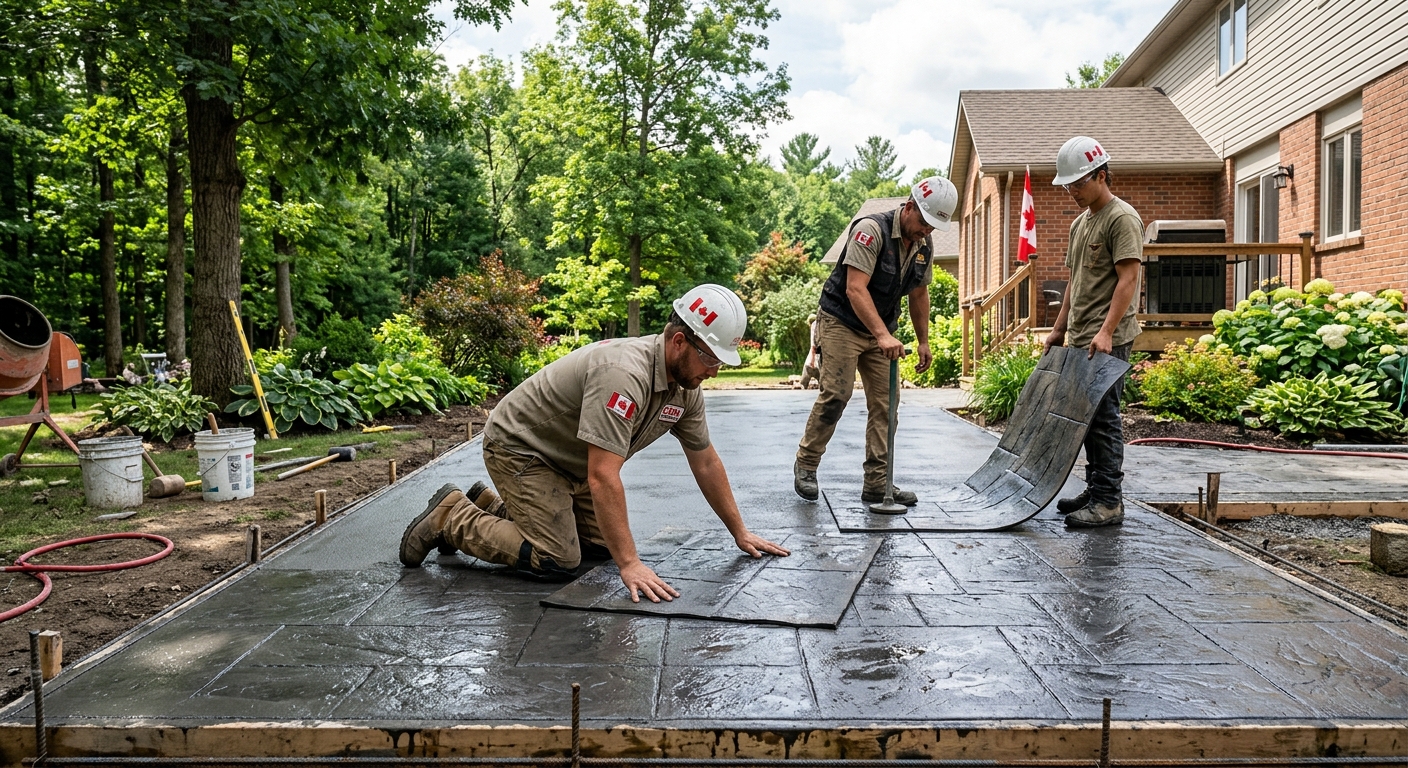
Concrete work options and costs in Burnaby Heights
In Burnaby Heights, concrete flatwork is popular because it handles wet weather, neighbourhood traffic, and the day-to-day freeze–thaw cycle that affects the Lower Mainland–Southwest. With a population of 8,280 (Statistics Canada, 2021 Census), the area has steady demand for driveways, patios, walkways and foundation work as homeowners update older homes and replace worn surfaces. Burnaby Heights is also known for a high share of traditional neighbourhood housing stock, which means lots of re-drives, front-step touch-ups, and garage slab repairs—jobs that concrete contractors can scale quickly when access is straightforward.
Pricing here is shaped by two realities: a shallow frost depth (commonly designed around ~450 mm / 18" in the region) and frequent coastal rain followed by cool nights. Even though frost isn’t as deep as in interior or northern BC, we still detail footings and thickened edges to sit below the design frost line to limit frost heave. For exterior slabs, contractors typically use air-entrained mixes and control joints to manage cracking and scaling. Scheduling also matters; longer cure times and rain planning can shift labour and formwork costs.
Trade demand is especially strong around the Burnaby Heights core and near Metrotown-side arterials where lots have vehicle access constraints and the driveway apron takes repeated pounding. If your property is in the middle of that “busy access” zone, you’ll usually see tighter excavation/placing logistics and more care around base prep.
Below is a practical comparison of common concrete options you’ll see in Burnaby Heights, with realistic price bands to help you read quotes before you book a site visit.
| Application |
Typical Size |
Key Spec |
Finish Option |
Price Range |
| Concrete driveway (standard broom finish) |
200–300 sq. ft. (18.6–27.9 m²) |
Air-entrained exterior mix, compacted granular base, control joints |
Broom finish, light saw-cut pattern |
$18,000 – $28,000 |
| Exposed aggregate driveway |
200–300 sq. ft. (18.6–27.9 m²) |
Air-entrained mix, proper base and finishing timing |
Exposed aggregate (sandblasted or retarder technique) |
$22,000 – $34,000 |
| Stamped concrete driveway or patio |
150–250 sq. ft. (14–23.2 m²) |
Air-entrained exterior mix, integral colouring or densifier |
Stamp mats + colour, optional sealer |
$22,000 – $36,000 |
| Plain concrete patio or walkway |
100–200 sq. ft. (9.3–18.6 m²) |
Air-entrained mix, thickened edge where needed, joints |
Broom or smooth trowel (slip-resistant finish where required) |
$16,000 – $26,000 |
| Garage floor (interior slab) |
300–500 sq. ft. (27.9–46.5 m²) |
Vapour control/insulation if needed, proper thickness and reinforcement |
Smooth float, optional stain/sealer |
$18,000 – $32,000 |
| Foundation footings (structural, below frost) |
Per linear foot equivalent for a typical underpin/footing scope |
Engineered requirements; placed below design frost; rebar cage and formwork |
Functional structural concrete; not a cosmetic finish |
$200 – $350 |
Prices are estimates only and vary by project scope, site access and material selection.
What affects the price of concrete work in Burnaby Heights
In the Lower Mainland–Southwest, you can see quote swings of 30–50% for what sounds like the “same” concrete job—mainly because excavation depth, base design, reinforcement, and curing controls vary from site to site. Compared to other parts of BC, the difference often comes down to weather risk and how much protection your contractor must plan for during cool, wet stretches.
First, frost line depth dictates every spec. In coastal BC, design frost depth is often in the 0.5–1.2 m range, but footings and thickened edges still must extend below the design frost to prevent frost heave. That’s why exterior slabs and driveways are priced with engineered base prep and drainage in mind, not just “pour and finish.” Second, freeze–thaw cycles drive mix requirements—exterior work typically needs air-entrained concrete (with the right air content) and proper control joints. Third, cold-weather curing precautions are a real cost driver: if the temperature dips, contractors may need curing blankets or short-term heating to maintain strength gain. Finally, de-icing salt accelerates surface deterioration, so sealing decisions can change long-term durability.
Concrete can cost more when your site needs additional granular replacement, when groundwater is high, or when access forces extra labour for forming and placement. It can cost less when the base is already compacted to grade and vehicle access is straightforward. For example, moving from a plain driveway (often closer to the $18–$28 band for standard work) to stamped or exposed aggregate can add labour, materials, and extra finishing time—so the higher $22–$36 stamped/decorative range is usually justified when you’re getting integral colour, stamping labour, and a sealer system.
Housing-stock age also matters. In older Burnaby Heights lots, replacing cracked edges or adjusting for settlement may require additional saw-cut removal, thicker replacement sections, or more rebar—so the price isn’t just “surface patching,” it’s structural slab thinking.
| Price Factor |
Why It Matters |
Cost Impact |
| Frost line depth — determines footing depth and form height |
Footings must sit below design frost to prevent heave and uneven settlement |
Higher excavation and formwork; can add significant foundation labour |
| Site preparation — excavation, grading, compacted granular base |
Proper base thickness and compaction reduce pumping, cracking, and failure |
More haul-off/haul-in can push costs upward quickly |
| Reinforcement — rebar or wire mesh requirement |
Controls cracking and improves load transfer in driveways and slabs |
Extra steel + tying time; often increases price mid-band to high-band |
| Mix design — air-entrainment and compressive strength spec |
Air entrainment improves freeze–thaw durability in coastal-wet conditions |
Material spec changes; can narrow durability risks but adds a line item |
| Finish type — broom vs. stamped vs. exposed aggregate |
Finishing steps affect labour hours and material handling |
Stamped/exposed typically add more finishing labour and consumables |
| Pour size and concrete truck access to site |
Large placements need staging, timing, and efficient placing to avoid cold joints |
Tighter access can increase labour for wheelbarrowing or multiple loads |
| Cold-weather curing precautions — heating and blankets |
Cold nights and rain require protection for strength gain |
Blankets, labour time, and sometimes temporary heating |
| Control joint pattern and sealing cost |
Joints manage cracking; sealing helps repel de-icing salts and moisture |
Additional layout/saw-cutting and sealer product and application |
Permits & regulations in British Columbia
In British Columbia, structural concrete work typically needs a building permit. That includes footings, foundation walls, grade beams, underpinning, and other load-bearing foundation elements. In many cases, the municipality will also expect engineered drawings for those structural components. Concrete flatwork—patios, walkways, and most driveways—often does not require a permit, unless your project affects lot grading, drainage, or impervious surface coverage limits, or it involves work that touches municipal right-of-way or stormwater requirements. Because rules can vary with site conditions, always confirm with the local authority before breaking ground.
For your contractor check in Burnaby Heights, start with three verifications: (1) licensing and corporate details, (2) liability insurance, and (3) workers’ compensation coverage. Step-by-step: request a copy of their certificate of insurance (liability) and review expiry dates and the project address; ask for proof of workers’ compensation coverage; then confirm their business info through the appropriate online registries and ensure the name on the quote matches the insured legal entity. Also ask for recent references on similar Lower Mainland–Southwest jobs (driveways, slab replacements, or foundation repairs) and check that their insurance certificate covers concrete-related work and excavation activities.
Getting concrete right in Burnaby Heights's freeze-thaw climate
Concrete fails in Burnaby Heights most often when the base isn’t built for local soil and water behaviour, or when the mix isn’t designed to survive repeated wetting and cooling. Coastal rainfall soaks the ground, then cool nights trigger freeze–thaw. The key spec chain starts with base prep: you need compacted granular sub-base to a proper thickness and grade that manages drainage away from the slab. Next is mix design: for exterior flatwork, specify air-entrainment (commonly 5–7% air content for durability) and minimum 32 MPa compressive strength so the concrete develops the required performance.
Third, control joints must be laid out to create planned crack locations. Without the right spacing and timing, random cracks will appear and can become pathways for moisture. Fourth, curing matters. Even though our frost line is typically shallower than inland BC, cold, damp spells slow strength gain—so plan for at least 7 days of curing under suitable conditions (blankets/curing protection when nights are cool). Fifth, seal after cure to improve resistance to moisture and de-icing salts; use a penetrating sealer applied after the appropriate cure window.
Ask technical questions like: “What air-entrainment target are you using and how will you verify it?” and “What base thickness and granular type are you installing, and how are you handling surface/subgrade drainage?” The most expensive failure mode here is spalling from inadequate air-entrainment.
Dollar example: upgrading from a plain broom-finish patio (often around the $16–$26 band) to a stamped option (commonly the $22–$36 range) is usually justified if you’re also getting better sealing and tighter control of finishing timing. If a quote jumps for stamping but doesn’t address air-entrainment, base prep, and curing protection, that difference isn’t protecting your investment.
| Spec |
Why It Matters in Burnaby Heights |
What to Ask For |
Impact if Skipped |
| Compacted granular base (depth?) |
Controls settlement and reduces freeze–thaw pumping under the slab |
Granular base type and compacted depth to grade, plus drainage approach |
Uneven cracking, spalling, early surface failure |
| Air-entrained concrete mix (target air %?) |
Improves freeze–thaw durability in coastal-wet conditions |
Target air content (often ~5–7% for exterior flatwork) and mix verification |
Scaling/spalling, especially near edges and joints |
| Compressive strength (MPa rating) |
Ensures strength development for service life and abrasion resistance |
Minimum 32 MPa (or engineered spec where required) |
Lower durability, higher risk of surface wear and cracking |
| Control joints (spacing per ACI guidelines) |
Limits random cracking and directs crack patterns |
Saw-cut timing and joint layout/spacings appropriate for slab dimensions |
Random cracks, moisture ingress, joint deterioration |
| Minimum 7-day curing period |
Cold/rain slows strength gain; curing protection prevents early damage |
How curing will be protected during cool nights and wet weather |
Weak surface, reduced weathering resistance |
| Penetrating sealer (when applied after cure) |
Repels moisture and helps protect against de-icing salt impacts |
Sealer type and application timing (often 28 days after pour) |
Faster staining, moisture uptake, and accelerated surface scaling |
How to choose a concrete work contractor in Burnaby Heights
Choosing the right concrete contractor in Burnaby Heights starts with verification, not vibes. In BC, you should confirm licensing/business status (where applicable), then check liability insurance and workers’ compensation (WSIB/WCB coverage). How to check: (1) request an up-to-date certificate of insurance and read the effective/expiry dates; (2) confirm the named insured and that the certificate references concrete work and excavation/placement activities; (3) request proof of workers’ compensation coverage and verify it’s active for employees/subcontractors; and (4) match the quote paperwork to the insured legal entity.
Next, get 2–3 itemised written quotes. You want a breakdown that separates labour and materials (demo/saw-cutting, excavation, granular base supply and compaction, reinforcement, concrete supply, forms, finishing, sealing, and disposal). Avoid quotes that only state “concrete supply and pour” without base thickness, joint plan, or curing expectations—especially in a region where prolonged rain and cool nights affect strength gain. Read the scope for what’s excluded: permit pull (if required), disposal/haul-off, utility marking, grind/smooth transitions, and any subgrade stabilization.
On warranty: ask for the workmanship warranty length and whether it covers cracking/spalling related to construction defects, plus any product/manufacturer warranty on sealers or admixtures. If the warranty is transferable to a new owner, that’s a helpful plus.
For payments, never pay more than about 10–15% upfront; hold back a portion until the work is complete and the final finishes and cleanup are done. Also demand a start date and completion estimate in writing so weather delays don’t turn into cost surprises.
- Confirm BC insurance and workers’ compensation coverage before any excavation
- Ask for the concrete mix spec: air-entrainment and compressive strength
- Require base prep details: compacted granular depth and how they handle drainage
- Insist on a control-joint layout plan (where and how far apart)
- Clarify reinforcement scope: rebar/wire mesh type and placement
- Get a curing plan for cool nights and rainy periods (blankets/sealer timing)
- Use itemised quotes that show demo, haul-away, concrete, forming, finishing, and sealing
- Ask who provides permits (if structural work is involved) and whether engineered drawings are required
- Verify disposal is included if they’re removing old slab/asphalt
- Check start date, pour window, and who decides whether weather causes rescheduling
- Review references: ask for driveways/patios in the Lower Mainland with similar slab sizes
- Confirm warranty terms in writing, including exclusions for user-caused damage and de-icing misuse
Concrete red flags in Burnaby Heights: quotes that omit air-entrainment targets, no mention of control joints, unclear base depth/compaction, “cheap” sealed-after-pour promises without curing timeline, and payment schedules that ask for large upfront deposits without a detailed scope.
Frequently asked questions — concrete work in Burnaby Heights
Do I need a permit for concrete work in British Columbia?
In British Columbia, structural concrete work—like footings, foundation walls, grade beams, and underpinning—normally requires a building permit and usually engineered drawings reviewed by the municipality. For concrete flatwork such as driveways, patios, and walkways, a permit often isn’t required unless your work changes lot grading, affects stormwater/drainage requirements, or touches municipal right-of-way rules. Because Burnaby Heights has lots with varied drainage and older foundations, it’s smart to confirm with the local authority before you start excavation. For your contractor, ask whether they will handle permit paperwork when needed and verify they carry liability insurance and workers’ compensation coverage.
Concrete vs pavers for a patio in Burnaby Heights?
Concrete and pavers both work well in Burnaby Heights, but the Lower Mainland–Southwest’s wet conditions and freeze–thaw cycles change the equation. Concrete patios typically need air-entrained mix, proper base drainage, and control joints; done right, they’re low-maintenance and long-lasting. Pavers can be excellent for aesthetics and easier section replacement, but they rely heavily on bedding sand, edging restraint, and good drainage to avoid shifting. In price terms, plain concrete patios often land in the $16,000–$26,000 band for typical residential sizes, while pavers can be competitive but often rise if you require extensive base rebuild or high-end edging. Choose based on how your yard drains, how important seamless flatness is, and whether you prefer repairs by section (pavers) or a single monolithic slab (concrete).
How long does a concrete driveway last?
A driveway lifespan depends mostly on base prep, mix design, and curing in Burnaby Heights’ climate. Exterior slabs need air-entrained concrete and a drainage-minded granular base to reduce freeze–thaw scaling, especially at edges and joints. A well-built concrete driveway commonly lasts many years before needing patching; you’ll still see maintenance like resealing. If a driveway was poured without proper air entrainment or with poor base compaction, you can get early spalling and scaling within a shorter window. When comparing quotes, don’t just look at whether it’s closer to the standard range (often about $18–$28 per project band for typical driveway scopes) versus decorative work—ask what’s included for joints, reinforcement, curing protection, and sealing schedule. Those details are what drive real durability.
What is air-entrained concrete and why does it matter here?
Air-entrained concrete is mixed with tiny, controlled air bubbles that give water space to expand when temperatures swing below freezing and then return above. In Burnaby Heights and the Lower Mainland–Southwest, that matters because coastal-wet conditions saturate surfaces and the freeze–thaw cycle can repeatedly stress the concrete. Without adequate air entrainment, water can freeze inside the paste and lead to scaling and spalling (flaking) over time, especially near joints and edges. Ask your contractor for the mix spec (including the target air content) and confirmation that the slab is designed with control joints and curing protection. If you’re paying for a decorative or upgraded finish—like options that often sit in higher bands such as $22–$36 for stamped work—make sure durability specs are present, not just colour and texture.
How do I prepare the base for a concrete slab?
Base preparation is where most driveway and patio failures start when something’s skipped. In Burnaby Heights, you typically need excavation to the right depth, placement of compacted granular sub-base to grade, and a drainage-aware approach so water doesn’t pool under the slab. Contractors should confirm the subgrade condition, then install granular in lifts, compact it properly, and check slopes before forming. A key point is that frost protection is about more than “going deeper”—it’s about placing the structural edges/footings below design frost and ensuring the slab sits on a stable base. For exterior flatwork, compaction and drainage details can be as important as the finish. When reviewing quotes, ask for the granular type, compacted depth, how they’ll handle wet soil, and what reinforcement/joint plan is included.
How do I compare concrete quotes?
To compare concrete quotes properly in Burnaby Heights, line-item them like you would a renovation bid. Ensure each quote includes the same scope: demo/saw-cutting, excavation depth, granular base thickness and compaction, reinforcement type, concrete mix spec (including air-entrainment and minimum compressive strength), finish method, and curing/sealer timing. Watch for differences in access and logistics—truck access, haul-away, and whether wheelbarrowing or extra equipment is required can shift labour. Also confirm exclusions: disposal, permit pulling (if structural work is involved), and any drainage corrections. Price alone can mislead; for example, a broom-finish driveway may land within standard bands like $18,000–$28,000 for many typical scopes, while stamped work usually costs more (often $22,000–$36,000) because of extra finishing labour and materials. The best quote is the one that matches specs, not just the lowest number.