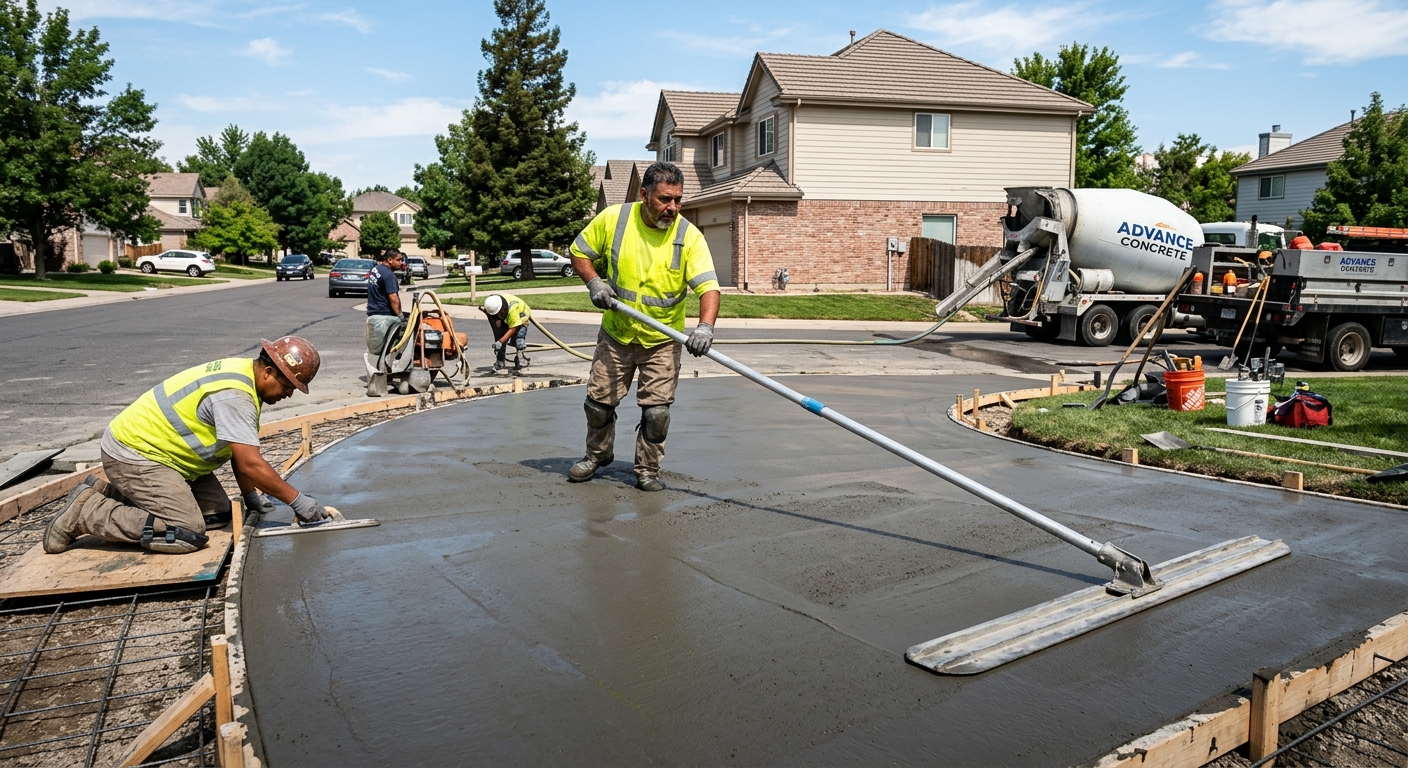
Concrete work options and costs in Killarney
Killarney homeowners typically start with concrete because it looks sharp, holds up well for decades, and fits the way Lower Mainland–Southwest properties are laid out—especially in a city built largely around family homes (29,325 people in the area; Statistics Canada, 2021 Census). In practice, most driveway, patio and walkway projects serve single-family lots and laneway access where equipment access, soil prep, and drainage details are just as important as the finish. That’s also why Killarney tradesmen often get called on around neighbourhood pockets like Kensington-Cedar Cottage and nearby residential streets where steady tear-out/replacement work is common.
In the Lower Mainland–Southwest, pricing isn’t just about cubic yards of concrete. Mild winters and a shallow frost line still matter because we design for frost protection and freeze–thaw durability. Local practice generally assumes a design frost depth around 450 mm / 18", so footings, thickened edges and piers are set below that to help prevent freeze heave. Coastal-wet weather also drives scheduling and curing: you may see longer timelines and extra labour for drainage, curing blankets, sealers and surface protection—particularly when cool nights and rain come in during the pour window. Availability can also tighten in peak season because concrete crews plan pours around weather and truck access.
Below are realistic starting ranges for common concrete work in Killarney, then you can compare finishes and specs in the next section.
| Application |
Typical Size |
Key Spec |
Finish Option |
Price Range |
| Concrete driveway (standard broom finish) |
400–600 sq. ft. |
Air-entrained exterior mix, compacted granular base, control joints |
Broom finish |
$12,500–$18,000 |
| Exposed aggregate driveway |
350–550 sq. ft. |
Air-entrained exterior mix, curing plan to avoid scaling, sealer |
Exposed aggregate / wash |
$16,000–$24,000 |
| Stamped concrete driveway or patio |
250–500 sq. ft. |
Air-entrained exterior mix, release agent, saw-cut joints |
Stamp pattern + color hardener |
$18,000–$28,000 |
| Plain concrete patio or walkway |
200–450 sq. ft. |
Compacted base, control joints, light broom texture |
Plain / broomed |
$6,500–$12,000 |
| Garage floor (interior slab) |
300–550 sq. ft. |
Vapour barrier where needed, reinforcement as required |
Float finish + cure |
$7,500–$14,000 |
| Foundation footings (structural, below frost) |
Per linear foot / scope-based |
Excavate to frost protection depth, formwork, rebar as engineered |
Structural concrete |
$200–$350 per sq. ft. equivalent |
Prices are estimates only and vary by project scope, site access and material selection.
What affects the price of concrete work in Killarney
In Killarney and across the Lower Mainland–Southwest, two quotes for the “same” concrete job can differ by 30–50% because the real scope isn’t just the concrete—it’s the prep, drainage, reinforcement, mix design and curing that protect the slab during coastal rain and freeze–thaw cycles. Contractors price the whole system: excavation and hauling, compacted granular base, correct reinforcement, proper air-entrainment, and the weather plan. In colder parts of British Columbia, the pour season is shorter and cold-weather precautions add cost; even within the Lower Mainland, cool nights and wet weeks can push crews to use curing blankets, sealers and longer curing windows. That’s why an exterior driveway might land anywhere from standard broom work to higher-end finishes such as stamped or exposed aggregate.
Frost line depth is a major spec driver. Footings and thickened edges must extend below the design frost depth (in coastal BC typically around 0.5–1.2 m depending on conditions and engineered requirements) to prevent frost heave. All exterior slabs require air-entrained concrete mixes to survive freeze–thaw cycles and reduce scaling/spalling risk. If a job is scheduled late in the year, cold-weather curing precautions—insulating blankets, heated enclosures for smaller pours, or extended curing time—can increase labour and equipment costs. De-icing salts also accelerate surface damage, so sealing becomes a practical “must-do” for driveways and steps.
In Killarney, you’ll often see costs rise when excavation hits saturated soils that need more granular, drainage work, and when formwork is complex due to tight access. Conversely, costs can drop for smaller, straightforward patios where truck access is easy and the subgrade is already well-drained. For example, a standard driveway might start closer to $18–$28 per sq. ft., while stamped concrete can push into the $22–$36 per sq. ft. range—often only justified when you’re also upgrading drainage, joint detailing and sealer as part of the durability plan.
| Price Factor |
Why It Matters |
Cost Impact |
| Frost line depth |
Determines footing depth and form height to reduce frost heave |
Medium–high (depends on engineered depth and soil) |
| Site preparation |
Excavation, grading and compacted granular base control settling and drainage |
High (especially in wet/saturated subgrades) |
| Reinforcement |
Rebar or mesh helps control cracking and supports load paths |
Medium (more for garage floors and structural edges) |
| Mix design |
Air-entrainment and compressive strength affect freeze–thaw durability |
Medium (higher spec mix and QA materials) |
| Finish type |
Broom vs. stamped vs. exposed aggregate changes labour time and sealing |
Low–high (stamped/exposed are the biggest jumps) |
| Pour size and concrete truck access to site |
Tight lanes can increase labour for wheelbarrowing and scheduling |
Medium (can spike for complex access) |
| Cold-weather curing precautions |
Heating/blankets protect strength gain when nights are cool and wet |
Medium–high near shoulder season |
| Control joint pattern and sealing cost |
Joint layout controls cracking; sealer helps repel salts and rain-driven damage |
Low–medium (often small cost vs. big durability value) |
Permits & regulations in British Columbia
In British Columbia, structural concrete work such as footings, foundation walls and grade beams generally requires a building permit, and it’s common for engineered drawings to be submitted and reviewed by the municipality. Concrete flatwork (driveways, patios and walkways) often does not require a permit by default, but it can trigger review if it affects lot grading, stormwater flow, or meets/impacts impervious surface or right-of-way concerns. Before breaking ground in Killarney, confirm the scope with the local authority so you don’t get surprises after demolition.
For contractor readiness, verify three essentials before you sign: (1) liability insurance, (2) workers’ compensation coverage (WSBC/WCB), and (3) any required trade/contracting registration for the work being performed. The practical steps for a homeowner in Killarney are:
- Licence/registration: ask the contractor for their business registration details and check the appropriate provincial/online registry listing for contractors where applicable.
- Liability insurance: request a certificate of insurance (COI) showing the policyholder, jobsite coverage details, and coverage limits.
- WSBC/WCB: ask for proof of account/coverage or a clearance letter confirming the contractor and their workers are properly covered.
- References: request 2–3 recent projects with similar scope and climate conditions (exterior flatwork durability and curing practices are a good differentiator).
If the quote includes foundation work, ensure the permit and inspections are clearly described in writing—structural concrete is the part you never want “handled casually.”
Getting concrete right in Killarney's freeze-thaw climate
Killarney’s concrete failures usually come from one or more weak links: inadequate base prep, wrong mix design for freeze–thaw exposure, poor jointing, or curing that’s too short when cool weather and coastal moisture slow strength gain. The spec should start with base preparation—excavate to the planned subgrade depth and place a compacted granular sub-base so the slab has stable support. For mix design, specify an air-entrained concrete with target 5–7% air content for exterior flatwork and a minimum 32 MPa compressive strength. That air content is what helps concrete tolerate freeze–thaw cycles without flaking and scaling. Next, control joints: they are intentional crack locations. Spacing the joints correctly helps the slab crack where you want, not randomly. Curing is also non-negotiable: plan for at least 7 days of proper curing conditions, and use curing blankets when nights are cool or the weather turns rainy for prolonged periods. Finally, sealing—apply a penetrating sealer about 28 days post-pour to repel de-icing salts and reduce water uptake, which matters in Killarney where winter maintenance often includes salt and frequent wetting.
A key question to ask is: “What is your air-entrainment plan for exterior work, and how do you protect curing during the cool/wet stretch?” When contractors skip air-entrainment or under-cure, you’ll often see spalling within a few winters—especially on edges and around expansion locations. A common pricing scenario: stamped concrete can be priced higher (often $22–$36 per sq. ft.), but the premium is only justified if the contractor also budgets for the correct air-entrained mix, proper joints, and sealing. If those durability steps are missing, you’re paying for looks without the performance.
| Spec |
Why It Matters in Killarney |
What to Ask For |
Impact if Skipped |
| Compacted granular base (depth?) |
Stable support and drainage reduces settlement and edge breakdown under freeze–thaw |
Base depth to match engineered frost/soil conditions and compacted in lifts |
Uneven settling, cracking and premature scaling |
| Air-entrained concrete mix (target air %?) |
Air void system protects from freeze–thaw scaling and spalling in wet winters |
Target 5–7% air for exterior flatwork |
Higher risk of spalling and surface deterioration |
| Compressive strength (MPa rating) |
Ensures strength gain supports loads and surface wear in a coastal climate |
Minimum 32 MPa |
Soft/weak surface, higher chance of cracking and abrasion damage |
| Control joints (spacing per ACI guidelines) |
Controls where cracks form so they don’t become random and wide |
Planned joint layout and saw-cut timing |
Random cracking, water intrusion and faster freeze–thaw damage |
| Minimum 7-day curing period |
Cold nights and humidity slow strength gain; curing protects durability |
Curing method and timeline (blankets/sealer prep if needed) |
Low strength, increased cracking and scaling risk |
| Penetrating sealer (when applied after cure) |
Repels water and de-icing salts, reducing freeze–thaw-driven deterioration |
Apply about 28 days after pour (once cured) |
Faster spalling/etching from salt and repeated wetting |
How to choose a concrete work contractor in Killarney
Choosing the right concrete contractor in British Columbia is mostly about verifying coverage, getting transparent scope, and making sure the technical details that prevent freeze–thaw damage are included. Start with the “can you legally and safely do this?” checks. Ask for a certificate of insurance (liability) and a WSBC/WCB clearance or proof of coverage for the company and their workers. If you’re unsure where to look, request the COI and clearance letter directly—reputable contractors provide them without hesitation. For business credibility, also confirm their business details match the quote and that references are for similar-scale exterior flatwork in wet/cool climates.
Then get 2–3 itemised written quotes. You want line items for labour and materials, not a single lump sum. Ask what’s included in “demo and haul-away,” whether disposal is included, and whether permits (if required for the specific structural scope) and inspections are covered. A proper quote should list base prep, reinforcement (rebar/mesh or not, as engineered), concrete mix spec (including air-entrainment for exterior work), finishing method, jointing plan, curing measures and sealing.
Warranty matters too: ask about workmanship warranty length, whether there’s a product/manufacturer warranty for concrete-related materials, and whether the warranty is transferable. Payment schedule should be conservative—typically no more than 10–15% upfront, with a holdback until final cleanup and completion. Finally, timeline: insist on a written start date and estimated completion date so weather-dependent curing steps are reflected, not improvised.
- Ask for a written scope that names mix design and air-entrainment requirements for exterior work.
- Confirm base prep includes compacted granular and that it’s described by depth and lift/compaction method.
- Require reinforcement details (mesh vs. rebar) and who decides the spec (engineer vs. contractor).
- Check how control joints will be laid out and when saw-cutting will occur.
- Ask about curing blankets/curing protection when cool, wet weather hits.
- Confirm sealer type and schedule (typically after full cure, around 28 days).
- Request insurance COI and WSBC/WCB clearance before work starts.
- Ensure disposal/hauling of demo materials is included or clearly excluded.
- Verify whether access constraints (narrow lane/driveway) change labour and cost.
- Get the quote itemised: labour, concrete supply, base materials, rebar/mesh, forms, finishing, sealing.
- Ask about warranty terms in writing, including coverage for spalling and surface scaling (and exclusions).
- Set payment milestones tied to measurable progress, not “completed” without verification.
Concrete red flags in Killarney include quotes that don’t mention air-entrainment for exterior slabs, no written curing plan for cool/wet weeks, reinforcement specs that are vague (“as needed” without clarity), payment demands over 15% upfront, and no clear warranty terms for workmanship or surface deterioration.
Frequently asked questions — concrete work in Killarney
Can concrete be poured in cold weather in Killarney?
Yes, concrete can be poured in Killarney in cold weather, but it must be managed correctly. In the Lower Mainland–Southwest, winters are milder than interior BC, yet cool nights and rain can still slow concrete strength gain and increase durability risk if protection isn’t planned. Contractors typically adjust curing with blankets and insulation and may limit exposure of fresh concrete to freezing conditions until it reaches adequate early strength. For exterior flatwork, the key is not just pouring “at temperature,” but protecting curing long enough to achieve the spec strength and to avoid surface scaling. If you’re comparing quotes, look for a written cold-weather curing plan and whether the contractor budgets time/equipment for protection; that’s often why pricing can shift even when the slab size is the same.
How do I maintain concrete in Killarney's freeze-thaw climate?
Maintenance in Killarney is mostly about water and de-icing salt control. Keep surfaces clear of debris and consider gentle cleaning rather than high-pressure blasting right after sealing. Use a penetrating sealer plan—commonly applied about 28 days after the pour—to reduce water uptake and salt-driven deterioration. In winter, avoid repeated heavy salt flooding on edges and steps where spalling starts first. Re-treat sealing when it’s visibly worn (often every few years depending on traffic and exposure). If you notice small surface cracks, address them early; letting water work into cracks accelerates freeze–thaw damage. For a practical cost reference, a basic broom-finished driveway is often closer to the $18–$28 per sq. ft. range, but skipping sealing to save money can reduce service life, especially on exterior edges.
What causes concrete to spall in Killarney winters?
Spalling is usually the result of freeze–thaw damage made worse by poor mix design, weak curing, or water intrusion. In Killarney’s wet climate, water gets into the concrete pores; then freeze–thaw cycles expand that water and break down the surface. The biggest preventable cause is insufficient air-entrainment in exterior mixes—air voids are what allow the concrete to tolerate freezing. Other contributors include inadequate compacted base drainage, control joints placed too far apart, and sealing that’s skipped or applied too early. Also, cold-weather curing that’s rushed can leave concrete underdeveloped at the surface. When you ask contractors for specs, insist on air-entrained concrete and a minimum 7-day curing approach under proper conditions for exterior work.
What is rebar and when is it required in British Columbia?
Rebar (reinforcing steel) is used to strengthen concrete and help control cracking by carrying tensile forces in areas that would otherwise crack under loads. In British Columbia, whether rebar is required depends on the engineered design for the specific concrete element: garage floors and structural components like foundation footings typically include reinforcement as specified. For plain patios and driveways, some projects use wire mesh or rebar depending on thickness, soil support, and anticipated loads (and on the contractor’s/engineer’s spec). For foundation and below-frost structural work, reinforcement is commonly engineered rather than guessed. The best homeowner move is to ask to see the reinforcement plan in the written scope and confirm it aligns with the thickness and base prep described.
How long does a concrete project take in Killarney?
Typical timelines in Killarney depend on weather, curing conditions, and site access. A small broom-finished patio might take a few days from prep through finish, but curing and protection still affect when you can use it. For driveways, demolition, base prep and forming can take longer—especially on tight lots—often followed by one main pour day and finishing the same day. Even if the “pour day” is quick, your usable timeline should reflect curing: for exterior flatwork, many crews plan around proper conditions for at least 7 days before heavy use, and you still want sealing later after full cure. In cool/wet stretches, expect more setup for curing blankets and longer waits. If you’re budgeting, use finish type as a guide too: stamped work (often $22–$36 per sq. ft.) takes additional labour for stamping and timing versus plain broom finishing.
What is a concrete overlay and is it suited to Killarney?
A concrete overlay is a new cementitious layer placed over an existing concrete slab to renew the surface without full replacement—often used to fix appearance issues or minor surface problems. In Killarney, overlays can be suitable when the existing slab is structurally sound, well-bonded, and not heavily cracked or lifting. Overlays are less suitable if there’s widespread settlement, deep spalling, or failed drainage underneath, because the new surface can only hide problems temporarily. The freeze–thaw climate makes prep critical: proper cleaning, repairs, crack treatment, and moisture/bond considerations determine success. If you’re considering an overlay, ask for a site evaluation and bonding spec, and compare it to replacement pricing. For reference, plain patios and walkways often fall around $16–$26 per sq. ft., while replacement with proper base and mix durability is sometimes the safer long-term option.