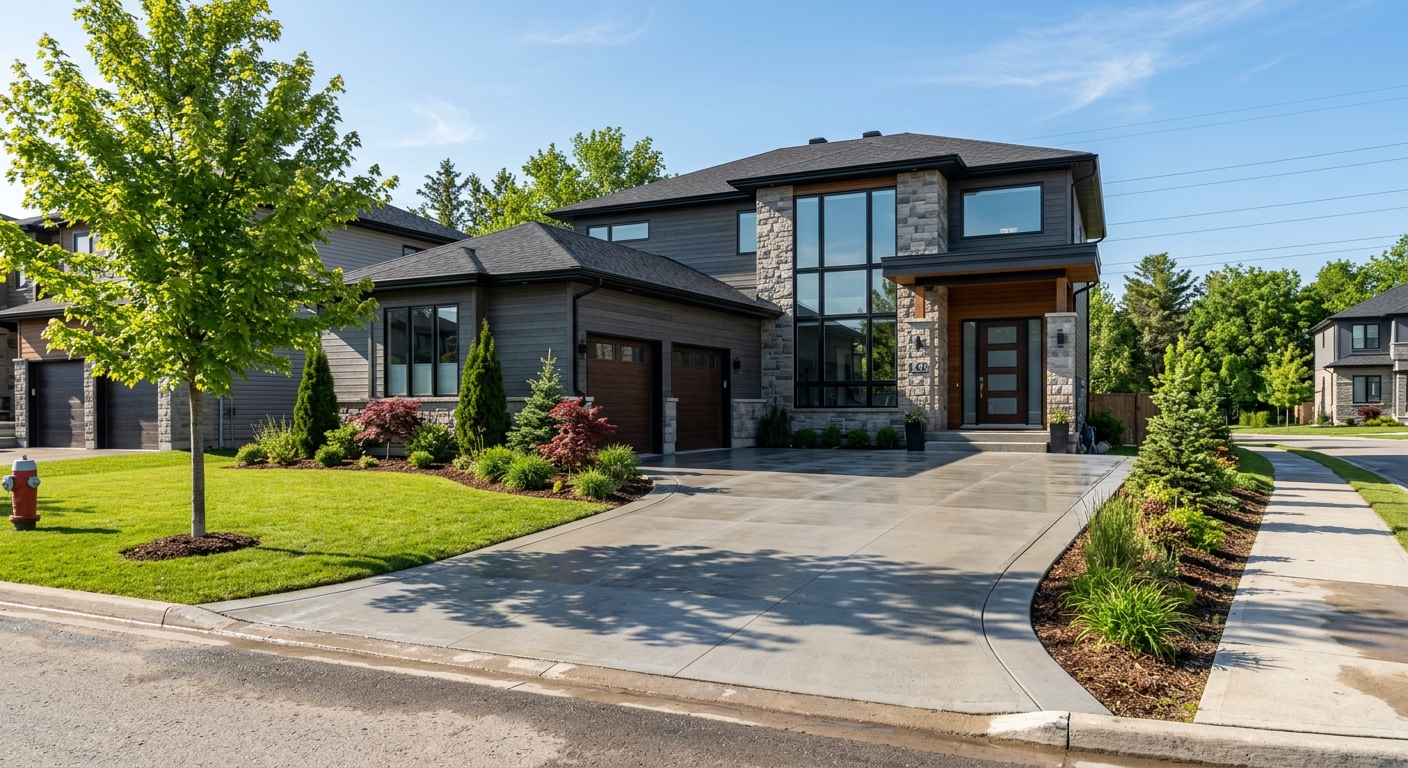
Concrete work options and costs in Lincoln Park
Concrete work in Lincoln Park is most often requested for driveways, patios and walkways—projects that sit right at the soil-and-water interface. In Lincoln Park (population 4,040 per the Statistics Canada, 2021 Census), the housing stock is largely shaped by single-detached homes, which is why flatwork contractors see steady demand for new and replacement concrete. In the Lower Mainland–Southwest, mild winters can sound “easy” for concrete, but the shallow frost depth and frequent coastal wet weather create their own cost drivers: wet subgrades, freeze–thaw cycling at slab surfaces, and the need for proper drainage, air-entrained mixes and control joints to reduce cracking and scaling. Frost depth is commonly planned around the local range of roughly 450 mm / 18", with exterior elements placed below that to limit frost heave—so even when the weather is milder than Interior BC, excavations and forming still matter.
Contractor availability also impacts your final number. Because the Vancouver–Surrey–Abbotsford corridor relies on coordinated crews and concrete truck scheduling around rain and cool nights, jobs can cost more if you’re pushing for short timelines or limited access. Areas of especially high day-to-day trade demand typically include the older residential pockets near transit corridors and busier feeder roads, where driveway approaches and backyard drainage repairs are common.
Below are realistic price bands homeowners in Lincoln Park usually see, depending on thickness, base prep, reinforcement, and finish level. Use this table to compare apples-to-apples when you request itemised quotes.
| Application |
Typical Size |
Key Spec |
Finish Option |
Price Range |
| Concrete driveway (standard broom finish) |
320–450 sq. ft. |
Air-entrained mix, compacted base, control joints |
Broom |
$18,000 – $28,000 |
| Exposed aggregate driveway |
320–450 sq. ft. |
Air-entrained mix, shaker-wash process, sealed for durability |
Exposed aggregate |
$24,000 – $34,000 |
| Stamped concrete driveway or patio |
200–400 sq. ft. |
Air-entrained mix, integral color, proper base and joints |
Stamped |
$22,000 – $36,000 |
| Plain concrete patio or walkway |
120–250 sq. ft. |
Compacted granular base, air-entrained mix, edges formed |
Broom or smooth trowel |
$6,500 – $13,500 |
| Garage floor (interior slab) |
400–600 sq. ft. |
Vapour barrier (where required), mesh/rebar as specified |
Power trowel or broom |
$17,000 – $26,000 |
| Foundation footings (structural, below frost) |
Varies by house plan |
Excavate below design frost, rebar steel, proper concrete class |
Structural finish |
$200,000 – $350,000 |
Prices are estimates only and vary by project scope, site access and material selection.
What affects the price of concrete work in Lincoln Park
For the same concrete project, quotes in the Lower Mainland–Southwest can differ by 30–50% compared with other parts of BC because the price isn’t only “per square foot.” It’s driven by whether your job needs deeper frost protection, heavier base prep, more reinforcement, or extra labour for weather delays. In colder regions, the pour season can be shorter and crews must add cold-weather curing precautions; those costs can be smaller in Lincoln Park than in Interior BC, but they don’t disappear—coastal humidity, cool night temperatures and frequent rain still affect scheduling and curing.
In our local practice, frost depth and freeze–thaw cycles dictate the spec. Exterior footings and thickened edges must extend below the design frost depth (commonly planned around 0.45 m / 18" in the Lower Mainland–Southwest), and slabs need an air-entrained concrete mix to resist freeze–thaw damage and surface scaling. If you’re salting sidewalks or have heavy drainage runoff near the slab, sealing becomes more than a “nice to have.” The curing plan also changes pricing: if you pour during a cool, wet stretch, contractors often use curing blankets and longer protection time to reach design strength.
Two Lincoln Park examples that move the number fast: (1) a driveway replacement on poorly drained soil may require extra granular base and subgrade improvement before you even get to concrete; (2) adding decorative work like stamped or exposed aggregate typically pushes you toward the $22,000 – $36,000 band for finishes, which is justified when the additional labour and form-prep time are actually included. Conversely, a straightforward broom-finished patio often lands closer to the $6,500 – $13,500 range—provided the base is corrected and joints are built in.
| Price Factor |
Why It Matters |
Cost Impact |
| Frost line depth |
Determines footing depth and form height |
More excavation and steel placement increases labour and equipment time |
| Site preparation |
Excavation, grading, compacted granular base |
Poor soil or soft pockets add hauling, granular, and compaction labour |
| Reinforcement |
Rebar or wire mesh requirement |
Additional steel, chairing/tie-wire and tighter placement raises cost |
| Mix design |
Air-entrainment and compressive strength spec |
Exterior air content and higher strength classes can add material cost |
| Finish type |
Broom vs. stamped vs. exposed aggregate |
Decorative finishes add labour, dyes/integral color, and process time |
| Pour size and concrete truck access to site |
How efficiently concrete can be placed |
Small access or long carry time increases labour and may require extra crew |
| Cold-weather curing precautions |
Heating and blankets |
Cool nights and rain protection add materials, labour, and schedule float |
| Control joint pattern and sealing cost |
Limits cracking; improves durability against salt and wet cycling |
Proper jointing and sealers reduce long-term failure and call-backs |
Permits & regulations in British Columbia
In British Columbia, structural concrete work—things like foundation walls, grade beams, and the footings that carry the house load—generally requires a building permit, and engineered drawings are often part of the review process through the municipality. Concrete flatwork (patios, walkways and driveways) typically does not require a permit by itself unless your scope affects lot grading, interferes with drainage plans, or triggers impervious-surface/lot coverage or right-of-way concerns. Even when a permit isn’t usually required, you should still confirm with the local authority before breaking ground, especially if you’re changing slope, adding steps, or relocating drainage.
For your contractor, insist they carry liability insurance and WSIB/WCB coverage where applicable for their workers. Step one for a Lincoln Park homeowner is to verify the contractor’s business credentials (online licence/registration listings in BC). Step two is to request a current certificate of insurance—look for adequate liability coverage, the correct business name, and expiry date. Step three is to ask for evidence of WSIB/WCB coverage (or the applicable coverage status) before work starts, not after the first day.
Finally, ask for references on similar-scale projects in the Lower Mainland—driveway and foundation-adjacent work—so you can gauge how they handle rain delays, base prep, and curing in our coastal-wet freeze–thaw conditions.
Getting concrete right in Lincoln Park's freeze-thaw climate
Concrete failures in Lincoln Park usually come from water and temperature working together: saturated soil, repeat freeze–thaw cycling at the slab surface, and de-icing salts that expand micro-cracks. The fix is not a “stronger mix only”—it’s a full system: base preparation, correct mix design, joints, proper curing and sealing. For base prep, contractors should place compacted granular to the right depth for your soil and frost protection strategy (commonly planned with exterior elements below roughly 450 mm / 18"). For the mix design, exterior flatwork should use air-entrained concrete—typically targeting 5–7% air content—and meet a minimum compressive strength spec such as 32 MPa, so it can resist scaling when cycles occur. Control joints need a sensible spacing pattern so cracking happens where you planned it, and not randomly through your driveway.
Curing is where many “cheap” jobs lose durability. A minimum 7-day curing period under proper conditions is the baseline; in cool, humid weather, curing blankets or other protection may be needed to keep the slab developing strength. After the curing window, apply a penetrating sealer (often around 28 days post-pour) to help repel de-icing salts and water.
As a concrete example: upgrading from a plain broom-finish patio to stamped concrete might move your budget into the $22,000 – $36,000 range for decorative driveways/patios, which is justified when the contractor also includes premium integral color, proper base thickness and correct jointing. If those items are missing, you’re paying for aesthetics without durability—exactly what leads to spalling and early surface scaling in wet-cold cycles.
| Spec |
Why It Matters in Lincoln Park |
What to Ask For |
Impact if Skipped |
| Compacted granular base (depth?) |
Controls settlement and frost protection under saturated soils |
Base depth to match your soil and frost strategy; compaction testing or documented proof |
Settlement, pumping, and accelerated cracking/spalling |
| Air-entrained concrete mix (target air %?) |
Helps concrete survive freeze–thaw and surface scaling |
Air content target of 5–7% for exterior flatwork |
Higher risk of freeze–thaw scaling and spalling |
| Compressive strength (MPa rating) |
Strength development supports long-term durability |
Minimum 32 MPa at specified curing/age |
Surface wear, increased micro-cracking, and premature deterioration |
| Control joints (spacing per ACI guidelines) |
Directs shrinkage cracking to planned lines |
Joint spacing and layout plan for your slab dimensions and exposure |
Random cracks that can open and let water in |
| Minimum 7-day curing period |
Ensures strength gain despite cool nights and humidity |
How curing will be protected during rain/cold; blankets/sealer timing plan |
Under-developed strength and increased surface damage |
| Penetrating sealer (when applied after cure) |
Repels water and de-icing salts common on driveways |
Apply penetrating sealer after curing (often around 28 days post-pour) |
Faster salt/water ingress and reduced surface life |
How to choose a concrete work contractor in Lincoln Park
Start by verifying British Columbia credentials the right way. Ask for the contractor’s business registration/licence details and confirm the certificate of insurance is current and matches their legal business name. Next, request proof of WSIB/WCB coverage status for workers (this matters for any crew doing site work). You should also check that the contractor is taking responsibility for the concrete scope—not subcontracting “unknowns” without telling you.
Then get 2–3 itemised written quotes. Don’t accept a single lump sum with vague language. Request line items for excavation/base, reinforcement, formwork, concrete supply, finishing, control joints, curing protection, and any sealing. Also confirm what’s included or excluded: permit pull (if required), disposal/haul-away, saw cutting timing, and how they handle rain delays and cool temperatures.
Warranty matters in concrete because shrinkage cracks and minor surface issues can happen, but the big failures shouldn’t. Ask for the workmanship warranty length and what it covers (and how long they’re responsible). Find out whether the product/manufacturer warranty is tied to the mix supplier or applicator and whether it’s transferable.
For payment schedule, never pay more than 10–15% upfront. Hold back remaining funds until the job is complete, cleaned, and sealed (if included) and you’ve walked the site for elevation and finish uniformity. Finally, ask for a start date and an estimated completion timeline in writing, especially since Lincoln Park’s coastal-wet conditions can stretch curing if scheduling isn’t protected.
- Confirm BC business credentials and contact details match the quote.
- Get a certificate of insurance and verify liability coverage limits and expiry date.
- Ask for WSIB/WCB coverage evidence (or applicable coverage status) before work begins.
- Request a detailed site plan: base thickness, drainage notes, and joint layout.
- Get itemised labour + materials (not one total line).
- Ask who supplies concrete and what air-entrainment target is used for exterior pours.
- Confirm reinforcement type (mesh vs rebar) and placement on chairs/spacers.
- Clarify curing plan for cool nights and wet stretches (blankets or time protection).
- Confirm whether saw-cut joints or formed joints are included and when cutting will occur.
- Confirm sealing product type and application timing (often around 28 days after pour).
- Check inclusions for haul-away, forms removal, and cleanup.
- Verify warranty terms in writing and ask what triggers a warranty call-back.
Concrete red flags in Lincoln Park include: a quote that omits air-entrainment details for an exterior slab, no clear joint plan, promises of “quick turnaround” without curing protection in cool/wet weather, vague scope language (no base thickness or reinforcement details), and requests for large upfront payments beyond 10–15%.
Frequently asked questions — concrete work in Lincoln Park
When is the best time to pour concrete in Lincoln Park?
The best time to pour in Lincoln Park is during stretches of stable weather when crews can protect curing from prolonged rain and cool nights. In the Lower Mainland–Southwest, winter can still work, but you need a contractor who plans for humidity, temperature drop at night, and curing protection. Many homeowners aim for late spring through early fall because it reduces the risk of delayed strength gain and helps finishing consistency. That said, good contractors can pour in shoulder seasons if they have a cold-weather curing plan (blankets/insulation where needed) and they schedule finishing and jointing correctly. Always ask how they’ll handle rain, how long the slab must cure before you can use it, and whether sealing is included—especially if you’ll be using de-icing salts on your driveway.
How long does concrete take to cure?
Concrete curing has two “clocks”: strength gain and surface readiness. In Lincoln Park, a common baseline is at least 7 days of curing under proper conditions for many exterior flatwork schedules, but full design durability often isn’t achieved immediately. If your contractor pours during cool, humid periods, curing protection becomes more important and may extend how long they keep the slab covered or protected. For homeowners, the practical timeline is: protect the slab immediately after finishing, avoid heavy loads during the early period, and plan sealing based on when the concrete has reached the correct cure stage. If you’re budgeting, sealing and curing protection are where lower bids often get cut—this is one reason driveways and patios can swing in cost into or out of the typical $18,000 – $28,000 driveway range.
Do I need a permit for concrete work in British Columbia?
In British Columbia, structural concrete work such as footings and foundation components usually needs a building permit and sometimes engineered drawings reviewed by the municipality. Concrete flatwork like patios, walkways, and driveways typically does not require a permit by itself, unless your work changes lot grading, drainage, or affects impervious surface/right-of-way considerations. Because Lincoln Park homeowners often deal with drainage and slope adjustments when replacing driveways, it’s worth confirming with the local authority before work starts. Also verify your contractor’s responsibilities: they should know whether your scope triggers a permit and whether they need inspection coordination for structural portions. When in doubt, ask your contractor to clearly state in writing what is included—permit pull, inspections, and any required documentation—so there are no surprises mid-job.
Concrete vs pavers for a patio in Lincoln Park?
Concrete and pavers can both work well in Lincoln Park, but the decision often comes down to freeze–thaw tolerance, drainage detailing, and maintenance expectations. Concrete flatwork is typically less labour to form once base prep is done correctly, and with air-entrained mix plus control joints, it can hold up against the wet-cold cycling common in the Lower Mainland–Southwest. Pavers can look great and are easier to spot-repair, but they require excellent base compaction and a stable bedding layer—otherwise you can get uneven settling. If you want decorative looks, stamped concrete can compete visually with pavers, and the price can land in the broader decorative band (commonly around $22,000 – $36,000 depending on the project scope). For durability, the biggest “win” is whichever option includes correct base depth, proper jointing/drainage, and sealing (for concrete) to resist water and salt exposure.
How long does a concrete driveway last?
A concrete driveway in British Columbia can last decades when it’s built with the right frost strategy, drainage, air-entrained mix, joints and proper curing. In Lincoln Park’s coastal-wet conditions, the biggest durability threats are water saturation, freeze–thaw scaling, and de-icing salt exposure. A well-built broom-finished driveway with correct base prep and air-entrainment is usually a long-life asset, while a driveway built with skimpy base or improper mix design often needs repairs earlier. Sealing and maintenance can stretch performance by reducing salt and water ingress. If you’re comparing quotes, don’t just look at the driveway finish—compare whether the contractor includes air-entrainment, reinforcement where needed, and an actual curing and sealing plan. That’s one reason driveway pricing commonly falls within the $18,000 – $28,000 band depending on scope and finish.
What is air-entrained concrete and why does it matter here?
Air-entrained concrete is mixed with tiny, uniformly distributed air bubbles that give freezing water somewhere to expand. In Lincoln Park and across the Lower Mainland–Southwest, freeze–thaw cycles and saturated conditions are key reasons concrete can scale or spall at the surface. Without proper air entrainment, water in the concrete can expand when temperatures drop, creating micro-damage that becomes visible deterioration over time. This is why exterior slabs, driveways and sidewalks should specify air-entrainment and why contractors should be able to explain their mix design target (often around 5–7% air content for exterior flatwork). It’s also why sealing and control joints matter: joints help cracking stay controlled, and sealing helps repel salt and water. When quotes differ, ask whether air-entrainment is included—this single spec often separates a durable pour from a costly redo.