Concrete work options and costs in Norgate
Norgate, British Columbia is a small community within the Lower Mainland–Southwest where concrete flatwork is in constant demand—especially for driveways, patios and walkways supporting the day-to-day look of local homes. With a population of 3,035 (Statistics Canada, 2021 Census), projects tend to be personal and site-specific, and contractors who can handle tight residential access are often booked in busy spring and early summer. In this part of the Lower Mainland, many households live in single-detached settings where curb appeal upgrades like broom-finished or decorative concrete are common, and that’s where concrete value shows up fast.
In the Lower Mainland–Southwest, costs are shaped by mild winters but a shallow, frost-sensitive design approach: local practice typically assumes a frost depth around 450 mm (18"), and footings/thickened edges are placed below that level to reduce freeze–thaw heave risk. Coastal rainfall and frequent moisture cycling also push attention toward drainage, air-entrained concrete, and careful curing. Because we’re in a dense housing corridor, excavation and disposal logistics can affect labour time, while deck and garage work is often constrained by truck access, hose runs and staging space.
That’s why two “similar” quotes can land in different price ranges—one may include the right granular base, reinforcement, and proper curing/surface protection for exterior freeze–thaw exposure. If you’re comparing options, a clear side-by-side helps you see where cost is justified (or not). Below is a practical comparison of typical sizes, specs and finish choices for Norgate projects.
| Application |
Typical Size |
Key Spec |
Finish Option |
Price Range |
| Concrete driveway (standard broom finish) |
400–600 sq. ft. |
Air-entrained mix, compacted granular base, control joints |
Broom finish with sealant |
$8,000–$16,000 |
| Exposed aggregate driveway |
400–600 sq. ft. |
Air-entrained mix, proper curing to support aggregate reveal |
Exposed aggregate (surface retarder or wash) |
$10,000–$20,000 |
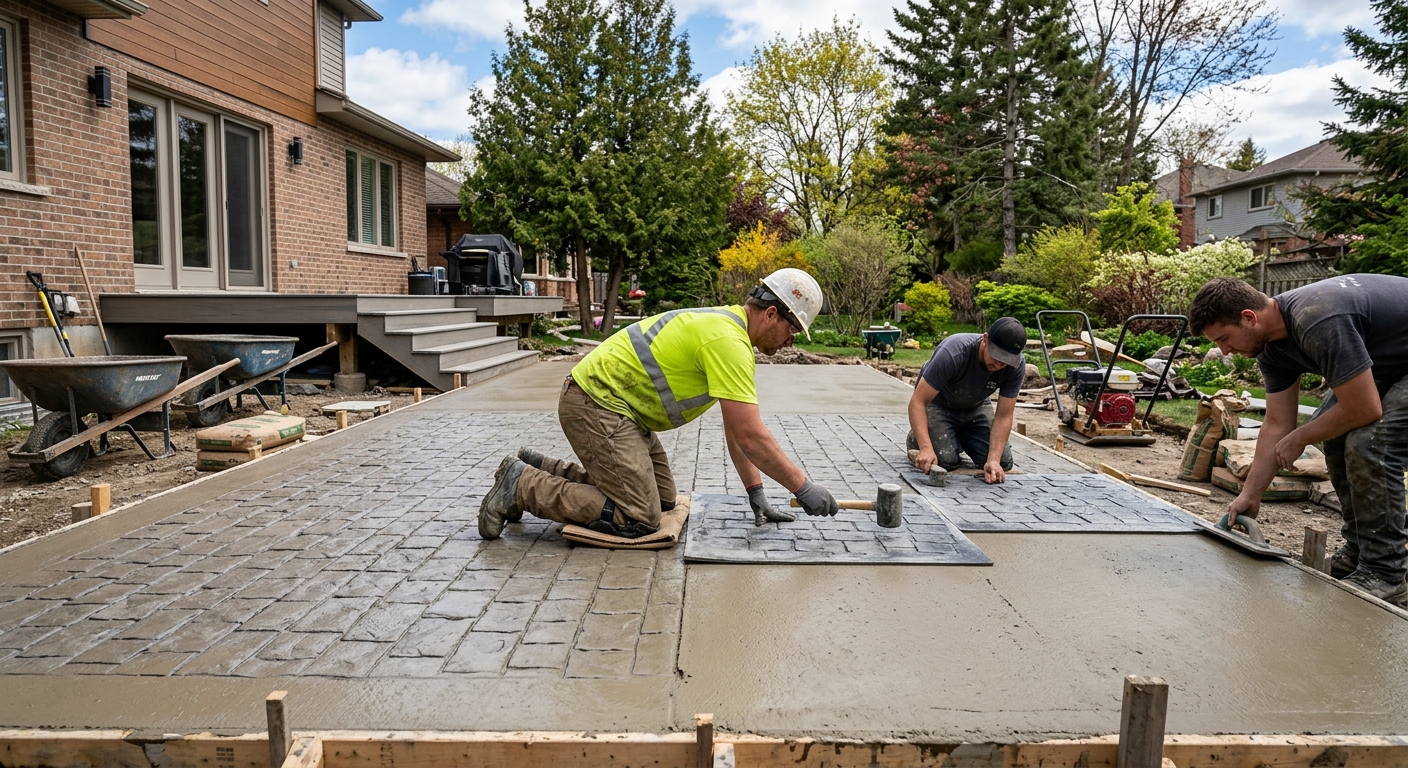
| Stamped concrete driveway or patio |
300–500 sq. ft. |
Air-entrained mix, reinforcement as required, cure timing plan |
Stamped pattern with colour hardener/release |
$12,000–$22,000 |
| Plain concrete patio or walkway |
150–300 sq. ft. |
Air-entrained mix (exterior), compacted base, joints |
Float and broom or light broom |
$2,400–$6,900 |
| Garage floor (interior slab) |
300–500 sq. ft. |
Vapour barrier as required, minimum 32 MPa mix, finishing plan |
Broom or trowel-finish with appropriate curing |
$6,000–$12,500 |
| Foundation footings (structural, below frost) |
Varies by foundation layout |
Excavate below design frost, formwork, reinforcement, engineered spec |
Structural concrete only (no decorative finish) |
$10,000–$18,000 |
Prices are estimates only and vary by project scope, site access and material selection.
What affects the price of concrete work in Norgate
In Norgate and across the Lower Mainland–Southwest, it’s common to see quotes for the same “basic” concrete job vary by 30–50%. The difference usually isn’t the cement itself—it’s the amount of preparation, the engineered specs for frost and drainage, and how the contractor schedules curing around rain and cool nights. In British Columbia, you can also run into longer lead times for forming materials and more truck time because residential access and staging are tight, which adds labour hours even when the slab area looks similar on paper.
Every exterior concrete spec is driven by frost and freeze–thaw cycles. Lower Mainland designs typically assume a frost depth around 450 mm (18"), so footings and thickened edges are placed below that level to prevent frost heave. Exterior slabs should also use air-entrained mixes to resist scaling and surface deterioration during wet–cold cycling. When you move to colder BC regions, contractors deal with a shorter pour season and more costly cold-weather curing precautions (blankets, sometimes temporary heating), but even here in Norgate the coastal humidity and frequent rain can slow curing, which still raises costs through extra labour and planning.
Here are a few real Norgate examples where conditions change the budget: (1) A driveway on saturated soils often needs more granular base and improved drainage, pushing the job upward toward the upper end of the standard driveway range (for example, broom-finish work typically lands in the $18–$28 per square foot backbone, depending on base depth and rebar). (2) A stamped driveway usually costs more because of colour system materials and faster, tighter workmanship; it’s the justified upgrade when you’re after long-term curb appeal and you’re willing to pay for proper curing—think the $22–$36 per square foot backbone. (3) If your project timing falls into a cooler, wetter stretch, curing blankets and longer wait times can add cost even if the pour date isn’t “cold” on the calendar.
| Price Factor |
Why It Matters |
Cost Impact |
| Frost line depth — determines footing depth and form height |
Controls how deep footings and thickened edges must be placed to resist heave |
More excavation and forming can raise costs significantly on structural work |
| Site preparation — excavation, grading, compacted granular base |
Stable subgrade and drainage prevent settlement and premature cracking |
Extra base depth and haul/disposal increase labour and equipment time |
| Reinforcement — rebar or wire mesh requirement |
Reduces cracking risk for driveways, garage slabs and exterior slabs |
Material + install time can move pricing up or down |
| Mix design — air-entrainment and compressive strength spec |
Exterior durability depends on air-entrained concrete for freeze–thaw scaling resistance |
Correct mix often adds a modest material cost but prevents expensive failures |
| Finish type — broom vs. stamped vs. exposed aggregate |
Decorative systems require tighter timing, added materials and skilled labour |
Decorative finishes typically command higher labour and product costs |
| Pour size and concrete truck access to site |
Truck distance affects pump/hose time, staging and pour efficiency |
Limited access can add labour hours and equipment fees |
| Cold-weather curing precautions — heating and blankets |
Protects strength gain and surface durability during cool, wet periods |
Heating/blankets and longer cure windows can add cost |
| Control joint pattern and sealing cost |
Controls where cracks form and reduces water/ice ingress at the surface |
Better joint planning and sealant schedule add small line items that pay off |
Permits & regulations in British Columbia
In British Columbia, structural concrete work typically needs a building permit—especially when it forms part of the foundation system. That includes footings, foundation walls, grade beams and any engineered structural elements. In many cases, engineered drawings are reviewed by the municipality or building department because the design must account for soil conditions, frost protection depth, and reinforcing requirements. For non-structural concrete flatwork, permits are often not required for a straightforward patio, walkway or driveway, but there are common exceptions: if the work changes lot grading, affects impervious surface coverage limits, ties into municipal right-of-way conditions, or impacts drainage (for example, altering slopes that direct water to a neighbour’s property), you may need municipal approval or a permit.
Step-by-step for homeowners in Norgate:
- Ask the contractor which permits they’re pulling (and whether any responsibility sits with you).
- Verify contractor business status and trade eligibility using the province’s online registries (licence and contractor identity details).
- Request a current certificate of liability insurance—confirm the policy is active for the job period.
- Confirm coverage for workplace injury protection (Workers’ compensation) and ask for the clearance letter/status documentation.
- Get references from similar Lower Mainland–Southwest projects (driveways/patios in wet climates) and check dates and scope.
Always confirm requirements with the local authority before you break ground, because requirements can change depending on grading, drainage and engineered foundation design needs.
Getting concrete right in Norgate's freeze-thaw climate
Concrete failures in Norgate almost always trace back to water movement, poor base prep, and weak or poorly protected surfaces during freeze–thaw cycling. Even though our frost depth is relatively shallow (commonly designed around 450 mm / 18"), the risk is not frost alone—it’s moisture getting under and into the slab edges, then freezing and thawing repeatedly. To spec the job correctly, start with the base: excavate to stable material and place a compacted granular sub-base to the correct thickness for your soil and drainage conditions. Next, require an air-entrained exterior mix—commonly targeting 5–7% air content—so the surface can withstand scaling. For strength, exterior slabs are typically specified with a minimum 32 MPa compressive strength.
Third, control joints matter more than most people expect. We lay out joint spacing so cracks form in predictable locations rather than randomly across the slab. Fourth, curing is critical in the Lower Mainland’s cool, damp stretches: plan for at least 7 days of curing under proper conditions, and in colder or rainy windows use curing blankets/covering and seal surface protection as planned. Fifth, apply a penetrating sealer after the concrete has fully cured—often 28 days post-pour—so de-icing salts and rain don’t keep driving moisture into pores.
Here’s a practical pricing example: adding control joints and proper sealing on a broom-finished driveway may cost less than 10% of the total slab budget, but it can prevent the edge scaling and early surface deterioration that would otherwise push you into costly resurfacing. If you’re choosing decorative concrete, pay attention to curing discipline—stamped jobs look great when done right, but they’re not forgiving of shortcuts.
| Spec |
Why It Matters in Norgate |
What to Ask For |
Impact if Skipped |
| Compacted granular base (depth?) |
Provides stable support and drainage to limit settlement and water pumping under the slab |
Confirm excavation depth, granular thickness, compaction testing or proof of proper compaction |
Settlement, uneven cracking, and water-related deterioration around edges |
| Air-entrained concrete mix (target air %?) |
Protects surface against freeze–thaw scaling in wet coastal cycles |
Ask for target air content (typically 5–7% for exterior flatwork) and mix certification |
Spalling and scaling that can start early, especially near joints |
| Compressive strength (MPa rating) |
Ensures strength gain for long-term durability and load resistance |
Minimum 32 MPa stated on the quote/spec |
Surface wear, faster breakdown, and weaker performance under freeze–thaw |
| Control joints (spacing per ACI guidelines) |
Creates planned crack locations so cracks don’t wander |
Joint spacing plan and whether joints are cut vs. formed |
Random cracking, more water entry, and accelerated joint-edge deterioration |
| Minimum 7-day curing period |
Builds strength while protecting the surface from rain/cool nights |
Confirm curing method and schedule; ask about blankets/covering in cooler weeks |
Reduced strength gain, surface weakness and higher long-term scaling risk |
| Penetrating sealer (when applied after cure) |
Repels moisture and reduces salt/rain intrusion at the surface pores |
Ask for sealer type and application timing (commonly 28 days after pour) |
Faster water penetration, staining and more frequent freeze–thaw damage |
How to choose a concrete work contractor in Norgate
Choosing the right contractor in Norgate, British Columbia is mostly about checking proof—not just trusting the quote. Start by confirming they carry current liability insurance. Ask for a certificate of insurance showing the effective dates that cover your project period. Next, verify workplace injury protection status (Workers’ compensation). In BC this is typically supported by a clearance letter/status documentation—request it and confirm it’s valid for the work window. Finally, verify the contractor’s identity and trade eligibility through provincial online resources so you know you’re dealing with a real business with traceable accountability.
Then slow down and get 2–3 itemised written quotes that break down labour and materials instead of only a lump sum. You want line items for excavation/grading, granular base, reinforcement, the specific concrete mix (including air-entrainment), finishing method, joints, curing practices and sealing. Read the scope carefully: what’s excluded (hauling/disposal, sawcutting, rebar, forms, permit fees if required, protection of existing landscaping, and patching tie-ins)? Make sure the quote says whether they’ll pull permits where needed and whether drainage corrections are included.
For warranty, ask for workmanship warranty length and whether it’s tied to a written process, not just a verbal promise. Also ask about manufacturer/product warranty for decorative systems and sealers, and if coverage transfers if you sell the property. Payment should protect you: never pay more than 10–15% upfront, and hold back a portion until the job is complete and cleaned up. Get a start date and a completion estimate in writing so you can plan around the Lower Mainland’s rain and curing windows.
- Request proof of liability insurance (active dates aligned to your schedule).
- Request proof/status of Workers’ compensation coverage (clearance letter or equivalent).
- Ask for at least two recent references in the Lower Mainland–Southwest for similar scope.
- Ensure the quote specifies air-entrained concrete and minimum 32 MPa for exterior work.
- Confirm base prep details: excavation depth, granular type, compaction approach.
- Ask whether reinforcement is included where required (mesh/rebar tied and positioned).
- Confirm control joint spacing and whether joints are cut as soon as appropriate.
- Ask how they protect curing in rain/cool nights (blankets/coverings if needed).
- Confirm sealing plan (penetrating sealer timing, typically after full cure).
- Check site protection and cleanup: protection of hedges, lawn reinstatement, debris removal.
- Verify truck access plan: pumping vs. hoisting, and costs if access is limited.
- Use a written payment schedule with a holdback until final inspection and curing steps.
Concrete contractor red flags in Norgate include: “no problem” claims about skipping air-entrainment for exterior slabs, vague scope wording that omits joints or sealer timing, refusing to provide insurance/coverage proof, quoting with no base prep details (granular depth/compaction), and asking for large upfront deposits before any forming or excavation is staged.
Frequently asked questions — concrete work in Norgate
What is air-entrained concrete and why does it matter here?
Air-entrained concrete is mixed with tiny, evenly distributed air bubbles that create space for water to expand when it freezes. In Norgate and the broader Lower Mainland–Southwest, the issue isn’t just freezing—it’s moisture from coastal rainfall and saturated soils that repeatedly cycles through thaw and freeze. That’s what leads to scaling and spalling when the mix isn’t designed for freeze–thaw durability. For exterior flatwork, we generally target 5–7% air content and specify minimum 32 MPa strength. This directly affects cost, but it’s not optional if you want the driveway or patio to survive wet winters. If you’re comparing quotes, look for language about air-entrainment in the mix spec rather than assuming all concrete is the same. Budget-wise, exterior driveway work in our price backbone is commonly in the $18–$28 per square foot range, and decorative upgrades often sit higher (for example, stamped work often aligns with the $22–$36 band) partly because the finishing system still requires the correct durability mix underneath.
How do I prepare the base for a concrete slab?
Base preparation is what most homeowners can’t see—but it’s what determines whether your slab stays flat and crack patterns behave. In Norgate, the goal is a stable, well-drained subgrade supported by a compacted granular base. The contractor should excavate to the required elevation, remove organic or unstable material, and then place granular in lifts, compacting each lift to the appropriate density. If drainage is a concern (common with saturated coastal soils), the base and slope plan should keep water from pooling under the edges. This is also where truck access and staging affect price, because it changes how long labour and equipment are on site. A good quote will specify base depth/thickness, not just “we’ll prep the base.” If a driveway quote doesn’t mention granular base and compaction approach, it’s hard to compare fairly, even if the overall total looks similar.
How do I compare concrete quotes?
When comparing quotes in Norgate, don’t compare only the total—compare what’s inside the scope. Ask for an itemised breakdown covering excavation/grading, granular base thickness and compaction method, reinforcement (rebar or mesh where required), the concrete mix spec (air-entrained for exterior and minimum 32 MPa), finishing method, and the control joint plan. Confirm whether curing practices are included (especially during cool or wet weeks) and whether sealing is part of the work or scheduled after cure. You should also watch for exclusions: disposal, permit handling (if needed for structural work or grading/drainage changes), pump costs due to truck access limits, and landscaping restoration. If one quote for a patio sits near the $16–$26 backbone while another is similar but omits joints or air-entrainment wording, the cheaper one may cost more later through early surface damage. Finally, check warranty terms and payment schedule. Legit contractors can explain their process clearly, not just provide a number.
Can concrete be poured in cold weather in Norgate?
Yes, concrete can be poured in cold weather in Norgate, but it depends on temperatures, wind, and how the contractor protects curing. The Lower Mainland–Southwest has cool nights and frequent damp conditions; even without severe frost, strength gain can slow and surface quality can suffer if the slab isn’t protected. A reputable contractor will plan cold-weather precautions when needed—commonly curing blankets, coverings to keep rain off, and sometimes controlled heating methods to protect the concrete while it reaches strength. Your contractor should also schedule pours around rain events and explain curing time and protection steps in writing. If a contractor suggests “we pour anytime and it’s fine,” without talking about curing protection or strength gain, that’s a risk. For planning purposes, exterior concrete durability depends on both the freeze–thaw-ready mix (air-entrained) and adequate curing—minimum 7 days under proper conditions is a good benchmark for most residential flatwork.
How do I maintain concrete in Norgate's freeze-thaw climate?
Maintenance in Norgate is about controlling water and salts from reaching the concrete pores and joint edges. First, let new concrete cure properly—don’t rush use or heavy loading. After full cure, schedule a penetrating sealer (commonly around 28 days post-pour) to reduce moisture and de-icing salt penetration. Keep drainage working: clear downspouts and avoid directing roof runoff onto driveways where possible. For joint maintenance, don’t ignore small voids—if joints open or edges crumble, water can get in and accelerate deterioration. When removing snow or ice, avoid harsh scraping that can chip the surface; use shovels and de-icers carefully. If you’re comparing finish types, remember that decorative concrete (stamped or exposed aggregate) still relies on the same durability basics underneath. The cost difference between finishes is real—stamped work often aligns with the $22–$36 backbone—but proper sealing and snow/ice habits are what keep those finishes looking good through British Columbia winters.
What causes concrete to spall in Norgate winters?
Spalling is the flaking or breaking of the concrete surface, and in Norgate it’s usually tied to freeze–thaw pressure plus moisture movement. The most common causes are inadequate air-entrainment (or no air-entraining mix) and insufficient protection during curing, which leaves the concrete more vulnerable to scaling. Water can also enter through cracked areas, poorly planned control joints, or edges where base drainage is weak. De-icing salts can accelerate deterioration if the surface isn’t sealed or if it’s repeatedly exposed during wet-cold cycles. Another contributor is poor curing discipline—if the concrete didn’t reach early strength properly, the surface can be weaker and more prone to pop-outs when moisture freezes. If your driveway shows early spalling near joints or edges, ask whether the mix design specified air content and whether the joint pattern and sealing schedule were followed. Getting the right freeze–thaw specs is where quotes should be scrutinized, because a low price that skips these items often creates a high repair cost later.