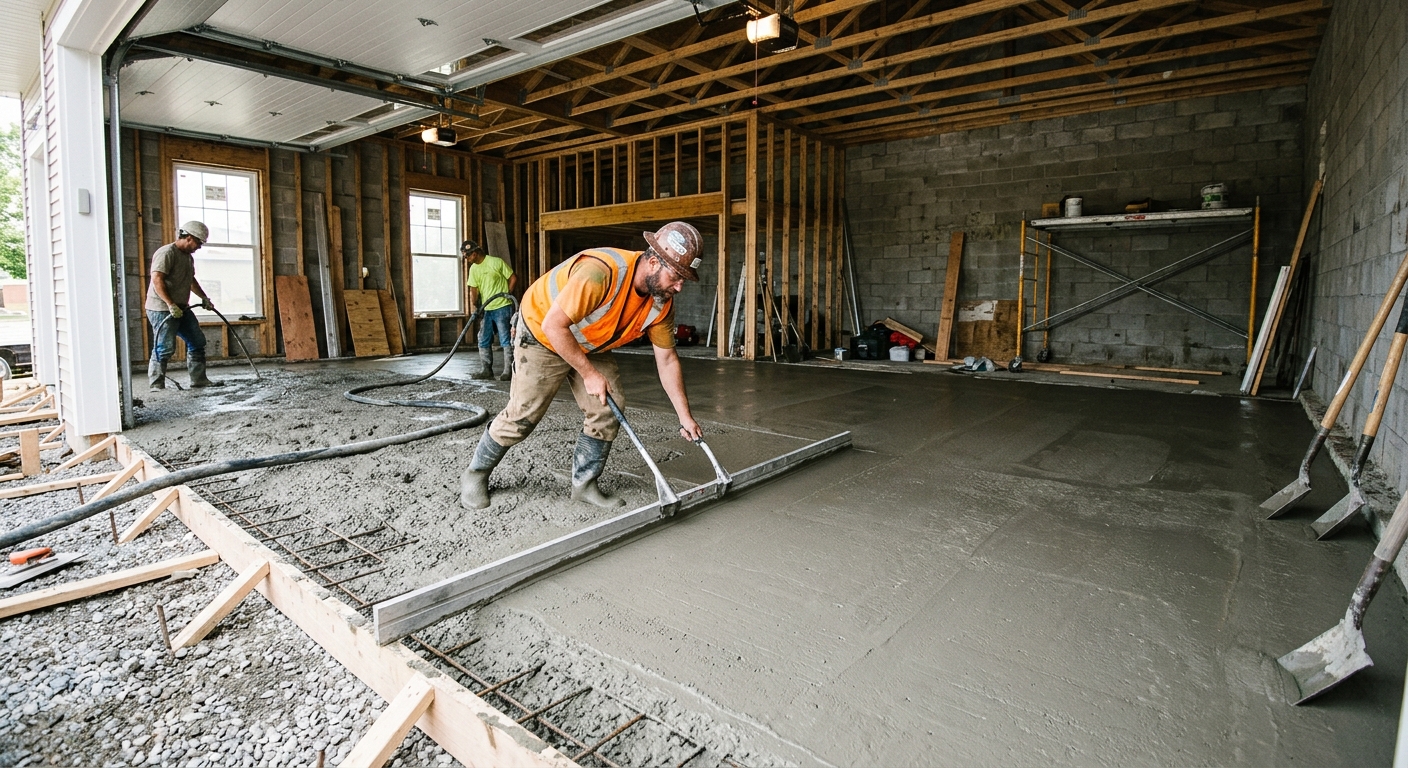
Concrete work options and costs in West Vancouver
West Vancouver homeowners typically start concrete projects with familiar upgrades—driveways, patios, walkways, and sometimes foundation repairs—because this part of the Lower Mainland–Southwest is densely built and many lots have steep grades. In West Vancouver, single-detached houses make up 55.6% of dwellings (Statistics Canada, 2021 Census), which is a big reason concrete flatwork trades are in steady demand for longer driveways and walk-access paths. You also see lots of older housing stock: 53.8% of homes were built before 1981 (Statistics Canada, 2021 Census), so re-stoning, re-sloping, and replacing tired slabs are common scopes when drainage has changed over the years.
Pricing here is shaped by our coastal-wet climate and freeze–thaw cycles. Even with a shallow frost depth of about 450 mm / 18", contractors still design footings and thickened edges below the frost zone to reduce frost heave and cracking risk. Wet weather and cool nights can slow curing on exterior work, and that affects labour scheduling, curing materials (blankets/sealers), and the time needed before surfaces can be used.
In practical terms, concrete work costs tend to be more predictable for standard broom-finish driveways, while decorative options (stamped or exposed aggregate) carry higher labour and material waste allowances. Areas like Dundarave and Ambleside often see faster turnarounds for driveway and walkway repairs because of year-round access and consistent demand from renovation-minded homeowners.
Below is a realistic comparison of common options in West Vancouver to help you benchmark your quote before you ask for design and drainage details.
| Application |
Typical Size |
Key Spec |
Finish Option |
Price Range |
| Concrete driveway (standard broom finish) |
400–650 sq ft |
Air-entrained exterior mix; compacted granular base; proper drainage and control joints |
Broom finish, saw-cut joints |
$18,000 – $28,000 |
| Exposed aggregate driveway |
400–650 sq ft |
Air-entrained mix with wash/exposure control; reinforced slab; careful curing |
Exposed aggregate (medium/small stone) |
$22,000 – $34,000 |
| Stamped concrete driveway or patio |
250–500 sq ft |
Air-entrained exterior mix; reinforcement; release agent and color hardener (where specified) |
Stamped pattern with antiquing/sealer |
$28,000 – $48,000 |
| Plain concrete patio or walkway |
200–450 sq ft |
Air-entrained exterior mix; compacted granular sub-base; slope to drainage |
Broom or trowel finish with joints |
$16,000 – $26,000 |
| Garage floor (interior slab) |
400–700 sq ft |
Reinforcement (wire mesh/rebar as required); proper vapour control if specified |
Float finish (possibly sealed) |
$20,000 – $34,000 |
| Foundation footings (structural, below frost) |
Varies by house footprint |
Excavate below frost; reinforced concrete; engineered dimensions/thickness as required |
Structural concrete (not decorative) |
$200,000 – $350,000 |
Prices are estimates only and vary by project scope, site access and material selection.
What affects the price of concrete work in West Vancouver
In the Lower Mainland–Southwest, two quotes for the “same” concrete job can still swing by 30–50% once you get into the actual specs. That’s largely because West Vancouver concrete work is governed by freeze–thaw risk, drainage needs, and seasonality—plus differences in how contractors build the base and manage curing. Even though Lower Mainland winters are comparatively mild, the coastal-wet weather means surfaces are often exposed to repeated saturation and temperature swings, which is exactly when poorly detailed exterior concrete starts to crack, scale, or spall.
For example, frost protection dictates footing depth and thickened edges. Practice typically assumes a frost depth around 450 mm / 18" in this region, so footings and exterior slab edges must be placed below that design line to limit frost heave. Exterior slabs also require air-entrained concrete mixes to survive freeze–thaw cycling; if the contractor uses a non-compliant mix, durability fails sooner. In colder parts of BC (and during colder snaps), contractors face shorter pour seasons and may need cold-weather curing precautions—heating and insulating blankets—which add cost. De-icing salt in driveways accelerates surface breakdown on unsealed or under-cured slabs, so sealing becomes part of the “real-world” lifecycle plan.
Cost can rise with site conditions: steep grades and limited truck access can add excavation and labour. Conversely, jobs with straightforward access and stable subgrade can land closer to baseline bands. As a reference point, a standard broom-finish driveway often tracks the $18–$28 band, while stamped or decorative work tends to follow the higher $22–$36 band because it requires additional materials, labour, and tighter finishing control. If you’re replacing pre-1981 concrete on older properties—53.8% of homes were built before 1981—drainage corrections and base rebuilds often drive the jump from “repair” to full-depth replacement, which is where the dollars concentrate.
| Price Factor |
Why It Matters |
Cost Impact |
| Frost line depth |
Determines footing depth, formwork height, and excavation volume needed to prevent frost heave |
Higher excavation and reinforcement; can add major labour and forming cost |
| Site preparation |
Excavation, grading, subgrade evaluation, and compacted granular base thickness control long-term settlement and cracking |
Heavy variance if soils are wet/soft or if drainage improvements are required |
| Reinforcement |
Wire mesh/rebar help control cracking in slabs and improve performance with freeze–thaw cycling |
Moderate material and labour increase; often essential for driveways |
| Mix design |
Air-entrainment and specified compressive strength support durability against scaling and spalling |
Can move the project up within the $16–$28 and $22–$36 bands depending on finish and spec |
| Finish type |
Broom vs stamped vs exposed aggregate changes labour intensity, timing, and colour/sealer materials |
Stamped/exposed typically add the most labour and consumables |
| Pour size and concrete truck access to site |
Shorter pours, long carry distances, and crane/bumper truck needs increase time and coordination |
Access problems can add significant hours and equipment charges |
| Cold-weather curing precautions |
Cool nights and high humidity can slow strength gain; blankets/heating protect the pour |
Raises cost if weather windows are narrow or curing needs extension |
| Control joint pattern and sealing cost |
Joint spacing limits random cracking; sealing helps repel moisture and de-icing salt impacts |
Small-to-moderate cost increase that protects durability and reduces callbacks |
Permits & regulations in British Columbia
In British Columbia, whether a permit is required depends on what structural element you’re affecting and whether the work changes the building’s structural system. Typically, structural concrete work—such as foundation footings, foundation walls, grade beams, and other load-bearing components—requires a building permit and often engineered drawings that the municipality reviews. That’s the category that can directly impact load paths and safety, so permitting and inspections are standard.
Concrete flatwork (patios, walkways, and driveways) usually does not require a permit on its own. However, a permit may become necessary if the project affects lot grading, changes drainage patterns, increases impervious surface coverage beyond municipal limits, or touches municipal right-of-way or lane/sidewalk interfaces. Because West Vancouver sites can be complex with retaining walls and drainage, it’s smart to confirm before you break ground.
Homeowner verification should be step-by-step. First, ask the contractor for their proof of liability insurance and a certificate of insurance listing you (or your property manager) as additional insured if applicable. Next, confirm their workplace coverage (WCB) for workers on site. Then check their concrete-related licensing/registration status in BC through the appropriate provincial business/licensing registry and review any clearance letter they provide. Finally, request references for similar concrete scopes in West Vancouver (driveways, patios, and foundation work), and verify dates and job types match your intended work.
Getting concrete right in West Vancouver's freeze-thaw climate
Concrete can fail in West Vancouver when moisture gets in and freezes, when the base isn’t prepared to handle drainage and movement, or when the mix and curing aren’t designed for exterior exposure. Our Lower Mainland–Southwest conditions combine rain, high humidity, and frequent temperature swings; the repeated wetting and freeze–thaw cycles are exactly what damages surfaces and corners. The goal is to spec for durability first: a stable compacted base, an exterior air-entrained mix, properly spaced control joints, and curing/sealing that keeps the slab from drying too fast or being exposed before it reaches adequate strength.
Start with base preparation: compacted granular sub-base to the right depth for local soil and frost protection needs. Next, mix design: for exterior flatwork, target air-entrainment in the 5–7% range and a minimum compressive strength of 32 MPa, so the concrete resists scaling and spalling. Then control joints: don’t rely on “random cracking”—plan the joint layout to control where cracks will go, particularly on wider driveways and patios. Curing is critical: minimum 7 days under appropriate conditions, and if it’s cool or damp, curing blankets and scheduling adjustments are often warranted to protect strength gain. Finally, sealing: apply a penetrating sealer around 28 days post-pour (when the concrete is cured enough) to repel moisture and help manage de-icing salt impacts in winter.
A concrete example: if you choose a broom-finish patio but skip proper drainage and sealing, the initial savings can be quickly erased by early surface breakdown. In a $16–$26k patio/ walkway range, spending the difference on correct base prep, air-entrainment, and sealing is typically justified because it reduces the likelihood of scaling callbacks.
| Spec |
Why It Matters in West Vancouver |
What to Ask For |
Impact if Skipped |
| Compacted granular base (depth?) |
Prevents settlement and limits water pumping that drives freeze–thaw damage in West Vancouver |
Base thickness for your soil, compaction method, and drainage details/slope requirements |
Uneven cracking, voids under slab, and accelerated surface deterioration |
| Air-entrained concrete mix (target air %?) |
Reduces internal ice expansion damage during wet/cold cycles |
Exterior air content target (commonly 5–7%) and mix approval before pour |
Higher risk of scaling and spalling within winters |
| Compressive strength (MPa rating) |
Strength gain affects durability and resistance to freeze–thaw exposure |
Minimum 32 MPa design strength and curing plan to reach it |
Surface wear, poor durability, and increased cracking risk |
| Control joints (spacing per ACI guidelines) |
Controls crack locations so they don’t become random structural-looking fractures |
Planned joint layout and saw-cut timing consistent with the slab size |
Random cracking and moisture ingress through cracks |
| Minimum 7-day curing period |
Cool, damp West Vancouver conditions can slow strength development |
How they protect curing (blankets/sealer curing schedule if needed) |
Reduced surface quality and early damage from rain and temperature swings |
| Penetrating sealer (when applied after cure) |
Helps repel moisture and reduces the impact of de-icing salts on exterior surfaces |
Sealer type and application timing (typically after 28 days when cured) |
Faster scaling/spalling and shortened service life |
How to choose a concrete work contractor in West Vancouver
Choosing the right concrete contractor in West Vancouver is mostly about verifying proof, then confirming the technical scope in writing. First, confirm BC coverage and responsibility: ask for their certificate of liability insurance (and request it be current for your project dates), and verify workplace coverage (WCB) for workers who will be on site. If you’re hiring a subcontractor or crew, don’t assume coverage—ask directly and keep copies.
Next, collect 2–3 itemised quotes instead of one lump sum. You want a breakdown that separates excavation/site prep, granular base, reinforcing, concrete supply and air-entrainment/mix spec, finishing labour (broom vs stamped/exposed), and curing/sealing (if included). Ask whether permit pull is included (if structural work triggers permitting) and whether disposal of excavated material is included—West Vancouver hauling can add real cost, especially with constrained access.
Warranty should be specific: workmanship warranty length, what’s covered (cracks due to curing timing or joint design vs cosmetic issues), and whether the warranty is tied to the original homeowner or transferable if you sell. Payment schedule matters too: never pay more than 10–15% upfront, and keep a holdback until the job is complete and surfaces are sealed/finished per the scope. Finally, request a written timeline with a start date and estimated completion, including how they handle rain delays and curing windows.
- Ask for proof of current liability insurance and request the COI for your property/job dates.
- Confirm workplace coverage (WCB) for all crew members working on your site.
- Get at least two references for similar West Vancouver scopes (driveways/patios with exterior exposure).
- Require an itemised quote: excavation, base prep, reinforcing, concrete supply, finishing, curing/sealer.
- Confirm mix spec: air-entrainment for exterior flatwork and minimum compressive strength.
- Ask for joint layout details (spacing and where joints will be placed to control cracking).
- Clarify curing plan: blankets/heating if cool weather hits, and minimum curing duration.
- Confirm sealing: product type and whether it’s penetrating sealer applied after curing.
- Verify disposal/haul-away is included (or priced separately) for wet/soft soil removals.
- Discuss site access: truck access, crane/bumper needs, and how concrete will be handled on grade.
- Review warranty terms in writing, including what happens if cracking appears early.
- Use a payment schedule with a holdback until finish work and sealing/cleanup are complete.
Concrete red flags in West Vancouver include: quoting with no discussion of air-entrainment or control joints, offering “cheap concrete” without a stated mix spec, skipping base depth/compaction details, dismissing drainage or saying “it’ll be fine,” and requiring large upfront payments before any documentation or schedule is confirmed.
Frequently asked questions — concrete work in West Vancouver
What is a concrete overlay and is it suited to West Vancouver?
A concrete overlay is a new layer poured over an existing concrete surface to improve appearance and level out minor deterioration without removing the entire slab. In West Vancouver, overlays can be suitable when the original concrete is sound (no major structural failure, deep spalling that has gone far below the surface, or widespread settlement). The key is surface preparation: mechanical profiling, cleaning, crack repair, and ensuring the bond is designed for exterior moisture exposure and de-icing salt. Because our Lower Mainland–Southwest climate cycles between wet conditions and freeze–thaw, overlays also need proper drainage and an appropriate exterior mix and curing so the new surface doesn’t scale quickly. If your slab is already failing structurally, full-depth replacement may be the better value than an overlay.
How do I seal concrete to protect it in West Vancouver?
Sealing is one of the simplest, most effective durability steps for exterior concrete in West Vancouver. After your pour, allow the slab to cure fully—typically around 28 days—before applying a penetrating sealer. Penetrating sealers help repel moisture so water can’t easily move into pores and freeze–thaw the surface. That matters because damp coastal conditions and winter freeze–thaw cycles increase scaling risk on poorly protected slabs. Make sure your contractor specifies the sealer type, coverage rate, and whether the concrete is dry enough at application. Also, don’t rely on sealing alone: it works best when the job includes air-entrained concrete, correct base prep, and properly spaced control joints.
What is the difference between concrete and cement?
Cement is one ingredient inside concrete. Concrete is the final building material made from cement, water, aggregates (sand and gravel/crushed stone), and often admixtures like air-entrainment for exterior durability. In West Vancouver’s exterior flatwork, air-entrainment is particularly important because our climate can drive repeated wetting and freeze–thaw cycles. When contractors talk about “concrete quality,” they’re usually referring to the full mix design (air content and strength) and correct curing—not just the cement bag. So, while cement is a component, it’s the engineered concrete mix, base preparation, jointing, and curing that determine whether your driveway or patio stays durable through Pacific coastal winters.
How much does concrete work cost in West Vancouver?
Costs vary by size, access, and how much base repair is needed, but you can use the local price bands to sanity-check quotes. For example, concrete patios or walkways often land in the $16,000 – $26,000 range depending on thickness, reinforcement, and finish. Standard broom-finish driveways commonly track the $18–$28 band for typical scopes, while decorative options like stamped concrete usually sit higher. The difference usually comes down to labour time, mix/curing requirements, and finishing complexity, not just the concrete truck. If your quote is much lower than the bands, ask what’s excluded—base depth, air-entrainment spec, rebar/wire mesh, joint layout, or sealing. Those items are where durability wins or losses happen in West Vancouver.
How deep must footings be for West Vancouver's frost line?
In West Vancouver and much of the Lower Mainland–Southwest, contractors commonly design around a frost depth of about 450 mm / 18". Practically, footings and thickened edges are placed below the design frost depth to reduce the risk of frost heave and movement that can crack foundations and slabs. Exact depth depends on soil conditions, engineered drawings, and local requirements. If you’re building or underpinning, your engineer/contractor should confirm the design frost depth used and how it translates to excavation depth on your property. This is one reason structural concrete quotes can vary: deeper excavation means more labour, more forming, and more material. For foundations, make sure the quote is tied to an engineered footing plan, not a guess.
Why does concrete crack in West Vancouver and how is it prevented?
Concrete cracks in West Vancouver primarily because of shrinkage, temperature movement, and moisture/freeze–thaw effects—especially if the slab is outside, on a wet site, or poorly detailed. Cracking is also strongly influenced by base prep and drainage; if water can collect or pump under the slab, movement becomes likely. The prevention approach is spec-driven: compacted granular base, exterior air-entrained mix (to resist freeze–thaw scaling/spalling), and a planned control joint pattern to force cracks to appear where they’re manageable. Proper timing matters too—joints must be cut/scheduled appropriately, and curing must be protected for at least 7 days under suitable conditions. If a contractor doesn’t discuss joint spacing and air-entrainment, that’s a major risk sign in our coastal-wet climate.